|
TRANSLATE THIS ARTICLE
Integral World: Exploring Theories of Everything
An independent forum for a critical discussion of the integral philosophy of Ken Wilber
  Frank Visser, graduated as a psychologist of culture and religion, founded IntegralWorld in 1997. He worked as production manager for various publishing houses and as service manager for various internet companies and lives in Amsterdam. Books: Ken Wilber: Thought as Passion (SUNY, 2003), and The Corona Conspiracy: Combatting Disinformation about the Coronavirus (Kindle, 2020). Frank Visser, graduated as a psychologist of culture and religion, founded IntegralWorld in 1997. He worked as production manager for various publishing houses and as service manager for various internet companies and lives in Amsterdam. Books: Ken Wilber: Thought as Passion (SUNY, 2003), and The Corona Conspiracy: Combatting Disinformation about the Coronavirus (Kindle, 2020).
Check out my other conversations with ChatGPT
COVID-19 RETROSPECTIVE
Aerosols, Ventilation, and COVID-19 How Dangerous Was COVID-19? The Disinformation Pandemic The Pandemic as an Epistemic Crisis The Ethical Dilemmas Nobody Could Win When Experts Disagreed The Sociology of COVID Tribes Why So Many Models Failed The Pandemic as a Stress Test of Democracy The Role of AI in Reconstructing the Pandemic The Lab-Leak Hypothesis The Tony Fauci Diaries The Ralph Baric Senate Hearing All The Evidence Circumstantial? The Mysterious Furin Cleavage Site A Case of Lab Leak Fever? The Furin Cleavage Site Mystery Peter Borger and the SARS-CoV-2 Origin All My Covid Essays Peter Borger and the SARS-CoV-2 Origin QuestionWhen a Real Genomic Clue Becomes a False IdentityFrank Visser / ChatGPT
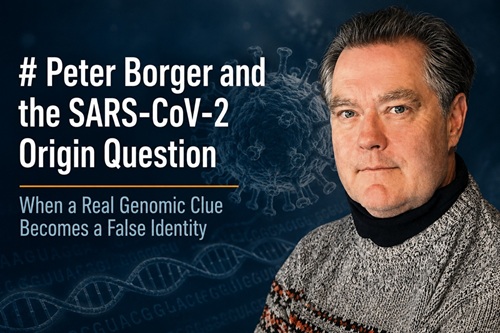
Peter Borger occupies an unusual place in the controversy over the origins of SARS-CoV-2. He is not simply another commentator who happened to become skeptical of the official pandemic narrative. Trained as a molecular biologist, he became one of the early and outspoken critics of the claim that SARS-CoV-2 should simply be regarded as a genuinely new virus that emerged naturally from an animal reservoir. His argument was provocative from the beginning: perhaps the apparent novelty of SARS-CoV-2 was largely a matter of nomenclature. Perhaps, he suggested, we were looking at the old SARS virus in a changed form. This idea deserves to be taken seriously enough to be reconstructed accurately, but not seriously enough to be accepted without examining its molecular premises. Borger's argument contains a curious mixture of genuine observations, questionable evolutionary assumptions and a conclusion that goes far beyond what the observations can establish. Indeed, the most revealing feature of his position is that he identifies something real—the remarkable conservation of particular sequences between SARS-CoV-1 and SARS-CoV-2—but then treats that conservation as if it were a forensic fingerprint proving identity. That distinction matters enormously in the continuing debate over whether SARS-CoV-2 emerged through a natural zoonotic spillover, through some form of laboratory-associated accident, or through a more complicated evolutionary history involving viruses collected and studied by researchers. Borger's provocative thesisBorger's most explicit statement appeared remarkably early, in March 2020, in the Dutch Reformatorisch Dagblad. His article was entitled, in translation, “Genetics brings clarity: Covid-19 is simply SARS.” He argued that SARS-CoV-2 was essentially a variant of the virus responsible for the 2003 SARS outbreak. He pointed to their common use of the ACE2 receptor, their similar disease manifestations, their common genome organization and, most importantly, particular genetic similarities. Borger went further than merely saying that the two viruses were related. He argued that the accumulation of mutations over seventeen years could have transformed SARS-CoV-1 into SARS-CoV-2. He even proposed a scenario in which this transformation could have occurred in a bat, a pangolin—or in a laboratory in Wuhan. His striking conclusion was that we were dealing with “the same virus,” despite its new name. This position was repeated in his subsequent publications. In his 2020 article “A SARS-like Coronavirus was Expected, but nothing was done to be Prepared,” Borger focused on two supposed “fingerprints”: the absence of the hemagglutinin-esterase, or HE, gene and a short lysine-rich sequence in the nucleocapsid protein. He argued that these two characteristics showed that SARS-CoV-2 was a variant of the 2003 SARS virus. The exact argument is therefore more interesting than the caricature of it. Borger was not simply saying, “They look alike.” He was pointing to specific molecular features that he believed were unusually diagnostic. And this is where the argument needs to be examined carefully. The first “fingerprint”: KTFPPTEPKKDKKKKBorger highlighted a short lysine-rich region in the nucleocapsid, or N, protein. In his 2020 article he gave the SARS-CoV-1 sequence as: KTFPPTEPKKDKKKKTDEAQ and the corresponding SARS-CoV-2 sequence as: KTFPPTEPKKDKKKKADETQ The central sequence is therefore: KTFPPTEPKKDKKKK This is not a fabricated similarity. The sequences really are strikingly similar. Borger was right to notice it. The question is what it means. A sequence of fifteen amino acids can look extremely impressive when displayed in isolation. Fifteen consecutive amino acids are not something one expects to find identical by chance in two completely unrelated proteins. But SARS-CoV-1 and SARS-CoV-2 are not unrelated proteins or unrelated viruses. They are members of the same sarbecovirus lineage and share a substantial evolutionary history. That makes the relevant question much more subtle. We are not asking whether two unrelated viruses could independently invent KTFPPTEPKKDKKKK. We are asking whether a short functional region could remain highly conserved while the rest of the viral genome diverges. The answer is obviously yes. Viral proteins contain regions under different evolutionary constraints. Some sites can change rapidly while others are strongly conserved because altering them interferes with protein structure, interaction with other molecules, replication, packaging or immune-related functions. There is another instructive complication. The six-amino-acid sequence KDKKKK, contained within Borger's “fingerprint,” also occurs in human HSP90-beta. A published table of predicted cross-reactive epitopes explicitly lists KDKKKK in SARS-CoV-2 nucleocapsid and in human HSP90-beta. That does not imply that SARS-CoV-2 acquired this sequence from humans. It demonstrates something much more modest but important: short sequence matches are not automatically unique molecular signatures of ancestry or identity. A fingerprint in the forensic sense has an extraordinary degree of individuality. A fifteen-amino-acid motif in a conserved viral protein does not necessarily have that property. The second “fingerprint”: the missing HE geneBorger's second argument concerned the absence of the hemagglutinin-esterase gene. SARS-CoV-1 does not possess an HE gene, and SARS-CoV-2 does not possess one either. Borger treated this shared absence as a second characteristic distinguishing the SARS viruses from other coronaviruses. But this is a much weaker argument. HE is not a universal coronavirus gene. It occurs in particular coronavirus lineages and is absent from others. Consequently, “both lack HE” is not analogous to finding a unique serial number engraved on both viruses. There is an important conceptual distinction here between a shared evolutionary characteristic and an identity marker. Two species can lack the same gene because their common ancestor lacked it. That tells us something about their ancestry. It does not tell us that one species is merely a mutated version of the other. Indeed, if anything, this is what evolutionary biology would predict. Closely related organisms share ancestral characteristics. Some genes are gained, some are lost, and some are retained. The absence of a gene can therefore be phylogenetically informative without being individually diagnostic. Borger's two fingerprints thus turn out to be two examples of the same logical problem. A feature can be informative about relatedness without being sufficient to establish identity. The whole-genome problemThis is where Borger's argument encounters its most serious obstacle. SARS-CoV-2 is not merely a slightly modified SARS-CoV-1 genome. Whole-genome comparisons show that SARS-CoV-2 and SARS-CoV-1 are approximately 79% identical at the nucleotide level. That is substantial similarity, but it is also substantial difference. By comparison, different early SARS-CoV-2 genomes were extraordinarily similar to one another—around 99.99% in one early comparison of patient isolates. This gives us the scale that Borger's argument tends to obscure. SARS-CoV-1 and SARS-CoV-2 are clearly related. But SARS-CoV-2 isolates are overwhelmingly similar to each other in a way that SARS-CoV-1 and SARS-CoV-2 simply are not. This is not a semantic dispute over whether a virus deserves the number “1” or “2.” It is a difference visible across the entire approximately 30,000-nucleotide genome. The divergence is especially striking in the spike protein. The receptor-binding domain of SARS-CoV-2 has only about 73% amino-acid similarity with SARS-CoV, according to a major review. Consequently, Borger's hypothesis requires us to imagine that a virus underwent enormous genomic change while nevertheless retaining a tiny fifteen-amino-acid sequence that functions as an identifying fingerprint. That is possible in the abstract, but it reverses the evidential priorities of genomics. The whole genome should dominate the interpretation of a short conserved motif, not the other way around. The RaTG13 confusionBorger's early article contains another revealing problem. He wrote that the SARS-CoV-2 genome was 96.11% identical to RaTG13 and then treated that similarity as evidence for his SARS-CoV-1/SARS-CoV-2 identity argument. But RaTG13 is not SARS-CoV-1. It is a bat sarbecovirus that is genetically much closer to SARS-CoV-2 than SARS-CoV-1 is. This actually illustrates the proper way to use genomic similarity. A 96% whole-genome similarity between RaTG13 and SARS-CoV-2 indicates a relatively close evolutionary relationship, while the approximately 79% identity between SARS-CoV-1 and SARS-CoV-2 indicates a more distant relationship within the broader sarbecovirus group. Neither number means that the viruses are identical. There is also a broader evolutionary point that becomes important here: the closest known virus is not necessarily the direct ancestor. The enormous amount of unsampled viral diversity in bats means that the true progenitor or immediate precursor could be a virus that has never been collected. Thus the absence of a currently identified virus that sits neatly between RaTG13 and SARS-CoV-2 is interesting, but it does not turn SARS-CoV-1 into the missing ancestor. SARS-CoV-2 contains something SARS-CoV-1 does notThe reverse comparison is particularly damaging to Borger's literal identity thesis. SARS-CoV-2 contains a distinctive polybasic cleavage site at the S1/S2 boundary of its spike protein. The insertion includes the sequence PRRA, generating the furin-cleavage motif RRAR. SARS-CoV-1 lacks this insertion. This is not a trivial difference. The spike protein is the virus's principal entry machinery, and the S1/S2 cleavage site has functional consequences for viral entry and fusion. SARS-CoV-2's furin-cleavage site distinguishes it from SARS-CoV-1 and from the other known sarbecoviruses available for comparison at the beginning of the pandemic. The furin-cleavage site subsequently became one of the central objects of the laboratory-origin controversy. Its unusualness does not prove engineering: related bat coronaviruses have since provided evidence that cleavage-site acquisition can occur through natural evolutionary mechanisms, and related viruses have been found with partial or analogous insertions. But the point here is narrower. The FCS is one of the very genomic features demonstrating that SARS-CoV-2 is not simply SARS-CoV-1 with a few cosmetic mutations. Borger's fifteen-amino-acid similarity is real. So is the major difference in spike architecture. Both observations have to be included in the analysis. From “same virus” to “laboratory origin”The most interesting aspect of Borger's position is that his “same virus” argument does not actually establish the laboratory-leak hypothesis. Borger himself initially left the location of the alleged transformation open. In his March 2020 article he suggested that the transition could have occurred in a bat, a pangolin, or a laboratory in Wuhan. That is important because virus identity and virus origin are separate questions. Suppose, for the sake of argument, that SARS-CoV-2 were genuinely a descendant of SARS-CoV-1. That still would not tell us whether the transformation occurred in nature or in a laboratory. Conversely, suppose SARS-CoV-2 originated in a laboratory. That would not imply that it must be SARS-CoV-1. A laboratory accident could theoretically involve a naturally occurring virus that had never previously infected humans, a virus collected from wildlife, a recombinant virus, or another form of laboratory-associated evolutionary process. The laboratory-origin hypothesis therefore does not stand or fall with Borger's “fingerprints.” Indeed, this is where his argument becomes less useful than the broader lab-leak question. The strongest version of that question is not “Does SARS-CoV-2 secretly equal SARS-CoV-1?” It is: What viruses were being collected and studied in Wuhan? What experiments were performed? What sequences existed in laboratory databases? What animals were sampled? What unpublished viruses existed? What personnel became ill? What records are missing? And can any genomic or epidemiological evidence distinguish a natural spillover from a laboratory-associated emergence? Those questions are much more consequential than whether one conserved N-protein sequence deserves to be called a fingerprint. Borger the lab-leakerBorger's position also needs to be situated within his broader intellectual trajectory. He became an outspoken critic of the standard pandemic narrative and was a co-author of the 2020 Corman-Drosten PCR critique, which argued that the RT-PCR test protocol used for SARS-CoV-2 detection contained serious methodological flaws. The report was subsequently subjected to detailed criticism, including a lengthy technical response from Andreas Beyer and colleagues. This history matters because it means Borger approached SARS-CoV-2 with a strong prior skepticism toward the prevailing interpretation. But that should not be turned into an ad hominem dismissal. A person's position on the lab-leak hypothesis does not determine whether a nucleotide sequence is real. If Borger points out a genuine conservation pattern, the pattern remains real whether he is a lab-leaker, a natural-origin advocate, or completely agnostic. The appropriate response is therefore neither “Borger is a lab-leaker, so ignore him” nor “Borger is a molecular biologist and therefore his conclusion must be right.” The appropriate response is to separate observation from inference. And on that test Borger's case is uneven. His observation that the N-protein contains an unusually conserved lysine-rich sequence is real. His observation that SARS-CoV-1 and SARS-CoV-2 both lack HE is real. His inference that these characteristics establish that SARS-CoV-2 is SARS-CoV-1 is not justified. And none of this by itself establishes a laboratory origin. Yet Borger's broader question should not simply be dismissedThere is an irony here. Borger's strongest question is actually not the one he framed most dramatically. The fact that SARS-CoV-2 shares particular features with SARS-CoV-1 is unsurprising given their evolutionary relationship. The interesting question is whether some parts of the SARS-CoV-2 genome have histories that are better explained by recombination, laboratory manipulation, adaptation in an unusual host environment, or ordinary natural evolution. That is a much more sophisticated problem. Sarbecoviruses recombine. Their evolutionary histories are therefore not necessarily represented by a single clean tree. A genome can contain regions with different evolutionary histories. Researchers studying the origins of SARS-CoV-2 consequently have to distinguish ordinary inheritance from recombination and convergence. This is particularly relevant because the origin debate has often been framed as a false binary between “natural” and “engineered.” There are intermediate possibilities. A virus could be natural but laboratory-associated. It could be collected from the wild and studied without deliberate genetic engineering. It could undergo adaptation during experimental work. It could be recombined naturally. Or it could emerge through a completely conventional animal-to-human transmission event. The genomic evidence alone does not necessarily discriminate cleanly among all these scenarios. That is precisely why Borger's “same virus” thesis is too simple. What would actually change the argument?The strongest way to evaluate Borger's claim would be to stop arguing about isolated sequences and reconstruct the evolutionary history of the relevant regions. Take the N-protein sequence KTFPPTEPKKDKKKK. How common is it among sarbecoviruses? Is the entire surrounding region conserved? Does the exact sequence occur in the closest known bat viruses? Do different sarbecovirus lineages contain homologous sequences? Does the nucleotide sequence, rather than merely the amino-acid sequence, show a shared ancestry? Does the region display evidence of recombination? And how does its evolutionary history compare with that of the spike, especially the receptor-binding domain and the furin-cleavage-site region? Those questions could establish whether Borger's “fingerprint” is genuinely exceptional or merely an example of selective conservation. The fact that a short sequence can also occur in human proteins should make us particularly cautious about assigning it forensic significance. A genuinely powerful fingerprint would be one whose length, nucleotide composition, surrounding sequence, phylogenetic distribution and evolutionary history make alternative explanations extraordinarily unlikely. Borger did not demonstrate that. The larger lesson of the origin controversyThere is a broader epistemological lesson here. The SARS-CoV-2 origin debate has repeatedly suffered from what might be called microscopic overinterpretation. One side sees the furin-cleavage site and concludes that engineering is obvious. Another sees evidence of natural cleavage-site acquisition and concludes that a laboratory origin is effectively ruled out. One side sees early epidemiological clustering at the Wuhan market and treats it as decisive evidence of zoonosis. Another sees the location of the Wuhan Institute of Virology and treats geographical proximity as evidence of a leak. Borger's fingerprint argument belongs to the same family of reasoning. A small piece of evidence becomes a miniature version of the entire case. But molecular evolution rarely works that way. A genome is a historical document. Its meaning lies in the pattern across thousands of sites, in the relationships among genomes, in recombination, in the distribution of variation and, ultimately, in the external historical evidence that tells us what viruses existed and where they were. A fifteen-amino-acid sequence cannot carry the evidential burden of a 30,000-nucleotide genome. Where does this leave Borger?Borger deserves credit for asking an uncomfortable question early: how novel was SARS-CoV-2 really? The answer is that it was both novel and evolutionarily familiar. It was novel in the sense that SARS-CoV-2 was a distinct viral lineage with a genome substantially different from SARS-CoV-1. It was familiar in the sense that it belonged to the same broader sarbecovirus family and retained numerous conserved molecular features inherited from common ancestry. His two “fingerprints” therefore tell us something real, but not what he claims they tell us. The N-protein sequence is genuinely conserved. The shared absence of HE is real. But neither constitutes proof that SARS-CoV-2 is merely SARS-CoV-1 under another name. Whole-genome comparisons, phylogenetic analyses and distinctive SARS-CoV-2 features such as the furin-cleavage site contradict that literal interpretation. More importantly, even if Borger's identity claim were correct, it would not by itself solve the origin question. It would merely relocate it. The real mystery would become: where and how did this supposed SARS-CoV-1 variant acquire its distinctive SARS-CoV-2 genome? And that brings us back to the question that actually matters. Was SARS-CoV-2 the product of an ordinary zoonotic event? Was it associated with research involving naturally occurring sarbecoviruses? Was there an intermediate evolutionary stage in an animal? Did recombination play a role? Did laboratory passage or manipulation contribute? Or did some combination of natural and research-related processes produce the virus that entered the human population? Borger's fingerprints do not answer those questions. But they do illustrate why the origin debate should not be reduced to a contest between “natural” and “lab leak” slogans. The proper question is always: what does each piece of evidence actually establish, and how much more does it establish than its discoverer wants us to believe? On that standard, Borger's observation survives scrutiny. His conclusion does not. And that distinction is precisely what makes his argument worth examining rather than simply dismissing.
Widget is loading comments...
|