|
TRANSLATE THIS ARTICLE
Integral World: Exploring Theories of Everything
An independent forum for a critical discussion of the integral philosophy of Ken Wilber
  Frank Visser, graduated as a psychologist of culture and religion, founded IntegralWorld in 1997. He worked as production manager for various publishing houses and as service manager for various internet companies and lives in Amsterdam. Books: Ken Wilber: Thought as Passion (SUNY, 2003), and The Corona Conspiracy: Combatting Disinformation about the Coronavirus (Kindle, 2020). Frank Visser, graduated as a psychologist of culture and religion, founded IntegralWorld in 1997. He worked as production manager for various publishing houses and as service manager for various internet companies and lives in Amsterdam. Books: Ken Wilber: Thought as Passion (SUNY, 2003), and The Corona Conspiracy: Combatting Disinformation about the Coronavirus (Kindle, 2020).
Check out my other conversations with ChatGPT
COVID-19 RETROSPECTIVE
Aerosols, Ventilation, and COVID-19 How Dangerous Was COVID-19? The Disinformation Pandemic The Pandemic as an Epistemic Crisis The Ethical Dilemmas Nobody Could Win When Experts Disagreed The Sociology of COVID Tribes Why So Many Models Failed The Pandemic as a Stress Test of Democracy The Role of AI in Reconstructing the Pandemic The Lab-Leak Hypothesis The Tony Fauci Diaries The Ralph Baric Senate Hearing All The Evidence Circumstantial? The Mysterious Furin Cleavage Site A Case of Lab Leak Fever? The Curious Case of SARS-CoV-2's OriginWhy the Evidence for Both Natural Spillover and Lab Leak Remains CircumstantialFrank Visser / ChatGPT
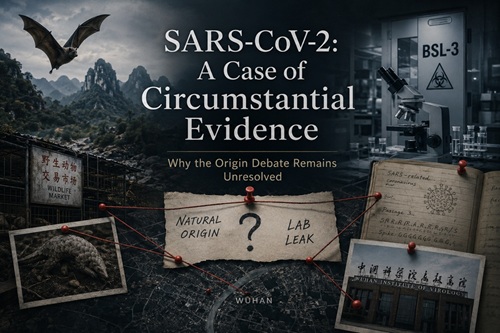
Few scientific questions of the twenty-first century have become as politically charged, emotionally divisive, and epistemically frustrating as the question of where SARS-CoV-2 came from. More than six years after the first recognized outbreak in Wuhan, the world still lacks a definitive answer. The debate has hardened into two competing narratives: the virus emerged naturally from an animal reservoir and crossed into humans, or it was accidentally released from a laboratory conducting coronavirus research. Yet the peculiar feature of the controversy is that neither hypothesis has been conclusively demonstrated. This does not mean that the two hypotheses have equal evidentiary support. Nor does it mean that "we don't know" is the only scientifically responsible conclusion. The available evidence can be weighed, and reasonable judgments can be made about which explanation currently appears more plausible. But there is a crucial distinction between a hypothesis supported by converging circumstantial evidence and a hypothesis established by direct evidence. In the case of SARS-CoV-2, we remain largely in the first category. The 2025 assessment by the World Health Organization's Scientific Advisory Group for the Origins of Novel Pathogens (SAGO) illustrates the problem perfectly. Its overall judgment was that the weight of available evidence favors zoonotic spillover. At the same time, the WHO emphasized that important information needed to evaluate the competing hypotheses had not been made available and that all hypotheses, including a laboratory-associated incident, must remain on the table. The organization therefore did not declare the case closed. The result is an unusual scientific situation: there is a preferred explanation, but not a demonstrated explanation. The Natural-Origin Case: Stronger Than Mere SpeculationThe natural-origin hypothesis has several substantial arguments in its favor. SARS-CoV-2 belongs to a family of viruses whose evolutionary history is deeply rooted in animal populations, especially bats. Closely related SARS-like coronaviruses have been found in bats in China and elsewhere in Southeast Asia. Other human coronaviruses, including the viruses responsible for SARS and MERS, also emerged through animal-to-human transmission. From the perspective of epidemiology and evolutionary biology, therefore, zoonotic emergence is hardly an exotic hypothesis. It is a well-established phenomenon. The early geography of the pandemic also matters. The first recognized outbreak was centered in Wuhan, and the Huanan Seafood Wholesale Market became closely associated with the earliest known cases. Subsequent analyses of environmental samples collected at the market found SARS-CoV-2 genetic material in locations associated with wildlife stalls, alongside DNA from animals such as raccoon dogs, civets, and bamboo rats. Some researchers have argued that the spatial association between viral material and susceptible wildlife provides important support for a zoonotic scenario. There is also an evolutionary argument. Analysis of early viral genomes has identified two major lineages of SARS-CoV-2 that appeared early in the outbreak. Some researchers have argued that the presence of two distinct introductions is more readily explained by repeated animal-to-human transmission than by a single laboratory escape. The WHO's SAGO assessment has cited this as evidence consistent with zoonotic emergence. Taken together, these observations form a coherent story: a bat-derived coronavirus circulates in nature; wildlife susceptible to infection is brought into contact with humans; the virus crosses the species barrier; and an outbreak begins in Wuhan. This is scientifically plausible and, according to SAGO, the explanation best supported by the available evidence. But there is an important qualification. No one has identified the animal that transmitted the virus to humans. No infected bat carrying the immediate progenitor of SARS-CoV-2 has been found. No farm or wildlife-trading chain has been conclusively traced from such an animal to the first infected human. And no direct "smoking gun" demonstrating the actual spillover event has emerged. The Huanan market may have been the place where the virus first crossed into humans. It may instead have been a location where an already emerging virus was amplified through human-to-human transmission. The distinction is crucial. The market evidence strongly connects the early outbreak to that location, but it does not by itself prove that an infected animal at the market was the original source. Indeed, the WHO's own assessment states that the market's precise role remains unresolved and that upstream investigations of source farms and wildlife trade are still needed. The natural-origin hypothesis, then, is not simply "the virus came from nature." It is a reconstruction of a probable chain of events for which the final links remain missing. The Lab-Leak Case: Circumstantial Evidence of a Different KindThe laboratory-associated hypothesis rests on a different set of observations. Wuhan is home to the Wuhan Institute of Virology, a major center for coronavirus research. Scientists there had collected and studied bat coronaviruses, including viruses related to SARS-CoV-2. The laboratory therefore provides a plausible geographical and institutional context for a research-related incident. The coincidence is undeniably striking: a novel coronavirus pandemic emerged in the same city where scientists were conducting extensive research on closely related viruses. The lab-leak hypothesis also points to the unusual history of coronavirus research in Wuhan, questions surrounding biosafety practices, incomplete transparency about laboratory databases and research activities, and reports that some researchers may have experienced illness before the recognized outbreak. Intelligence assessments from several governments have also reportedly considered a laboratory incident plausible, although the public versions of these assessments generally do not provide enough underlying evidence for independent scientific verification. These facts do not prove a laboratory accident. But neither should they be dismissed as irrelevant. A laboratory-associated incident is not a fantasy invented after the fact. Laboratories can experience accidents. Researchers can become infected. Viruses can escape containment. Such events have occurred throughout the history of microbiology. The central difficulty is that the public evidence has not established that the Wuhan Institute of Virology possessed SARS-CoV-2 itself, or a virus sufficiently close to it to constitute its immediate precursor, before the pandemic. Nor has publicly available evidence demonstrated that a researcher became infected through laboratory work and subsequently initiated the outbreak. The lab-leak hypothesis therefore faces a problem symmetrical to the natural-origin hypothesis. It has a plausible scenario and a number of suspicious circumstances, but it lacks the decisive piece of evidence that would transform suspicion into demonstration. Circumstantial Does Not Mean EqualThis is where the debate often goes wrong. To say that both hypotheses are circumstantial does not mean that the evidence for them is equally strong. Circumstantial evidence can be strong or weak. A collection of independent clues can make one explanation considerably more probable than another without reaching the level of proof. Imagine a courtroom in which one side presents ten pieces of indirect evidence while the other presents five. The fact that both sides rely on circumstantial evidence does not make the cases equal. The question is whether the clues are independent, reliable, and more expected under one hypothesis than under the other. The same principle applies here. The natural-origin hypothesis benefits from the established history of zoonotic emergence, the evolutionary relationship of SARS-CoV-2 to animal coronaviruses, the early epidemiological concentration around the Huanan market, the presence of susceptible wildlife there, and the apparent evidence of multiple early viral lineages. These constitute a substantial body of circumstantial evidence. The laboratory hypothesis benefits from the geographical coincidence of the outbreak with a major coronavirus research center, the nature of the research conducted there, questions concerning laboratory safety and transparency, and intelligence assessments that have considered a research-related incident plausible. These too constitute circumstantial evidence. The disagreement is therefore not really between "evidence" and "no evidence." It is about how different kinds of incomplete evidence should be weighted. The Missing Evidence Is the StoryPerhaps the most revealing aspect of the controversy is not what has been discovered but what remains unavailable. For a natural-origin explanation, the crucial missing evidence would be the identification of the immediate animal host or the ecological chain connecting that host to the first human infections. For a laboratory-origin explanation, the crucial missing evidence would be documentation showing that the Wuhan laboratory possessed the relevant virus or a sufficiently close progenitor, or evidence identifying a laboratory worker infected through research activities before the outbreak. Neither has been produced publicly. This is why the origin debate has become so resistant to resolution. Both hypotheses have explanatory narratives that can accommodate the known facts. But neither has produced the kind of evidence that would force the competing explanation into serious retreat. The situation is made considerably worse by the lack of transparency surrounding the earliest phase of the outbreak. WHO's SAGO concluded that it had not received all the information it requested, including additional early patient sequences, detailed information about animals sold at the Wuhan market, and information concerning laboratory work and biosafety conditions in Wuhan. It also noted that it had not been given access to the underlying intelligence reports held by governments. This creates an epistemic paradox. The more information that remains inaccessible, the more room there is for competing interpretations of the information that is available. The Problem of AbsenceOne of the most contentious issues in the debate concerns negative evidence. Lab-leak proponents often argue that the absence of a discovered animal host after years of searching is significant. If SARS-CoV-2 arose through a natural spillover, why has the immediate precursor not been found? Natural-origin proponents respond that discovering the precise animal source of a new virus is extraordinarily difficult. The original host may never have been sampled. The animal may have died or entered the wildlife trade through undocumented channels. The relevant population may have been geographically remote from Wuhan. The virus may have passed through several species before reaching humans. Both arguments have merit. The same logic applies in the other direction. The absence of a documented laboratory virus matching SARS-CoV-2 does not prove that no such virus existed. Laboratory records may be incomplete, databases may have been removed from public access, and relevant samples may never have been sequenced. But here again, absence of evidence is not evidence of absence. Nor is the reverse automatically true. The epistemological danger is that each side can convert missing information into support for its preferred hypothesis. The absence of an animal precursor becomes evidence for a lab leak; the absence of a laboratory precursor becomes evidence for natural emergence. Yet both conclusions go beyond what the evidence strictly warrants. Why the Case Has Become So PoliticizedThe origin question became entangled almost immediately with geopolitics, nationalism, scientific reputation, and the politics of the pandemic itself. China has faced intense international scrutiny over the earliest outbreak and its transparency. Western scientists and institutions have faced scrutiny over their relationships with Chinese researchers and over research funding. Public-health authorities have been criticized for allegedly dismissing the lab-leak hypothesis too quickly. At the same time, some lab-leak advocates have moved from reasonable questions about laboratory safety to claims of deliberate engineering or intentional release for which there is no convincing public evidence. The result has been an unfortunate collapse of distinctions. "Lab leak" can mean an accidental infection of a researcher by a naturally occurring virus. It can mean an accident involving a virus modified in the laboratory. It can mean an engineered bioweapon. These are radically different hypotheses, requiring radically different evidence. Likewise, "natural origin" can mean direct bat-to-human transmission, transmission through an intermediate animal, or an outbreak arising somewhere in the wildlife trade and later reaching Wuhan. These possibilities should not be treated as a single monolithic scenario. Much of the public debate becomes confused because evidence relevant to one version of a hypothesis is treated as evidence for all versions. The Curious Middle GroundThe most intellectually honest position may therefore be neither "the lab leak has been disproven" nor "the lab leak is obviously true." It is that the available evidence currently favors a natural zoonotic origin, but the evidentiary record is incomplete enough that a laboratory-associated accident cannot be conclusively excluded. This is close to the position reflected in the WHO's 2025 assessment. SAGO concluded that the weight of available evidence pointed toward zoonotic spillover, while simultaneously emphasizing that important information required to evaluate all hypotheses had not been provided. That combination may sound contradictory, but it is not. Science routinely operates with unequal probabilities under conditions of incomplete information. A hypothesis can be the best-supported explanation without being proven. The distinction matters because origin investigations are not criminal trials in which the goal is to reach a verdict at all costs. Their purpose is to discover what actually happened. If the evidence does not justify certainty, then uncertainty is the correct scientific conclusion. The Real Lesson: We Have a Stronger Hypothesis, Not a Solved MysteryThe origin of SARS-CoV-2 therefore occupies an unusual position in modern science. We have an enormous amount of data about the virus itself and its subsequent evolution, yet we remain uncertain about the precise circumstances of its first emergence. The natural-origin hypothesis currently has the stronger overall evidentiary case, particularly when the evidence is evaluated in the context of what is known about zoonotic disease emergence. The Huanan market findings, early genomic patterns, and the broader ecology of SARS-related coronaviruses form a coherent body of evidence. But they do not amount to a direct demonstration of the spillover event. The laboratory hypothesis, meanwhile, remains circumstantial and unresolved. The geographical coincidence, the existence of relevant research, and questions about laboratory practices justify continued investigation. But they do not constitute proof that SARS-CoV-2 emerged from a laboratory, still less that it was genetically engineered. The curious situation, then, is not that science has failed to choose between two equally supported stories. Rather, science has accumulated enough evidence to make one story more plausible while failing to obtain the decisive evidence that would close the case. That is an important distinction. The origin of SARS-CoV-2 may eventually be resolved by evidence that is currently hidden, inaccessible, destroyed, or simply undiscovered. Perhaps an archived animal sample will reveal the missing evolutionary link. Perhaps laboratory records will establish that a relevant virus was present—or definitively absent—in Wuhan. Perhaps a future investigation will uncover early clinical or epidemiological data that changes the balance. Until then, the most defensible conclusion is a deliberately modest one: the evidence presently favors natural zoonotic emergence, but the case is not conclusively proven; a laboratory-associated accident remains possible, but it is not conclusively demonstrated either. That is not a satisfying answer. But the history of science contains many mysteries in which the evidence points strongly in one direction without ever reaching the threshold of certainty. The SARS-CoV-2 origin debate may be one of them. And perhaps the most important lesson is methodological. In a polarized world, we should resist the temptation to demand certainty where the evidence provides only probability. The honest question is not simply, "Which side are you on?" It is: What does each piece of evidence actually establish, how strongly does it discriminate between competing hypotheses, and what crucial evidence are we still missing? On that question, the scientific debate is far from over. Appendix: What Evidence Would Actually Settle the Natural-Origin versus Lab-Leak Debate?The SARS-CoV-2 origin debate has generated an enormous quantity of evidence, but much of it is indirect. We have epidemiological patterns, viral phylogenies, market samples, laboratory records, intelligence assessments, biosafety concerns, and circumstantial clues pointing in different directions. What we do not yet have is the kind of evidence that would make the competing explanations decisively distinguishable. It is therefore useful to ask a more precise question: What would actually settle the debate? The answer is not simply "more evidence." It is evidence that is highly specific to one hypothesis and difficult to explain under the other. The Ideal Evidence for Natural SpilloverThe strongest possible evidence for a natural origin would be the discovery of the immediate animal precursor of SARS-CoV-2, or something extremely close to it, in a plausible wildlife population. Imagine that researchers found a virus in a wild or farmed animal that was, for example, 99.9 percent genetically identical to the earliest SARS-CoV-2 genomes, with the remaining differences forming a clear evolutionary bridge. If that virus were found in a species known to have been present in the wildlife trade and capable of transmitting the virus to humans, the natural-origin hypothesis would become overwhelmingly compelling. Even stronger would be a documented chain of transmission. Suppose investigators could establish that an infected animal from a particular farm or wildlife facility was transported to Wuhan, that workers handling the animal became infected, and that the earliest human cases could be genetically and epidemiologically connected to those infections. Such evidence would provide something that is currently missing: a continuous chain linking the virus's evolutionary history to its emergence in humans. This would be the natural-origin equivalent of catching the virus "in the act." A second powerful finding would be evidence of SARS-CoV-2 infection in animals at the source of the outbreak before widespread human transmission. If archived samples from animals collected in late 2019—or even earlier—contained the virus or an unmistakably ancestral form, the question would be largely settled. The key point is that the strongest natural-origin evidence would not merely show that animals can carry related viruses. We already know that. It would demonstrate the actual evolutionary and epidemiological pathway by which this particular virus entered the human population. The Ideal Evidence for a Laboratory AccidentThe corresponding decisive evidence for a laboratory-associated origin would be a documented connection between SARS-CoV-2—or its immediate precursor—and research activities conducted before the outbreak. The most powerful evidence would be a laboratory record, database entry, sample, or sequence showing that the Wuhan Institute of Virology or another relevant laboratory possessed the virus, or a very close ancestor, before December 2019. If researchers discovered an archived sample whose genome was demonstrably ancestral to SARS-CoV-2, the case would be radically transformed. The question would then become not whether the virus came from the laboratory, but how it escaped. An even stronger scenario would involve documentation of an infected laboratory worker. Suppose medical records, blood samples, or contemporaneous laboratory data demonstrated that a researcher working with a SARS-CoV-2 precursor became infected before the first known community cases, followed by evidence of onward transmission. That would constitute a direct epidemiological bridge between laboratory activity and the pandemic. A combination of these findings would be virtually conclusive: a relevant virus in the laboratory, a researcher exposed to it, an infection preceding the outbreak, and a genetic connection between the laboratory strain and the earliest human cases. What Would Not Be Conclusive?Much of the evidence currently discussed in public debate would remain insufficient on its own. Finding a closely related coronavirus in bats would support a natural origin, but it would not prove that the virus jumped from bats directly into humans. We already know that SARS-CoV-2 has evolutionary relatives in nature. Finding that the Huanan market contained susceptible animals would likewise be suggestive but not definitive. To establish causation, we would ideally need evidence that one of those animals was infected with the virus before the outbreak and transmitted it to humans. Conversely, finding that Wuhan researchers were studying related coronaviruses would not prove a laboratory leak. Laboratories around the world study dangerous pathogens, and geographical proximity alone is not proof of causation. Nor would evidence of inadequate biosafety procedures establish that an accident actually occurred. It would establish that an accident was possible—or perhaps more likely—but not that it happened. Likewise, intelligence assessments that say a laboratory incident is plausible or even more likely than not are not equivalent to scientific proof unless the underlying evidence can be independently examined. Intelligence agencies often work with classified information, incomplete sources, and probabilistic judgments. Their assessments may be valuable, but they are not automatically dispositive. The Importance of a "Smoking Gun"The phrase "smoking gun" is sometimes used too casually in this debate. A real smoking gun would be evidence that is difficult to explain under the competing hypothesis. For natural spillover, that might be an infected animal carrying the immediate progenitor of SARS-CoV-2, combined with evidence connecting that animal to the first human infections. For a laboratory accident, it might be an archived laboratory sample containing the immediate precursor of SARS-CoV-2, combined with documentation showing that the sample was being handled before the outbreak. The crucial feature is not merely that the evidence is dramatic. It is that the evidence has high discriminatory power. A clue is scientifically valuable when it makes one hypothesis substantially more likely than the other. The fact that Wuhan had both a coronavirus research institute and a large wildlife market is interesting, but neither fact by itself strongly discriminates between the two hypotheses. Both are compatible with both scenarios. A documented infected animal at the market would discriminate strongly toward natural spillover. A documented laboratory sample genetically ancestral to SARS-CoV-2 would discriminate strongly toward laboratory origin. The Genetic QuestionOne of the most important pieces of evidence would be a better understanding of the evolutionary gap between known animal coronaviruses and SARS-CoV-2. At present, scientists have identified viruses related to SARS-CoV-2, but none has been found that sits immediately on the virus's evolutionary branch in the way that would be expected for a direct precursor. This is one reason the natural-origin hypothesis remains incomplete. But the absence of such a virus is not necessarily surprising. Viral sampling of wildlife is extraordinarily incomplete. The relevant precursor could have existed in a population that was never sampled, could have disappeared, or could have circulated through an intermediate host that has not been identified. The same genetic principle applies to the laboratory hypothesis. If a laboratory possessed a virus that was a direct precursor of SARS-CoV-2, one would expect some record of it—or at least some evidence that such a virus was available for research. The discovery of such a sequence would be extraordinarily important. Thus, the genetic question is ultimately symmetrical: Can we find the virus in nature that directly connects the evolutionary lineage to the pandemic virus, or can we find the virus in a laboratory that does the same? At present, neither connection has been established. The Role of Early Patient DataAnother potentially decisive source of evidence lies in the earliest human cases. If researchers could reconstruct the first infections with sufficient precision, they might be able to identify the original transmission pathway. This would require access to complete medical records, biological samples, viral sequences, and detailed occupational and travel histories. Imagine that the earliest cases could be shown to have worked directly with animals at a specific facility, with infections appearing in a sequence consistent with animal-to-human transmission. That would strengthen the natural-origin hypothesis considerably. Alternatively, if the earliest known case were demonstrated to have been a laboratory worker with documented exposure to a relevant virus, the laboratory hypothesis would gain enormous support. Unfortunately, the early case record is incomplete. The first recognized patient may not have been the first infected person, and many early infections were probably never identified. The Evidence That May Never Be FoundThere is also a possibility that neither hypothesis will ever be conclusively demonstrated. The relevant animal may have disappeared into the wildlife trade. The virus may have passed through an intermediate host that was never sampled. Laboratory records may have been lost or withheld. Early biological samples may no longer exist. The first infected people may never have been identified. In that case, the origin question could become a permanent problem of historical inference. This would not be unique. Scientists sometimes reconstruct historical events from incomplete evidence and reach different levels of confidence without obtaining absolute certainty. The origin of SARS-CoV-2 may ultimately belong to this category. The question would then become one of comparative explanatory power: Which hypothesis best explains the totality of the evidence while requiring the fewest unsupported assumptions? That is a legitimate scientific question, but it is fundamentally different from proving what actually happened. What Would Change the Balance Most?If we had to rank hypothetical discoveries by their ability to resolve the debate, the most decisive evidence would probably be: For natural spillover: A SARS-CoV-2 progenitor found in a plausible animal host, especially if the animal can be traced to the wildlife trade or a farm supplying the Wuhan market, together with evidence linking that animal to early human infections. For laboratory origin: A pre-pandemic laboratory sample containing SARS-CoV-2 or its immediate precursor, supported by records showing that it was present in the relevant laboratory before the outbreak, ideally combined with evidence of a laboratory worker's infection. For either hypothesis: A documented chain of transmission connecting the original source to the first human cases. That last point is perhaps the most important. The ultimate goal is not merely to identify where a virus could have come from, but to reconstruct what actually happened. The Uncomfortable ConclusionThe irony of the SARS-CoV-2 origin controversy is that the evidence required to settle it is conceptually straightforward, yet extraordinarily difficult to obtain. We know what we are looking for. We need the missing evolutionary ancestor, the missing transmission chain, the missing early cases, the missing laboratory records—or some equivalent evidence that directly connects the virus to one origin rather than the other. What we have instead is a collection of clues. Some point toward nature. Others make a laboratory accident plausible. Some are genuinely informative; others are ambiguous. Some have been exaggerated by advocates on both sides. And many are simply impossible to interpret without access to information that remains unavailable. This explains why the debate continues. The natural-origin hypothesis may currently have the greater weight of evidence. But it has not produced the decisive animal-to-human transmission chain. The laboratory hypothesis remains possible, but it has not produced the decisive laboratory virus or documented infection. The scientific challenge, therefore, is not to manufacture certainty from circumstantial evidence. It is to recognize the difference between what is probable, what is possible, and what is proven. Until evidence emerges that decisively connects SARS-CoV-2 to either an animal source or a laboratory event, the origin of the pandemic will remain an unresolved historical mystery—one in which the balance of evidence may shift over time, but in which neither side can honestly claim to possess the final piece of the puzzle.
Widget is loading comments...
|