|
TRANSLATE THIS ARTICLE
Integral World: Exploring Theories of Everything
An independent forum for a critical discussion of the integral philosophy of Ken Wilber
  Frank Visser, graduated as a psychologist of culture and religion, founded IntegralWorld in 1997. He worked as production manager for various publishing houses and as service manager for various internet companies and lives in Amsterdam. Books: Ken Wilber: Thought as Passion (SUNY, 2003), and The Corona Conspiracy: Combatting Disinformation about the Coronavirus (Kindle, 2020). Frank Visser, graduated as a psychologist of culture and religion, founded IntegralWorld in 1997. He worked as production manager for various publishing houses and as service manager for various internet companies and lives in Amsterdam. Books: Ken Wilber: Thought as Passion (SUNY, 2003), and The Corona Conspiracy: Combatting Disinformation about the Coronavirus (Kindle, 2020).
Check out my other conversations with ChatGPT
COVID-19 RETROSPECTIVE
Aerosols, Ventilation, and COVID-19 How Dangerous Was COVID-19? The Disinformation Pandemic The Pandemic as an Epistemic Crisis The Ethical Dilemmas Nobody Could Win When Experts Disagreed The Sociology of COVID Tribes Why So Many Models Failed The Pandemic as a Stress Test of Democracy The Role of AI in Reconstructing the Pandemic The Lab-Leak Hypothesis The Tony Fauci Diaries The Ralph Baric Senate Hearing All The Evidence Circumstantial? The Mysterious Furin Cleavage Site A Case of Lab Leak Fever? All My Covid Essays The Role of AI in Reconstructing the PandemicWhat Artificial Intelligence Can Reveal About COVID-19 - and Where It Can Go WrongFrank Visser / ChatGPT
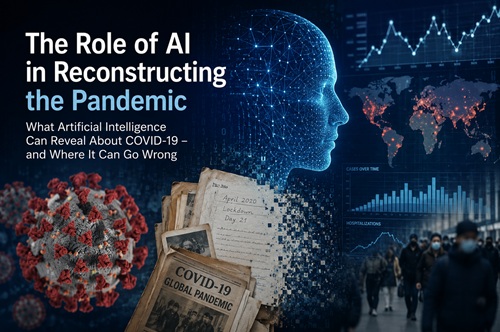 The COVID-19 pandemic was not only a global health crisis; it was also an unprecedented information crisis. Within months, humanity produced an avalanche of scientific papers, preprints, policy documents, media reports, social media discussions, and personal testimonies. The scientific literature expanded at a pace that overwhelmed traditional methods of review. Questions that normally took years of careful investigation—about transmission, immunity, vaccines, origins, treatments, and public policy—were debated in real time under intense political and emotional pressure. Now, several years after the acute phase of the pandemic, a new possibility has emerged: using artificial intelligence to reconstruct what happened. AI systems can process enormous volumes of text, identify patterns across thousands of documents, compare competing arguments, and revisit earlier debates with the advantage of hindsight. In principle, AI can help humanity learn from the pandemic more systematically than was possible during the crisis itself. But AI is not a time machine that reveals the truth automatically. It is a powerful analytical tool whose conclusions depend on the quality of the information it receives, the questions it is asked, and the assumptions built into its reasoning. AI can illuminate the pandemic record—but it can also create false confidence, amplify existing biases, and produce convincing narratives that exceed the evidence. The challenge is therefore not simply asking what AI can tell us about COVID-19. It is asking how AI itself should be used responsibly as a historical and scientific instrument. The Pandemic as an Information Overload ProblemOne of the defining characteristics of COVID-19 was the speed at which knowledge accumulated. Researchers published at unprecedented rates. Thousands of studies appeared on topics ranging from viral evolution and epidemiology to behavioral science and vaccine effectiveness. Meanwhile, governments issued changing recommendations, journalists interpreted emerging findings, and millions of individuals participated in online debates. Human researchers have always relied on literature reviews and expert synthesis, but the scale of COVID-19 created a problem of cognitive overload. Even specialists could only follow a small fraction of the available literature. Important findings could be buried beneath hundreds of less relevant publications. Contradictory studies could circulate without a clear understanding of differences in methodology, population, or timing. AI offers a new approach. Large language models and other analytical systems can examine vast collections of documents and identify relationships that would be difficult for individuals to see. They can summarize debates, compare conclusions across studies, trace how scientific understanding changed over time, and highlight areas where researchers genuinely disagreed. In this sense, AI functions as a kind of intellectual microscope. It does not replace human judgment, but it can help bring hidden structures within complex information systems into view. Revisiting Scientific Controversies with HindsightOne of the most valuable applications of AI is retrospective analysis. During the pandemic, many controversies were experienced as immediate conflicts between opposing camps. Years later, AI can help separate temporary uncertainty from enduring disagreement. Consider the debate about masks. Early public communication was inconsistent, partly because evidence about community masking was limited and partly because authorities were concerned about shortages of medical-grade masks for healthcare workers. Later evidence provided stronger support for masks, particularly in indoor settings and during periods of high transmission. An AI-assisted review could map how scientific understanding evolved, rather than simply selecting one moment and judging it by later knowledge. The same applies to debates about aerosols, school closures, immunity after infection, vaccine effectiveness, and the appropriate balance between individual freedom and collective protection. A major advantage of AI is its ability to reconstruct timelines. It can ask: What was known at a particular moment? What evidence existed? Which uncertainties were recognized? Which predictions proved inaccurate? Which warnings were ignored? This historical perspective is important because hindsight can easily become unfair. Decision-makers during the pandemic did not have access to information that became available later. A serious reconstruction must distinguish between mistakes made because of poor reasoning and mistakes made because the available evidence was genuinely incomplete. AI as a Tool for Scientific Self-CorrectionScience advances not because scientists are always correct, but because scientific communities have mechanisms for detecting and correcting errors. AI could strengthen this process. For example, AI systems can compare early pandemic models with later outcomes. They can examine why some projections were inaccurate, whether assumptions were unrealistic, or whether uncertainty was communicated poorly. They can analyze thousands of scientific abstracts to identify changing concepts, such as the gradual recognition of airborne transmission. AI can also help reveal patterns of scientific disagreement. Not all controversies represent the same kind of conflict. Some involve competing interpretations of limited evidence. Others involve methodological weaknesses. Still others arise when political values influence how risks are evaluated. A careful AI-assisted analysis could distinguish between: • genuine scientific uncertainty; • premature claims presented as certainty; • methodological disagreements; • political disagreements disguised as scientific disputes; • and misinformation unsupported by evidence. This distinction is crucial. During COVID-19, critics sometimes accused mainstream science of suppressing debate, while others portrayed all skepticism as misinformation. Reality was more complicated. Science contained legitimate disagreements, but public discussion often blurred the difference between evidence-based criticism and unsupported claims. AI has the potential to clarify these distinctions by examining arguments rather than merely counting opinions. The Danger of AI Becoming a Machine for False ConsensusHowever, AI has serious limitations. The greatest danger is that it may create the illusion of objectivity. An AI system does not directly observe reality. It processes human-generated information. If the scientific literature contains biases, political pressures, publication incentives, or blind spots, AI may reproduce them. A sophisticated summary of flawed information is still a flawed summary. During the pandemic, scientific publishing itself was affected by extraordinary circumstances. Some early studies were rushed, some preprints received enormous attention before peer review, and some findings were later revised or withdrawn. AI trained on this material must distinguish between stronger and weaker evidence. Another danger is that AI may confuse popularity with truth. A claim repeated thousands of times online is not necessarily more valid than a claim discussed by a small number of experts. Social media created massive visibility for emotionally powerful narratives, including conspiracy theories and exaggerated claims. AI systems that merely analyze frequency can mistake cultural impact for evidential strength. The opposite problem also exists. AI can reinforce institutional assumptions simply because mainstream sources dominate available datasets. A claim supported by major organizations may deserve trust—but institutions are not infallible. Good historical analysis requires examining both consensus and dissent. The Problem of Artificial Intelligence and Narrative ConstructionPerhaps the most subtle risk is that AI is extremely good at creating coherent stories. Humans naturally seek narratives. We want explanations with causes, villains, heroes, and lessons. The pandemic generated competing narratives: one emphasizing scientific success and public cooperation; another emphasizing governmental overreach and institutional failure. Both narratives contain elements of truth, but both can become overly simplified. AI is particularly capable of producing polished narratives. It can connect thousands of documents into an apparently seamless explanation. But coherence is not the same as correctness. A convincing AI-generated reconstruction may hide unresolved questions. It may smooth over uncertainty, eliminate contradictions, or give the impression that history followed a predictable path. In reality, the pandemic was a chaotic process involving incomplete information, changing circumstances, and difficult trade-offs. The best AI-assisted history should therefore preserve uncertainty rather than erase it. AI and the Future of Pandemic PreparednessThe greatest value of AI may not be in deciding who was right or wrong about COVID-19. It may be in improving preparation for future crises. Future pandemics will again generate enormous amounts of information. AI could help researchers monitor emerging threats, synthesize evidence more rapidly, detect misinformation patterns, and support decision-makers facing uncertainty. But technological capability must be accompanied by intellectual humility. AI should not become an oracle consulted for final answers. It should function as an assistant that helps humans ask better questions. The pandemic revealed that knowledge production is not simply a technical process. It involves trust, communication, institutions, politics, and human psychology. AI can analyze information, but it cannot replace the social processes through which societies decide what evidence means and how risks should be managed. Conclusion: Learning from the Pandemic Without Rewriting HistoryArtificial intelligence offers a remarkable opportunity to revisit the COVID-19 pandemic with a broader perspective. It can analyze thousands of studies, trace scientific debates, compare predictions with outcomes, and reveal patterns invisible to individual researchers. But AI does not eliminate the difficulties of interpretation. It inherits human limitations and introduces new ones. It can clarify evidence, but it can also manufacture certainty. It can expose misinformation, but it can also amplify hidden assumptions. It can reconstruct history, but it cannot determine the meaning of history on its own. The ultimate lesson is that AI should not be viewed as a replacement for scientific reasoning. It is a new instrument within scientific reasoning. Used carefully, it can help humanity transform the painful experience of COVID-19 into deeper understanding. The goal is not to create a perfect retrospective in which every decision is judged with the advantage of hindsight. The goal is to build a more mature understanding of how societies think, argue, learn, and adapt when confronted with profound uncertainty. In that task, AI may become one of our most valuable tools—but only if we remember that the intelligence behind the analysis must remain human.
Widget is loading comments...
|