|
TRANSLATE THIS ARTICLE
Integral World: Exploring Theories of Everything
An independent forum for a critical discussion of the integral philosophy of Ken Wilber
  Frank Visser, graduated as a psychologist of culture and religion, founded IntegralWorld in 1997. He worked as production manager for various publishing houses and as service manager for various internet companies and lives in Amsterdam. Books: Ken Wilber: Thought as Passion (SUNY, 2003), and The Corona Conspiracy: Combatting Disinformation about the Coronavirus (Kindle, 2020). Frank Visser, graduated as a psychologist of culture and religion, founded IntegralWorld in 1997. He worked as production manager for various publishing houses and as service manager for various internet companies and lives in Amsterdam. Books: Ken Wilber: Thought as Passion (SUNY, 2003), and The Corona Conspiracy: Combatting Disinformation about the Coronavirus (Kindle, 2020).
Check out my other conversations with ChatGPT
COVID-19 RETROSPECTIVE
Aerosols, Ventilation, and COVID-19 How Dangerous Was COVID-19? The Disinformation Pandemic The Pandemic as an Epistemic Crisis The Ethical Dilemmas Nobody Could Win When Experts Disagreed The Sociology of COVID Tribes Why So Many Models Failed The Pandemic as a Stress Test of Democracy The Role of AI in Reconstructing the Pandemic The Disinformation PandemicHow Social Media Turned a Public Health Crisis into an Information WarFrank Visser / ChatGPT
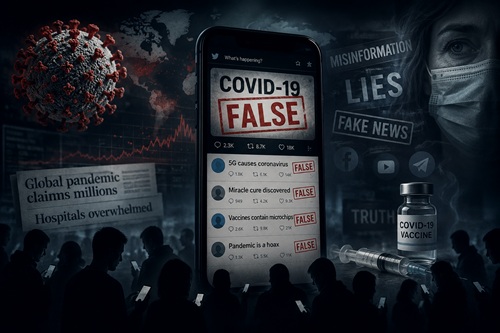 IntroductionThe COVID-19 pandemic was not merely a biological event. It was also the largest information crisis in modern history. Alongside the spread of SARS-CoV-2 came a parallel epidemic of claims, counterclaims, conspiracy theories, political propaganda, institutional mistakes, scientific uncertainty, and outright falsehoods. The World Health Organization quickly coined the term "infodemic" to describe this phenomenon, but even that understated the scale of the problem. For perhaps the first time, billions of people received much of their medical information not from physicians or public health agencies but from Facebook, X (formerly Twitter), YouTube, Telegram, TikTok, podcasts, and messaging apps. Every smartphone became a broadcasting station. Every citizen became a potential expert. The consequences were profound. Disinformation did not simply confuse people; it altered behavior, delayed vaccination, undermined trust in institutions, fueled political polarization, and in many cases almost certainly cost lives. Yet the story is more complicated than simply blaming conspiracy theorists. One of the enduring ironies of the pandemic is that both the scientific mainstream and the alternative media ecosystem became convinced that the other side was the primary source of disinformation. Each saw itself as defending truth against propaganda. Understanding this mutual distrust is essential if society hopes to respond more effectively to future crises. Social Media: The Perfect Disinformation MachinePrevious pandemics spread through physical contact. COVID spread simultaneously through digital networks. Social media platforms reward engagement rather than accuracy. Algorithms amplify content that provokes outrage, fear, surprise, or moral indignation. Calm scientific explanations rarely go viral. Emotional certainty does. This created ideal conditions for misinformation. Posts claiming that masks suffocated children, that hospitals were empty, that vaccines contained microchips, or that governments planned permanent dictatorship often attracted millions of views before experts could respond. Unlike traditional journalism, there was no editorial gatekeeping. A physician explaining uncertainty might receive a few thousand views. A charismatic influencer promising "the truth they don't want you to know" could reach millions overnight. The pandemic thus exposed a structural weakness in the modern information ecosystem. Why Conspiracy Theories FlourishedPandemics naturally generate uncertainty. At the beginning of 2020, scientists genuinely did not know how deadly COVID would become, whether masks worked, how long immunity lasted, or whether vaccines could be developed quickly. Science advances by correcting itself. Social media punishes correction. Each revised guideline appeared to many observers as evidence that authorities were lying. Changing recommendations about masks became "proof" of deception. Revised estimates of fatality rates became "proof" that numbers had been fabricated. Updated vaccine recommendations became "proof" of hidden dangers. What scientists regarded as normal self-correction was interpreted by many citizens as evidence of corruption. This misunderstanding created fertile ground for conspiracy narratives. Humans generally prefer coherent stories over statistical uncertainty. "They are hiding the truth." "The virus was planned." "The pandemic is fake." "The vaccine is genocide." Such claims offered psychological certainty during a frightening period. The Alternative Information EcosystemLong before COVID, an extensive alternative media landscape had developed. Independent journalists, wellness influencers, political commentators, anti-establishment activists, and self-described citizen researchers increasingly distrusted governments, pharmaceutical companies, mainstream journalism, and academic institutions. COVID transformed this existing skepticism into a comprehensive counter-narrative. Within this worldview: • PCR tests were fundamentally unreliable. • Excess mortality was caused mainly by lockdowns or vaccines. • Pharmaceutical companies manipulated regulators. • Public health agencies suppressed effective treatments. • Scientific journals were politically controlled. • Fact-checkers functioned as censors. Some criticisms contained elements worthy of investigation. Governments undoubtedly made mistakes. Pharmaceutical companies have checkered historical records. Public communication was sometimes inconsistent. Legitimate scientific debate occasionally became politicized. But alongside reasonable criticism emerged claims that simply lacked credible evidence. • Microchips. • Magnetized arms. • Mass depopulation. • 5G activation. • Global dictatorship. • Virus denialism The alternative ecosystem rarely distinguished clearly between well-supported criticism and speculative conspiracy. Institutional Mistakes Fed DistrustThe mainstream bears part of the responsibility as well. Public health officials sometimes communicated with excessive certainty despite limited evidence. Authorities occasionally blurred the distinction between scientific evidence and policy choices. Early dismissal of the possibility of a laboratory accident, later followed by greater openness to investigation, damaged credibility. School closures, lockdown policies, and vaccine mandates involved difficult value judgments, yet were often presented as though science alone dictated them. Meanwhile, social media companies removed content that later turned out to concern legitimate scientific questions. This strengthened the perception that censorship was replacing debate. Trust, once lost, proved difficult to regain. The Irony of Mutual AccusationsPerhaps the most fascinating sociological feature of the pandemic was the symmetry of accusation. Mainstream scientists argued that alternative media spread dangerous misinformation responsible for vaccine hesitancy and preventable deaths. Alternative media insisted that governments, pharmaceutical companies, legacy media, and medical journals spread official propaganda responsible for censorship, unnecessary lockdowns, vaccine injuries, and suppression of dissent. Each side saw itself as the defender of science. Each side accused the other of ideological blindness. Each side compiled long lists of alleged falsehoods committed by its opponents. To mainstream observers, the anti-vaccine movement appeared detached from reality. To alternative observers, establishment institutions appeared hopelessly captured by political and corporate interests. This mutual delegitimization produced a remarkable inversion. Instead of debating evidence, each community increasingly questioned whether the other deserved to participate in public discourse at all. Echo Chambers and Confirmation BiasSocial media intensified existing psychological tendencies. People rarely seek information neutrally. Instead, they seek confirmation. Algorithms learned these preferences with extraordinary efficiency. Someone skeptical of vaccines would quickly receive increasingly anti-vaccine content. Someone trusting public health agencies would receive increasingly establishment-oriented information. Both groups inhabited different realities. Different experts. Different statistics. Different heroes. Different villains. Different interpretations of identical events. Once these informational bubbles formed, dialogue became extraordinarily difficult. Evidence supporting one's own side seemed obvious. Evidence supporting the other side appeared manipulated. The Cost of PolarizationThis polarization had tangible consequences. Some individuals rejected vaccines despite overwhelming evidence that they substantially reduced severe disease and death, particularly before widespread immunity developed. Others developed excessive faith in governmental competence, assuming that every recommendation reflected settled science rather than evolving evidence. Medical decisions became political identity markers. Masks became ideological symbols. Vaccination became tribal membership. Questions became interpreted as betrayal. Nuance largely disappeared. This environment made honest scientific discussion nearly impossible. Lessons for Future PandemicsFuture public health crises are inevitable. The information crisis accompanying them may be even worse unless important lessons are learned. Authorities must communicate uncertainty honestly rather than projecting unwarranted certainty. Scientists should distinguish empirical evidence from policy preferences. Journalists should resist sensationalism regardless of ideological direction. Social media platforms should reduce algorithmic amplification of demonstrably false claims while avoiding becoming arbiters of legitimate scientific disagreement. Citizens must also cultivate greater epistemic humility. Neither official institutions nor alternative influencers deserve automatic trust. Claims should be evaluated according to evidence, transparency, reproducibility, and willingness to correct mistakes. Skepticism is healthy. Cynicism is not. Beyond the BinaryThe pandemic exposed a deeper cultural problem extending far beyond COVID itself. Modern societies increasingly divide into rival epistemic tribes. One tribe places primary trust in established scientific institutions. The other places primary trust in decentralized networks of independent investigators. Both contain valuable correctives. Institutions provide expertise, quality control, and accumulated knowledge. Independent critics expose blind spots, conflicts of interest, and institutional failures. Healthy democracies require both. The danger arises when either side claims a monopoly on truth. ConclusionCOVID-19 demonstrated that disinformation is not simply false information. It is also a social phenomenon rooted in distrust, identity, polarization, and the architecture of modern communication. Conspiracy theories undoubtedly complicated the public health response. But institutional overconfidence, inconsistent communication, and occasional censorship also contributed to the erosion of trust that allowed those theories to flourish. Perhaps the greatest irony is that both conventional and alternative communities sincerely believed they were fighting disinformation while accusing the other side of deceiving the public. Each viewed itself as defending reason and evidence against ideology. This symmetry should encourage humility rather than triumphalism. The challenge for future crises is not to eliminate disagreement—scientific progress depends on disagreement—but to preserve a shared commitment to evidence, proportionality, and intellectual honesty. Once societies lose the ability to distinguish between legitimate skepticism and reflexive distrust, or between justified confidence and institutional dogmatism, every public emergency risks becoming not only a medical crisis but also a crisis of shared reality.
Widget is loading comments...
|