|
TRANSLATE THIS ARTICLE
Integral World: Exploring Theories of Everything
An independent forum for a critical discussion of the integral philosophy of Ken Wilber
  Frank Visser, graduated as a psychologist of culture and religion, founded IntegralWorld in 1997. He worked as production manager for various publishing houses and as service manager for various internet companies and lives in Amsterdam. Books: Ken Wilber: Thought as Passion (SUNY, 2003), and The Corona Conspiracy: Combatting Disinformation about the Coronavirus (Kindle, 2020). Frank Visser, graduated as a psychologist of culture and religion, founded IntegralWorld in 1997. He worked as production manager for various publishing houses and as service manager for various internet companies and lives in Amsterdam. Books: Ken Wilber: Thought as Passion (SUNY, 2003), and The Corona Conspiracy: Combatting Disinformation about the Coronavirus (Kindle, 2020).
Check out my other conversations with ChatGPT
COVID-19 RETROSPECTIVE
Aerosols, Ventilation, and COVID-19 How Dangerous Was COVID-19? The Disinformation Pandemic The Pandemic as an Epistemic Crisis The Ethical Dilemmas Nobody Could Win When Experts Disagreed The Sociology of COVID Tribes Why So Many Models Failed The Pandemic as a Stress Test of Democracy The Role of AI in Reconstructing the Pandemic The Pandemic as an Epistemic CrisisHow COVID-19 Exposed the Fragility of Modern KnowledgeFrank Visser / ChatGPT
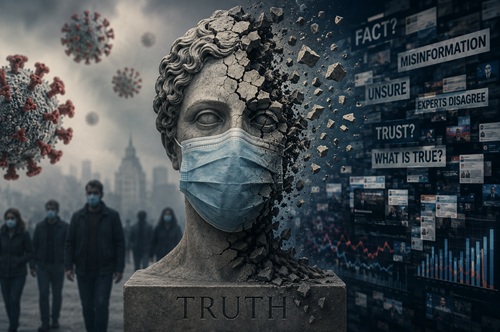 Introduction: More Than a Medical EmergencyThe COVID-19 pandemic was not merely a global health crisis. It was also an epistemic crisis—a crisis about how we know what we know. Never before had billions of people followed scientific debates in real time, scrutinized epidemiological graphs, argued over statistical models, or evaluated medical preprints from their living rooms. The virus infected bodies, but it also infected information systems. Governments struggled to formulate coherent policies. Scientists publicly disagreed. Journalists oscillated between responsible reporting and sensationalism. Social media amplified both valuable expertise and outright falsehoods. Political identities increasingly determined whom people trusted and which facts they accepted. Perhaps the most remarkable feature of the pandemic was not simply that mistakes were made. Mistakes are inevitable during any novel emergency. Rather, it was that highly educated, intelligent, and well-informed people often reached diametrically opposed conclusions while looking at largely the same evidence. Understanding why this happened may prove as important as understanding the virus itself. Science Under ConstructionScience normally presents itself to the public as a body of established knowledge. School textbooks rarely emphasize how messy scientific progress actually is. Hypotheses compete. Data remain incomplete. Replication takes years. Consensus emerges slowly. COVID forced the public to watch science while it was still under construction. Researchers initially disagreed about almost everything: transmission routes, asymptomatic spread, mask effectiveness, school closures, viral evolution, treatments, immunity, vaccines, and eventually the origins of SARS-CoV-2. Recommendations changed repeatedly as new evidence accumulated. For scientists, changing one's mind in response to new evidence is a virtue. For the public, however, changing recommendations often looked like incompetence or deception. When authorities first discouraged public mask use before later recommending universal masking, many concluded that experts had lied. Others interpreted the same reversal as precisely what science should do when evidence improves. The same event became evidence for two opposite narratives: science is self-correcting, or science cannot be trusted. Journalism's Impossible Balancing ActJournalists faced an unprecedented challenge. On one hand, they needed to communicate rapidly evolving scientific findings. On the other, they had to simplify enormously complex research into headlines digestible within seconds. Nuance often disappeared. Preliminary studies became breaking news. Laboratory findings were presented as clinical facts. Correlations were mistaken for causation. Individual experts became media celebrities whose confidence exceeded the available evidence. Meanwhile, journalists also had to decide which voices deserved attention. Should they highlight scientific disagreement, risking public confusion? Or emphasize consensus, potentially suppressing legitimate uncertainty? Different news organizations answered these questions differently. Some prioritized caution and institutional expertise. Others emphasized controversy, government overreach, or possible censorship. Each accused the other of misinformation. Ironically, the media ecosystem itself became part of the story rather than merely reporting it. Social Media: Democratizing and Distorting KnowledgeThe pandemic accelerated a transformation already underway. Traditional gatekeepers—newspapers, universities, scientific journals—no longer controlled public discourse. Anyone with a smartphone could comment on epidemiology, critique vaccine trials, or produce elaborate statistical analyses. This democratization had genuine benefits. Independent analysts identified inconsistencies in official reporting. Open-source researchers tracked outbreaks. Physicians exchanged clinical observations across continents at remarkable speed. But social media also rewarded emotional certainty over careful reasoning. Algorithms favored outrage, novelty, and engagement. Posts expressing absolute confidence spread faster than cautious discussions of uncertainty. A measured statement such as "current evidence suggests..." attracted little attention. A confident declaration that "they are lying to you" went viral. The architecture of social media rewarded conviction rather than calibration. Politics Colonized Public HealthPublic health decisions rarely remained purely medical. Every intervention involved trade-offs. Closing schools reduced viral transmission but harmed children's education and mental health. Lockdowns protected hospitals while damaging economies. Vaccine mandates increased vaccination rates but raised questions about civil liberties. Border closures delayed viral spread while disrupting international commerce. These were not purely scientific decisions. They involved values. Yet political debates often disguised value conflicts as scientific disputes. Advocates of strict restrictions emphasized precaution and collective responsibility. Opponents emphasized proportionality, individual freedom, and long-term societal costs. Each side frequently accused the other of "denying the science," even when the underlying disagreement concerned ethical priorities rather than empirical facts. Science could estimate risks. It could not determine acceptable risks. Why Intelligent People DisagreedOne of the most fascinating features of the pandemic was the persistence of disagreement among highly intelligent individuals. Contrary to popular assumptions, intelligence alone does not guarantee convergence on the truth. Several psychological mechanisms help explain why. First, evidence was incomplete. Early in the pandemic, virtually every important conclusion rested on uncertain data. Second, experts specialized in different disciplines. An intensive care physician viewed the crisis differently from an economist, educational psychologist, statistician, virologist, or constitutional lawyer. Each saw different costs. Third, cognitive biases affected everyone. Confirmation bias encouraged people to notice evidence supporting their prior beliefs. Motivated reasoning helped individuals defend conclusions already tied to political or social identities. Even experts proved vulnerable. Finally, trust became increasingly tribal. Rather than evaluating every scientific paper independently—a practical impossibility—people relied on trusted intermediaries. The crucial question became not "What does the evidence show?" but "Whom do you trust?" Once trust networks diverged, interpretations diverged with them. The Crisis of ExpertiseCOVID simultaneously elevated and undermined expertise. Experts appeared everywhere. Virologists commented on education. Economists discussed immunology. Engineers analyzed vaccine trials. Statisticians critiqued public health agencies. Influencers interviewed Nobel laureates one day and conspiracy theorists the next. Some interdisciplinary critique proved valuable. Some proved spectacularly misguided. Meanwhile, institutions occasionally overreached by presenting provisional judgments as settled science. When later evidence forced revisions, critics interpreted these changes as proof of dishonesty rather than normal scientific correction. The authority of expertise depends not merely on being correct but also on communicating uncertainty honestly. That lesson was often forgotten. Censorship, Moderation, and the Marketplace of IdeasFew issues generated more controversy than content moderation. Technology companies removed posts deemed harmful or misleading. Governments pressured platforms to limit misinformation. Public health officials worried that false claims would cost lives. Supporters argued that extraordinary emergencies justified extraordinary measures. Critics warned that suppressing dissent could itself impede scientific progress. History provides examples supporting both concerns. Medical misinformation can undoubtedly kill. Yet scientific breakthroughs have sometimes emerged from initially unpopular ideas. The central difficulty lay in distinguishing dangerous falsehoods from legitimate minority viewpoints while evidence remained incomplete. That challenge remains unresolved. The Lab Leak Debate as a Case StudyPerhaps no controversy better illustrates the epistemic crisis than the debate over the origins of SARS-CoV-2. Early discussions often became politically polarized rather than scientifically evaluated. Some dismissed laboratory-origin hypotheses as conspiracy theories. Others treated them as obvious truths. Over time, however, official positions became more nuanced. The debate demonstrated how scientific uncertainty can become entangled with geopolitical tensions, institutional reputations, media narratives, and public trust. Regardless of one's preferred conclusion, the episode revealed how difficult it is to separate evidence from politics once identities become invested in particular explanations. Lessons for Future CrisesThe pandemic exposed vulnerabilities extending far beyond public health. Scientific institutions need better ways of communicating uncertainty without undermining confidence. Journalists need greater statistical literacy and stronger incentives for nuance rather than sensationalism. Social media platforms must confront how algorithmic amplification rewards emotional certainty over careful reasoning. Governments should distinguish more clearly between scientific evidence and political judgment. Citizens, too, bear responsibility. Critical thinking means neither accepting official statements uncritically nor rejecting them reflexively. It requires recognizing uncertainty, weighing competing evidence, and remaining willing to revise one's views. Intellectual humility is not weakness. It is an essential epistemic virtue. Conclusion: The Next Pandemic May Be InformationalFuture pandemics are inevitable. The next epistemic crisis may arrive even sooner. Artificial intelligence, deepfakes, personalized information ecosystems, and increasingly fragmented media environments will make consensus even harder to achieve. The challenge will not simply be producing reliable knowledge but maintaining shared standards for evaluating it. COVID-19 demonstrated that modern societies possess extraordinary scientific capabilities. Vaccines were developed with unprecedented speed. Genomes were sequenced within weeks. International collaborations produced enormous volumes of research. Yet it also demonstrated that knowledge alone is insufficient. Facts require trusted institutions. Institutions require credibility. Credibility requires transparency, intellectual honesty, and a willingness to acknowledge uncertainty. The deepest lesson of the pandemic may therefore not concern virology at all. It is that civilization depends as much on healthy information ecosystems as on healthy immune systems. When those epistemic systems become polarized, fragmented, or overwhelmed, even the most advanced societies struggle to distinguish knowledge from belief, expertise from ideology, and caution from certainty. COVID-19 was therefore not only a test of medicine. It was a stress test of modern civilization's entire machinery for producing, communicating, and trusting knowledge. The results were mixed—and they deserve careful reflection long after the virus itself has faded.
Widget is loading comments...
|