|
TRANSLATE THIS ARTICLE
Integral World: Exploring Theories of Everything
An independent forum for a critical discussion of the integral philosophy of Ken Wilber
  Frank Visser, graduated as a psychologist of culture and religion, founded IntegralWorld in 1997. He worked as production manager for various publishing houses and as service manager for various internet companies and lives in Amsterdam. Books: Ken Wilber: Thought as Passion (SUNY, 2003), and The Corona Conspiracy: Combatting Disinformation about the Coronavirus (Kindle, 2020). Frank Visser, graduated as a psychologist of culture and religion, founded IntegralWorld in 1997. He worked as production manager for various publishing houses and as service manager for various internet companies and lives in Amsterdam. Books: Ken Wilber: Thought as Passion (SUNY, 2003), and The Corona Conspiracy: Combatting Disinformation about the Coronavirus (Kindle, 2020).
Check out my other conversations with ChatGPT
COVID-19 RETROSPECTIVE
Aerosols, Ventilation, and COVID-19 How Dangerous Was COVID-19? The Disinformation Pandemic The Pandemic as an Epistemic Crisis The Ethical Dilemmas Nobody Could Win When Experts Disagreed The Sociology of COVID Tribes Why So Many Models Failed The Pandemic as a Stress Test of Democracy The Role of AI in Reconstructing the Pandemic The Pandemic as a Stress Test of DemocracyDid Democratic Systems Prove Resilient or Fragile?Frank Visser / ChatGPT
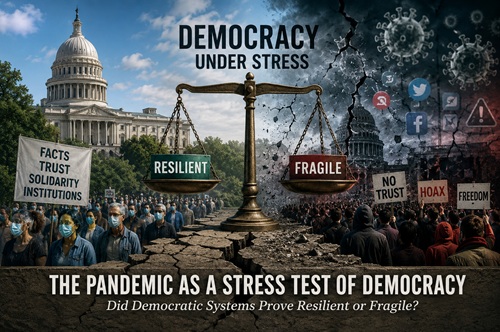 The COVID-19 pandemic was not only a medical crisis; it was also a political experiment conducted under extreme conditions. Governments across the world faced the same fundamental dilemma: how to protect public health while preserving economic life, individual freedoms, and social trust. The pandemic therefore became a stress test for democracy itself. Did democratic systems, with their slower procedures, public debates, and competing interests, prove capable of managing an unprecedented emergency? Or did the crisis reveal that authoritarian systems, with their ability to impose rapid decisions, were better suited for moments of collective danger? The answer is more complicated than either democratic triumphalism or authoritarian admiration suggests. Some democracies struggled badly, while some authoritarian governments achieved impressive short-term results. Yet speed and control are not the only measures of success. The deeper question is whether a political system can make good decisions under uncertainty, correct its mistakes, maintain public trust, and remain accountable when power is concentrated. The Democratic Dilemma: Freedom Versus Emergency PowerDemocracies are built around principles that can become obstacles during emergencies. Decision-making requires consultation, legal procedures, parliamentary oversight, independent courts, media scrutiny, and public debate. These mechanisms exist because unchecked power is dangerous. But during a fast-moving pandemic, they can appear inefficient. A virus does not wait for parliamentary committees, court hearings, or political negotiations. Governments had to make decisions with incomplete information: whether to close schools, restrict gatherings, mandate masks, impose lockdowns, or accelerate vaccine approvals. In such circumstances, democratic governments often appeared hesitant or inconsistent. However, this apparent weakness also reflected one of democracy's strengths: the recognition that uncertainty requires humility. Scientific advice changed as knowledge improved. Policies that seemed reasonable in March 2020 could appear misguided months later. Democratic systems allowed those changes to be debated openly, criticized by opposition parties, challenged in courts, and investigated afterward. The same processes that slow democracies down can also prevent catastrophic mistakes from becoming permanent. Authoritarian Efficiency: The Appeal of the Strong StateThe pandemic created an attractive narrative about authoritarian efficiency. Countries with centralized political systems could rapidly impose restrictions, mobilize resources, and enforce compliance. The early response of China became a frequent example in global debates. After the initial outbreak in Wuhan, Chinese authorities implemented extraordinary measures, including mass testing, digital surveillance, and strict lockdowns. Such measures demonstrated the capacity of a powerful state to organize collective action. Many observers argued that democracies, constrained by individual rights and political divisions, could not match this level of coordination. But authoritarian efficiency has a hidden cost: information control. The early handling of the outbreak in Wuhan raised questions about whether local officials suppressed warnings and delayed the spread of crucial information. In authoritarian systems, leaders may receive filtered information because officials fear punishment for reporting bad news. A system designed for obedience can sometimes become a system that discourages truth-telling. This is a central paradox of authoritarian governance: it may be able to act quickly once a decision is made, but it may be less capable of recognizing when the decision itself is wrong. Transparency and the Importance of Bad NewsA functioning democracy depends on the circulation of uncomfortable information. Journalists investigate governments, scientists criticize policies, opposition parties challenge decisions, and citizens organize protests. During a crisis, these activities can appear disruptive. Yet they serve an essential corrective function. The pandemic showed the value of independent institutions. In countries where governments attempted to minimize the seriousness of COVID-19, independent media and scientific organizations often challenged official narratives. Public debate exposed failures in hospital preparation, testing strategies, vaccine distribution, and communication. Of course, democratic openness also created problems. The same information environment that allowed criticism also allowed misinformation to spread rapidly. Social media platforms amplified conspiracy theories, false medical claims, and politically motivated narratives. Democracies sometimes seemed overwhelmed by information chaos. But misinformation was not a uniquely democratic problem. Authoritarian governments could suppress false information, but they could also suppress accurate information. The challenge was not simply controlling information; it was creating systems capable of distinguishing reliable knowledge from noise. The Role of TrustPerhaps the most important democratic resource during the pandemic was not institutional power but social trust. Public health measures require voluntary cooperation. Even strict governments cannot monitor every individual action indefinitely. People must believe that restrictions are justified, that experts are acting in good faith, and that sacrifices are shared fairly. Some democracies performed remarkably well because citizens trusted institutions. Countries such as New Zealand demonstrated that democratic governments could achieve high levels of compliance through communication and legitimacy rather than relying primarily on coercion. Other democracies struggled because trust had already been weakened by political polarization. In countries where citizens viewed public health measures through partisan identity, even basic recommendations such as mask-wearing became symbols of political allegiance. The pandemic revealed that democracy depends not only on elections and constitutions but also on a culture of mutual confidence. A technically excellent public health policy can fail if large parts of society no longer trust those implementing it. Democratic Accountability After the CrisisOne of democracy's greatest advantages appears after the emergency has passed: accountability. Governments can be investigated, criticized, voted out, and legally challenged. Decisions made during the pandemic can be examined through parliamentary inquiries, independent commissions, journalism, and academic research. This does not guarantee that democracies always learn from their mistakes. Political interests can obstruct honest reflection. Leaders may avoid admitting failures. Institutions may defend their reputations rather than acknowledge errors. But the possibility of accountability matters. A government that knows its decisions will eventually be scrutinized faces pressure to justify its actions and preserve evidence for future evaluation. Authoritarian systems often face the opposite problem. If leaders control the courts, media, and political institutions, failures can be hidden or blamed on lower-level officials. This may preserve political stability in the short term but prevents genuine learning. The Danger of Romanticizing Either SystemThe pandemic did not produce a simple victory for democracy or authoritarianism. Some democracies made serious mistakes. Some authoritarian states managed impressive logistical achievements. Political systems are complex, and outcomes depend on leadership quality, institutional competence, public trust, and cultural factors. A poorly governed democracy can perform worse than a competent authoritarian state. But a transparent and accountable democracy has advantages that become visible over time: the ability to correct mistakes, challenge authority, and incorporate new information. The crucial comparison is therefore not merely between speed and slowness, or control and freedom. It is between systems that can admit errors and systems that cannot. Conclusion: Democracy's Real TestCOVID-19 tested whether democratic societies could balance emergency action with constitutional restraint. The results were mixed. Democracies sometimes appeared divided, slow, and vulnerable to misinformation. Authoritarian systems sometimes appeared decisive and efficient. Yet the pandemic also demonstrated why democracy remains valuable. A crisis does not eliminate the need for accountability; it increases it. When governments possess extraordinary powers, citizens need mechanisms to question those powers and demand evidence for their use. The ultimate measure of a political system is not whether it can act quickly in a crisis. It is whether it can learn afterward. The pandemic was a stress test of democracy not because democracies were expected to be perfect, but because they were expected to remain capable of self-correction. Their greatest strength may not be the ability to avoid mistakes, but the ability to recognize, debate, and repair them.
Widget is loading comments...
|