|
TRANSLATE THIS ARTICLE
Integral World: Exploring Theories of Everything
An independent forum for a critical discussion of the integral philosophy of Ken Wilber
  Frank Visser, graduated as a psychologist of culture and religion, founded IntegralWorld in 1997. He worked as production manager for various publishing houses and as service manager for various internet companies and lives in Amsterdam. Books: Ken Wilber: Thought as Passion (SUNY, 2003), and The Corona Conspiracy: Combatting Disinformation about the Coronavirus (Kindle, 2020). Frank Visser, graduated as a psychologist of culture and religion, founded IntegralWorld in 1997. He worked as production manager for various publishing houses and as service manager for various internet companies and lives in Amsterdam. Books: Ken Wilber: Thought as Passion (SUNY, 2003), and The Corona Conspiracy: Combatting Disinformation about the Coronavirus (Kindle, 2020).
Check out my other conversations with ChatGPT
COVID-19 RETROSPECTIVE
Aerosols, Ventilation, and COVID-19 How Dangerous Was COVID-19? The Disinformation Pandemic The Pandemic as an Epistemic Crisis The Ethical Dilemmas Nobody Could Win When Experts Disagreed The Sociology of COVID Tribes Why So Many Models Failed The Pandemic as a Stress Test of Democracy The Role of AI in Reconstructing the Pandemic The Lab-Leak Hypothesis The Tony Fauci Diaries The Ralph Baric Senate Hearing All The Evidence Circumstantial? The Mysterious Furin Cleavage Site A Case of Lab Leak Fever? All My Covid Essays When Experts DisagreedWas Scientific Disagreement During COVID-19 a Failure - or a Sign of Science Working?Frank Visser / ChatGPT
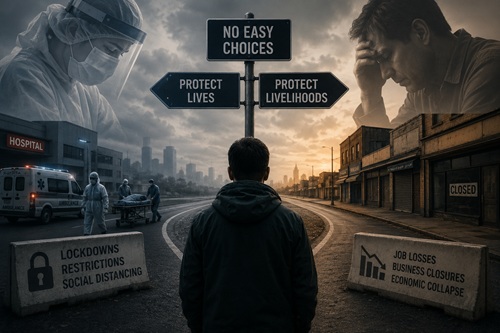 The COVID-19 pandemic created an unusual public spectacle: scientists disagreeing in full view of the world. Epidemiologists contradicted epidemiologists. Virologists challenged public health officials. Doctors, researchers, and statistical experts interpreted the same emerging evidence in sharply different ways. For many people, this disagreement was deeply unsettling. Science is often presented as a reliable source of knowledge, and during a global crisis the public understandably wanted clear answers. Should we wear masks? Were schools safe? Did vaccines prevent transmission? Did immunity after infection matter? Did the virus emerge naturally or through a laboratory-related event? When experts disagreed, many concluded that science itself had failed. Others went further, interpreting disagreement as evidence that scientific institutions were corrupt, politically motivated, or incapable of telling the truth. But disagreement is not necessarily a weakness of science. In many cases, it is one of its defining characteristics. The difficult question is not whether scientists disagreed. They always do. The deeper question is whether the disagreement followed the normal process of scientific correction and refinement—or whether it was amplified by politics, media incentives, institutional failures, and public mistrust. The pandemic revealed both sides: science at its best and science under extraordinary social pressure. Science Is Not a Collection of Final AnswersOne of the most persistent misunderstandings during COVID-19 was the idea that scientists should have immediately known the correct answers. But science rarely operates that way, especially during a novel crisis. At the beginning of the pandemic, researchers were confronted with a new virus, limited data, incomplete knowledge of transmission mechanisms, uncertain estimates of mortality risk, and rapidly changing circumstances. Early recommendations were necessarily provisional. Scientific knowledge develops through a process of hypothesis formation, evidence gathering, debate, replication, and revision. A scientist who changes their position after new evidence emerges is not necessarily admitting failure; they may be demonstrating the basic mechanism by which science advances. The difficulty was that public health decisions had to be made before scientific certainty was available. Governments could not wait years for definitive studies. They had to act under uncertainty. This created a fundamental tension: science works slowly and cautiously, while politics demands immediate decisions. The Mask Controversy: Symbol of ConfusionFew issues became more controversial than masks. Early in the pandemic, many public health authorities did not recommend widespread mask use for the general population. Later, many of the same institutions strongly supported masking. For critics, this appeared to be a dramatic reversal and evidence that experts were unreliable. The reality was more complicated. Early debates were influenced by several factors: limited evidence about community transmission, uncertainty about the effectiveness of different types of masks, and concerns about shortages of medical-grade masks for healthcare workers. As evidence accumulated about asymptomatic transmission and airborne spread, recommendations changed. The scientific question also became entangled with social and political meanings. Masks became symbols of trust or distrust in institutions. Wearing one could be interpreted as an act of solidarity or as a political statement. The problem was not that scientists revised their views. The problem was that institutions often communicated uncertainty poorly. Instead of explaining, “this is our current best judgment based on limited evidence, and it may change,” officials sometimes presented changing recommendations as settled facts. That damaged public trust when those recommendations inevitably evolved. Aerosols and the Battle Over TransmissionOne of the most significant scientific debates concerned how SARS-CoV-2 spread. Early public messaging emphasized large respiratory droplets and contaminated surfaces. Later, the importance of airborne transmission through smaller aerosols became increasingly recognized. Some scientists argued from the beginning that airborne transmission deserved greater attention. Others were more cautious, emphasizing the difficulty of proving transmission routes in real-world settings. This debate was not simply about personalities or institutions. It reflected a deeper scientific challenge: proving how microscopic biological particles behave in complex environments. Laboratory experiments, epidemiological studies, and real-world observations gradually converged toward the conclusion that airborne transmission played a major role, especially indoors. In hindsight, the delay in recognizing this importance was a genuine weakness. Scientific institutions can sometimes be slow to revise established frameworks, especially when evidence is incomplete. But the eventual correction also demonstrated science functioning as intended: competing interpretations were tested against reality. School Closures: Science Meets ValuesThe debate over school closures revealed perhaps the clearest example of the difference between scientific questions and policy choices. Experts generally agreed that children faced lower direct health risks from COVID-19 than older adults. But they disagreed about the consequences of school reopening for transmission, vulnerable family members, teachers, and communities. Some argued that prolonged closures would cause enormous educational and psychological harm. Others warned that reopening schools prematurely could accelerate outbreaks. Importantly, science alone could not decide the question. Data could estimate infection risks, hospitalization rates, and educational impacts. But societies also had to decide how to balance competing values. This distinction was often blurred. Public debate frequently treated policy disagreements as if one side represented “science” and the other represented ignorance. In reality, different experts often prioritized different harms. A pandemic forces societies to make moral choices under uncertainty. Scientific evidence informs those choices but does not eliminate them. Natural Immunity, Vaccines, and Changing EvidenceThe discussion around immunity after infection became another major source of controversy. Early in the pandemic, there was uncertainty about how long immunity after infection lasted and how it compared with vaccine-induced immunity. As research accumulated, it became clear that previous infection did provide meaningful protection against severe disease, while vaccines offered strong protection against hospitalization and death. The emergence of new variants complicated the picture. Protection against infection and transmission declined as the virus evolved, especially with variants such as Omicron, while protection against severe outcomes remained stronger. Some critics accused authorities of denying natural immunity. Others argued that emphasizing natural immunity could encourage people to deliberately seek infection. Again, the underlying issue was not simply scientific disagreement. It involved communication, risk perception, and policy goals. The scientific picture was dynamic. The public conversation often treated it as a battle between fixed positions. Vaccine Controversies: Safety, Effectiveness, and TrustVaccines became the most politically charged scientific issue of the pandemic. The evidence was clear that COVID-19 vaccines dramatically reduced the risk of severe disease and death, especially before the emergence of immune-evasive variants. But questions remained about duration of protection, effects on transmission, rare side effects, and the ethics of mandates. Some experts supported vaccination requirements as necessary tools during a public health emergency. Others worried about coercion, social division, and declining trust. These disagreements reflected both empirical questions and ethical judgments. The mistake was to treat every vaccine critic as anti-science, while also treating every institutional recommendation as beyond legitimate questioning. Scientific societies require open criticism, but criticism must remain connected to evidence. A healthy scientific culture allows questions. An unhealthy information environment turns every uncertainty into a conspiracy narrative. The Origins Debate: Natural Emergence or Laboratory Accident?Few controversies became as politically charged as the origin of SARS-CoV-2. Early in the pandemic, many scientists considered natural spillover from animals the most likely explanation. Others argued that a laboratory-related accident could not be ruled out and deserved serious investigation. The debate became polarized. Some dismissed the laboratory hypothesis as conspiracy thinking. Others presented it as obvious proof of institutional deception. The scientific position evolved. Many researchers came to acknowledge that multiple hypotheses remained possible because definitive evidence was unavailable. This episode illustrates an important distinction: scientific uncertainty is not the same as scientific ignorance. A lack of definitive evidence means conclusions should remain proportional to available evidence. The danger lies on both sides: prematurely closing legitimate questions and turning unanswered questions into unsupported certainty. Did Disagreement Damage Public Trust?The pandemic undoubtedly damaged trust in experts and institutions. But the cause was not disagreement itself. In fact, a society where experts never disagree would be more concerning. Scientific progress depends on criticism, competition, and revision. The deeper problem was the public presentation of disagreement. Scientific debates that normally occur inside journals, conferences, and professional communities were suddenly happening on television and social media, where nuance often disappeared. A preliminary hypothesis could be portrayed as an official conclusion. A minority scientific opinion could be amplified as if it represented equal evidence. Legitimate uncertainty could be confused with incompetence. Social media transformed scientific disagreement into a cultural conflict. The result was that many people learned the wrong lesson: that changing one's mind is evidence of dishonesty rather than evidence of learning. The Lessons for Future PandemicsCOVID-19 showed that science is neither a flawless authority nor a collection of arbitrary opinions. Experts made mistakes. Institutions communicated poorly. Some assumptions proved wrong. Some scientific debates were unnecessarily politicized. But science also adapted. Knowledge improved. Treatments advanced. Vaccines were developed at unprecedented speed. Transmission models were revised. Earlier assumptions were challenged. The lesson should not be that experts cannot be trusted because they disagreed. The lesson should be that scientific expertise is valuable precisely because it has mechanisms for recognizing and correcting errors. A mature scientific culture does not demand certainty before action. It demands honesty about uncertainty, transparency about evidence, and willingness to revise conclusions. The pandemic was not a demonstration that science failed because experts disagreed. It was a demonstration that science is a human enterprise—one that works best when disagreement is not suppressed, but examined.
Widget is loading comments...
|