|
TRANSLATE THIS ARTICLE
Integral World: Exploring Theories of Everything
An independent forum for a critical discussion of the integral philosophy of Ken Wilber
  Frank Visser, graduated as a psychologist of culture and religion, founded IntegralWorld in 1997. He worked as production manager for various publishing houses and as service manager for various internet companies and lives in Amsterdam. Books: Ken Wilber: Thought as Passion (SUNY, 2003), and The Corona Conspiracy: Combatting Disinformation about the Coronavirus (Kindle, 2020). Frank Visser, graduated as a psychologist of culture and religion, founded IntegralWorld in 1997. He worked as production manager for various publishing houses and as service manager for various internet companies and lives in Amsterdam. Books: Ken Wilber: Thought as Passion (SUNY, 2003), and The Corona Conspiracy: Combatting Disinformation about the Coronavirus (Kindle, 2020).
Check out my other conversations with ChatGPT
COVID-19 RETROSPECTIVE
Aerosols, Ventilation, and COVID-19 How Dangerous Was COVID-19? The Disinformation Pandemic The Pandemic as an Epistemic Crisis The Ethical Dilemmas Nobody Could Win When Experts Disagreed The Sociology of COVID Tribes Why So Many Models Failed The Pandemic as a Stress Test of Democracy The Role of AI in Reconstructing the Pandemic The Lab-Leak Hypothesis The Tony Fauci Diaries The Ralph Baric Senate Hearing All The Evidence Circumstantial? The Mysterious Furin Cleavage Site A Case of Lab Leak Fever? All My Covid Essays The Ethical Dilemmas Nobody Could WinHow COVID forced societies to choose between competing harmsFrank Visser / ChatGPT
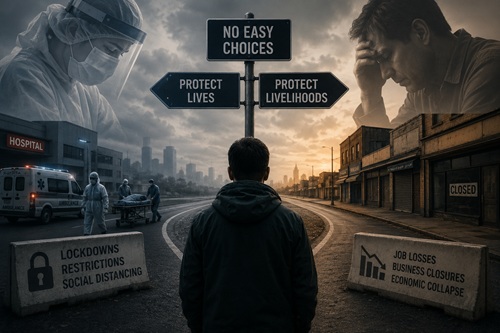 The COVID-19 pandemic produced a category of moral problems that modern societies had largely forgotten how to handle: situations in which every available choice caused serious harm. Public debates often treated pandemic policies as if there had been a simple division between good and bad options. One side supposedly defended science and public health; the other defended freedom and individual rights. But the reality was far more uncomfortable. Policymakers faced genuine ethical conflicts involving autonomy, solidarity, economic survival, mental health, education, dignity, and the protection of vulnerable people. With hindsight, it is tempting to judge past decisions from a position of certainty. We now know more about transmission, immunity, long-term effects, and the limitations of some interventions. But ethical evaluation requires more than asking whether a policy produced perfect outcomes. It requires asking: What information was available at the time? What risks were being weighed? Were alternatives realistically possible? COVID was not a story of good people versus bad people. It was a story of societies confronting dilemmas in which every path had victims. The illusion of the perfect pandemic responseA common feature of retrospective debates is the assumption that there must have been a correct path that was ignored because of incompetence, ideology, or hidden motives. Yet pandemic management is fundamentally a problem of decision-making under uncertainty. In early 2020, governments faced a novel virus with unknown mortality, unknown transmission patterns, and no vaccine. Hospitals in several countries were overwhelmed. Images of intensive care units under extreme pressure shaped public perception. The central question was not simply, “What restrictions are acceptable?” but rather: “How much preventable suffering and death should society tolerate while waiting for better solutions?” The difficulty was that the harms were distributed differently. A policy that protected one group could damage another. The elderly benefited most from reducing infections, while children and young adults often carried more of the social and educational burden. Businesses faced collapse. Healthcare workers faced exhaustion. People with other illnesses experienced delayed care. A single moral principle could not solve the problem because multiple legitimate values were in conflict. Mandatory vaccination: autonomy versus collective responsibilityFew issues became as polarizing as vaccination mandates. The argument for mandates was straightforward. Vaccines dramatically reduced severe disease and death, especially before the emergence of immune-evasive variants. Healthcare systems depend on preventing avoidable hospitalizations. In occupations involving vulnerable people, such as healthcare and elderly care, vaccination requirements could be understood as part of professional responsibility. The opposing argument focused on bodily autonomy. A liberal society normally requires strong justification before compelling individuals to undergo a medical intervention. Even if vaccines are beneficial, critics argued that coercion risks undermining trust and creating a dangerous precedent. Both concerns were legitimate. The ethical question was never simply whether vaccines worked. It was whether the expected collective benefit justified limiting individual choice. That calculation changed over time. Early in the pandemic, when vaccines strongly reduced infection and transmission, the case for mandates appeared stronger. Later, when protection against infection declined and vaccines primarily reduced severe outcomes, the justification became more complicated. A major lesson from the pandemic is that public health measures require proportionality. A policy that is ethically defensible under one set of scientific conditions may become questionable when circumstances change. Vaccine passports: incentives or social division?Vaccine certificates attempted to balance reopening society with reducing risk. They allowed restaurants, cultural institutions, workplaces, and travel to operate while encouraging vaccination. Supporters argued that participation in society has always involved certain health requirements. Schools require vaccinations against several childhood diseases. Food workers must follow hygiene regulations. Driving requires licensing. Individual choices can create public consequences. Critics saw vaccine passports differently. They argued that they created a two-tier society and pressured people into medical decisions through social exclusion rather than informed consent. In societies already experiencing declining trust in institutions, such measures risked deepening resentment. The ethical tension was between conditional freedom and equal citizenship. Is it acceptable to restrict access to public life based on health status if doing so reduces harm? Or does such a system undermine fundamental principles of social inclusion? There was no answer that satisfied every moral framework. School closures: protecting lives while sacrificing childhoodFew pandemic decisions revealed competing values more clearly than school closures. The initial closures were driven by fear that schools could accelerate transmission and overwhelm healthcare systems. In the absence of vaccines and reliable knowledge about children's role in transmission, caution seemed reasonable. But the costs became increasingly visible. Children lost months of education, social development, routine, and emotional stability. The burden was especially severe for children from disadvantaged backgrounds, who often lacked quiet study environments, technological resources, or parental support. Looking back, many experts argue that prolonged school closures caused greater harm than initially recognized. The ethical mistake was not necessarily closing schools temporarily during the early uncertainty of the pandemic, but failing to prioritize reopening strategies once more evidence became available. The lesson is not that protecting public health was wrong. It is that children's interests deserved greater weight in the balance. Nursing home visitor bans: saving lives while creating lonelinessThe restrictions on visitors in nursing homes may represent one of the most painful ethical dilemmas of the pandemic. Older adults were among the groups at greatest risk from COVID. Preventing visitors reduced infections and saved lives. Few societies would accept large numbers of preventable deaths among nursing home residents if a simple intervention could reduce the risk. Yet the emotional costs were profound. Many elderly people experienced isolation during their final months. Some died without family members present. The very people society wanted to protect were sometimes deprived of the relationships that gave their lives meaning. This dilemma exposed a deeper ethical question: Is extending biological life always the highest priority, or must dignity, connection, and emotional wellbeing receive equal consideration? Public health traditionally focuses on mortality reduction, but human flourishing involves more than survival. ICU triage: the unbearable mathematics of scarcityThe most extreme ethical dilemma occurred in overwhelmed intensive care units. When hospitals lack sufficient beds, ventilators, or medical staff, doctors may face decisions about who receives treatment. Modern medicine usually avoids such choices, but pandemics can force societies into crisis standards of care. Triage is ethically painful because it transforms individual suffering into population-level calculations. Medical professionals may have to prioritize those with the greatest chance of survival or those expected to benefit most from scarce resources. Critics sometimes describe such systems as cold or inhumane. Yet refusing to make choices does not eliminate scarcity. It simply allows decisions to happen without ethical frameworks. The real tragedy is not that triage exists. The tragedy is that a pandemic can create circumstances where compassionate care becomes impossible for everyone. The danger of retrospective moral certaintyOne of the most damaging consequences of the pandemic has been the tendency to turn complex ethical debates into moral battles. Some people portray all restrictions as authoritarian overreach. Others portray all criticism of restrictions as selfish denial of science. Both approaches simplify reality. A democratic society needs room for disagreement about difficult trade-offs. Questioning a policy does not automatically mean rejecting public health. Supporting a policy does not automatically mean ignoring individual rights. The challenge is maintaining intellectual humility. Many decisions made during COVID were based on incomplete information. Some interventions were justified at the time but later proved less effective than hoped. Some harms were underestimated. Some warnings were exaggerated. Institutions deserve criticism where they failed—but criticism should be based on evidence, not hindsight alone. The pandemic's uncomfortable legacyThe deepest lesson of COVID may be that ethics becomes most difficult precisely when values collide. Protecting vulnerable people matters. Individual freedom matters. Children's development matters. Economic stability matters. Human connection matters. Scientific expertise matters. Democratic accountability matters. A mature society does not pretend these values never conflict. It develops ways to negotiate those conflicts honestly. The pandemic did not reveal that humanity lacked ethical principles. It revealed that ethical principles are often easiest to defend when they do not compete with one another. COVID forced societies into situations where every choice carried a cost. The goal was never to find a path without suffering. The goal was to make decisions that minimized unnecessary harm while recognizing the humanity of those who bore the burden. That is a far more difficult moral task than choosing heroes and villains after the crisis has passed.
Widget is loading comments...
|