|
TRANSLATE THIS ARTICLE
Integral World: Exploring Theories of Everything
An independent forum for a critical discussion of the integral philosophy of Ken Wilber
  Frank Visser, graduated as a psychologist of culture and religion, founded IntegralWorld in 1997. He worked as production manager for various publishing houses and as service manager for various internet companies and lives in Amsterdam. Books: Ken Wilber: Thought as Passion (SUNY, 2003), and The Corona Conspiracy: Combatting Disinformation about the Coronavirus (Kindle, 2020). Frank Visser, graduated as a psychologist of culture and religion, founded IntegralWorld in 1997. He worked as production manager for various publishing houses and as service manager for various internet companies and lives in Amsterdam. Books: Ken Wilber: Thought as Passion (SUNY, 2003), and The Corona Conspiracy: Combatting Disinformation about the Coronavirus (Kindle, 2020).
Check out my other conversations with ChatGPT
COVID-19 RETROSPECTIVE
Aerosols, Ventilation, and COVID-19 How Dangerous Was COVID-19? The Disinformation Pandemic The Pandemic as an Epistemic Crisis The Ethical Dilemmas Nobody Could Win When Experts Disagreed The Sociology of COVID Tribes Why So Many Models Failed The Pandemic as a Stress Test of Democracy The Role of AI in Reconstructing the Pandemic The Lab-Leak Hypothesis The Tony Fauci Diaries The Ralph Baric Senate Hearing All The Evidence Circumstantial? The Mysterious Furin Cleavage Site A Case of Lab Leak Fever? The Furin Cleavage Site Mystery Peter Borger and the SARS-CoV-2 Origin All My Covid Essays Aerosols, Ventilation, and COVID-19How a Scientific Debate Changed the PandemicFrank Visser / ChatGPT
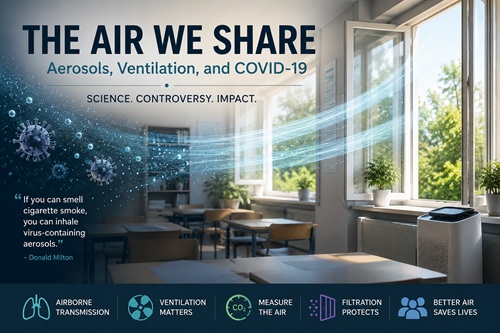 From Handwashing to Fresh AirOne of the most consequential scientific controversies of the COVID-19 pandemic was not about vaccines, lockdowns, or masks, but about something as ordinary as the air we breathe. During 2020 and 2021, a fierce debate unfolded over whether SARS-CoV-2 spread primarily through large respiratory droplets—which fall quickly to the ground—or through tiny airborne aerosols capable of lingering indoors for hours. The outcome of that debate profoundly influenced public health guidance, building design, workplace safety, and ultimately, mortality. It also became a case study in how scientific institutions sometimes adapt slowly to emerging evidence. The Early "Droplet Dogma"At the beginning of the pandemic, most health authorities followed a decades-old framework inherited from twentieth-century infection control. Diseases were classified into two broad categories: Droplet transmission: large particles falling within one or two meters. Airborne transmission: tiny particles remaining suspended, supposedly limited to diseases like measles and tuberculosis. Organizations including the World Health Organization and the Centers for Disease Control and Prevention initially emphasized: • handwashing • surface disinfection • social distancing • plexiglass barriers Ventilation received comparatively little attention. The assumption was straightforward: infected droplets landed on surfaces or directly on nearby individuals. The Aerosol Scientists Push BackA relatively small group of aerosol physicists argued almost immediately that this framework was outdated. Among the most prominent voices were: • Lidia Morawska • José Luis Jiménez • Donald Milton Their argument rested on basic physics. People continuously exhale microscopic particles while: • breathing • talking • singing • exercising These particles are often less than five micrometers across and can remain airborne for extended periods, especially in enclosed, poorly ventilated spaces. If infectious virus is carried inside these aerosols, then infection resembles exposure to cigarette smoke more than being struck by droplets. Their slogan became famous: "If you can smell cigarette smoke, you can inhale virus-containing aerosols." While imperfect as an analogy, it vividly illustrated the role of shared indoor air. The Famous Open LetterIn July 2020, over 200 scientists signed an open letter urging the WHO to acknowledge airborne transmission. Initially, the WHO responded cautiously, arguing that evidence remained limited. But accumulating outbreak investigations increasingly supported the aerosol hypothesis. Superspreading events consistently occurred in: • choirs • restaurants • call centers • bars • churches • meatpacking plants Common features included: • indoor environments • prolonged exposure • inadequate ventilation • loud speaking or singing Surface transmission rarely explained these events. Real-World EvidencePerhaps the strongest evidence came from epidemiology rather than laboratory experiments. Consider several well-known outbreaks. Choir rehearsalsOne infected singer infected dozens of others despite maintaining distance and avoiding physical contact. RestaurantsAir conditioning circulated contaminated air between tables. People seated far beyond two meters became infected. Cruise shipsOnce thought to demonstrate surface transmission, later analyses suggested that shared indoor air played a much larger role. SchoolsClassrooms with improved ventilation generally experienced substantially lower transmission than comparable poorly ventilated classrooms, particularly before widespread immunity developed. Although ventilation was only one of several factors, its contribution became increasingly clear. Ventilation Enters Public HealthGradually the recommendations shifted. Attention moved toward: • opening windows • improving HVAC systems • portable HEPA filters • outdoor gatherings • CO2 monitoring • limiting time indoors CO2 became a practical proxy for rebreathed air. Although carbon dioxide itself is harmless at typical indoor levels, elevated concentrations indicate that occupants are repeatedly inhaling air exhaled by others. This concept proved easy to understand and gave schools and businesses a measurable target. The "Swiss Cheese" ModelEventually ventilation became one layer in the now-famous "Swiss cheese" approach. No intervention was perfect. Protection resulted from combining: • vaccination • masking • ventilation • isolation • testing • reduced crowding Rather than replacing other measures, ventilation complemented them. The Role of Alternative MediaInterestingly, discussion of aerosol transmission flourished outside mainstream channels long before official guidance fully shifted. Science blogs, Twitter (before its later transformation), YouTube interviews, podcasts, and independent newsletters hosted extensive debates among aerosol researchers. Scientists like José Luis Jiménez became unusually visible public communicators. Alternative media often criticized public-health agencies for clinging to outdated assumptions. However, this landscape was mixed. Some independent commentators accurately promoted airborne transmission months before official recognition. Others combined correct aerosol science with unsupported claims about masks, vaccines, or conspiracy theories. As a result, "alternative media" cannot be treated as a single reliable source. Institutional InertiaWhy did acceptance take so long? Several explanations have been proposed. Medical infection control historically developed separately from aerosol physics. The traditional distinction between droplets and aerosols relied on an arbitrary five-micrometer cutoff that aerosol scientists regarded as physically unrealistic. Changing official guidance during a rapidly evolving pandemic also carried practical and political consequences, including concerns about shortages of high-grade respirators and the feasibility of upgrading ventilation systems. These factors likely contributed to institutional caution, although the relative importance of each remains debated. How Much Difference Did Ventilation Make?Quantifying lives saved is difficult because ventilation was implemented alongside vaccination, masking, behavioral changes, and accumulating immunity. Nevertheless, multiple studies conclude that improving indoor air quality substantially reduces transmission risk. Modeling studies suggest that increasing ventilation rates or adding effective HEPA filtration can reduce infection risk by roughly 30-80% in many indoor settings, depending on occupancy, exposure duration, and baseline ventilation. By lowering infections, better ventilation indirectly reduced hospitalizations and deaths, particularly before vaccines became widely available. It would be misleading, however, to assign a precise fraction of prevented fatalities to ventilation alone. The pandemic's course reflected the combined effects of multiple interventions, viral evolution, and growing population immunity. A Lasting LegacyPerhaps the most enduring consequence of the aerosol debate is that indoor air quality is increasingly viewed as a public health issue comparable to clean drinking water. Many experts now argue that schools, hospitals, offices, and public buildings should routinely monitor ventilation and filtration, not only to reduce COVID-19 but also influenza and other respiratory diseases. The pandemic exposed a long-standing blind spot: buildings had been engineered primarily for thermal comfort and energy efficiency, not infection control. The renewed emphasis on ventilation may become one of COVID-19's most durable public health legacies. ConclusionThe controversy over aerosols was more than a technical dispute among scientists. It shaped public policy, influenced everyday behavior, and likely prevented many infections once ventilation and filtration were widely adopted. The episode also illustrated both the strengths and weaknesses of modern science: evidence eventually prevailed, but only after prolonged debate, institutional hesitation, and public scrutiny. COVID-19 demonstrated that pathogens do not simply spread from person to person; they spread through shared air. Recognizing that fact transformed both our understanding of the pandemic and our approach to preventing future airborne epidemics. Appendix: The Dutch Aerosol Debate — A Battle Between Physics and Public HealthThe Netherlands became one of the countries where the international debate over aerosol transmission played out most visibly. It was not merely a scientific disagreement but also a public dispute involving the National Institute for Public Health and the Environment, the Outbreak Management Team, politicians, independent scientists, journalists, and one particularly persistent public commentator: Maurice de Hond. Looking back, the Dutch experience illustrates both the strengths and limitations of evidence-based policymaking during a rapidly evolving crisis. RIVM's Initial PositionThroughout most of 2020, the RIVM maintained that SARS-CoV-2 spread predominantly through large respiratory droplets and close personal contact. While it acknowledged that aerosols might occur under special medical circumstances—such as intubation or certain hospital procedures—it regarded airborne transmission in ordinary indoor settings as unproven and probably of limited importance. This position closely mirrored the early guidance of the WHO. Consequently, Dutch policy focused on: • keeping 1.5 meters apart, • hand hygiene, • staying home when symptomatic, • avoiding crowded settings. Ventilation was recommended as good general practice but was not initially treated as a primary infection-control measure. Maurice de Hond's CampaignBeginning in the spring of 2020, Maurice de Hond became the most outspoken Dutch advocate of the aerosol hypothesis. Unlike many critics of government policy, De Hond did not primarily argue against restrictions themselves. Rather, he argued that the government was targeting the wrong transmission route. Drawing on international studies, outbreak investigations, and the work of aerosol researchers such as Lidia Morawska and José Luis Jiménez, he argued that infection occurred predominantly through inhaling virus-laden aerosols in poorly ventilated indoor spaces. His recommendations included: • opening windows, • measuring indoor CO2, • improving ventilation, • installing air filtration, • avoiding crowded indoor environments. These themes, now familiar, were still considered controversial during much of 2020. His website became an important alternative source of information for those following the aerosol debate closely. Although some regarded him as an outsider without formal epidemiological training, others appreciated his ability to synthesize emerging international evidence months before official policy changed. Jaap van Dissel and the OMTThe public face of Dutch COVID policy was Jaap van Dissel, director of infectious disease control at the RIVM and chair of the OMT. Van Dissel repeatedly emphasized that policy should be based on established scientific evidence rather than plausible hypotheses. From his perspective, the available evidence in 2020 did not yet justify major revisions to Dutch policy. Even after acknowledging that aerosols could contribute under certain conditions, he continued to argue that large droplets remained the dominant transmission route and that ventilation should be viewed as one element among several preventive measures rather than the primary focus. Supporters viewed this as appropriate scientific caution. Critics saw it as excessive institutional conservatism. The Maassluis Nursing HomeOne incident became emblematic of the controversy. In the summer of 2020, a severe outbreak occurred in nursing home De Tweemaster in Maassluis. Microbiologist Peter de Man argued that the pattern strongly suggested airborne spread through a recirculating ventilation system after viral material was detected in parts of the ventilation infrastructure. The RIVM, however, concluded that the available evidence did not prove that the ventilation system had caused transmission and continued to emphasize more conventional routes of infection. This disagreement became a symbol of the wider conflict over airborne transmission. Years later, documents released under the Dutch Open Government Act (WOO) reignited debate over whether officials had minimized the significance of the findings. Critics interpreted the documents as evidence of institutional reluctance to embrace the aerosol hypothesis, whereas the RIVM maintained that it had simply applied appropriate evidentiary standards. A Gradual ShiftDuring 2021 the Dutch position slowly evolved. The RIVM increasingly acknowledged that infection could occur through aerosols, especially: • indoors, • during prolonged exposure, • in poorly ventilated rooms, • where many people gathered. Ventilation advice became more explicit, and attention shifted toward practical measures such as opening windows and ensuring adequate fresh-air exchange. However, the OMT remained cautious about claiming that specific ventilation standards had been conclusively shown to reduce SARS-CoV-2 transmission in real-world settings. The change was evolutionary rather than revolutionary. Was De Hond Right?With hindsight, much of De Hond's central argument has been broadly validated. Today there is widespread scientific agreement that SARS-CoV-2 is transmitted substantially through inhalation of infectious aerosols, particularly indoors, and that ventilation and air filtration are important mitigation measures. That does not mean every criticism he made was necessarily correct, nor that the RIVM acted in bad faith. Public-health authorities faced genuine uncertainty, had to weigh incomplete evidence, and were understandably cautious about changing national guidance during an unfolding emergency. Nevertheless, many observers—including some who had initially defended the official position—now acknowledge that ventilation deserved greater emphasis earlier in the pandemic. Lessons LearnedThe Dutch aerosol debate offers several broader lessons. First, expertise from outside medicine—in this case aerosol physics and building engineering—proved indispensable for understanding transmission. Second, scientific consensus is not static. Institutions sometimes require considerable evidence before revising established frameworks, while outsiders may identify important patterns earlier. Finally, the controversy demonstrated that improving indoor air quality should not be viewed as a temporary pandemic measure but as a long-term investment in public health. One of COVID-19's enduring legacies may be a greater appreciation that the quality of the air inside buildings matters just as much as the quality of the water we drink.
Widget is loading comments...
|