|
TRANSLATE THIS ARTICLE
Integral World: Exploring Theories of Everything
An independent forum for a critical discussion of the integral philosophy of Ken Wilber
  Frank Visser, graduated as a psychologist of culture and religion, founded IntegralWorld in 1997. He worked as production manager for various publishing houses and as service manager for various internet companies and lives in Amsterdam. Books: Ken Wilber: Thought as Passion (SUNY, 2003), and The Corona Conspiracy: Combatting Disinformation about the Coronavirus (Kindle, 2020). Frank Visser, graduated as a psychologist of culture and religion, founded IntegralWorld in 1997. He worked as production manager for various publishing houses and as service manager for various internet companies and lives in Amsterdam. Books: Ken Wilber: Thought as Passion (SUNY, 2003), and The Corona Conspiracy: Combatting Disinformation about the Coronavirus (Kindle, 2020).
Check out my other conversations with ChatGPT
COVID-19 RETROSPECTIVE
Aerosols, Ventilation, and COVID-19 How Dangerous Was COVID-19? The Disinformation Pandemic The Pandemic as an Epistemic Crisis The Ethical Dilemmas Nobody Could Win When Experts Disagreed The Sociology of COVID Tribes Why So Many Models Failed The Pandemic as a Stress Test of Democracy The Role of AI in Reconstructing the Pandemic The Lab-Leak Hypothesis The Tony Fauci Diaries The Lab-Leak HypothesisWhere Does the Evidence Stand Now?Frank Visser / ChatGPT
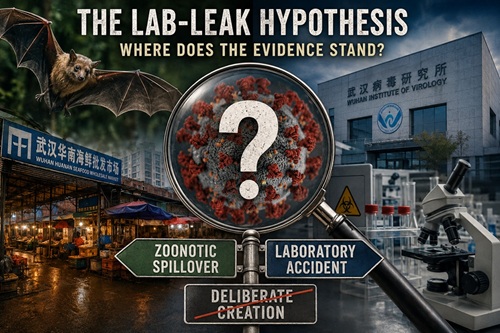
Few scientific questions of the twenty-first century have become as politically charged as the origin of SARS-CoV-2. In the first months of the COVID-19 pandemic, the suggestion that the virus might have escaped from a laboratory was widely dismissed as irresponsible speculation. Later, the hypothesis entered mainstream political and scientific debate. Intelligence agencies began investigating it, governments demanded greater transparency from China, and some scientists argued that the possibility of a laboratory-associated origin had been prematurely excluded. Where does the matter stand today? The short answer is both more complicated and less dramatic than the polarized debate suggests. The lab-leak hypothesis remains scientifically possible, and it has not been conclusively disproved. But neither has it been demonstrated. The strongest available scientific evidence still favors a zoonotic origin, while the lack of access to crucial Chinese data means that a laboratory-associated accident cannot be confidently ruled out. That is the uncomfortable middle ground in which the evidence currently resides. From conspiracy theory to legitimate hypothesisThe term "lab leak" actually covers several different propositions, which should not be conflated. One possibility is that a naturally occurring virus was collected in the field and subsequently escaped accidentally from a laboratory. Another is that researchers were studying a naturally occurring virus and accidentally became infected. A much more specific claim is that SARS-CoV-2 itself was genetically engineered or deliberately created as a biological weapon. These are very different hypotheses. The first two are scientifically plausible scenarios in principle, because laboratory accidents involving infectious pathogens have occurred in the past. The third is a much stronger claim and requires correspondingly stronger evidence. So far, there is no convincing evidence that SARS-CoV-2 was deliberately engineered as a biological weapon. This distinction is essential because public discussion has often treated "lab leak" as synonymous with "man-made virus." They are not synonymous. The laboratory hypothesis became prominent partly because the pandemic began in Wuhan, the same city that houses the Wuhan Institute of Virology, a major center for coronavirus research. That geographical coincidence is certainly relevant, but geography alone is not proof of causation. Wuhan also contained the Huanan Seafood Wholesale Market, which became the center of the earliest known cluster of cases. The real question is therefore not whether the virus appeared near a coronavirus laboratory. It is whether the totality of evidence better fits a laboratory-associated accident or a natural spillover from animals into humans. What the scientific evidence saysThe most important recent assessment came from the World Health Organization's Scientific Advisory Group for the Origins of Novel Pathogens, or SAGO. Its 2025 report was unusually careful in its conclusions. SAGO stated that the weight of available scientific evidence supports zoonotic spillover, meaning that SARS-CoV-2 most likely entered the human population from an animal, either directly from bats or through an intermediate host. The group also emphasized, however, that essential information needed to evaluate all hypotheses had not been made available. Consequently, it concluded that the laboratory-associated hypothesis could not be definitively excluded. This is an important distinction. "We cannot rule out a lab leak" does not mean "the lab leak is equally likely." It means that the evidence is incomplete. Indeed, a group of 23 former SAGO members writing in Nature in 2026 reiterated that the peer-reviewed scientific evidence they reviewed generally favors zoonotic origins and that no concrete evidence of a laboratory breach has emerged. They also noted that intelligence assessments pointing toward a lab origin have generally relied on information about laboratory practices and conditions rather than direct evidence that SARS-CoV-2 escaped from the Wuhan Institute of Virology. That is perhaps the most important point in the current debate: there is a difference between evidence that a laboratory accident was possible and evidence that one actually happened. The case for zoonotic spilloverThe natural-origin hypothesis has several important pieces of evidence behind it. First, the earliest known cases were geographically concentrated around the Huanan market in Wuhan. Subsequent analyses of early case distributions and environmental samples have provided evidence consistent with a market-associated emergence. The discovery of SARS-CoV-2-related viruses in bats and other wildlife also establishes a plausible evolutionary pathway by which a coronavirus could eventually reach humans. Second, the broader history of emerging infectious diseases strongly supports the general plausibility of zoonotic emergence. SARS, MERS, Ebola, avian influenza and numerous other diseases have crossed from animals into humans. A pandemic emerging from an animal-to-human spillover is therefore not an extraordinary mechanism. Third, the genetic evidence has not produced a clear "smoking gun" of engineering. Claims that the virus contains obvious signs of artificial construction have not been substantiated. The presence of a furin cleavage site in the spike protein has generated considerable debate, but its existence by itself does not demonstrate genetic engineering. The scientific argument for zoonotic emergence is therefore not based on one decisive discovery. It is a cumulative argument: epidemiology, evolutionary biology, the history of pandemics and the available genomic evidence collectively point in that direction. But there is an important caveat. The scientific community has not identified the precise animal-to-human transmission event. No infected intermediate animal has been definitively established as the source of the pandemic. That missing link remains a significant gap. The case for a laboratory-associated accidentThe lab-leak hypothesis, meanwhile, rests on a different kind of evidence. The Wuhan Institute of Virology was conducting research on coronaviruses, including viruses collected from bats. The laboratory was therefore engaged in precisely the kind of work that could, in principle, create opportunities for accidental exposure. Questions have also been raised about laboratory safety, the nature of coronavirus research being conducted in Wuhan, and the transparency of Chinese authorities. There is also the broader issue of what happened in the earliest weeks of the outbreak. China has not provided investigators with unrestricted access to all relevant laboratory records, databases, research notebooks, personnel information and biological samples. This absence of information does not prove a laboratory origin, but it prevents the hypothesis from being tested as thoroughly as scientists would ideally like. The 2025 SAGO investigation explicitly highlighted this problem. The WHO concluded that important information had not been made available and called for further disclosure. Its director-general, Tedros Adhanom Ghebreyesus, said that all hypotheses—including zoonotic spillover and laboratory-associated incidents—should remain on the table. This is where the lab-leak hypothesis has gained legitimate scientific standing. Not because a decisive piece of evidence has emerged, but because the investigation has never had complete access to the evidence that could decisively settle the question. What about the intelligence agencies?The intelligence community has complicated the picture further. In January 2025, the CIA publicly assessed that a laboratory-associated origin was more likely than a natural origin, but emphasized that it had low confidence in this conclusion. The assessment did not represent the discovery of a decisive new piece of evidence; rather, it reflected a reassessment of existing intelligence. Other U.S. intelligence agencies have reached different conclusions or remained uncertain. This is often misunderstood. An intelligence agency saying "low confidence" does not mean "we have proved it." Nor does it mean "we have no evidence whatsoever." It means that the available information is insufficiently reliable, complete or consistent to support a high-confidence conclusion. Intelligence assessments and scientific assessments also operate differently. Intelligence agencies may have access to classified information unavailable to scientists, but their conclusions may be difficult for outsiders to independently evaluate. Scientists, by contrast, rely primarily on publicly available evidence that can be examined and challenged by other researchers. The result is an unusual situation in which intelligence assessments have not converged on a single answer. The CIA's conclusion therefore deserves to be taken seriously, but it should not be mistaken for scientific proof. The crucial distinction between "possible" and "probable"Much of the confusion surrounding this debate comes from the failure to distinguish three different propositions. The first is: Could SARS-CoV-2 have emerged from a laboratory? Yes. There is no scientific principle that makes this impossible. The second is: Has a laboratory-associated origin been demonstrated? No. The third is: Which hypothesis is currently better supported by the available evidence? The answer from the major scientific assessments remains: natural zoonotic emergence has the stronger evidentiary basis, while the laboratory hypothesis remains unresolved because critical evidence is missing. This is not an intellectually satisfying conclusion. But science often has to work with incomplete evidence. The politics of uncertaintyThe origin debate became toxic partly because uncertainty was interpreted as evidence of bad faith. Early in the pandemic, some scientists and institutions were too quick to dismiss the possibility of a laboratory accident. The fact that the outbreak occurred in Wuhan, home to a major coronavirus laboratory, was a legitimate reason for investigation, not something to be automatically suppressed. At the same time, some advocates of the lab-leak theory moved rapidly from "this deserves investigation" to "this is what happened." That leap was not justified by the evidence. Both errors are understandable products of a highly polarized environment. One side sometimes treated the lab hypothesis as a conspiracy theory; the other sometimes treated the absence of definitive evidence for zoonotic spillover as evidence for a laboratory origin. Neither position is scientifically sound. The correct approach is more mundane: formulate competing hypotheses, identify predictions, gather evidence, quantify uncertainty and revise conclusions when new information emerges. The deeper problem: we may never knowThe most sobering possibility is that the origin of SARS-CoV-2 may never be established with certainty. If a naturally infected animal transmitted the virus to a human, the original animal may never be identified. If a laboratory worker accidentally became infected, the event may have occurred without documentation or without leaving recoverable evidence. If critical records and samples are unavailable, retrospective investigation becomes increasingly difficult with every passing year. This means that the debate may eventually settle not with a dramatic revelation but with a probabilistic judgment. The current scientific balance can therefore be summarized as follows: The zoonotic hypothesis remains the leading explanation because it is supported by the greater weight of published scientific evidence. The laboratory-associated hypothesis remains viable because important evidence is missing and because a laboratory accident is biologically plausible. The claim that SARS-CoV-2 was deliberately engineered, however, remains unsupported by convincing evidence. That is a much more nuanced conclusion than either "the lab leak has been debunked" or "the lab leak has been proven." The lesson for science and societyPerhaps the most important lesson is not about Wuhan at all. It is about how societies should handle uncertainty during a crisis. Scientists should be willing to investigate uncomfortable hypotheses without fear of political consequences. Governments should not suppress relevant data. Intelligence agencies should distinguish clearly between evidence and inference. Journalists should avoid turning provisional conclusions into certainties. And the public should resist the temptation to treat every unanswered question as proof of a hidden conspiracy. The COVID-19 origins debate also exposes a fundamental asymmetry in scientific reasoning. A natural origin requires evidence of a natural pathway; a laboratory origin requires evidence of a laboratory pathway. The absence of evidence for one does not automatically prove the other. At present, the evidence has not crossed the threshold required to say that SARS-CoV-2 came from a laboratory. Nor has it crossed the threshold required to close the laboratory hypothesis forever. The scientifically responsible position, therefore, is neither credulity nor dismissal. It is provisional judgment combined with continued investigation. The leading hypothesis remains zoonotic spillover. The lab-leak hypothesis remains open. The definitive answer remains elusive. And perhaps the greatest scandal would not be that one hypothesis ultimately proves correct and the other wrong. It would be if, after the worst pandemic in a century, political secrecy and institutional defensiveness prevented humanity from ever finding out. Appendix: Does the SARS-CoV-2 Genome Contain the Answer?The SARS-CoV-2 genome is the most obvious place to look for the answer to the origin question. It is, after all, the historical record of the virus itself. If the virus evolved naturally, its genome should contain the signatures of evolutionary descent. If it was manipulated in a laboratory, perhaps it should contain signs of genetic engineering. The temptation is therefore to treat the genome as a kind of forensic fingerprint. But viral genomes are not quite that simple. They record evolutionary history, but they do not necessarily tell us why a particular mutation occurred. Natural selection, recombination, mutation, laboratory passage, and genetic engineering can sometimes produce overlapping patterns. The genome can provide powerful evidence, but it does not automatically provide a verdict. The controversy over SARS-CoV-2 revolves particularly around one feature: the furin cleavage site, or FCS, in the spike protein. The broader question is whether this unusual feature outweighs the much larger pattern of genome-wide mutations and evolutionary relationships. The answer, at present, is no—but the FCS remains one of the most legitimate reasons why the laboratory-origin hypothesis has not disappeared. The unusual feature in the spikeSARS-CoV-2 differs from its closest known relatives in possessing a polybasic furin cleavage site at the boundary between the S1 and S2 portions of its spike protein. This site, involving the amino-acid sequence PRRAR, can be recognized by furin-like proteases in human cells and affects how efficiently the virus enters certain cells and tissues. That feature immediately attracted attention because the closest known sarbecoviruses do not possess an equivalent functional furin cleavage site. The SARS-CoV-2 sequence also contains a 12-nucleotide insertion at this location, producing four additional amino acids. The question is obvious: How did it get there? The laboratory-leak argument begins with the observation that inserting a cleavage site into a coronavirus is the kind of experiment that could be imagined in a laboratory. The fact that coronavirus researchers were studying viral entry and host range makes this possibility particularly relevant. Proponents of a laboratory-associated origin therefore argue that the FCS deserves to be treated as a potential fingerprint of manipulation. But "possible laboratory insertion" is not the same as "demonstrated laboratory insertion." The critical question is whether the sequence itself bears unmistakable signs of artificial construction. So far, the answer is no. The SARS-CoV-2 genome does not contain a molecular equivalent of a serial number saying "I was engineered." There is no universally accepted genetic signature that proves the FCS was artificially inserted. Indeed, the 2025 WHO SAGO assessment noted that furin cleavage sites occur in naturally circulating coronaviruses, including bat merbecoviruses and other human coronaviruses, and that such features can arise through natural evolutionary processes. That does not prove that the SARS-CoV-2 FCS arose naturally. It merely means that the existence of an FCS is not, by itself, evidence of engineering. The genome-wide picture is more complicatedThis is where the broader genome becomes important. SARS-CoV-2 is not simply a familiar coronavirus with one suspicious sequence inserted into it. Its genome as a whole contains a complex mosaic of evolutionary relationships. Different regions of the genome have different degrees of similarity to known animal coronaviruses. The virus is particularly close to certain bat sarbecoviruses in some parts of its genome, while its spike receptor-binding domain has distinctive characteristics. This is exactly what one might expect from a virus that has evolved through mutation and recombination over a long period. But it is also why the genome cannot be reduced to a simple "natural" or "artificial" signature. Coronaviruses are extraordinarily capable of recombination. Their genomes can exchange genetic material when related viruses infect the same host. Natural selection can subsequently favor mutations that improve viral replication or transmission. Consequently, a genome that looks like a patchwork of evolutionary histories is not inherently suspicious. At the same time, the fact that SARS-CoV-2's closest known relatives are not its direct ancestors leaves an important gap. The viruses we currently know are related to SARS-CoV-2, but none provides the missing evolutionary bridge that leads directly to the pandemic virus. This is a crucial point for both sides. The absence of the immediate progenitor does not prove a laboratory origin. In nature, we routinely fail to identify the precise ancestor of an emerging pathogen. Sampling is incomplete, and viruses circulate in enormous populations of animals that are only sporadically surveyed. But the missing progenitor also means that the natural-origin hypothesis has not yet reconstructed the complete evolutionary story. The genome, in other words, gives us a family tree with some branches missing. The "smoking gun" problemThe strongest version of the laboratory hypothesis would require something like a genetic smoking gun: evidence that the virus was constructed using a recognizable laboratory technique, based on a known viral backbone, or derived from a documented research project. Such evidence has not emerged from the SARS-CoV-2 genome itself. The genome does not display an obvious genetic "scar" that would compel the conclusion of engineering. Arguments that particular nucleotide patterns, restriction sites, or codon usage prove manipulation have not achieved broad scientific acceptance. This is why the scientific mainstream has resisted the claim that the genome demonstrates artificial construction. But there is a subtle distinction that is often lost in the debate. Failure to find a genetic smoking gun does not eliminate the possibility of a laboratory-associated accident. A laboratory leak does not necessarily require genetic engineering at all. Researchers could theoretically have collected a naturally occurring virus in the field, brought it into a laboratory, and accidentally released it. Alternatively, a researcher could have become infected while handling a naturally occurring virus. In these scenarios, the genome could look entirely natural. This is why the genetic evidence is much more relevant to the question of engineering than to the broader question of laboratory accident. The two hypotheses are often mistakenly treated as one. The FCS versus the rest of the genomeThe debate can therefore be framed as a contest between two kinds of evidence. On one side is the FCS: a relatively unusual feature at a biologically important location, absent from the closest known sarbecoviruses and appearing in the virus that suddenly became extraordinarily successful in humans. On the other side is the genome as a whole: a complex sequence whose broader evolutionary characteristics are compatible with natural coronavirus evolution and for which no unequivocal engineering signature has been identified. Which should carry more weight? The answer depends partly on what question we are asking. If the question is "Was SARS-CoV-2 deliberately engineered?", the genome currently provides no compelling proof. The FCS is intriguing, but it is not sufficient. If the question is "Could the virus have been manipulated in a laboratory?", the genome leaves the possibility open but does not establish it. If the question is "Could a naturally occurring virus have escaped from a laboratory?", the genome may be almost powerless to answer the question, because such a virus could have a completely natural genome. This is why the FCS debate, although scientifically fascinating, cannot by itself resolve the origin controversy. What about the "natural mutations" argument?One of the most important counterarguments to the FCS hypothesis is that the SARS-CoV-2 genome shows evidence of evolutionary processes that are entirely familiar in natural viruses. The virus accumulated mutations as it spread. Variants such as Alpha, Delta and Omicron subsequently acquired large numbers of mutations, demonstrating how rapidly SARS-CoV-2 can evolve under natural selection. But this fact must be handled carefully. The mutations observed during the pandemic do not necessarily explain how the original SARS-CoV-2 genome arose. Once the virus was circulating among millions of humans, its subsequent evolution is a separate question from its emergence. The fact that SARS-CoV-2 naturally accumulated mutations after 2020 proves that the virus is capable of natural evolution. It does not by itself tell us whether the ancestral virus acquired its FCS through natural evolution, recombination, or laboratory manipulation. The distinction between evolution after emergence and the origin of the ancestral genome is therefore essential. Could the FCS have arisen naturally?Yes. That possibility is biologically credible. Natural selection can favor mutations that increase viral fitness. Recombination can introduce new sequence combinations. Coronaviruses have mechanisms that make both processes especially relevant. The strongest argument against the FCS being automatically suspicious is therefore not that we have found a direct natural ancestor containing precisely the same sequence. We have not. It is that nature is capable of producing unusual viral features, and the existence of an unusual feature does not establish artificial origin. The WHO SAGO assessment explicitly emphasized this broader evolutionary context. It concluded that the available evidence overall favors zoonotic spillover while acknowledging that the necessary information to evaluate all hypotheses fully has not been provided. That is a cautious conclusion, but it is scientifically important. The strongest counterargument: "Why this virus, in this city?"The FCS becomes more compelling when it is combined with circumstantial evidence. The virus emerged in Wuhan, a city containing the Wuhan Institute of Virology, where researchers had extensive experience studying bat coronaviruses. The pandemic began at a time when laboratories were actively investigating coronavirus host range and pathogenicity. Critical records remain unavailable. And the immediate animal precursor of SARS-CoV-2 has not been identified. None of these facts proves a laboratory origin. But neither should they be dismissed as irrelevant. The problem is that the evidence is asymmetrical. The natural-origin hypothesis has substantial positive evidence—particularly the epidemiological concentration around the Huanan market and the genetic and environmental data associated with that early outbreak—but lacks the final animal-to-human transmission link. The laboratory hypothesis has a plausible setting and a number of unresolved questions but lacks direct evidence that a laboratory accident actually occurred. The genome sits somewhere in between. It does not solve the puzzle, but it helps define what the puzzle actually is. The Project DEFUSE complicationThe controversy became even more complicated with the public disclosure of the 2018 Project DEFUSE proposal, which involved researchers including Peter Daszak, Ralph Baric and colleagues associated with the Wuhan Institute of Virology. The proposal discussed coronavirus research involving, among other things, the insertion of furin cleavage sites into certain viruses. This has understandably attracted enormous attention. But the proposal was not funded, and the existence of a proposal is not evidence that its proposed experiments were actually performed. Nor does a research proposal containing an idea resembling a feature of SARS-CoV-2 prove that SARS-CoV-2 was produced through that research. At most, it demonstrates that scientists had contemplated experiments involving coronavirus cleavage sites before the pandemic. That is relevant contextual evidence. It is not genetic proof. The distinction is crucial. A blueprint that resembles a building is not evidence that the building was constructed from that blueprint—unless one can establish that the construction actually took place. Does the genome contain the answer?Perhaps, but not in the way we would like. The SARS-CoV-2 genome contains evidence about its origin, but not necessarily a decisive answer. It tells us that the virus is related to a large family of animal coronaviruses. It tells us that its evolutionary history is complex. It tells us that its spike protein contains a distinctive furin cleavage site. It tells us that no obvious signature of genetic engineering has been universally accepted by the scientific community. But it does not tell us, unequivocally, whether that FCS emerged naturally or was introduced in a laboratory. Nor can the genome tell us whether the virus, if naturally evolved, was circulating in an animal population before being brought into a laboratory. This is the fundamental limitation of genomic forensics. The same genetic sequence can sometimes be compatible with multiple historical scenarios. The genome is therefore more like a witness than a fingerprint. It can testify to evolutionary relationships, but it may not be able to tell us who was holding the virus at the moment it entered the human population. The balance of evidenceThe most defensible conclusion today is that the FCS should neither be ignored nor treated as a smoking gun. It is a genuinely unusual feature that deserves serious investigation. It is one reason why the laboratory-origin hypothesis cannot simply be dismissed as conspiracy theory. At the same time, the FCS is not unique to the entire world of coronaviruses, and its presence does not establish engineering. The broader SARS-CoV-2 genome does not contain a universally accepted signature of artificial construction. The genome-wide evidence therefore weakens the strongest form of the lab-leak argument—the claim that the virus was obviously engineered—but does not eliminate the weaker and scientifically more plausible laboratory-accident hypothesis. That distinction may ultimately prove decisive. If SARS-CoV-2 was deliberately designed, one would expect the genome to carry stronger evidence of human intervention. We do not have that evidence. If SARS-CoV-2 was a naturally occurring virus that accidentally escaped from a laboratory, however, the genome might look exactly as it does today. And if SARS-CoV-2 emerged through zoonotic spillover, the genome could also look much as it does today. The genome alone therefore cannot adjudicate between the latter two possibilities. The real answer may lie outside the genomeThe most promising evidence may ultimately come not from another round of increasingly elaborate sequence analysis but from the historical and epidemiological record surrounding the virus's emergence. Were there laboratory workers infected before the first recognized cases? What viruses were actually held in Wuhan laboratories? What experiments were performed? What samples were collected? What happened to laboratory databases? What were the earliest cases, and where exactly did they occur? Which animals were present in the relevant markets, and were any infected? These are questions that genomic analysis alone cannot answer. This is also why the WHO's 2025 assessment is so important. SAGO concluded that the weight of available evidence favors zoonotic spillover, but also stated that crucial information needed to evaluate all hypotheses had not been provided. In particular, SAGO said it had not been given evidence that would allow it to assess whether a laboratory incident occurred in Wuhan. That leaves us with an uncomfortable conclusion. The SARS-CoV-2 genome does not contain a simple answer to the origin question. The FCS is odd enough to deserve continued scrutiny, but not so diagnostic that it overturns the broader genome-wide evidence. Conversely, the absence of an obvious engineering signature should not be misrepresented as proof that no laboratory accident occurred. The genome tells us that SARS-CoV-2 is a natural-looking coronavirus with a few unusual features. The real historical question is whether those features arose in the wild, in a laboratory, or through some combination of natural viral evolution and laboratory research. Until the missing evidence is found—or made available—the genome can narrow the possibilities, but it cannot close the case. The FCS is a clue. The genome is a record. Neither, by itself, is the verdict.
Widget is loading comments...
|