|
TRANSLATE THIS ARTICLE
Integral World: Exploring Theories of Everything
An independent forum for a critical discussion of the integral philosophy of Ken Wilber
  Frank Visser, graduated as a psychologist of culture and religion, founded IntegralWorld in 1997. He worked as production manager for various publishing houses and as service manager for various internet companies and lives in Amsterdam. Books: Ken Wilber: Thought as Passion (SUNY, 2003), and The Corona Conspiracy: Combatting Disinformation about the Coronavirus (Kindle, 2020). Frank Visser, graduated as a psychologist of culture and religion, founded IntegralWorld in 1997. He worked as production manager for various publishing houses and as service manager for various internet companies and lives in Amsterdam. Books: Ken Wilber: Thought as Passion (SUNY, 2003), and The Corona Conspiracy: Combatting Disinformation about the Coronavirus (Kindle, 2020).
Check out my other conversations with ChatGPT
COVID-19 RETROSPECTIVE
Aerosols, Ventilation, and COVID-19 How Dangerous Was COVID-19? The Disinformation Pandemic The Pandemic as an Epistemic Crisis The Ethical Dilemmas Nobody Could Win When Experts Disagreed The Sociology of COVID Tribes Why So Many Models Failed The Pandemic as a Stress Test of Democracy The Role of AI in Reconstructing the Pandemic The Lab-Leak Hypothesis The Tony Fauci Diaries The Fauci Diaries and the Origin of COVID-19What Rand Paul's latest revelations really change and what they don'tFrank Visser / ChatGPT
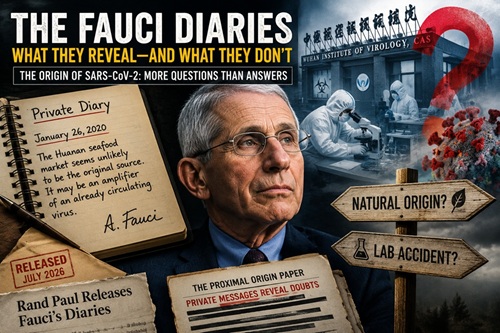
The release of Anthony Fauci's private diaries by Senator Rand Paul[1] has generated precisely the kind of political earthquake that has surrounded the origins of COVID-19 from the beginning. The diaries, covering the period from the emergence of the pandemic through 2022, are being released through Paul's expanding public archive of documents concerning COVID origins and federally funded coronavirus research. Their publication comes alongside other recent document releases, including internal messages concerning the authors of the influential Proximal Origin paper. The temptation is therefore strong to treat the diaries as the missing piece of the laboratory-origin puzzle. But that would be premature. The diaries are potentially important evidence about what Fauci knew, what he suspected, what he said privately, and how he behaved publicly. They are much less direct evidence about where SARS-CoV-2 actually came from. That distinction is crucial. The origins debate has often been distorted by a category error: evidence that someone behaved suspiciously is treated as evidence that a particular biological hypothesis is true. Conversely, evidence that a scientist was mistaken, evasive, or politically compromised is treated as proof that the scientific conclusion must therefore be false. Neither inference is logically justified. The new material nevertheless deserves serious attention. The most consequential revelation: what did Fauci think about the Wuhan market?According to reporting on the newly released diary material, Fauci wrote as early as January 26, 2020, that the Wuhan seafood market appeared unlikely to be the original source of the outbreak and may instead have been an amplifier of an already circulating virus. If accurately characterized, this is potentially significant because it suggests that Fauci's private assessment was more skeptical of the market-origin story than his subsequent public communications might have suggested. This does not, however, automatically establish a laboratory accident. The alternatives are not simply "Wuhan market" versus "Wuhan Institute of Virology." A virus could have entered humans through another animal-to-human transmission event in Wuhan or elsewhere and then been amplified at the market. The absence of a direct link between the earliest patients and the market would therefore weaken one particular version of the zoonotic hypothesis without eliminating zoonotic emergence itself. This is an important point that is frequently lost in the political debate. The question is not merely whether the Huanan market was the source. The larger question is whether the virus entered the human population through a natural spillover or through a research-related incident. The diaries, insofar as they show Fauci questioning the market as the precise origin, may narrow one part of the natural-origin story. They do not by themselves establish the other. The diaries may change the history of the debate more than the biologyThe most important contribution of the diaries may therefore be historical and epistemological. They potentially show that senior officials were privately entertaining uncertainties that were not fully reflected in their public messaging. If so, the problem is not simply that Fauci reached the wrong conclusion. It is that the public was given a more confident picture than the available evidence justified. That matters enormously. Science progresses by uncertainty, competing hypotheses and the gradual accumulation of evidence. During the first months of COVID, however, the origins question quickly became politically radioactive. A laboratory accident was treated in some quarters as a conspiracy theory; in others, natural spillover was presented as virtually settled fact. The result was an unfortunate compression of a complicated evidential spectrum into two political camps. The diaries could reinforce the conclusion that this was a mistake. There is a world of difference between saying, "The laboratory hypothesis is correct," and saying, "The laboratory hypothesis was reasonable enough in early 2020 that it should not have been dismissed." The second claim is much easier to defend—and the accumulating documentary record increasingly supports it. That distinction is especially important in light of the recently released communications concerning the authors of The Proximal Origin of SARS-CoV-2. According to Senator Paul's committee, internal messages show that the scientists involved privately entertained a laboratory origin while their eventual publication became one of the principal public documents cited against that possibility. Those claims themselves need to be assessed against the full correspondence and scientific context, but if the documents are accurately represented, they raise legitimate questions about how scientific uncertainty was translated into public certainty. Fauci's diaries do not prove that SARS-CoV-2 was engineeredHere we should resist the opposite temptation. Nothing in a personal diary can substitute for molecular evidence. The question of whether SARS-CoV-2 emerged from a laboratory ultimately depends on evidence about the virus, the laboratories, the research being conducted, the animals and viruses involved, and the epidemiological history of the earliest cases. The diaries do not demonstrate that SARS-CoV-2 was genetically engineered. They do not establish that the virus was deliberately constructed. They do not prove that a researcher was infected. And they do not identify a specific progenitor virus from which SARS-CoV-2 was derived. These are major evidentiary gaps. Indeed, the strongest version of the laboratory hypothesis—that SARS-CoV-2 was deliberately designed as a bioweapon—is still extraordinarily weak. There is no convincing evidence for it. The more plausible laboratory scenario, if one accepts a laboratory origin, is an accidental infection involving naturally occurring or experimentally manipulated viruses during research. That is a much narrower claim. It is also why the argument over the furin cleavage site has become so important. The site is unusual and was absent from the closest known relatives of SARS-CoV-2, but its unusualness is not equivalent to proof of engineering. The genome as a whole does not contain an accepted molecular "signature" that settles the question. The FCS therefore remains an intriguing feature in the debate, not a smoking gun. The diaries cannot fill this evidentiary gap. But the diaries may strengthen the case for a laboratory possibilityWhere the diaries may matter is indirectly. Suppose we reconstruct the evidence available in early 2020. We have a novel coronavirus appearing in Wuhan, a city containing a major laboratory specializing in bat coronaviruses; researchers working with viruses related to SARS; documented concerns about laboratory safety; a history of controversial coronavirus experiments; incomplete access to laboratory records; missing early epidemiological data; and no publicly demonstrated chain of transmission from a known animal reservoir to the first human cases. None of this proves a laboratory accident. But neither does it justify dismissing one. If Fauci himself privately recognized uncertainties about the market explanation at the beginning, that makes the later confidence surrounding the natural-origin narrative more difficult to defend as a straightforward reflection of the evidence available at the time. This is where the diaries could be historically consequential. They may demonstrate that the origins debate was not suppressed because the evidence clearly ruled out a laboratory origin. Rather, the evidence may have remained ambiguous while influential institutions and scientists converged prematurely on one public narrative. That would be a serious failure of scientific communication even if the virus ultimately turns out to have emerged naturally. The deeper problem: conflicts of interest and institutional self-protectionThe most troubling aspect of the entire origins controversy is therefore not necessarily that Fauci "knew the virus came from a lab." There is no evidence in the diary material, at least as currently reported, that he possessed such knowledge. The deeper issue is the possibility of institutional conflict of interest. The U.S. government funded coronavirus research through a complicated network of grants and subcontractors. Some of that work involved EcoHealth Alliance and the Wuhan Institute of Virology. The exact classification of particular experiments as "gain of function" has itself become a semantic and regulatory battleground, but there is no serious question that U.S.-funded research was connected to coronavirus work in Wuhan. That creates an obvious reason for investigators to be cautious about conflicts of interest. If a laboratory accident were responsible for the pandemic, institutions involved in funding or overseeing related research would have reputational and political exposure. That does not mean they covered up a laboratory accident. But it means that their testimony should be subjected to especially rigorous scrutiny. The same principle applies to Rand Paul. Paul has made the laboratory-leak hypothesis central to his political criticism of Fauci. His investigation has produced documents that deserve examination, but his conclusions are not automatically more reliable because they are politically opposed to Fauci. The proper response is to read the underlying documents, not simply accept the narrative attached to them. This is the great advantage of Paul's "Reading Room": primary documents can be examined by journalists, historians and scientists rather than remaining locked inside government archives. But transparency only works if the documents are interpreted with equal skepticism toward all sides. The diaries and the "cover-up" hypothesisDo the diaries prove a cover-up? No—not by themselves. They may contribute to a case that there was institutional defensiveness, selective communication and an unwillingness to acknowledge uncertainty. Those are serious problems. But a cover-up implies knowledge of a specific truth that was deliberately concealed. To establish that, we would need evidence showing that officials knew the virus came from a laboratory and deliberately suppressed that knowledge. We do not have that evidence in the diaries. There is, however, a weaker and more plausible possibility: that institutions collectively became committed to a particular interpretation before the evidence justified such confidence, and subsequently defended that interpretation because admitting uncertainty would have been embarrassing or politically costly. That is a familiar phenomenon in science and bureaucracy. It does not require a conspiracy. It requires only institutional inertia. And institutional inertia may be exactly what the historical record increasingly reveals. What has actually changed?So, has Rand Paul's release of Fauci's diaries changed what we know about the origin of SARS-CoV-2? Yes—but less dramatically than either side of the political debate would like to believe. It has potentially changed our understanding of the early epistemic history of the pandemic. It may show that Fauci privately recognized uncertainties that were not adequately reflected in his public statements. It may further undermine the idea that the natural-origin hypothesis was settled beyond reasonable doubt in the first weeks and months of 2020. And, when combined with other document releases, it strengthens the case for a more searching investigation into how the laboratory hypothesis was evaluated and communicated. What it has not done is provide the decisive biological evidence needed to establish a laboratory origin. The diaries do not identify the source virus. They do not document a specific laboratory accident. They do not demonstrate that SARS-CoV-2 was engineered. They do not establish that the virus escaped from the Wuhan Institute of Virology. The most defensible conclusion, therefore, is more modest but also more significant. The diaries may make it harder to maintain that the natural-origin hypothesis was transparently and objectively established in 2020. They may strengthen the argument that a laboratory origin was prematurely stigmatized and that genuine scientific uncertainty was obscured by politics, institutional interests and the enormous pressure of a global emergency. But that is not the same as proving that the laboratory hypothesis is true. From "lab leak versus zoonosis" to a more honest questionPerhaps the greatest lesson from the Fauci diaries is that we should stop asking whether one new document "proves" one side or the other. The real scientific question remains: What happened in Wuhan in late 2019? The evidence still points in different directions. The epidemiological clustering around the Huanan market is relevant to zoonotic emergence. The absence of a confirmed intermediate host remains a significant gap. The unusual features of the SARS-CoV-2 genome deserve continued investigation but are not conclusive. The existence of coronavirus research in Wuhan and the history of risky experiments make a research-related accident plausible, but plausibility is not proof. The lack of transparent laboratory records and early case data prevents a definitive resolution. The diaries add another layer: they illuminate the human institutions that were supposed to investigate this question. And that may be their most important legacy. The COVID origins controversy has become a test not merely of virology but of how modern societies handle uncertainty. If the virus emerged naturally, we still need to know why the laboratory hypothesis was treated as illegitimate so early. If it emerged from a laboratory, we need to know why the possibility was minimized or obscured. In either case, the public deserves a transparent reconstruction of what was known, what was suspected, what was uncertain—and when. The Fauci diaries do not solve the mystery of SARS-CoV-2. But they may help solve a different mystery: how the world's most consequential scientific uncertainty became entangled with institutional self-interest, political polarization and the human desire for certainty before the evidence was ready. That is a story worth investigating independently of which origin hypothesis ultimately wins. My bottom line: the new diaries are more damaging to the claim that the origins debate was handled with complete scientific openness than they are decisive evidence for a lab leak. They shift the burden toward a more honest re-examination of the early evidence, but they do not, by themselves, rewrite the biological origin story. The strongest conclusion remains that a laboratory-related origin is a legitimate hypothesis that should never have been dismissed out of hand—but the available evidence still falls short of proving it. NOTES[1] Rand Paul, "Tony's Diary: What He Wrote Privately vs. What He Said Publicly", July 25, 2026 (PDF, 64 MB)
Widget is loading comments...
|