|
TRANSLATE THIS ARTICLE
Integral World: Exploring Theories of Everything
An independent forum for a critical discussion of the integral philosophy of Ken Wilber
  Frank Visser, graduated as a psychologist of culture and religion, founded IntegralWorld in 1997. He worked as production manager for various publishing houses and as service manager for various internet companies and lives in Amsterdam. Books: Ken Wilber: Thought as Passion (SUNY, 2003), and The Corona Conspiracy: Combatting Disinformation about the Coronavirus (Kindle, 2020). Frank Visser, graduated as a psychologist of culture and religion, founded IntegralWorld in 1997. He worked as production manager for various publishing houses and as service manager for various internet companies and lives in Amsterdam. Books: Ken Wilber: Thought as Passion (SUNY, 2003), and The Corona Conspiracy: Combatting Disinformation about the Coronavirus (Kindle, 2020).
Check out my other conversations with ChatGPT
COVID-19 RETROSPECTIVE
Aerosols, Ventilation, and COVID-19 How Dangerous Was COVID-19? The Disinformation Pandemic The Pandemic as an Epistemic Crisis The Ethical Dilemmas Nobody Could Win When Experts Disagreed The Sociology of COVID Tribes Why So Many Models Failed The Pandemic as a Stress Test of Democracy The Role of AI in Reconstructing the Pandemic The Lab-Leak Hypothesis The Tony Fauci Diaries The Ralph Baric Senate Hearing All The Evidence Circumstantial? The Mysterious Furin Cleavage Site A Case of Lab Leak Fever? The Furin Cleavage Site Mystery Peter Borger and the SARS-CoV-2 Origin All My Covid Essays Lab Leak FeverThe Case Against a Theory and the Danger of Closing the Case Too SoonFrank Visser / ChatGPT
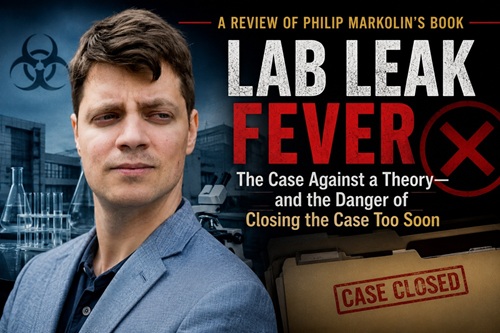
Philipp Markolin's Lab Leak Fever: The COVID-19 Origin Theory That Sabotaged Science and Society is an ambitious, highly detailed, and at times exasperating book. Running to roughly 500 pages, it attempts to do much more than adjudicate the origins of SARS-CoV-2. Markolin wants to explain how the laboratory-leak hypothesis emerged, why it became so powerful, how social media and political polarization amplified it, and how a scientific question was transformed into a cultural and political battlefield. His deeper subject is not simply the origin of COVID-19 but the contemporary crisis of epistemic authority: what happens when scientific uncertainty enters an information ecosystem designed to reward outrage, suspicion, tribal loyalty, and emotionally satisfying narratives. That is a worthwhile subject. Indeed, it may ultimately prove to be the more important one. Yet Lab Leak Fever is also a book with a clear thesis, and that thesis sometimes threatens to become the very thing Markolin warns against: a framework through which ambiguous evidence is too readily interpreted in one direction. His central argument is that the lab-leak hypothesis has acquired influence far beyond what the evidence warrants, and that activists, influencers, politicians, alternative media, and algorithmic platforms have turned a scientifically weak hypothesis into a powerful cultural narrative. Markolin argues that the available scientific evidence is much more consistent with zoonotic emergence than with a laboratory accident. The strength of the book is that it takes seriously the social life of an hypothesis. Its weakness is that, in trying to expose the sociology of the lab-leak movement, it sometimes risks substituting sociology for epistemology. The fact that an idea is amplified by political actors, internet personalities, or conspiracy entrepreneurs tells us something about its dissemination. It does not, by itself, tell us whether the underlying proposition is true. That distinction is crucial. The book's real subject: how uncertainty becomes ideologyMarkolin's most compelling achievement is his reconstruction of the informational environment in which the origins debate unfolded. The pandemic created a perfect storm. A mysterious new virus appeared in a city containing one of the world's leading coronavirus laboratories. The Chinese government restricted access to crucial information. Scientists had incomplete data. Governments had strong political incentives to control the narrative. Journalists had enormous public demand for explanations. Social media rewarded provocative claims. And millions of frightened people wanted a coherent story about how an unprecedented catastrophe had happened. Under such circumstances, the laboratory hypothesis was almost bound to become culturally explosive. Markolin is particularly effective when he shows how a complicated scientific question can be transformed into a chain of increasingly simplified claims. "The virus emerged in Wuhan" becomes "the virus emerged near a coronavirus laboratory." This becomes "the laboratory was studying coronaviruses." That becomes "the laboratory was conducting risky experiments." Finally, the conclusion is drawn that the virus must therefore have escaped from that laboratory. The problem, of course, is that each step in this chain requires evidence of its own. Geographic coincidence is not proof of causation. The existence of risky research does not establish that the particular virus causing the pandemic was part of that research. And the possibility of a laboratory accident is not evidence that an accident actually occurred. Here Markolin makes an important contribution. The lab-leak hypothesis is not one hypothesis but a family of hypotheses. A natural virus accidentally released from a laboratory is a radically different proposition from a genetically engineered bioweapon. The former is scientifically conceivable; the latter requires a much more specific evidentiary case. Yet these possibilities have frequently been conflated in public debate. Markolin is right to resist that conflation. Where the book is strongest: separating evidence from inferenceThe most valuable lesson of Lab Leak Fever is methodological. Markolin repeatedly asks a question that should have been asked much more often during the pandemic: What does this piece of evidence actually demonstrate? The Wuhan Institute of Virology conducted coronavirus research. That is a fact. The laboratory worked with viruses collected from bats. That is a fact. Some forms of coronavirus research involve risks. That is a fact. Laboratory accidents have occurred in the past. That is a fact. But none of these facts, individually or collectively, demonstrates that SARS-CoV-2 originated in the Wuhan Institute of Virology. This is where Markolin's skepticism is at its best. He is particularly persuasive in criticizing arguments that quietly transform possibility into probability, and probability into certainty. A laboratory accident is possible. That does not establish that one happened. A virus could theoretically have been genetically manipulated. That does not establish that it was. The same principle, however, must be applied symmetrically. A natural spillover is possible. That does not establish that one happened. The presence of infected animals and environmental samples at the Huanan market is important evidence. But it does not, by itself, prove that the market was the location of the original spillover rather than the site of subsequent amplification. The fact that SARS-CoV-2 has natural-looking mutations across its genome is significant. But it does not logically exclude a laboratory-associated accident involving a naturally occurring virus. This is where I would part company somewhat with Markolin's larger rhetorical framing. The scientific question is not whether the lab-leak theory has been exploited by conspiracists. It plainly has. The question is whether that exploitation tells us anything about the truth of the underlying hypothesis. It does not. An argument can be politically contaminated and scientifically valid. It can also be politically fashionable and scientifically false. The two questions must remain separate. The genome: evidence, but not a verdictThe most contentious part of the origins debate concerns the genome itself. Markolin's position is broadly that the genetic evidence supports natural emergence and does not provide convincing evidence of engineering. That is a defensible reading of the literature, and there is no established genetic signature that proves laboratory construction. But the genetic argument is often presented with more certainty than the evidence permits. The furin cleavage site remains the most obvious example. Its presence in SARS-CoV-2 is unusual among closely related sarbecoviruses, and the precise evolutionary history of the insertion remains unresolved. At the same time, an unusual feature is not necessarily an artificial feature. Evolution routinely produces rare events, and a rare event becomes especially conspicuous when examined retrospectively in the genome of a virus that caused a pandemic. The crucial point is that the furin cleavage site is compatible with more than one scenario. It is not a smoking gun for engineering, but neither is its unusualness something that can simply be waved away. The same applies to the genome as a whole. SARS-CoV-2 contains extensive patterns of mutation and adaptation that are entirely compatible with natural evolution. This is powerful evidence against simplistic claims that the virus is obviously a laboratory-designed construct. But a naturally evolved virus accidentally escaping from a laboratory is a different proposition from a deliberately engineered virus. The genome alone cannot necessarily distinguish those scenarios. This distinction matters enormously. The strongest version of the lab-leak hypothesis does not require that SARS-CoV-2 was "made" in a laboratory. It requires only that a naturally occurring virus, perhaps one being studied or characterized, was accidentally released. If that is the hypothesis under consideration, arguments about the absence of obvious engineering signatures have limited force. Markolin is therefore strongest when criticizing the claim of deliberate construction, but less decisive when treating the genome as evidence against any possible laboratory-associated origin. The great missing pieceThe deepest problem with the origins debate is not that we lack theories. It is that we lack decisive evidence. For natural spillover, the missing piece is a demonstrated evolutionary chain from a plausible animal reservoir through an intermediate host to humans, ideally with evidence showing when and where the transmission occurred. For a laboratory accident, the missing piece is equally obvious: documentation that the Wuhan laboratory possessed SARS-CoV-2 or a sufficiently close precursor, evidence that researchers were working with it, or credible evidence connecting laboratory personnel or activities to the earliest infections. Neither side possesses the decisive document. That is why the origins question remains so frustrating. Markolin's book is at its most convincing when it insists that the absence of evidence for a laboratory accident should not be replaced by imaginative reconstructions of what might have happened. But the same rule must apply to natural-origin narratives. The absence of a documented animal-to-human transmission chain cannot simply be treated as a minor inconvenience. This is the central epistemological tension that Lab Leak Fever does not always handle with sufficient symmetry. The scientific literature may well provide more positive evidence for zoonotic emergence than for a laboratory accident. That is an important distinction. But "the evidence currently favors zoonotic emergence" is not the same statement as "the laboratory hypothesis has been debunked." The former is a scientific judgment under uncertainty. The latter is a rhetorical verdict. The 2023 market evidenceThe discovery of SARS-CoV-2-positive environmental samples associated with the Huanan market, including samples containing genetic material from susceptible wildlife, became one of the most important developments in the origins debate. Markolin treats such evidence as part of the cumulative case for zoonotic emergence. The evidence is indeed significant. But here again, the epistemological lesson is more complicated than either side often acknowledges. Environmental samples from a market can establish that the virus and susceptible animals were present in the same environment. They can strengthen a zoonotic hypothesis. They cannot necessarily reconstruct the exact direction of transmission. The virus could have arrived at the market through an infected human, an infected animal, or another route. This does not make the market evidence unimportant. Quite the opposite. It is probably among the strongest pieces of evidence supporting natural emergence. But the appropriate conclusion is probabilistic, not absolute. The market evidence shifts the balance. It does not close the case. Markolin's strongest argument—and his most questionable oneThe book's strongest argument is that the laboratory hypothesis became culturally powerful partly because it satisfied a deep psychological need. The pandemic was too consequential to have an apparently mundane explanation. People wanted an agent, a culprit, a hidden story. The laboratory provided a compelling narrative structure: dangerous scientists, secret experiments, a mysterious Chinese institution, government concealment, and a catastrophe that might have been prevented. That story is emotionally powerful. Markolin is right that emotional power can be mistaken for evidentiary power. But his own rhetoric occasionally risks creating a mirror image of the phenomenon he criticizes. By describing the lab-leak movement primarily through the language of "chaos agents," conspiratorial thinking, manipulation, and misinformation, he can make the hypothesis appear discredited by association. The reader is encouraged to see not merely a scientific proposition but a social pathology. That is rhetorically effective. It is also dangerous. The origins debate contains genuine scientific questions about biosafety, gain-of-function research, transparency, laboratory practices, Chinese government secrecy, conflicts of interest, and the institutional incentives that shape scientific communication. Some of the people raising those questions are indeed conspiracy theorists. Others are serious scientists and journalists who have never claimed that the virus was engineered or that the pandemic was deliberately caused. A responsible history of the debate must therefore distinguish between these groups. The existence of a conspiracy theory does not make every criticism of the scientific establishment conspiratorial. The politics of scientific authorityThis is where Lab Leak Fever becomes more than a book about virology. It becomes a book about trust. Markolin is right that scientific authority suffered enormously during the pandemic. But the causes were not exclusively external. Scientific institutions themselves contributed to the erosion of trust through overconfidence, poor communication, institutional defensiveness, and occasional failures to disclose relevant conflicts of interest. The early response to the origins question is a case in point. The public was repeatedly given the impression that the laboratory hypothesis was not merely unsupported but absurd. Yet internal scientific discussions in early 2020 show that prominent researchers did take the possibility seriously. The subsequent publication of The Proximal Origin of SARS-CoV-2 helped establish the natural-origin interpretation as the dominant scientific narrative, but the public presentation of the debate often became more categorical than the underlying evidence justified. This history does not prove a laboratory origin. But it does explain why some members of the public became suspicious. Trust is not restored by telling people that they should trust experts. It is restored by demonstrating that experts can tolerate uncertainty, acknowledge mistakes, disclose conflicts, and revise conclusions when new evidence appears. On this point, the origins debate has much to teach us. The danger of turning a scientific question into a moral testOne of the unfortunate features of the COVID origins controversy is that the question of where the virus came from became entangled with judgments about what kind of person asks the question. For some, belief in a laboratory origin became a badge of political identity. For others, rejection of the hypothesis became a badge of scientific virtue. Once that happened, evidence became secondary to allegiance. Markolin is entirely justified in criticizing this phenomenon. But the same warning applies to his own side of the argument. The proper scientific position is not "lab leak" or "natural origin" as identities. It is a willingness to assign probabilities to competing hypotheses and update those probabilities as evidence changes. On that basis, the current situation remains genuinely uncomfortable. The natural-origin hypothesis has substantial evidence behind it, especially from epidemiology and the association of early cases and viral material with the Huanan market. The laboratory hypothesis lacks a demonstrated chain of evidence connecting the virus to the Wuhan Institute of Virology. At the same time, the absence of such evidence is partly a consequence of the extraordinary lack of transparency surrounding key Chinese data and records. The result is not a scientific tie in the sense that both hypotheses have equal evidentiary support. But neither is it a closed case. The evidence is circumstantial. That is precisely why the debate has lasted so long. A valuable book that should be read criticallyLab Leak Fever deserves attention because it documents an important chapter in the history of the pandemic: the transformation of a scientific question into an information war. Markolin is particularly strong on the mechanics of misinformation, the psychology of conspiracy narratives, and the way digital platforms reward simplistic explanations. His investigation also serves as a useful corrective to the idea that every unresolved question is evidence of a cover-up. But the book should not be treated as the final word on SARS-CoV-2 origins. Its greatest limitation is that it sometimes comes close to confusing the social history of a hypothesis with the scientific evaluation of that hypothesis. The lab-leak narrative has undoubtedly been exploited by political movements, influencers, and conspiracy entrepreneurs. That is a fact worth documenting. But the scientific merits of the hypothesis must be evaluated independently of its worst advocates. The same principle applies in reverse. The fact that many scientists support zoonotic emergence does not make that hypothesis true by authority alone. Its strength must come from evidence. The best conclusion, therefore, is neither Markolin's implied closure nor the maximalist lab-leak narrative. It is a more modest position. The evidence currently gives the natural-origin hypothesis the stronger scientific case. The laboratory-accident hypothesis remains possible but unproven. The deliberate-engineering hypothesis is weaker still and lacks convincing evidence. The furin cleavage site is unusual but not dispositive. The genome contains abundant evidence of natural evolutionary processes but cannot, by itself, exclude every form of laboratory-associated accident. The Huanan market evidence strengthens the zoonotic case without providing an indisputable reconstruction of the first transmission. And the absence of decisive evidence for a laboratory origin should not be confused with proof that no laboratory accident occurred. In that sense, Lab Leak Fever is both an important book and an instructive product of the controversy it describes. It reminds us that science can be distorted by politics, algorithms, tribalism, and motivated reasoning. But the origins debate also reminds us of something equally important: science can be distorted by premature certainty. The real lesson of COVID may therefore be more uncomfortable than either camp would like. We should resist conspiracy theories. We should resist institutional groupthink. We should demand evidence. And, above all, we should learn to live with the possibility that the most honest scientific answer to a historical question may sometimes be: we do not yet know.
Widget is loading comments...
|