|
TRANSLATE THIS ARTICLE
Integral World: Exploring Theories of Everything
An independent forum for a critical discussion of the integral philosophy of Ken Wilber
  Frank Visser, graduated as a psychologist of culture and religion, founded IntegralWorld in 1997. He worked as production manager for various publishing houses and as service manager for various internet companies and lives in Amsterdam. Books: Ken Wilber: Thought as Passion (SUNY, 2003), and The Corona Conspiracy: Combatting Disinformation about the Coronavirus (Kindle, 2020). Frank Visser, graduated as a psychologist of culture and religion, founded IntegralWorld in 1997. He worked as production manager for various publishing houses and as service manager for various internet companies and lives in Amsterdam. Books: Ken Wilber: Thought as Passion (SUNY, 2003), and The Corona Conspiracy: Combatting Disinformation about the Coronavirus (Kindle, 2020).
Check out my other conversations with ChatGPT
COVID-19 RETROSPECTIVE
Aerosols, Ventilation, and COVID-19 How Dangerous Was COVID-19? The Disinformation Pandemic The Pandemic as an Epistemic Crisis The Ethical Dilemmas Nobody Could Win When Experts Disagreed The Sociology of COVID Tribes Why So Many Models Failed The Pandemic as a Stress Test of Democracy The Role of AI in Reconstructing the Pandemic The Lab-Leak Hypothesis The Tony Fauci Diaries The Ralph Baric Senate Hearing All The Evidence Circumstantial? The Mysterious Furin Cleavage Site A Case of Lab Leak Fever? The Furin Cleavage SiteWhy One Molecular Feature Became the Center of the Lab-Leak DebateFrank Visser / ChatGPT
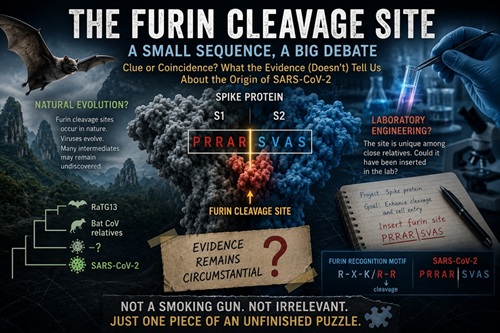
Few features of SARS-CoV-2 have attracted as much attention in the origin debate as its furin cleavage site, or FCS. To some researchers and commentators, the presence of this feature in the virus's spike protein is an important clue pointing toward laboratory manipulation. To others, it is an entirely natural feature whose presence is compatible with ordinary viral evolution. The disagreement has become so intense that the FCS has sometimes been treated as if it were a molecular fingerprint proving one origin or the other. It is not. But neither is it irrelevant. The furin cleavage site sits at the boundary between the two major functional parts of the SARS-CoV-2 spike protein. Cleavage at this site helps the spike protein undergo the structural changes necessary for efficient entry into host cells. Because furin and related proteases are widely distributed in human tissues, the presence of a cleavage site that can be recognized by furin-like enzymes can potentially affect viral tropism, cell entry, and transmission. The unusual feature of SARS-CoV-2 is that its closest known relatives do not possess an equivalent furin cleavage site at the same position. This observation immediately raised an obvious question: How did SARS-CoV-2 acquire it? There are two broad possibilities. The feature could have arisen naturally through mutation, recombination, or other evolutionary processes. Alternatively, it could have been introduced through laboratory manipulation. Both possibilities are biologically conceivable. The challenge is determining which one is actually supported by the evidence. Why the FCS Looks SuspiciousThe laboratory-origin argument begins with a simple observation: SARS-CoV-2 possesses a functional furin cleavage site that is absent from the closest known SARS-related bat coronaviruses. This is noteworthy because the site appears to have functional consequences. It can increase the ability of the spike protein to be activated by host proteases and may contribute to the virus's capacity to infect human cells and transmit efficiently. The sequence itself has also attracted attention because of its unusual characteristics. The insertion that creates the cleavage site is not obviously present in the closest known viral relatives, producing a conspicuous evolutionary gap. From this, some critics have proposed that the FCS could have been inserted artificially during laboratory research. This possibility is not entirely fanciful. Scientists have experimentally modified coronaviruses, and researchers have explored how changes in spike proteins affect viral entry and host range. The general concept of inserting or modifying cleavage sites is therefore within the technical capabilities of molecular virology. But this is where the argument must be handled carefully. The fact that scientists could have inserted such a sequence does not establish that they did. Laboratory plausibility is not evidence of laboratory occurrence. The central question is therefore not whether the FCS could have been engineered. It is whether the available genetic evidence makes engineering more likely than natural acquisition. The Natural-Evolution CounterargumentViruses evolve rapidly, and their genomes are shaped by mutation, recombination, selection, and other mechanisms. Features that appear unusual in one virus can sometimes arise naturally in another. Furin cleavage sites are not unique to laboratory-generated viruses. They occur naturally in a wide variety of viral families, including other coronaviruses. Some coronaviruses have acquired cleavage sites at the boundary between spike subunits through evolutionary processes. This provides an important counterpoint to the lab-leak argument. A feature does not become artificial merely because it is absent from the closest virus we happen to have sampled. The evolutionary history of viruses is reconstructed from an incomplete fossil record. We have sampled only a tiny fraction of the viruses circulating in wildlife. The actual precursor of SARS-CoV-2 may never have been collected. The absence of an intermediate virus containing the evolutionary steps leading to the FCS is therefore not, by itself, proof of engineering. The natural-origin argument is that the relevant precursor may simply be missing from our current dataset. This is an entirely reasonable possibility. But it leaves a genuine question unresolved. The Evolutionary GapThe difficulty is that the FCS is not merely an ordinary mutation that has been directly observed evolving in SARS-CoV-2's lineage. We do not have a sequence of viruses showing the gradual acquisition of the feature. Instead, the closest known relatives lack the site, while SARS-CoV-2 possesses it. That creates what might be called an evolutionary gap. The gap does not prove laboratory engineering. Evolutionary history frequently contains gaps because sampling is incomplete. But the larger and more unexplained the gap, the more important it becomes to find a plausible natural mechanism that could have produced the feature. This is where the debate becomes genuinely interesting. The natural-origin hypothesis requires us to imagine an evolutionary event that occurred in a virus whose immediate ancestors have not yet been identified. The laboratory hypothesis requires us to imagine that researchers deliberately or accidentally introduced the feature during coronavirus research. Neither explanation is automatically established. The question is which requires fewer unsupported assumptions. The "CGG-CGG" ArgumentAnother frequently discussed feature is the codon usage of the amino acids involved in the furin cleavage site. Critics have pointed to the presence of CGG codons, arguing that these are relatively uncommon in coronaviruses and that the particular combination could be suggestive of laboratory design. This argument has attracted considerable attention because codon choices are sometimes deliberately optimized in genetic engineering. But the inference is much weaker than it is sometimes presented. Codon usage varies among organisms and viruses, and rare codons can arise naturally. The mere presence of a codon that is uncommon in a particular viral lineage does not demonstrate engineering. Nor is there a universally accepted genetic signature that distinguishes an artificially inserted sequence from one produced naturally. Furthermore, the presence of CGG codons does not establish that the sequence was designed by a human. The relevant question is whether the entire genetic context displays patterns that are substantially more probable under laboratory construction than under natural evolution. That is a much higher evidentiary bar. The codon argument is therefore best understood as a clue that invites investigation, not as a genetic fingerprint of laboratory manipulation. The "No Natural Precursor" ProblemThe strongest argument surrounding the FCS is perhaps not the sequence itself but the absence of a known natural precursor. If SARS-CoV-2 emerged naturally, where is the evolutionary intermediate? This question is legitimate. In many zoonotic emergence events, scientists can identify closely related viruses in the animal reservoir. In the case of SARS-CoV-2, the closest known viruses are related but still evolutionarily distant enough that substantial evolutionary history remains unexplained. This has led some researchers to argue that the virus's origin cannot be fully explained by the currently known natural virus database. But there is a logical asymmetry here. The absence of the precursor is evidence of an unknown evolutionary history. It is not automatically evidence of a laboratory history. To turn the absence into positive evidence for a lab leak, we would need to show that the missing evolutionary steps are substantially more likely to have occurred through laboratory manipulation than through natural evolution. That is a much more difficult claim. After all, the natural world contains enormous numbers of unsampled viruses. We cannot assume that the viruses currently known to science represent the complete evolutionary landscape. Why the FCS Does Not Prove a Lab LeakThe most important point is that the FCS cannot, by itself, establish the origin of SARS-CoV-2. There are at least three reasons. First, furin cleavage sites occur naturally in viruses. Their existence is therefore not inherently evidence of genetic engineering. Second, the precise evolutionary history of SARS-CoV-2 remains incomplete. We do not know all the viruses that circulated in the relevant animal populations before 2019. Third, no publicly available evidence has established that a laboratory in Wuhan possessed a SARS-CoV-2 precursor containing the relevant sequence before the outbreak. The strongest version of the lab-leak argument would require a chain of evidence connecting the FCS to laboratory work: documentation that researchers were working with a close relative, evidence that they introduced the sequence or were experimenting with similar modifications, and evidence that the resulting virus escaped. That chain has not been demonstrated publicly. The FCS is therefore not a smoking gun. But Why Doesn't It Simply Prove Natural Evolution Either?The opposite mistake would be to dismiss the FCS as irrelevant. The feature is biologically important. It is evolutionarily interesting. Its absence from the closest known relatives is unexplained. And the fact that laboratory researchers have conducted experiments involving coronavirus spike proteins means that a laboratory origin cannot be rejected merely by saying, "Viruses mutate." That would be an equally simplistic argument. The correct scientific position is more nuanced. The FCS represents a real anomaly requiring explanation. Natural evolution is capable of producing such features, but the precise pathway by which this particular feature appeared in SARS-CoV-2 has not been demonstrated. Laboratory manipulation is technically possible, but the claim that it actually occurred lacks direct evidence. Thus, the FCS occupies precisely the uncomfortable middle ground that characterizes much of the origin debate. It is compatible with both hypotheses. The question is not whether either hypothesis can explain it. Both can. The question is whether the FCS is significantly more probable under one hypothesis than under the other. That remains disputed. The Deeper Problem: Anomaly Versus EvidenceThe FCS debate reveals a broader problem in reasoning about the origin of SARS-CoV-2. An anomaly is not the same thing as evidence for a particular alternative explanation. Suppose we observe something that is difficult to explain under hypothesis A. It does not automatically follow that hypothesis B is therefore true. We must ask whether B actually explains the observation better. This is especially important in a case where the competing hypotheses are both incomplete. The FCS may be difficult to explain with the currently known natural evolutionary record. But the laboratory hypothesis also lacks the crucial evidence that would connect the feature to an actual research program. The scientific question therefore remains open. What Evidence Would Make the FCS Decisive?The FCS could become decisive if new evidence connected it directly to one of the competing scenarios. For natural emergence, the discovery of a plausible animal virus closely ancestral to SARS-CoV-2 that already possessed the cleavage site—or a sequence of related viruses showing a credible natural evolutionary pathway toward it—would substantially strengthen the natural-origin hypothesis. Even better would be the discovery of the virus in an animal population linked to the early outbreak. For laboratory origin, the discovery of pre-pandemic laboratory records showing that researchers possessed a closely related virus and experimentally introduced the relevant cleavage site would be far more decisive. An archived sequence, laboratory notebook, research proposal, or experimental record documenting such work could fundamentally change the debate. The strongest possible evidence would be a direct match between a pre-pandemic laboratory construct and the earliest SARS-CoV-2 genomes. At that point, the FCS would cease to be circumstantial evidence and become part of a documented causal chain. We do not have such evidence. The FCS as a Test of Scientific HumilityThe furin cleavage site has become a symbol of the entire SARS-CoV-2 origin controversy because it sits precisely at the boundary between what we know and what we do not know. We know that SARS-CoV-2 has a functional furin cleavage site. We know that the closest known relatives do not. We know that such sites can arise naturally. We also know that scientists can manipulate viral genomes. What we do not know is how this particular site arose in this particular virus. That missing piece is the heart of the controversy. The temptation is to leap from "this is unusual" to "therefore it was engineered." But that leap is not scientifically justified. The opposite leap—from "natural evolution can produce such features" to "therefore this one must have evolved naturally"—is equally unjustified. The FCS therefore remains an intriguing clue, but not a verdict. Its real importance may lie elsewhere. It highlights how little we know about the evolutionary history of SARS-CoV-2 and how dependent our conclusions are on incomplete sampling of the natural viral world. At the same time, it reminds us that laboratory research can create plausible alternative pathways that must be taken seriously when investigating the origins of emerging pathogens. The most defensible conclusion is consequently a modest one. The furin cleavage site is neither proof of natural evolution nor proof of laboratory engineering. It is an unresolved evolutionary feature whose significance depends on evidence that lies outside the sequence itself. Until we discover either a natural evolutionary bridge or a laboratory record connecting the site to pre-pandemic research, the FCS will remain what it has always been: a fascinating anomaly, a legitimate subject of scientific investigation, and one of the most contested pieces of circumstantial evidence in the origin debate—but not the smoking gun that either side would like it to be.
Appendix: How Can Just 12 Letters Out of a 30,000-Letter Genome Have Such a Huge Impact?One of the most striking features of the SARS-CoV-2 origin debate is the disproportionate importance attached to a very small stretch of its genome. The viral genome contains roughly 30,000 nucleotides, yet a tiny insertion of only about a dozen nucleotides at the boundary between the S1 and S2 portions of the spike protein has become one of the central clues in the debate over natural evolution versus laboratory manipulation. At first glance, this seems almost absurd. How could twelve letters out of thirty thousand matter so much? The answer is that biology does not treat every nucleotide equally. A genome is not like a long sentence in which every letter contributes approximately the same amount of meaning. It is more like a complex computer program, in which a very small change at a critical location can completely alter the behavior of the system. The furin cleavage site is a good example of this principle. A Genome Is Not a Flat SequenceThe first misconception is to imagine a viral genome as a uniform string of genetic information. In reality, different parts of a genome perform radically different functions. Some regions encode structural proteins. Others encode enzymes. Some regulate how genes are expressed. Some determine how proteins fold. Others influence how a virus enters cells or evades the immune system. A mutation in a relatively unimportant region may have little or no noticeable effect. A mutation in a critical functional region, by contrast, can dramatically change the properties of the entire organism. This is why the phrase "only twelve letters" can be misleading. The important question is not: How many nucleotides changed? The important question is: Where did they change, and what did that change do? The Spike Protein Is the Virus's Entry MachineryThe reason the furin cleavage site attracts so much attention is that it occurs in the gene encoding the spike protein. The spike protein is not just another component of the virus. It is the molecular machinery that allows SARS-CoV-2 to interact with host cells and initiate infection. One part of the spike protein binds to the ACE2 receptor on human cells. Another part is involved in the subsequent membrane-fusion process that allows the viral genome to enter the cell. The boundary between these functional regions is therefore strategically important. The furin cleavage site provides a location where host enzymes can cut the spike protein into its functional components. This cleavage can help activate the protein and facilitate the sequence of molecular events leading to cell entry. A tiny genetic change can therefore have consequences far beyond its physical size. It is comparable to changing a single switch in a machine. The switch itself may be tiny, but it controls an important process. The Difference Between a Mutation and a Functional MutationThis distinction is fundamental. Suppose a virus acquires a mutation in a region that has little effect on protein structure. The mutation may be essentially neutral. It can spread through a population without substantially changing the virus's behavior. Now suppose another mutation changes the shape of a protein's active site, alters receptor binding, or affects the way a viral protein is activated. The number of changed nucleotides may be equally small in both cases. The biological consequences can be radically different. This is why evolutionary biologists pay particular attention to mutations that occur at functional sites. A small genetic alteration can sometimes change host range, tissue tropism, transmissibility, immune escape, or disease severity. The furin cleavage site is interesting precisely because it occurs at such a functionally important location. The "12 Letters" Are Not Really 12 Independent LettersThere is another subtlety. The insertion is often described as approximately twelve nucleotides, but those nucleotides do not function as twelve independent switches. They form a short genetic sequence that encodes a specific stretch of amino acids in the spike protein. The biological effect comes from the resulting protein sequence and its structural context. In other words, the relevant chain of causation is: DNA-like nucleotide sequence ? RNA sequence ? amino-acid sequence ? protein structure ? interaction with host enzymes ? viral behavior. A tiny change at the beginning of this chain can propagate through the entire system. This is why the physical size of a mutation tells us almost nothing about its functional importance. Evolution Is Full of Small Changes With Large ConsequencesThe idea that small genetic changes can have large effects is not unique to viruses. In biology, many major evolutionary transitions involve relatively small changes in regulatory regions or protein sequences. A single mutation can alter an enzyme's activity. A small change in a receptor can change what molecule it recognizes. A regulatory mutation can switch a gene on or off at a different time or in a different tissue. In some cases, a single nucleotide substitution can cause a major disease. The famous example of sickle-cell disease involves a single nucleotide change in the gene encoding beta-globin. One small alteration changes one amino acid in the resulting protein, with profound consequences for red blood cell shape and function. The lesson is straightforward: Biological importance is not proportional to genetic size. The same principle applies to viruses. Why the FCS Could Matter So MuchThe furin cleavage site is positioned at a particularly consequential location in the spike protein. Without going too far beyond what the evidence establishes, it is reasonable to say that the site can influence how efficiently the spike protein is activated by host proteases. That can affect the virus's ability to enter certain cells and tissues. This is why a small sequence can potentially influence viral fitness. But an important distinction must be made. The fact that a furin cleavage site can have a large biological effect does not tell us how it got there. A mutation can be highly consequential and still arise naturally. Conversely, a sequence can be artificially introduced and have little functional effect. Function and origin are two separate questions. The first asks: What does this sequence do? The second asks: How did this sequence arise? The furin cleavage site may have a significant biological function without providing a definitive answer to the origin question. The Evolutionary PuzzleThe real puzzle is therefore not that twelve nucleotides can matter. That is perfectly understandable in molecular biology. The more interesting question is why SARS-CoV-2 has this particular sequence at this particular location, while the closest known relatives do not. This is where the origin debate begins. Natural evolution can produce functional innovations. The history of life is full of them. A virus circulating in an animal population could acquire mutations or recombination events that alter its biological properties. If those changes increase viral fitness, natural selection may favor their spread. From this perspective, the furin cleavage site could represent an evolutionary innovation that arose naturally in an unsampled viral population. The problem is that we have not yet found the intermediate viruses that would demonstrate such a pathway. That absence makes the feature interesting. But it does not automatically make it artificial. The Laboratory HypothesisThe laboratory hypothesis approaches the same observation from another direction. Scientists know how to manipulate viral genomes. They also know that changes in cleavage sites can affect viral properties. Therefore, it is technically conceivable that a sequence like this could have been introduced experimentally. Again, however, possibility is not evidence. The fact that a laboratory could create a particular genetic feature does not establish that it did so. To make the laboratory hypothesis compelling, we would need evidence connecting the actual sequence to actual laboratory research: a pre-pandemic virus containing the relevant precursor, experimental records showing manipulation of the site, or some other direct connection. Without that, the FCS remains a biological feature whose origin is uncertain. The "Small Target, Big Effect" ParadoxThe furin cleavage site therefore creates an interesting paradox. Its biological significance may be large precisely because its location is important. But its evidentiary significance may be smaller than its biological significance. These are not the same thing. A sequence can have a huge effect on how a virus behaves while telling us very little about where the sequence came from. This distinction is easily lost in the public debate. When someone says, "The furin cleavage site has a major impact on the virus," that may be scientifically correct. But when the statement becomes, "Therefore it must have been engineered," the reasoning has made an unjustified leap. The biological effect does not determine the historical origin. A Useful Analogy: The Computer ProgramA useful analogy is computer programming. Imagine a program containing 30,000 lines of code. Somewhere in the middle is a single twelve-character command that controls whether the program can access an important function. Changing those twelve characters could completely transform the program's behavior. If we discovered the unusual command after the program had begun malfunctioning, we might reasonably ask how it got there. Was it written by the original programmer? Was it introduced accidentally? Was it inserted deliberately? Was it generated automatically by another process? The importance of the command would justify investigating its origin. But the fact that the command is important would not, by itself, tell us who wrote it. The same logic applies to the furin cleavage site. Its functional importance explains why scientists are interested in it. It does not settle the historical question of its origin. Why Evolution Can Exploit Tiny ChangesThere is another reason small mutations can have disproportionate effects: evolution operates on function, not on the physical size of genetic changes. Natural selection does not care whether a beneficial mutation involves one nucleotide or one thousand. If a mutation improves viral replication, transmission, or survival, it may spread. A virus is therefore capable of acquiring substantial functional innovations through very small genetic steps. The difficulty is that we often observe the final product without observing the evolutionary process that produced it. This is particularly true for emerging viruses. The virus that becomes visible to scientists during a pandemic is the result of an evolutionary history that may have unfolded for years or decades in poorly sampled animal populations. The intermediate stages may have disappeared. The relevant animal hosts may never have been collected. The virus may have undergone recombination events that are difficult to reconstruct. Thus, the absence of an evolutionary record does not necessarily mean that evolution did not occur. It may simply mean that we arrived too late to observe it. The Real Question Is Not "How Could Twelve Letters Matter?"The real question is therefore much more precise. How did this particular sequence arise at this particular location in this particular virus? That is the question that remains unresolved. The fact that the sequence can have a major functional effect is entirely unsurprising from the perspective of molecular biology. What remains uncertain is the evolutionary history that produced it. This is why the furin cleavage site should be treated neither as a trivial detail nor as a smoking gun. It is a small genetic feature with potentially large biological consequences, located in precisely the part of the virus where small changes can matter enormously. That makes it scientifically important. But its importance as a clue to the origin of SARS-CoV-2 depends on something else entirely: whether the evidence can demonstrate that the sequence arose through natural evolution or through laboratory manipulation. So far, it has not. The paradox of the twelve letters therefore dissolves once we distinguish biological impact from historical evidence. Twelve nucleotides can indeed change the behavior of a virus dramatically. But twelve nucleotides cannot, by themselves, tell us whether nature or a scientist put them there.
Widget is loading comments...
|
||||||||||||||||||||||||||||||