|
TRANSLATE THIS ARTICLE
Integral World: Exploring Theories of Everything
An independent forum for a critical discussion of the integral philosophy of Ken Wilber
  Frank Visser, graduated as a psychologist of culture and religion, founded IntegralWorld in 1997. He worked as production manager for various publishing houses and as service manager for various internet companies and lives in Amsterdam. Books: Ken Wilber: Thought as Passion (SUNY, 2003), and The Corona Conspiracy: Combatting Disinformation about the Coronavirus (Kindle, 2020). Frank Visser, graduated as a psychologist of culture and religion, founded IntegralWorld in 1997. He worked as production manager for various publishing houses and as service manager for various internet companies and lives in Amsterdam. Books: Ken Wilber: Thought as Passion (SUNY, 2003), and The Corona Conspiracy: Combatting Disinformation about the Coronavirus (Kindle, 2020).
Check out my other conversations with ChatGPT
COVID-19 RETROSPECTIVE
Aerosols, Ventilation, and COVID-19 How Dangerous Was COVID-19? The Disinformation Pandemic The Pandemic as an Epistemic Crisis The Ethical Dilemmas Nobody Could Win When Experts Disagreed The Sociology of COVID Tribes Why So Many Models Failed The Pandemic as a Stress Test of Democracy The Role of AI in Reconstructing the Pandemic The Lab-Leak Hypothesis The Tony Fauci Diaries The Ralph Baric Senate Hearing All The Evidence Circumstantial? The Mysterious Furin Cleavage Site A Case of Lab Leak Fever? The Furin Cleavage Site Mystery Peter Borger and the SARS-CoV-2 Origin All My Covid Essays The Sociology of COVID TribesHow a Public Health Crisis Became a Battle of Identities, Trust, and Moral WorldsFrank Visser / ChatGPT
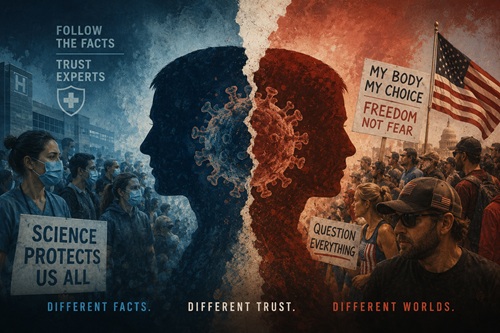 The COVID-19 pandemic was not only a biological crisis. It was also a social and psychological crisis that divided societies into competing interpretive communities. People did not merely disagree about masks, vaccines, lockdowns, origins, or treatments; they often inhabited different moral universes. Each side developed its own experts, narratives, heroes, villains, evidence standards, and explanations for why the other side was mistaken. These divisions were often described as a conflict between “science” and “anti-science,” or between “experts” and “skeptics.” But such descriptions, while sometimes accurate in particular cases, fail to capture the deeper sociology of the conflict. Both supporters and critics of mainstream pandemic policies formed what can be called COVID tribes: groups bound together not only by shared beliefs but by shared identities, emotional commitments, and perceptions of threat. Understanding these tribes does not mean declaring them equivalent. Beliefs must still be judged by evidence. A claim supported by extensive research is not made equal to a claim based on speculation simply because both sides have social dynamics. But understanding the tribal psychology of the pandemic helps explain why disagreements became so intense and why compromise became increasingly difficult. The Formation of COVID TribesA crisis of the scale of COVID-19 creates ideal conditions for social polarization. People faced uncertainty, fear, economic disruption, isolation, and rapidly changing information. Under such circumstances, individuals naturally seek communities that provide clarity and belonging. Sociologists have long observed that human beings organize themselves into groups through shared narratives. Groups answer fundamental questions: Who are we? What do we value? Who threatens us? Who can we trust? During COVID, many people found themselves choosing between competing interpretive frameworks. One broad coalition, which might be called Team Mainstream, emphasized institutional expertise, public health authorities, peer-reviewed research, vaccination campaigns, and collective responsibility. Its central narrative was that society faced an unprecedented biological threat requiring coordinated action guided by scientific expertise. Another coalition, Team Skeptic, emphasized individual autonomy, distrust of institutions, uncertainty in scientific claims, possible harms from interventions, and suspicion that political or economic interests influenced pandemic responses. Its central narrative was that society faced not only a virus but also a crisis of authority, transparency, and civil liberties. Both narratives contained elements of truth. Both also developed tendencies toward simplification. Team Mainstream: Trust, Expertise, and Collective ResponsibilityTeam Mainstream's strongest virtue was its appreciation of scientific expertise and the complexity of managing a contagious disease. Modern societies depend on specialized knowledge. Few citizens can independently evaluate epidemiological models, vaccine trials, or viral evolution. Trust in institutions is therefore unavoidable. The mainstream narrative emphasized several sacred values: • Scientific consensus • Protection of vulnerable populations • Prevention of healthcare collapse • Collective responsibility • Evidence-based policymaking Within this worldview, skepticism toward public health measures could appear not merely mistaken but dangerous. Someone refusing vaccination or spreading misinformation was sometimes interpreted as directly contributing to preventable deaths. This moral framing strengthened group cohesion. Healthcare workers became heroes, scientists became guardians of truth, and public health institutions represented civilization's defense against chaos. But every group has blind spots. At times, Team Mainstream treated uncertainty as weakness rather than an unavoidable feature of science. Scientific communication often became overly confident, especially during early phases of the pandemic when knowledge was incomplete. Statements that later required revision—about masks, transmission, immunity, or the durability of protection—sometimes damaged trust because changing conclusions were interpreted as contradictions rather than normal scientific updating. The mainstream tribe could also develop its own forms of social punishment. Critics were sometimes dismissed as ignorant, selfish, or conspiracy-minded without carefully examining whether some criticisms reflected legitimate concerns about policy trade-offs. The result was a paradox: a movement committed to science sometimes struggled to communicate the uncertainty that is intrinsic to science. Team Skeptic: Autonomy, Distrust, and the Search for Hidden TruthsTeam Skeptic emerged from a different psychological starting point: suspicion toward concentrated power and institutional authority. Its strongest concerns were often legitimate. Governments made unprecedented interventions into everyday life. Restrictions affected education, employment, mental health, businesses, and personal freedoms. Scientific institutions are not immune to error, political pressure, or conflicts of interest. The skeptic narrative emphasized values such as: • Individual liberty • Transparency • Questioning authority • Medical autonomy • Attention to unintended consequences For many skeptics, the pandemic became a symbol of a larger struggle against institutional overreach. Doctors, journalists, and politicians who challenged official narratives became heroes. Alternative researchers and whistleblowers were celebrated as courageous truth seekers. However, skepticism itself could become a form of identity protection. Once distrust became central to group membership, evidence from mainstream sources could automatically be rejected because it came from distrusted institutions. This created a mirror image of the mainstream problem. Just as some mainstream voices sometimes dismissed criticism too quickly, some skeptics dismissed expert consensus too quickly. The possibility that institutions could make mistakes was sometimes expanded into the assumption that institutions were systematically deceptive. A healthy scientific attitude asks: “What does the evidence show?” A tribal skeptical attitude can drift toward: “If authorities say it, it is probably false.” Echo Chambers and Alternative Information UniversesOne of the defining features of the pandemic was the creation of parallel information ecosystems. Mainstream media, public health agencies, and many academic institutions reinforced one another. Skeptical communities often formed around alternative media, social platforms, independent commentators, and online networks. Each ecosystem developed mechanisms for filtering information. Within mainstream circles, certain sources were considered reliable and others were treated as misinformation outlets. Within skeptical circles, official sources were often viewed as compromised while independent voices were elevated. Social media intensified these divisions because algorithms reward emotionally engaging content. Anger, fear, and outrage spread more efficiently than careful analysis. A nuanced discussion about probabilities and uncertainty rarely competes successfully with a dramatic claim about heroes and villains. The result was not merely disagreement about facts. It was disagreement about which institutions and people deserved trust in the first place. Heroes and VillainsEvery social movement creates symbolic figures. For Team Mainstream, heroes included scientists developing vaccines, frontline healthcare workers, and public health officials attempting to manage an unprecedented crisis. Villains included misinformation spreaders, vaccine opponents, and political figures accused of undermining public health. For Team Skeptic, heroes included doctors who challenged official policies, journalists investigating institutional failures, and individuals refusing to comply with what they saw as unjust restrictions. Villains included pharmaceutical companies, government bureaucracies, mainstream media organizations, and experts perceived as arrogant or dishonest. These symbolic battles reveal an important sociological fact: people do not only defend ideas. They defend communities and identities. An attack on a belief can feel like an attack on the group itself. Sacred Beliefs and Moral BoundariesReligious traditions have sacred objects. Political movements have sacred principles. COVID tribes developed their own sacred commitments. For Team Mainstream, questioning vaccination campaigns or public health authority could approach a moral violation because it endangered others. For Team Skeptic, accepting restrictions or mandates could approach a moral violation because it threatened personal freedom and democratic accountability. The same action could therefore be interpreted in opposite moral terms. A vaccine mandate could be seen as an act of social solidarity or as an act of authoritarian control. A protest against restrictions could be seen as defending liberty or as endangering public health. These disagreements were so intense because they involved competing moral priorities rather than simple factual disputes. The Problem of Tribal ThinkingTribal thinking is not unique to COVID. It is a recurring feature of human social life. Groups help us interpret complexity, but they also encourage conformity. Both tribes developed predictable cognitive biases: Confirmation bias: accepting information that supports existing beliefs while rejecting contradictory evidence. Motivated reasoning: using intelligence not primarily to discover truth but to defend identity. Moral licensing: believing that good intentions justify questionable actions. Group polarization: moving toward more extreme positions through interaction with like-minded people. Recognizing these patterns is uncomfortable because people usually see tribalism in others more easily than in themselves. Beyond the Pandemic DivideThe lessons of COVID are not that all sides were equally correct or equally wrong. Reality does not emerge from compromise between opposing opinions. Viruses, vaccines, and epidemiological facts exist independently of social identities. The deeper lesson is that science operates within society. Scientists are human beings. Institutions have strengths and weaknesses. Citizens need expertise but also need accountability. Skepticism is essential to democracy but can become destructive when it rejects evidence itself. A mature post-pandemic society would aim for a more difficult balance: trusting expertise without worshipping authority, questioning institutions without assuming conspiracy, and recognizing uncertainty without turning uncertainty into nihilism. COVID revealed not only the vulnerability of human bodies to pathogens but also the vulnerability of human minds to division. The greatest challenge was never merely defeating a virus. It was learning how a pluralistic society can disagree without turning disagreement into tribal warfare.
Widget is loading comments...
|