|
TRANSLATE THIS ARTICLE
Integral World: Exploring Theories of Everything
An independent forum for a critical discussion of the integral philosophy of Ken Wilber
  Frank Visser, graduated as a psychologist of culture and religion, founded IntegralWorld in 1997. He worked as production manager for various publishing houses and as service manager for various internet companies and lives in Amsterdam. Books: Ken Wilber: Thought as Passion (SUNY, 2003), and The Corona Conspiracy: Combatting Disinformation about the Coronavirus (Kindle, 2020). Frank Visser, graduated as a psychologist of culture and religion, founded IntegralWorld in 1997. He worked as production manager for various publishing houses and as service manager for various internet companies and lives in Amsterdam. Books: Ken Wilber: Thought as Passion (SUNY, 2003), and The Corona Conspiracy: Combatting Disinformation about the Coronavirus (Kindle, 2020).
Check out my other conversations with ChatGPT
COVID-19 RETROSPECTIVE
Aerosols, Ventilation, and COVID-19 How Dangerous Was COVID-19? The Disinformation Pandemic The Pandemic as an Epistemic Crisis The Ethical Dilemmas Nobody Could Win When Experts Disagreed The Sociology of COVID Tribes Why So Many Models Failed The Pandemic as a Stress Test of Democracy The Role of AI in Reconstructing the Pandemic Pandemic Forecasting: Why So Many Models FailedThe Promise and Limits of Predicting an Unpredictable VirusFrank Visser / ChatGPT
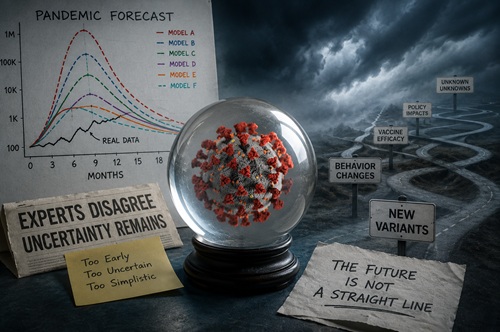 When COVID-19 emerged in early 2020, epidemiological models suddenly became some of the most influential scientific instruments in the world. Governments used projections of future infections, hospitalizations, and deaths to decide whether to impose lockdowns, close schools, restrict travel, or accelerate vaccine development. Graphs showing possible futures became political symbols: the famous “flatten the curve” charts, exponential growth curves, and projections of overwhelmed hospitals shaped public perception of the crisis. Yet as the pandemic unfolded, many early predictions appeared to miss the mark. Some models projected catastrophic death tolls that did not occur. Others underestimated the speed of transmission or failed to anticipate new variants. Critics argued that models had been exaggerated and used to justify excessive restrictions. Defenders responded that models were never intended as crystal balls but as conditional scenarios designed to guide decisions under uncertainty. The controversy revealed a deeper issue: epidemic forecasting operates in a world where the object being modeled is constantly changing. Viruses evolve, humans adapt, policies intervene, and behavior shifts. The failure of some predictions does not necessarily mean modeling failed. It reveals the difficult task of making decisions when the future is both mathematically describable and fundamentally unpredictable. The Early Predictions: A World Facing an Unknown ThreatIn the first months of 2020, scientists had limited information. They knew SARS-CoV-2 was highly transmissible, that many infections were asymptomatic or mild, and that severe disease could overwhelm healthcare systems. But they did not yet know the precise infection fatality rate, the degree of population immunity, the role of children in transmission, or how much human behavior would change. Models therefore relied on assumptions. One of the most influential early approaches was the Imperial College London model led by Neil Ferguson and colleagues. In March 2020, it estimated that if no interventions were implemented in the United Kingdom, hundreds of thousands of deaths could occur, and that the United States could experience millions of deaths under an uncontrolled epidemic scenario. These projections were not predictions in the ordinary sense. They were “if-then” scenarios: • If the virus spreads without mitigation, and • if human behavior remains unchanged, and • if healthcare capacity is not expanded, • then the outcome could be catastrophic. But once communicated publicly, these distinctions often disappeared. A hypothetical worst-case scenario became interpreted as a forecast. When governments introduced interventions and deaths remained lower than the worst-case scenarios, critics claimed the models had been wrong. This criticism confused two different questions: “Was the scenario accurate under the assumptions?” and “Did reality follow those assumptions?” The Problem of CounterfactualsThe greatest difficulty in evaluating pandemic models is that their success is measured against a reality that was partly shaped by the models themselves. Suppose a model warns that uncontrolled transmission could lead to 500,000 deaths. A government responds by imposing restrictions, increasing hospital capacity, encouraging vaccination, and changing public behavior. The resulting death toll is much lower. Did the model fail? Not necessarily. The model described a possible future that was avoided. This is similar to weather forecasting when a hurricane warning leads millions of people to evacuate. If fewer people die because preparations were successful, the warning was not a failure. Its purpose was not merely to predict events but to influence decisions. Pandemic models are therefore closer to engineering tools than fortune-telling devices. They help policymakers explore possible consequences of different choices. Why Some Models Overestimated the FutureNevertheless, some pandemic projections did fail in important ways. Understanding why is essential for improving future forecasting. One major problem was that early models often assumed limited behavioral adaptation. Human beings are not passive particles moving through a system. When people learn about a dangerous virus, they change their behavior. They reduce social contacts, avoid crowded places, work remotely, wear masks, and modify routines. The virus itself also changes. A model based on the characteristics of the original Wuhan strain could not perfectly predict later variants such as Alpha, Delta, and Omicron, each with different transmission dynamics and immune escape properties. Another challenge was uncertainty about biological parameters. Early estimates of the infection fatality rate varied considerably. Small changes in assumptions about transmission, severity, or immunity could produce very different projections over months. Exponential growth is particularly difficult for human intuition. A small difference in the estimated reproduction number—the average number of people infected by one person—can create enormous differences over time. But exponential growth also eventually slows because susceptible populations decline, immunity increases, and interventions occur. Why Some Models Underestimated the PandemicThe story is not simply one of exaggeration. Some forecasts underestimated COVID-19 as well. Early in 2020, many people assumed the virus would behave similarly to seasonal influenza. Some models underestimated the role of asymptomatic transmission and the importance of airborne spread. Others failed to anticipate the emergence of highly transmissible variants. The pandemic demonstrated that uncertainty cuts both ways. Models can overestimate danger, but they can also underestimate it. The public conversation often focused on “alarmist” predictions that did not materialize, while ignoring scenarios that proved too optimistic. This selective attention reflected the political polarization surrounding COVID-19. The Difference Between Forecasting and Scenario ModelingA key lesson from the pandemic is that not all models serve the same purpose. A weather forecast might say: “There is an 80% chance of rain tomorrow.” A pandemic model more often says: “Under these assumptions, this is the range of possible outcomes.” The distinction matters. Epidemiological models are not simply attempts to predict the future. They are tools for understanding dynamics: • How quickly can a virus spread? • How much pressure could hospitals face? • What effect might vaccination have? • How much could reducing contacts slow transmission? • Which interventions have the greatest impact? The value of a model is not only whether its final number matches reality. It is whether it improves decisions. Models Are Only as Good as Their AssumptionsThe phrase “garbage in, garbage out” is often used in computer science, and it applies to epidemic modeling as well. Mathematical sophistication cannot compensate for poor assumptions or incomplete data. Models depend on: • reliable case and death reporting, • accurate estimates of transmission, • realistic assumptions about human behavior, • understanding of immunity, • knowledge of viral evolution. During COVID-19, many of these variables were uncertain. This does not mean models were useless. It means their outputs should have been communicated with greater humility. Scientists and policymakers sometimes presented uncertain projections with excessive confidence, creating unrealistic expectations. When reality changed, public trust suffered. The Politics of Failed PredictionsThe controversy over COVID models became part of a larger cultural conflict. Supporters of strict interventions pointed to worst-case scenarios as evidence that action was necessary. Critics highlighted inaccurate predictions as evidence that experts had exaggerated the threat. Both sides sometimes overlooked the complexity of scientific forecasting. A failed prediction does not automatically prove incompetence or deception. Science often advances by making provisional estimates that are later revised. But scientists also have a responsibility to communicate uncertainty clearly and avoid presenting models as unquestionable forecasts. The pandemic exposed a gap between how scientists understand models and how the public often interprets them. The Future of Pandemic ForecastingThe lesson of COVID-19 is not that models should be abandoned. Without models, governments would have been navigating a crisis blindly. The alternative to imperfect information is not perfect information—it is ignorance. Future pandemic forecasting will likely improve through better real-time data, faster genomic surveillance, more sophisticated behavioral models, and greater integration between epidemiology, economics, psychology, and social science. But uncertainty will remain. A pandemic is not a laboratory experiment. It is a complex adaptive system involving biology, human behavior, technology, politics, and culture. The goal of forecasting should therefore not be to eliminate uncertainty but to manage it intelligently. Conclusion: The Value of Imperfect MapsPandemic models are often judged by whether they predicted the exact destination. But their true purpose is closer to that of a map used during an uncertain journey. A map does not guarantee that the traveler will arrive exactly where expected. Roads change, conditions shift, and decisions alter the route. Yet traveling without a map is usually worse. COVID-19 showed both the power and the limitations of epidemic modeling. Some projections were overly pessimistic. Some assumptions proved wrong. Communication failures damaged public trust. But the fundamental challenge remains: policymakers must act before all the answers are available. The failure was not that models could not predict the future perfectly. The failure was sometimes expecting them to do something they were never designed to do. Their role is not prophecy. It is preparation.
Widget is loading comments...
|