|
TRANSLATE THIS ARTICLE
Integral World: Exploring Theories of Everything
An independent forum for a critical discussion of the integral philosophy of Ken Wilber
  Frank Visser, graduated as a psychologist of culture and religion, founded IntegralWorld in 1997. He worked as production manager for various publishing houses and as service manager for various internet companies and lives in Amsterdam. Books: Ken Wilber: Thought as Passion (SUNY, 2003), and The Corona Conspiracy: Combatting Disinformation about the Coronavirus (Kindle, 2020). Frank Visser, graduated as a psychologist of culture and religion, founded IntegralWorld in 1997. He worked as production manager for various publishing houses and as service manager for various internet companies and lives in Amsterdam. Books: Ken Wilber: Thought as Passion (SUNY, 2003), and The Corona Conspiracy: Combatting Disinformation about the Coronavirus (Kindle, 2020).
Check out my other conversations with ChatGPT
COVID-19 RETROSPECTIVE
Aerosols, Ventilation, and COVID-19 How Dangerous Was COVID-19? The Disinformation Pandemic The Pandemic as an Epistemic Crisis The Ethical Dilemmas Nobody Could Win When Experts Disagreed The Sociology of COVID Tribes Why So Many Models Failed The Pandemic as a Stress Test of Democracy The Role of AI in Reconstructing the Pandemic The Lab-Leak Hypothesis The Tony Fauci Diaries The Ralph Baric Senate Hearing All The Evidence Circumstantial? The Mysterious Furin Cleavage Site A Case of Lab Leak Fever? Ralph Baric Under OathWhat the Senate Interview Really Reveals About Gain-of-Function ResearchFrank Visser / ChatGPT
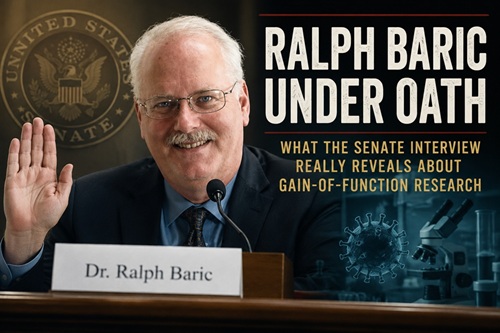
Below is a critical review based primarily on the April 10, 2026 Senate transcribed interview of Ralph Baric, released by Senator Rand Paul's office. I have treated the committee's framing and Baric's own testimony separately, because the document is an investigative record—not a neutral adjudication of the facts. The April 10, 2026, Senate interview of Ralph Baric is unlikely to settle the question of whether SARS-CoV-2 originated through a laboratory accident.[1] It does, however, illuminate something almost as important: the extraordinary looseness with which high-risk coronavirus research was conceived, funded, reviewed, documented, and later described to the public. Baric is not a peripheral figure in this story. He is one of the world's leading coronavirus researchers, a professor at the University of North Carolina, and a central participant in the development of experimental coronavirus systems. His work with Zhengli Shi of the Wuhan Institute of Virology and Peter Daszak of EcoHealth Alliance made him an important witness in the congressional investigation into the origins of COVID-19 and the history of government-supported gain-of-function research. The interview was conducted voluntarily and under oath as part of the Senate Committee on Homeland Security and Governmental Affairs' investigation. The resulting document is striking precisely because it is neither the smoking gun that some critics of the laboratory-origin hypothesis may hope for nor the complete exoneration that defenders of the existing scientific consensus might prefer. Instead, it exposes a system in which the categories "gain of function," "loss of function," "enhanced potential pandemic pathogen," and "dual-use research" were sufficiently malleable that the same experiment could be described very differently depending on who was doing the describing and for what purpose. That is the central lesson of the Baric testimony. The most consequential admission: gain of function is in the eye of the beholderPerhaps the most revealing section concerns the DARPA PREEMPT program and the DEFUSE proposal submitted by EcoHealth Alliance, Baric, and Zhengli Shi. Baric was asked about a DARPA solicitation that sought to understand what makes viruses cross species barriers "down to the nucleotide level." His answer was unusually direct. In his view, this necessarily implied gain-of-function experiments, because demonstrating that a particular genetic change causes a virus to acquire a new capacity requires adding or altering genetic material and observing the resulting phenotype. "That's a gain-of-function experiment," he told the committee. This is important because it cuts through years of semantic argument. The controversy over gain-of-function research has often become a dispute over definitions. Researchers may say that an experiment was not "gain of function" in the regulatory sense, while critics point to the obvious fact that a virus was genetically modified to investigate whether it acquired a new biological capability. Baric's testimony demonstrates that the ambiguity is real—but it is also politically convenient. The DEFUSE proposal illustrates the problem. According to Baric's testimony, the proposed work would initially have involved finding sarbecoviruses with unusual characteristics, examining their spike proteins in pseudovirus systems, and investigating the role of the furin cleavage site. The proposal contemplated removing such a site and examining its effects, but it also contemplated a later step in which a furin cleavage site could be introduced into a viral backbone. Baric acknowledged that this part of the work would have been performed by him. His defense is that the proposal was structured as a sequence of experiments, beginning with lower-risk work and proceeding only if the evidence justified it. In his account, the potentially dangerous experiment would have come only after extensive preliminary characterization and would have required additional review. That is a reasonable scientific defense. It does not, however, make the distinction between "gain of function" and "not gain of function" disappear. Nor does it answer the broader question of whether a research program designed to identify, manipulate, and test precisely those genetic features that influence viral host range and pathogenicity should be considered inherently high-risk. The most troubling conclusion is therefore not that Baric secretly created SARS-CoV-2. The testimony does not establish that. It is that the scientific and regulatory vocabulary was incapable of producing a stable answer to the question of what constituted risky gain-of-function research. DEFUSE does not prove the lab-leak hypothesis—but it changes the contextThe Baric interview does not establish that the DEFUSE proposal was carried out. On the contrary, Baric repeatedly emphasized that the proposal was not funded and that he was unaware of any U.S. grant in which he actually performed the proposed furin-cleavage-site insertion. He also stressed that the practical implementation of the proposal depended on whether the Chinese collaborators would actually provide the relevant viruses. That distinction is essential. There is a vast difference between "scientists proposed an experiment" and "scientists performed the experiment." The Senate interview does not bridge that gap. Yet it does undermine the simplistic claim that the laboratory-origin hypothesis was always based on an imagined type of research that no serious coronavirus scientist would have contemplated. The testimony demonstrates that scientists were in fact thinking about furin cleavage sites, receptor binding, cross-species transmission, and the genetic determinants of viral host range before the pandemic. This does not prove that SARS-CoV-2 was engineered. It does demonstrate that the conceptual territory occupied by the lab-leak hypothesis was not science fiction. That is a significant distinction. The problem with "The Proximal Origin of SARS-CoV-2"The most intellectually interesting part of the interview concerns the relationship between Baric's earlier research and the arguments presented in the influential paper The Proximal Origin of SARS-CoV-2. The Senate staff's summary argues that an earlier Baric experiment complicated one of the paper's arguments against deliberate engineering. The argument at issue concerns the receptor-binding domain. The Proximal Origin paper reasoned, broadly, that if the virus had been engineered to optimize its ability to bind the human ACE2 receptor, it would have been designed differently. The fact that SARS-CoV-2 did not display the theoretically "optimal" configuration was therefore presented as evidence against intentional engineering. But Baric's earlier experimental work suggested that maximal binding is not necessarily optimal for viral transmission. A virus that binds too tightly may become less effective at spreading. Consequently, a hypothetical designer could deliberately avoid maximal binding affinity. The Senate staff therefore argues that a feature used as evidence against engineering might not actually exclude engineering. This point deserves serious attention—but also caution. At most, it weakens one argument against engineering. It does not demonstrate engineering. Scientific arguments about origins are rarely settled by a single molecular feature. Even if the "optimal binding" argument is weaker than initially presented, the question remains whether the total genomic architecture of SARS-CoV-2 is better explained by natural evolution or laboratory manipulation. The Senate investigation is therefore right to ask whether the reasoning in Proximal Origin was as definitive as it was sometimes portrayed. But it would be a mistake to move from "one argument is less conclusive than claimed" to "therefore the alternative is proven." The real lesson is epistemic: a hypothesis should not be declared impossible merely because one expected signature of that hypothesis is absent. The February 1 call: the most suspicious episode, but not the strongest evidenceThe testimony also raises new questions about the famous February 1, 2020, conference call involving Anthony Fauci, Francis Collins, Jeremy Farrar, and scientists who would later contribute to The Proximal Origin. Baric confirmed that he participated in the call, yet he could not recall exactly how he came to be included and said he could not find the record that explained how he received the invitation. He also gave somewhat inconsistent recollections about whether he spoke. At one point he said he remained silent so as not to influence the direction of the discussion; later he said he thought participants introduced themselves around the room and that he was surprised others apparently did not know he was there. This is certainly worth investigating. But it is important not to exaggerate what it proves. The Senate document itself establishes that the committee found Baric's presence unusual and that some participants apparently did not recall him being on the call. It does not establish that his presence was deliberately concealed, nor does it prove that the call was organized to suppress evidence of a laboratory origin. The more interesting question is why the scientific conclusions emerging from that period became so rapidly polarized. The documentary record now shows that several researchers initially considered the possibility of laboratory involvement seriously enough to discuss it, while later public statements often portrayed the laboratory-origin hypothesis as essentially discredited. That transition deserves scrutiny. It is entirely legitimate for scientists to change their minds when evidence changes. But when private uncertainty becomes public certainty, the evidentiary path between the two should be transparent. The missing paperwork is a scandal of governance, not proof of a leakOne of the most disturbing revelations in the interview concerns NIH recordkeeping. Baric testified that when he met with NIH officials in February 2020, they appeared not to possess the documents relating to the earlier review of his research. He found this surprising and subsequently supplied copies. He understood that NIH had previously reviewed the material, but the officials apparently could not locate their own records. This is deeply troubling. If a government agency is funding research involving potentially dangerous pathogens, the review trail should be one of the most carefully preserved elements of the entire enterprise. The fact that the scientist himself could provide documents that the funding agency could not readily locate points to a serious institutional weakness. But again, this is not evidence that SARS-CoV-2 escaped from a laboratory. It is evidence that the system designed to prevent or investigate such an accident was less robust than it should have been. That distinction matters. A failure of oversight increases the plausibility of a laboratory accident as a general possibility. It does not establish that a particular accident occurred. The Wuhan connection: troubling, but easily overstatedBaric also confirmed that he provided a taxpayer-funded mouse model to Zhengli Shi's laboratory in Wuhan. He defended this as a normal consequence of open science and the requirement to share research materials. The mice were shipped after extensive paperwork and approvals. Later, when he learned that Chinese researchers were apparently attempting to sell the model back to American scientists, he was furious. This episode is politically explosive but scientifically ambiguous. The fact that Baric sent a mouse model to Wuhan is not evidence of a laboratory accident. Nor is it evidence that SARS-CoV-2 was created there. Scientific collaboration routinely involves international exchange of reagents, animals, and genetic material. What it does reveal is the tension between the ideal of open science and the reality of biosafety and geopolitical competition. The same openness that accelerates scientific progress can also make it difficult to control who has access to potentially consequential biological technologies. Baric's answer to this problem—that if Congress wants different rules, Congress should write them—is, in one sense, entirely reasonable. It is also an indictment of the regulatory system. Scientists should not be expected to invent their own boundaries for research security. Those boundaries must be established clearly and enforced consistently by governments and institutions. The five-year funding acknowledgment raises legitimate questionsAnother issue concerns the 2015 paper involving Baric and Zhengli Shi. The interview discusses an email from Peter Daszak requesting acknowledgment of USAID PREDICT and NIAID funding. Baric acknowledged that the requested acknowledgment was not added until 2020, five years later. When asked whether this was intended to conceal the funding, he said he did not know why he would have any interest in doing so. He also said that he was not familiar enough with the details of the relevant grants to determine precisely what USAID had funded. This is another case where suspicion should not be confused with proof. The delayed acknowledgment is certainly unusual enough to warrant investigation. But Baric's testimony does not establish deliberate concealment. It is also important to distinguish funding of surveillance and virus discovery from funding of subsequent laboratory experiments. Multiple funding streams can converge on a single scientific project without every funding agency having supported every component of it. The Senate investigation is right to demand a precise accounting of who funded what. That is not a partisan question. It is a basic requirement of research transparency. The deeper problem: a research culture built around semantic escape routesPerhaps the most important conclusion to emerge from the Baric testimony concerns the institutional culture surrounding high-risk biological research. Again and again, the same pattern appears. An experiment may involve altering viral genomes, yet its proponents describe it as "loss of function." A proposal may contemplate inserting a furin cleavage site, yet the actual experiment is described as hypothetical or contingent. A project may investigate the genetic basis of cross-species transmission, yet the terminology used to describe it depends on whether the emphasis is placed on surveillance, mechanism, or intervention. A research program may involve international collaborators and multiple government funding streams, yet the responsibility for knowing exactly who funded what becomes diffuse. And when investigators later ask what happened, the relevant documents may be difficult to locate. None of this proves a laboratory origin of COVID-19. But it does demonstrate why the public lost confidence. The public was repeatedly told that the debate was simple: natural emergence versus a fringe conspiracy theory. Yet the underlying reality was anything but simple. There was genuine high-risk coronavirus research. There were international collaborations involving Wuhan. There were proposals to manipulate viral features associated with host range and pathogenicity. There were disagreements over whether particular experiments qualified as gain of function. There were inadequate records. There were disputed funding streams. And there was a scientific establishment that sometimes communicated greater certainty than the evidence justified. That is not a conspiracy. It is a governance failure. What the Baric testimony does—and does not—tell us about the origin of SARS-CoV-2The strongest conclusion that can responsibly be drawn from the Senate interview is therefore a limited one. The testimony makes it harder to claim that the laboratory-origin hypothesis is inherently absurd or that gain-of-function research was irrelevant to the pre-pandemic coronavirus research environment. Baric's own testimony confirms that scientists were contemplating experiments involving the genetic determinants of cross-species transmission and, at least in the DEFUSE proposal, the possible insertion of a furin cleavage site into a coronavirus backbone. At the same time, the testimony does not show that the DEFUSE proposal was funded or executed. It does not show that Baric or Zhengli Shi created SARS-CoV-2. It does not demonstrate that the virus escaped from the Wuhan Institute of Virology. And it does not disprove natural zoonotic emergence. The evidentiary balance therefore remains more complicated than either side of the political debate would like. What has changed is the burden of intellectual honesty. The natural-origin hypothesis should not be treated as synonymous with "no laboratory involvement," and the laboratory-origin hypothesis should not be treated as synonymous with "engineered virus." A laboratory accident could involve a naturally occurring virus collected in the field. A virus could undergo laboratory adaptation without being deliberately engineered as a pandemic pathogen. Conversely, a virus could be genetically modified without ever escaping. These are distinct hypotheses and must be tested separately. The real scandal is not that scientists did risky research. It is that they could not clearly explain what they were doing.Ralph Baric's Senate testimony is valuable precisely because it complicates the story. It portrays a highly accomplished scientist who appears to have believed that his research was scientifically justified, that the relevant experiments were subject to review, and that open scientific collaboration was fundamentally beneficial. Much of what he describes is entirely consistent with legitimate biomedical research. But the same testimony also reveals a system in which the boundaries between legitimate research and risky research were blurred; where the terminology surrounding gain of function could change according to context; where crucial records were difficult to locate; where international collaborations created complicated chains of responsibility; and where the public was left with an oversimplified account of a highly complicated scientific reality. That should be the lasting significance of the Baric hearing. It does not prove that SARS-CoV-2 came from a laboratory. It does something more modest, but perhaps more important: it demonstrates why the origins question cannot be settled by appeals to authority, institutional reputation, or categorical declarations that one hypothesis is "debunked." The research ecosystem that existed before COVID-19 was sufficiently complex, and sufficiently opaque, that continued investigation is justified. The proper response is neither conspiracy nor complacency. It is documentation, transparency, independent review, and a willingness to follow the evidence wherever it leads. If the virus emerged naturally, that conclusion should survive rigorous investigation. If it emerged through a laboratory accident, the evidence should eventually reveal that too. And if the evidence remains inconclusive, scientists and governments should have the intellectual honesty to say so. The Baric testimony, perhaps more than anything else, reminds us why that standard matters. Appendix: Did the DRASTIC Research Group Find Any Conclusive Evidence?The DRASTIC Research Group occupies an unusual place in the story of the COVID-19 origins debate. It was not a conventional academic institution, nor was it a government investigative body. It was an informal, international collective of researchers, data analysts, scientists, and independent investigators who began examining the origins of SARS-CoV-2 when they believed that official investigations were moving too quickly toward a natural-spillover explanation. Their work helped bring several important documents and questions into public view, most notably the DEFUSE proposal, the disappearance of the Wuhan Institute of Virology's virus database, and questions surrounding the Mojiang mine and the RaTG13 virus. But the crucial question is whether DRASTIC found conclusive evidence that SARS-CoV-2 originated in a laboratory. The answer, in my assessment, is no—not in the strict evidentiary sense of the word "conclusive." What DRASTIC uncovered was a substantial body of circumstantial evidence, anomalies, documentary leads, and reasons for further investigation. Some of these findings are genuinely important. None, by itself or collectively as publicly documented so far, constitutes the kind of direct evidence that would conclusively establish a laboratory origin. That distinction is important because the DRASTIC investigation is sometimes presented in two opposite ways. Critics dismiss it as conspiracy-driven internet sleuthing, while some supporters treat its discoveries as if they amount to a solved case. Neither characterization is adequate. The DEFUSE proposal: DRASTIC's most important discoveryThe most consequential DRASTIC contribution was undoubtedly the identification and publication of the DEFUSE research proposal submitted to DARPA in 2018 by EcoHealth Alliance and collaborators, including Peter Daszak, Ralph Baric, and Zhengli Shi. DRASTIC's analysis brought public attention to the proposal's discussion of coronavirus research involving spike proteins, furin cleavage sites, and the manipulation of viruses to investigate their potential for cross-species transmission. This was a major finding because it established something that had previously been disputed: researchers connected to the Wuhan Institute of Virology and Ralph Baric's laboratory had indeed contemplated experiments involving precisely the kinds of viral characteristics that later became central to the origins debate. Yet the crucial caveat remains: the proposal was not funded by DARPA, and there is no publicly available evidence that the proposed experiments were actually performed as described. A proposal is evidence of scientific intent and capability, not evidence that the resulting virus was created. The DEFUSE documents therefore provide strong evidence that the laboratory-origin hypothesis was plausible enough to investigate seriously. They do not prove that SARS-CoV-2 was the product of DEFUSE. The Mojiang mine and RaTG13DRASTIC investigators also drew attention to the 2012 incident in which miners working in the Mojiang mine became seriously ill with a pneumonia-like disease after exposure to bat guano. The mine later became important because a virus collected there—known as RaTG13—was found to be the closest known relative of SARS-CoV-2. The combination of the miners' illness, the virus collection, and the subsequent research at the Wuhan Institute of Virology naturally raised questions. DRASTIC argued that the episode deserved much more investigation than it received. Again, however, the evidence remains circumstantial. RaTG13 is not SARS-CoV-2, and its genome is too genetically distant to be considered a direct precursor. The available evidence does not establish that the miners were infected with SARS-CoV-2, nor that SARS-CoV-2 was derived from RaTG13. What DRASTIC did accomplish was to expose an important information gap: the public record surrounding the Mojiang mine, the viruses collected there, and the subsequent laboratory research was incomplete. That is a legitimate reason for demanding more data. It is not itself proof of a laboratory origin. The deleted WIV databaseAnother DRASTIC finding concerned the removal of the Wuhan Institute of Virology's online database of viral sequences and samples in September 2019. The database reportedly contained information about thousands of virus samples and was subsequently taken offline. This is unquestionably relevant. A database containing information about viruses collected from nature is precisely the sort of resource that would be valuable in reconstructing the origins of SARS-CoV-2. Its disappearance before the pandemic understandably generated suspicion. But once again, suspicion is not proof. The database's removal is consistent with several possibilities, including ordinary security concerns, institutional decisions, or an attempt to restrict access to sensitive information. It is also consistent with a desire to conceal information. Without access to the underlying database, however, we cannot know which explanation is correct. This is perhaps the recurring pattern in the DRASTIC story: the group found things that deserved explanation, but not the final evidence that provided the explanation. The geography of WuhanDRASTIC researchers also examined the geographical distribution of early cases and questioned whether the Huanan Seafood Wholesale Market was truly the epicenter of the outbreak. They argued that the relationship between the market and the earliest cases was more complicated than the initial public narrative suggested. DRASTIC's own research materials describe analyses of early cases and alleged anomalies in the epidemiological data. These arguments are important because the natural-spillover hypothesis depends heavily on the interpretation of early epidemiological evidence. But this is also an area where competing analyses exist. The spatial clustering of early cases around the market has been interpreted by other researchers as evidence supporting zoonotic emergence, while critics have argued that ascertainment and reporting biases complicate the picture. The debate therefore remains unresolved rather than conclusively settled in either direction. The real achievement of DRASTICThe most defensible way to evaluate DRASTIC is therefore not to ask whether it "proved the lab leak." It did not. Its real achievement was to expand the evidentiary landscape. DRASTIC demonstrated that there were significant questions about the origins investigation that could not simply be dismissed as conspiracy theories. It helped bring the DEFUSE proposal into public discussion. It investigated the missing WIV database. It reconstructed the significance of the Mojiang mine. It challenged assumptions about the early epidemiology. And it repeatedly insisted that the laboratory hypothesis should be investigated rather than dismissed in advance. Those contributions matter even if the ultimate conclusion turns out to be natural zoonotic emergence. In science, discovering that a question has been inadequately investigated is itself a meaningful discovery. Why "conclusive evidence" remains elusiveThe central weakness of the DRASTIC case is that it consists largely of indirect evidence. We have evidence that Wuhan researchers collected and studied coronaviruses. We have evidence that scientists contemplated manipulating coronavirus genomes. We have evidence of international funding and collaboration. We have evidence that some relevant databases and records became inaccessible. We have evidence of biosafety concerns and incomplete transparency. We have evidence that the early origins investigation was conducted under unusually difficult political circumstances. But we do not have publicly verified evidence showing a specific virus being taken into a laboratory, genetically modified into SARS-CoV-2, and subsequently released—accidentally or deliberately. That missing link is decisive. It is also worth noting that the 2025 WHO SAGO report did not resolve the issue. The WHO's scientific advisory group concluded that the available evidence was insufficient to definitively determine the origin and emphasized that important information had not been provided. It explicitly kept both zoonotic spillover and laboratory-related hypotheses on the table. That is a much more cautious conclusion than either "the lab leak has been proved" or "the lab leak has been debunked." The paradox of DRASTICThere is an interesting paradox here. The more DRASTIC uncovered, the more reasonable it became to investigate the laboratory hypothesis. But the more reasonable the hypothesis became, the higher the evidentiary standard should have been for claiming that it was proven. DRASTIC's discoveries therefore have a curious double effect. They weaken the claim that the laboratory hypothesis is a baseless conspiracy theory. At the same time, they do not provide the final evidentiary bridge from "this could have happened" to "this is what happened." This is why the strongest conclusion from the DRASTIC research is neither vindication nor dismissal. It is uncertainty. And that uncertainty is not necessarily a failure of DRASTIC. It reflects the fact that the crucial evidence may remain inaccessible. The WHO itself has stated that significant information needed to evaluate the hypotheses fully has not been provided. The verdictIf "conclusive evidence" means a piece of evidence that establishes, beyond reasonable scientific doubt, that SARS-CoV-2 emerged from the Wuhan Institute of Virology, DRASTIC did not find it. If, however, "evidence" means material that substantially increases the plausibility of a laboratory-related scenario and demonstrates that the hypothesis deserves serious investigation, then DRASTIC found quite a lot. The distinction can be summarized simply: DRASTIC found evidence of opportunity, capability, relevant research, unusual circumstances, and missing information. It did not find conclusive evidence of the actual event. That may sound like a modest conclusion, but it is an important one. The laboratory-origin hypothesis should not be dismissed because DRASTIC did not produce a "smoking gun." Nor should every anomaly it uncovered be treated as proof of guilt. The proper historical judgment may ultimately be that DRASTIC did something more valuable than solving the mystery: it prevented the mystery from being prematurely declared solved. That is a legitimate contribution to science—and to the public record. NOTES[1] Rand Paul, "Dr. Ralph Baric Transcribed Interview Released", July 23, 2026 (PDF, 2 MB)
Widget is loading comments...
|