|
TRANSLATE THIS ARTICLE
Integral World: Exploring Theories of Everything
An independent forum for a critical discussion of the integral philosophy of Ken Wilber
  Frank Visser, graduated as a psychologist of culture and religion, founded IntegralWorld in 1997. He worked as production manager for various publishing houses and as service manager for various internet companies and lives in Amsterdam. Books: Ken Wilber: Thought as Passion (SUNY, 2003), and The Corona Conspiracy: Combatting Disinformation about the Coronavirus (Kindle, 2020). Frank Visser, graduated as a psychologist of culture and religion, founded IntegralWorld in 1997. He worked as production manager for various publishing houses and as service manager for various internet companies and lives in Amsterdam. Books: Ken Wilber: Thought as Passion (SUNY, 2003), and The Corona Conspiracy: Combatting Disinformation about the Coronavirus (Kindle, 2020).
Check out my other conversations with ChatGPT
COVID-19 RETROSPECTIVE
Aerosols, Ventilation, and COVID-19 How Dangerous Was COVID-19? The Disinformation Pandemic The Pandemic as an Epistemic Crisis The Ethical Dilemmas Nobody Could Win When Experts Disagreed The Sociology of COVID Tribes Why So Many Models Failed The Pandemic as a Stress Test of Democracy The Role of AI in Reconstructing the Pandemic The Lab-Leak Hypothesis The Tony Fauci Diaries The Ralph Baric Senate Hearing All The Evidence Circumstantial? The Mysterious Furin Cleavage Site A Case of Lab Leak Fever? The Furin Cleavage Site Mystery Peter Borger and the SARS-CoV-2 Origin All My Covid Essays The Furin Cleavage Site MysteryWhat the New Coronavirus Insertion Study Really ShowsFrank Visser / ChatGPT
A new bioRxiv preprint by Paul Bieniasz and colleagues makes an important contribution to one of the most persistent questions surrounding the origin of SARS-CoV-2: how could a coronavirus acquire a novel insertion in the spike protein that created its distinctive furin cleavage site? The paper, “Genetic innovation in coronaviruses driven by a viral nuclease,” reports experimental evidence that coronavirus nonstructural protein 15 (NSP15), an RNA-cutting enzyme, can generate precisely the sort of insertion mutations that have long been difficult to explain mechanistically. The authors find such events in both human coronavirus OC43 and SARS-CoV-2, and report numerous examples in which insertions can create or alter furin-cleavage motifs. This is potentially a very important result. But it is important for a narrower reason than some headlines or social-media discussions may suggest. The study does not identify the evolutionary history of the SARS-CoV-2 furin cleavage site. It does not demonstrate that the SARS-CoV-2 FCS arose through this mechanism. And it certainly does not establish that the pandemic virus arose naturally rather than through a laboratory-associated event. What it does is attack one of the strongest remaining arguments from the genetic side of the laboratory-origin hypothesis: the idea that the SARS-CoV-2 furin cleavage site represents an extraordinarily improbable kind of insertion that natural coronavirus evolution has no plausible mechanism for producing. That distinction is crucial.
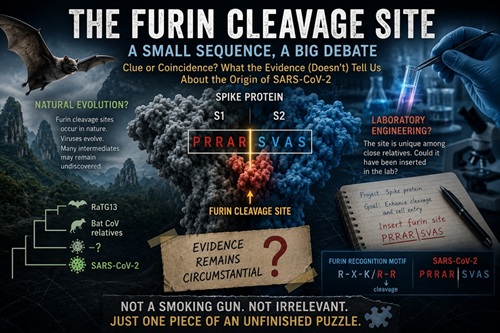
Note that the insert PRRA is out-of-synch with the triplet codons.
The FCS problem in its proper contextSARS-CoV-2 differs from its closest known sarbecovirus relatives in possessing a polybasic cleavage site at the S1/S2 boundary of spike. The relevant region is usually represented as PRRAR, with the inserted PRRA sequence forming the core of the furin-cleavage motif. Furin and related host proteases can cleave spike at this position, facilitating particular routes of cell entry and influencing viral tropism and pathogenicity. Experimental work has confirmed that disrupting the cleavage site reduces spike processing and attenuates SARS-CoV-2 in experimental systems. The evolutionary puzzle arose because no known close relative of SARS-CoV-2 possesses the same complete site. Furin cleavage sites are certainly not unique to coronaviruses, nor even to betacoronaviruses. They occur naturally in several coronavirus lineages, including OC43, HKU1 and MERS-CoV. But among the known sarbecoviruses—the subgenus containing SARS-CoV, SARS-CoV-2 and their bat relatives—the SARS-CoV-2 site was, until recently, exceptional. That made the question unusually sharp: where did the inserted nucleotides come from, and by what mechanism were they introduced into the spike gene? Early arguments about the FCS often blurred three different questions. First, is the FCS biologically unusual? Yes. Second, is it difficult to imagine a natural evolutionary mechanism that could produce it? That was much more controversial. Third, does its presence demonstrate laboratory engineering? No. A peculiar genetic feature can be evidence requiring explanation without being a diagnostic signature of engineering. This distinction was already emphasized by early genomic analyses. The FCS is not an optimal textbook furin motif, and its acquisition involved an insertion rather than a straightforward substitution. The surrounding sequence also has evolutionary features compatible with RNA recombination and insertion processes. The fact that the site is suboptimal compared with some engineered furin sites has therefore been one reason why its existence does not constitute a genetic “smoking gun.” But there remained a genuine mechanistic gap. Showing that something is theoretically possible is different from showing that the relevant mutational process actually occurs in coronaviruses. The new preprint is important precisely here. A different way of generating insertionsThe central discovery concerns NSP15, also known as EndoU. NSP15 is a coronavirus-encoded endoribonuclease. It cuts RNA, particularly at uridine-rich sequences, and has traditionally been studied in connection with processing viral RNA and evasion of innate immune recognition. Its activity is highly conserved among coronaviruses. The new study asks a deceptively simple question: could this RNA-cutting activity itself generate insertion mutations? The answer appears to be yes. The researchers developed an experimental system using human coronavirus OC43 in which rare insertion and deletion events could be detected. They found that NSP15 promotes a particular class of insertion mutations. They then used ultra-deep sequencing to examine populations of both OC43 and SARS-CoV-2. The same general dependence on NSP15 was observed in SARS-CoV-2. According to the preprint, insertional mutations occurred at frequencies exceeding 10-3 per genome in the experimental coronavirus populations. The proposed mechanism is especially interesting. NSP15 cuts viral RNA, generating RNA fragments or oligonucleotides. Some of these fragments can subsequently become incorporated at other, distant positions in viral genomes. In other words, the virus possesses an intrinsic molecular machinery capable of cutting and reusing pieces of its own RNA. This is not quite the same thing as the classical picture of homologous recombination, in which two related viral genomes exchange corresponding pieces of sequence. It is closer to an RNA “cut-and-paste” process capable of generating insertions. That matters enormously for the FCS question. Why this changes the evolutionary argumentOne of the problems with explaining the SARS-CoV-2 FCS through ordinary mutation is that a four-amino-acid insertion requires several nucleotides to appear at precisely the right location and in the correct reading frame. A single-base substitution is easy to conceptualize. A novel, functional twelve-nucleotide insertion is another matter. Classical coronavirus recombination offers one possible solution: the virus could acquire sequence from another coronavirus. But that immediately raises a second question. Where is the donor sequence? Known sarbecoviruses do not provide an obvious donor carrying the SARS-CoV-2 PRRA sequence. This has encouraged hypotheses involving an undiscovered coronavirus, more distant coronavirus lineages, or laboratory manipulation. The new mechanism changes the logic because an insertion does not necessarily require a conventional donor virus carrying the entire finished sequence. The coronavirus replication machinery itself can generate and redistribute short RNA fragments. The authors report numerous examples of potential furin-cleavage-site acquisition and replacement through insertional mutagenesis during normal coronavirus replication. Their conclusion is therefore not merely that “an FCS can theoretically arise.” It is that the molecular machinery of coronaviruses can produce insertions of the relevant general type, including insertions capable of generating furin-cleavage motifs. That is a substantial advance over earlier speculation. The really important distinction: generation is not fixationThere is, however, an important statistical caveat. An insertion frequency above 10-3 per genome does not mean that a functional FCS will appear in one out of every thousand naturally occurring viruses. Nor does it mean that a particular twelve-nucleotide insertion such as PRRA has a probability of 10-3. The reported frequency concerns insertional mutagenesis as a class. The enormous majority of insertions will presumably be neutral, deleterious or lethal. Most will therefore disappear rapidly. Evolution has two stages here. Mutation generates possibilities. Selection determines which possibilities survive. This distinction is particularly important for interpreting the SARS-CoV-2 FCS. The relevant question is not simply whether NSP15 can generate insertions. It is whether this mechanism can generate a viable insertion at the S1/S2 junction, whether the resulting spike remains functional, whether the resulting virus gains a fitness advantage in some host environment, and whether that lineage can subsequently spread. The preprint provides strong evidence for the first part of this chain and evidence relevant to the second. It does not reconstruct the entire historical chain that produced SARS-CoV-2. That is not a weakness unique to this paper. It is simply the nature of evolutionary inference. Why the FCS may have been a particularly consequential insertionThe evolutionary importance of the SARS-CoV-2 insertion becomes clearer when we distinguish the mutation from its consequences. An insertion at an arbitrary position in spike may do nothing useful. An insertion at the S1/S2 boundary can alter proteolytic processing. If the resulting sequence creates an effective cleavage motif, the consequences can be much larger. This is a classic example of evolutionary exaptation: a relatively mundane mutational mechanism can produce an unusual structural feature, and natural selection can subsequently preserve it because of its functional consequences. There is already abundant evidence that insertions are not evolutionary impossibilities for SARS-CoV-2. Independent insertion events have repeatedly occurred in the spike protein during the pandemic. For example, numerous SARS-CoV-2 lineages independently acquired insertions in the N-terminal domain, and Omicron itself contains an insertion. The new study supplies something that was previously missing: a plausible molecular mechanism explaining how at least some such insertions can arise. And there is an intriguing precedent. A 2025 study found that NSP15 activity influences RNA recombination in SARS-CoV-2. Altering NSP15 produced substantial effects on recombinant and deletion products, reinforcing the idea that this nuclease is involved in the generation of coronavirus genomic rearrangements. The new preprint therefore does not stand alone. It fits into an emerging picture in which coronavirus genome evolution is considerably more dynamic and mechanistically diverse than a simple “copying errors plus selection” model would suggest. What about the famous CGG-CGG argument?The FCS controversy has often been accompanied by another argument: the presence of two consecutive CGG codons encoding arginine. CGG is relatively uncommon among coronavirus arginine codons, and because CGG is a convenient codon in molecular cloning, some have regarded this as evidence of engineering. But this argument has never been particularly strong by itself. Codon usage is shaped by multiple forces, and CGG is certainly not absent from coronavirus genomes. Moreover, once the sequence became established in a successful viral lineage, strong selection could preserve it. The more fundamental issue is that codon rarity cannot tell us whether the sequence arrived through natural mutation, recombination, insertion or laboratory construction. The new NSP15 mechanism makes the codon argument even less decisive. If coronavirus replication can naturally move short nucleotide fragments into new genomic positions, then the existence of an unusual codon combination inside an insertion is not, by itself, evidence of human construction. That does not prove that the CGG-CGG sequence arose naturally. It simply removes one possible argument from the category of “this sequence is inherently incompatible with natural evolution.” Does this prove that the SARS-CoV-2 FCS arose naturally?No. This is where the scientific significance of the paper should neither be exaggerated nor minimized. The experiment establishes a mechanism. It establishes that coronaviruses can generate insertion mutations through an intrinsic viral process involving NSP15. It establishes that the process occurs in SARS-CoV-2. It shows that furin-cleavage motifs can arise or be replaced through insertional processes in coronavirus populations. What it does not establish is the historical identity of the mutation that became the SARS-CoV-2 FCS. There is a fundamental difference between saying: “Here is a mechanism by which SARS-CoV-2 could naturally acquire such a sequence.” and saying: “We have demonstrated that this is how SARS-CoV-2 acquired its FCS.” The first appears to be strongly supported by this preprint. The second is not demonstrated. To establish the latter, we would ideally need an evolutionary trail: ancestral sequences, intermediate insertion products, a plausible donor fragment or precursor, and evidence connecting those intermediates to the lineage leading to SARS-CoV-2. We do not have that historical record. And this is precisely where the severe limitations of coronavirus sampling become important. The known sarbecovirus diversity represents only a fraction of the viruses that exist in bats and other mammals. The absence of a sequence in today's database does not demonstrate that it never existed in nature. Does it rule out laboratory involvement?Again, no. This is probably the most important qualification. A mechanism being natural does not establish that a particular historical event was natural. Human beings can manipulate precisely the same biological processes that nature uses. Laboratory recombination, reverse genetics, serial passage and synthetic biology can all generate mutations that could theoretically arise spontaneously. Consequently, demonstrating a natural pathway does not logically exclude a laboratory pathway. This is a general principle of forensic reasoning. If a bullet could have been fired by an ordinary firearm, that does not establish that it was fired by an ordinary firearm rather than by a particular weapon. One needs additional evidence concerning the actual historical event. The same applies here. The new study substantially weakens an argument from impossibility or extreme implausibility. It does not independently establish the circumstances under which SARS-CoV-2 emerged. Where the evidence stands nowThe broader genomic evidence is becoming increasingly interesting because several previously mysterious features of SARS-CoV-2 have acquired plausible evolutionary explanations. The receptor-binding domain is now known to have close relatives in bat viruses from Laos, particularly the BANAL viruses. Some of these viruses can interact with human ACE2, showing that substantial human-receptor compatibility existed in the sarbecovirus reservoir before SARS-CoV-2 was recognized. Recombination is demonstrably an important feature of coronavirus evolution. Contemporary research shows that coronavirus genomes can recombine extensively and that genomic structure, sequence similarity and RNA architecture influence where such events occur. The spike protein itself is demonstrably capable of recurrent insertion and deletion evolution. And now we have evidence that coronavirus NSP15 can actively participate in the generation of insertional diversity. Taken together, these findings make the old picture of SARS-CoV-2 as a genome containing several evolutionary “impossibilities” increasingly difficult to sustain. But that should not be confused with proof of a natural spillover. The strongest conclusion is narrower and more scientifically defensible: the SARS-CoV-2 genome no longer requires an implausible mutational mechanism to explain the existence of its FCS. That is a major change. What the preprint actually settlesThe title of the paper is therefore almost more revealing than its implications for the origin debate. It is about “genetic innovation in coronaviruses,” not about the origin of SARS-CoV-2. And that is appropriate. The study tells us that coronaviruses possess an unexpectedly powerful mechanism for generating genetic novelty. It adds insertional mutagenesis to the already impressive repertoire of coronavirus evolutionary mechanisms, alongside point mutation, deletion, homologous recombination, non-homologous rearrangement and selection. In evolutionary terms, this is quite profound. Coronaviruses are not merely slowly accumulating copying errors despite their enormous genomes. Their replication machinery can actively reshuffle pieces of RNA and thereby explore sequence space in larger jumps. That makes the appearance of apparently “novel” short genetic elements much less mysterious. For the FCS controversy, however, the conclusion must be stated carefully: The preprint does not settle the historical origin of the SARS-CoV-2 furin cleavage site. It does something almost as important: it substantially reduces the evidential weight that can reasonably be assigned to the FCS's mere existence as an argument for engineering. The FCS remains unusual. Its precise evolutionary history remains unknown. A laboratory-associated origin therefore cannot be excluded simply because a natural mechanism exists. But the old argument—“this sort of insertion is so extraordinary that natural coronavirus evolution cannot plausibly produce it”—has been dealt a serious blow. And that is precisely how good evolutionary science should work. It does not make an inconvenient observation disappear. It supplies a mechanism that makes the observation less mysterious. The remaining question is no longer primarily, “Could a coronavirus naturally do this?” The answer is increasingly clear: yes, it can. The harder question is the historical one: did this particular coronavirus do it, in this particular way, before the pandemic began? That question remains open. Further Reflections on the implications of this preprintThere is a further point that deserves emphasis, because it changes how I would frame the significance of the preprint in the larger origin debate. The paper is actually stronger than merely saying “insertions happen.” Its striking result is that the coronavirus has a molecular mechanism capable of generating exactly the kind of genetic novelty that the FCS represents. The authors report thousands of insertion mutants in both HCoV-OC43 and SARS-CoV-2 and infer that NSP15 cuts viral RNA, producing oligonucleotides that can subsequently appear as inserts at distal genomic positions. The reported insertion frequency exceeds 10-3 per genome. They also find numerous examples of furin-cleavage-site acquisition or replacement in their experimental populations. That deserves a more careful look at what it does—and does not—do to the origin debate. The missing step in the old “impossibility” argumentThe strongest version of the FCS argument was never simply that SARS-CoV-2 contains an unusual sequence. It was that the sequence required a highly specific insertion for which there was no convincing natural mechanism. That distinction matters. If the only known mechanism were ordinary polymerase copying errors, one could reasonably ask how a twelve-nucleotide insertion appeared at exactly the S1/S2 junction and happened to produce a biologically useful cleavage motif. The probability of one particular sequence arising through independent nucleotide substitutions would indeed be tiny. But that is not the relevant mutational model if coronavirus genomes can literally generate and relocate short RNA fragments. The new result therefore changes the probability landscape. We no longer have to imagine twelve specific nucleotides independently appearing at one particular position. A pre-existing RNA fragment can be incorporated elsewhere in the genome. The mutational event is consequently a structural rearrangement rather than twelve independent point mutations. That is a much more plausible route to an insertion. And it is important that this is not merely a computer simulation. The authors experimentally observe the phenomenon in replicating coronaviruses. But there is an even more interesting questionThe critical question now becomes: where do the inserted sequences come from? This is where the preprint potentially offers a genuinely elegant explanation for something that has bothered evolutionary biologists since 2020. The SARS-CoV-2 FCS does not look like a simple duplication of the immediately adjacent sequence. Nor is there an obvious known sarbecovirus that can be identified as the donor of the complete PRRA insertion. But the NSP15 mechanism does not require a conventional “donor virus.” The donor can be RNA from elsewhere in the viral genome. That is conceptually important. Coronavirus evolution has often been described in terms of recombination between related viruses. But this mechanism suggests another source of innovation: the genome can effectively become a reservoir of its own fragments. RNA is cut, fragments persist long enough to be incorporated, and the resulting genome contains a new sequence arrangement. The evolutionary implications are considerable. A virus does not need to wait for a distant relative carrying precisely the right sequence to coinvent a useful genetic innovation. Its own genome can provide raw material. This is precisely why the paper's title—“Genetic innovation in coronaviruses driven by a viral nuclease”—is appropriate. The authors are identifying a mechanism for generating genetic novelty, not merely documenting another curiosity of SARS-CoV-2. The 10-3 number needs to be handled carefullyThere is nevertheless a danger of misunderstanding the paper's most spectacular number. An insertion frequency exceeding 10-3 per genome does not mean that the SARS-CoV-2 FCS itself has a one-in-a-thousand probability of appearing. It means that insertion mutations as a class are generated at surprisingly high frequency. The overwhelming majority of these insertions will presumably be useless. Some will disrupt an essential protein. Some will shift a reading frame. Some will introduce stop codons. Some will produce proteins that are simply less fit. Evolutionary novelty is cheap; useful evolutionary novelty is expensive. The relevant probability is therefore something like: generation x viability x functional effect x fitness advantage x transmission x persistence. The preprint provides evidence primarily for the first term, and importantly demonstrates that some generated insertions can have recognizable functional consequences, including the creation or replacement of furin-cleavage motifs. It does not reconstruct the entire sequence of events that produced the Wuhan-Hu-1 FCS. That distinction should remain absolutely clear. What would actually constitute a “smoking gun”?This is where the origin debate often becomes confused. Suppose tomorrow we discovered a bat coronavirus with a sequence almost identical to SARS-CoV-2 except that it possessed PRRA at the homologous position. That would be enormously informative. It would provide a plausible evolutionary intermediate. Conversely, suppose researchers discovered laboratory records showing that a virus closely related to SARS-CoV-2 had been experimentally manipulated at precisely this site before the pandemic. That would be enormously informative in the opposite direction. Neither type of evidence is provided by the NSP15 experiment. The paper instead changes the status of the FCS from something that appeared to require a special explanation to something that has a demonstrable natural mutational pathway. That is an important distinction between mechanistic plausibility and historical proof. And this is where the laboratory-origin argument needs to become more sophisticatedThe existence of a natural mechanism does not logically exclude a laboratory origin. This point is sometimes lost when people react to findings like this as though they have “solved” the origin question. They have not. Imagine that a forensic investigator discovers that fingerprints can arise through a perfectly ordinary physical process. That would show that fingerprints are not uniquely diagnostic of a particular person. It would not establish who actually touched the object. Likewise, showing that coronavirus replication can naturally generate FCS-like insertions means that the sequence itself is no longer strong evidence of engineering. But it does not tell us whether the particular SARS-CoV-2 ancestor acquired its FCS in a bat, in another animal, in a human, during natural virus passage, or in a laboratory. For that we need historical evidence. And this is why I would regard claims that the preprint “proves natural origin” as just as excessive as claims that the FCS “proves engineering.” Neither follows. The preprint nevertheless changes the balance of one specific argumentThere is, however, a legitimate Bayesian consequence. Before this study, one could reasonably assign some evidential weight to the proposition: “The SARS-CoV-2 FCS is difficult to explain through known natural coronavirus mutational processes.” After this study, that proposition is considerably weaker. We now know a coronavirus can generate insertion mutations through a conserved viral nuclease, and we know that among the resulting mutants are examples involving furin-cleavage sites. That does not prove that the SARS-CoV-2 FCS arose this way. But it means that the FCS can no longer carry the same evidential burden it once carried. In Bayesian terms, the likelihood of observing an FCS under a natural-evolution model has increased. Therefore, all else being equal, the FCS provides less discrimination between the hypotheses “natural emergence” and “laboratory-associated emergence.” That is probably the most important conceptual consequence of the paper. What about the extraordinary specificity of PRRA?There is still a legitimate question here. The SARS-CoV-2 sequence is not merely “some insertion.” It is PRRA, inserted precisely at the S1/S2 boundary, creating a polybasic cleavage site. That combination remains biologically interesting. But evolution frequently produces remarkable combinations when mutation and selection operate together. The mistake is to calculate the probability of the final feature as though evolution had to predict it in advance. Natural selection does not. There may be millions or billions of viral genomes passing through hosts and enormous numbers of replication cycles. A vast number of different mutations and rearrangements can therefore be generated. Most disappear. Occasionally one happens to be advantageous and becomes visible retrospectively as though the evolutionary process had somehow aimed at it. The relevant question is consequently not: “What is the probability that evolution randomly invented PRRA?” It is: “What is the probability that among the enormous number of coronavirus replication events, some insertion occurred near a functionally important proteolytic boundary and produced a virus capable of exploiting the resulting phenotype?” The new paper makes that second scenario considerably more credible. There is an intriguing asymmetry in the evidenceOne thing I find particularly interesting is that the paper addresses the FCS at the level where the controversy has actually been weakest: mechanism. Much of the earlier debate became trapped in sequence statistics. Is CGG unusual? Is PRRA unusual? Is the insertion unusual? Is the cleavage motif unusual? All of those questions are relevant, but they are ultimately indirect. The stronger scientific question is: Can coronavirus molecular machinery actually produce such an insertion? Now we have experimental evidence that it can. That is much more consequential than another round of codon-frequency arguments. It also illustrates a general lesson in evolutionary biology. Apparent improbability often reflects an incomplete model of variation. Once an additional mutational mechanism is discovered, an event that previously looked extraordinary can become quite ordinary. That does not mean that every particular historical event must have happened by that mechanism. It means we should stop treating the event itself as evidence that the mechanism did not exist. What remains genuinely unresolved?Quite a lot. We still do not possess the immediate progenitor of SARS-CoV-2. We do not have a sampled ancestral sarbecovirus showing the evolutionary transition into SARS-CoV-2. We do not know the precise host and ecological circumstances in which the relevant evolutionary changes occurred. We do not know exactly when the FCS arose. And we do not have a historical record connecting the particular PRRA insertion to the NSP15 mechanism demonstrated in this experiment. Those are not trivial omissions. On the other hand, it would be equally wrong to conclude that because these questions remain unanswered, the FCS remains as mysterious as it was in early 2020. It does not. The mechanistic mystery has been substantially reduced. My verdictI would therefore rate the preprint as potentially a major contribution to coronavirus evolutionary biology, while being much more restrained about what it establishes concerning SARS-CoV-2's origin. Its strongest result is not: “We have solved the origin of the SARS-CoV-2 furin cleavage site.” It is: “We have identified a natural coronavirus mechanism capable of generating the sort of insertion that produces furin-cleavage sites.” That is a very different claim, and a much more defensible one. The distinction matters because the FCS has sometimes been treated as though it were a forensic fingerprint of laboratory construction. This experiment makes that interpretation substantially harder to maintain. A naturally occurring coronavirus possesses the machinery to generate precisely the kind of genetic innovation that the FCS represents. But there is a final irony. The paper may simultaneously weaken the FCS argument while strengthening the scientific case for investigating laboratory-origin claims properly. Why? Because once the FCS ceases to be a quasi-mystical genetic anomaly, the debate has to move to the evidence that actually distinguishes the competing historical hypotheses: virus databases, unpublished sequences, laboratory records, sampling histories, fieldwork, early epidemiological data, and the precise viruses that were being collected and manipulated before December 2019. That is where the origin question ultimately has to be decided. The FCS was never a verdict. It was a clue. This new preprint makes that clue considerably less incriminating—but also considerably more interesting.
Widget is loading comments...
|
||||||||||||||||||||||||||||||