|
TRANSLATE THIS ARTICLE
Integral World: Exploring Theories of Everything
An independent forum for a critical discussion of the integral philosophy of Ken Wilber
  Frank Visser, graduated as a psychologist of culture and religion, founded IntegralWorld in 1997. He worked as production manager for various publishing houses and as service manager for various internet companies and lives in Amsterdam. Books: Ken Wilber: Thought as Passion (SUNY, 2003), and The Corona Conspiracy: Combatting Disinformation about the Coronavirus (Kindle, 2020). Frank Visser, graduated as a psychologist of culture and religion, founded IntegralWorld in 1997. He worked as production manager for various publishing houses and as service manager for various internet companies and lives in Amsterdam. Books: Ken Wilber: Thought as Passion (SUNY, 2003), and The Corona Conspiracy: Combatting Disinformation about the Coronavirus (Kindle, 2020).
Check out my other conversations with ChatGPT
NOTES ON CREATIONISM
The Tree or the Forest? The Myth of Divine Design Genetic Gymnastics The Human Chromosome 2 Fusion Who's Who in Creationism Hox Genes and Their Relevance The GULO Gene Controversy Does DNA Point to a Creator? The Denial of Deep Time Fine-Tuning: The God of the Knobs The 'Historical Science' Gambit Beyond Creationism NOTES ON PETER BORGER Peter Borger's Darwin Revisited Auditing Borger's Case Against Evolution Where Borger's Molecular Argument Really Leads The Darwinian Straw Man A Summary of Peter Borger's Claims The Third Way of Evolution The Third Way of EvolutionBetween Scientific Revision and Creationist AppropriationFrank Visser / ChatGPT
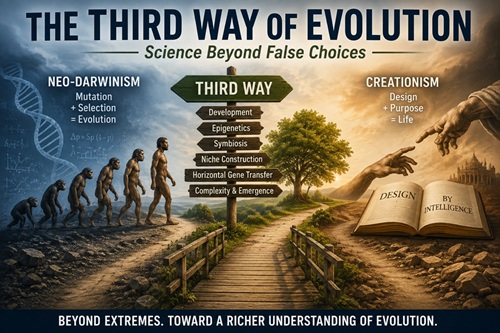
The phrase “Third Way of Evolution” sounds as if evolutionary biology is divided into two established camps and that a new movement has arrived to escape the impasse between them. In reality, the situation is more complicated—and more interesting. The Third Way is not a unified alternative theory of evolution comparable to Darwinism or the Modern Synthesis. It is better understood as a loose intellectual movement of evolutionary biologists and philosophers who believe that important mechanisms of evolutionary change have been underemphasized, misunderstood, or insufficiently integrated into mainstream evolutionary theory. The movement was launched in 2014 by James Shapiro, Denis Noble and Raju Pookottil. Its stated purpose was to create a forum for scientists dissatisfied with what they regarded as restrictions imposed by the Modern Synthesis. At the same time, the founders explicitly rejected creationism and Intelligent Design. The official Third Way website describes creationism as unscientific because it invokes supernatural intervention, while arguing that contemporary evolutionary science needs to take greater account of phenomena such as symbiogenesis, horizontal gene transfer, mobile genetic elements and epigenetic inheritance. That double rejection is important. The Third Way is not supposed to be “creationism without God.” Nor is it simply another name for Intelligent Design. Its central claim is rather that one can reject supernatural design while also rejecting what its proponents regard as an overly narrow, gene-centered and mutation-selection-centered picture of evolution. The question, therefore, is not whether the Third Way is “anti-evolution.” It plainly is not. The more interesting question is how much of its criticism represents legitimate scientific development, how much overlaps with the Extended Evolutionary Synthesis (EES), and how much consists of overstated claims about what evolutionary biology actually says. The Two-Way PictureThe Third Way's rhetorical starting point is a familiar dichotomy: creationism on one side, neo-Darwinism on the other. Creationism explains biological diversity through divine creation or supernatural intervention. Neo-Darwinism explains it through natural processes, particularly hereditary variation, differential reproduction and natural selection. The Third Way argues that this is a false dichotomy because contemporary evolutionary biology contains many mechanisms that do not fit neatly into the simplified textbook version of neo-Darwinism. There is considerable truth in this criticism. Modern evolutionary biology is not simply the nineteenth-century theory of random mutation plus natural selection. Evolutionary research encompasses population genetics, molecular evolution, evo-devo, developmental plasticity, genome evolution, horizontal gene transfer, symbiosis, hybridization, niche construction, epigenetic inheritance, sexual selection, gene regulation, drift and many other processes. The irony is that this observation is simultaneously one of the strongest arguments for the Third Way and one of the reasons to be cautious about its rhetoric. Much of what the Third Way presents as a challenge to “neo-Darwinism” is already part of contemporary evolutionary biology. The real debate is therefore not between “Darwinism” and “everything else.” It is about which mechanisms deserve theoretical primacy, how they interact, and whether evolutionary theory needs a substantially reorganized conceptual framework. The Third Way Is Not a Single TheoryThis is perhaps the most important point to establish at the outset. There is no single Third Way mechanism that replaces natural selection. The movement brings together researchers with quite different interests and theoretical commitments. James Shapiro emphasizes natural genetic engineering and the active role of genomes. Denis Noble criticizes gene-centric causal explanations and stresses multilevel biological organization. Eva Jablonka works on epigenetic inheritance and evolutionary processes. Gerd Müller emphasizes developmental bias and the problem of phenotypic novelty. Others work on symbiogenesis, niche construction, systems biology, evolutionary medicine and related subjects. Consequently, “Third Way” is more accurately the name of a research coalition than the name of a finished evolutionary theory. James Shapiro himself has described the movement as an attempt to make clear that the Modern Synthesis is not the last word on descent with modification. The objective was to provide space for dissenting approaches and new research lines rather than to establish another closed synthesis. That makes the movement intellectually productive, but it also creates a problem. When one Third Way author makes a strong claim, it cannot automatically be attributed to all Third Way researchers. The movement contains genuine theoretical diversity. Where the Third Way Meets the EESThe closest scientific relative of the Third Way is the Extended Evolutionary Synthesis. The EES emerged from work in evolutionary developmental biology, developmental plasticity, niche construction and expanded concepts of inheritance. Its proponents argue that evolutionary theory should give greater causal importance to developmental processes, organism-environment interactions and forms of inheritance extending beyond conventional genetic inheritance. The landmark 2015 EES paper by Kevin Laland and colleagues explicitly proposed a framework in which developmental bias, inclusive inheritance and niche construction participate in determining the direction and rate of evolutionary change. Natural selection and genetic inheritance remain important, but they are no longer treated as the entire causal architecture of evolution. This is remarkably close to much Third Way thinking. Both movements challenge the simplistic picture in which evolution consists of random genetic mutations appearing in organisms, followed by natural selection sorting those mutations according to their effects on reproductive success. Both emphasize that organisms develop before they reproduce, that development constrains and biases what forms can arise, that organisms modify their environments, and that evolutionary inheritance is more complicated than DNA transmission alone. The difference is partly one of emphasis and institutional identity. The EES is explicitly an attempt to construct an alternative or expanded conceptual framework for evolutionary biology. It has a relatively identifiable theoretical program. The Third Way is broader and more heterogeneous. It includes EES-compatible ideas but also more radical proposals concerning genome organization, natural genetic engineering, biological agency and causal hierarchies. Indeed, some scholars regard the Third Way as an umbrella under which several evolutionary schools can coexist. Nathalie Gontier, for example, has situated the Third Way alongside EES, evo-devo, eco-evo-devo and approaches emphasizing reticulate evolution such as symbiosis and horizontal gene transfer. So the relationship might best be represented like this: EES is a relatively defined theoretical program within the broader movement of evolutionary revision; the Third Way is a broader coalition of heterodox evolutionary approaches. They overlap substantially, but they should not be treated as synonyms. The Legitimate Scientific ChallengeThere is a serious scientific case behind the criticism. The Modern Synthesis was constructed primarily around population genetics, natural selection and Mendelian inheritance. Since its formation, biology has discovered enormous amounts of information about development, genome architecture, regulatory networks, epigenetic effects, ecological interactions and organism-environment feedback. The developmental process matters because organisms do not emerge from genes in a simple one-way causal chain. The phenotype results from interactions between genes, developmental systems and environments. Development can constrain which variants are possible and can make some evolutionary trajectories much more accessible than others. Niche construction adds another dimension. Organisms do not merely adapt to environments; they can modify those environments. Beavers build dams, plants alter soils, microorganisms alter chemical environments, and humans construct extraordinarily elaborate ecological niches. Those modifications can feed back into selection and inheritance. Likewise, evolutionary novelty can arise through mechanisms other than ordinary point mutation. Gene duplication, recombination, transposable elements, horizontal gene transfer, hybridization and symbiotic mergers can all contribute to evolutionary innovation. These are not fringe observations. They are established subjects of evolutionary research. The EES therefore has a legitimate point when it argues that evolutionary explanations can be enriched by giving these processes greater causal prominence. The Royal Society literature describes the issue well: the EES does not deny natural selection, Mendelian inheritance or genetic drift; rather, it argues that developmental and ecological processes should be incorporated more centrally into explanations of evolutionary change. This is a scientific debate, not a rebellion against science. But What Exactly Is Being Overthrown?Here the Third Way becomes more vulnerable. Its rhetoric frequently portrays “neo-Darwinism” as if contemporary evolutionary biology were still operating with a simplistic version of the Modern Synthesis from the middle of the twentieth century. That is historically and scientifically questionable. Evolutionary biology has never been static. The Modern Synthesis itself was an integration of previously competing traditions. Since then, population genetics has expanded enormously; molecular evolution, neutral theory, quantitative genetics, evo-devo, genomics and ecological evolutionary theory have transformed the field. Consequently, saying that the Modern Synthesis is incomplete is much easier to defend than saying that modern evolutionary biology is based on the obsolete assumptions attributed to “neo-Darwinism.” This distinction is crucial. One can argue that developmental bias is causally important without arguing that natural selection is therefore obsolete. One can demonstrate horizontal gene transfer without demonstrating that population genetics is wrong. One can show that organisms modify their environments without showing that adaptation by natural selection is an illusion. The scientific question is always comparative: does the proposed mechanism explain something that existing evolutionary models cannot adequately explain? Does it generate new predictions? Does it provide a demonstrably better causal explanation? That is a much higher bar than merely showing that evolution is more complicated than the textbook version. The Problem of “Random Mutation”The word “random” is another source of unnecessary confusion. Third Way authors are often highly critical of the conventional idea that mutations are random. But in evolutionary biology, “random” does not normally mean “uncaused,” “completely unpredictable,” or “equally probable in every genomic location.” Mutation is obviously produced by physical and biochemical mechanisms. Mutation rates vary enormously between genomic regions and types of DNA. DNA repair, replication mechanisms, transposable elements, environmental stresses and cellular processes all influence mutational patterns. What evolutionary theory requires is primarily that mutation is not systematically generated because it would be advantageous to the organism that possesses it. There is an important difference between saying: “Mutation is not random in the simplistic colloquial sense.” and saying: “Evolutionary theory is wrong because mutations are not random.” The first statement is largely uncontroversial. The second does not follow. Natural selection does not require every mutation to have the same probability, nor does it require mutation to be a metaphysical lottery. It requires a distinction between the processes generating variation and the subsequent differential survival and reproduction of variants. This is one place where Third Way rhetoric can obscure rather than clarify the scientific issue. The Same Problem Applies to Natural SelectionA similar problem arises when Third Way writers portray natural selection as a kind of universal creative force that supposedly explains everything. There is a legitimate criticism here. Natural selection does not generate variation. Selection is a statistical consequence of differential reproductive success. If the evolutionary question concerns the origin of a particular form of variation, invoking selection alone is indeed insufficient. But contemporary evolutionary theory does not actually require selection to perform this job alone. A better formulation is: variation-generating processes produce possibilities; developmental and ecological processes constrain and channel them; inheritance transmits some consequences; and selection, drift and other processes alter their frequencies and persistence. Natural selection remains indispensable because differential reproduction is one of the major processes that changes populations over generations. The EES itself explicitly retains natural selection. Its proponents describe the problem not as the elimination of selection but as a reconsideration of its relative explanatory role. This is a far more defensible position than the claim that Darwinian selection has somehow been scientifically defeated. The Creationist TrapThis brings us to the most politically and intellectually delicate aspect of the Third Way. Creationists and Intelligent Design advocates have obvious reasons to celebrate criticism of the Modern Synthesis. Their strategy has often been to argue: “If evolutionary biologists themselves admit that neo-Darwinism cannot explain evolution, then evolution is in crisis.” But this conclusion does not follow. Scientific theories are routinely criticized from within science. In fact, that is how science progresses. A biologist who identifies an inadequacy in an evolutionary model has not thereby supplied evidence for supernatural creation. There is a fundamental logical gap between: “Current evolutionary theory requires revision” and: “Therefore an intelligent designer exists.” The Third Way's official position on this matter is unequivocal. Its website specifically warns that Intelligent Design and creationist groups have incorrectly cited the movement as support for their arguments and explicitly states that its members do not endorse supernatural intervention. This distinction should be defended vigorously. The fact that creationists sometimes cite Third Way or EES criticism does not make the criticism creationist. Nor does it make the criticism illegitimate. But the reverse is also true: the fact that Third Way scientists reject Intelligent Design does not automatically make every scientific claim made under the Third Way label correct. Why Creationists Find the Third Way So UsefulThere is nevertheless a structural reason for the appropriation. Creationism and Intelligent Design have traditionally benefited from presenting evolution as a simple binary conflict: Darwinian mechanism versus divine design. The Third Way destroys that binary—but in an unexpected direction. It says that there are many scientifically respectable ways of investigating evolutionary causation beyond the simplified mutation-selection narrative. Creationists can then quote these criticisms while quietly removing the crucial second half of the argument: the Third Way scientists are still looking for entirely natural mechanisms. This creates a rhetorical sleight of hand. “Natural selection is not the only evolutionary mechanism” becomes “natural selection cannot explain evolution.” Then: “Natural selection cannot explain everything” becomes “therefore evolution cannot explain everything.” And finally: “Evolution cannot explain everything” becomes “therefore design.” Every step introduces an additional conclusion that does not follow from the preceding one. This is why it is important to separate criticism of evolutionary theory from criticism of evolution itself. The EES Is an Especially Good Test CaseThe EES demonstrates why this distinction matters. Its proponents have explicitly argued that evolutionary theory should be expanded to accommodate developmental bias, plasticity, inclusive inheritance and niche construction. But the EES does not abandon the empirical foundations of evolutionary biology. Natural selection, genetic inheritance and drift remain part of the framework. There is also genuine disagreement among evolutionary biologists about whether the EES represents a major theoretical revision or whether its phenomena can largely be incorporated into existing evolutionary theory. This is not evidence of scientific collapse. It is evidence of a functioning scientific discipline debating the appropriate level of theoretical integration. A 2019 analysis by Tim Lewens makes this particularly clear by separating the EES debate into empirical, historical and philosophical questions. One can disagree about how important epigenetic inheritance is, disagree about what the Modern Synthesis actually claimed, and disagree about the conceptual significance of niche construction without necessarily disagreeing about the empirical facts themselves. That distinction is frequently lost in public discussions. The Strongest Third Way ContributionThe strongest contribution of the Third Way is therefore not that it has discovered a replacement for Darwinism. It is that it has helped challenge a certain caricature of evolutionary biology. Evolution is not simply: random mutation → selection → adaptation. It is a multilevel historical process involving mutation, recombination, gene duplication, regulation, development, inheritance, selection, drift, migration, symbiosis, ecological interaction, organismal activity and many other processes. The organism is not merely a passive container for genes. Development matters. Organisms modify environments. Genomes are dynamic systems. Inheritance is more complicated than DNA sequence transmission alone. These insights deserve serious scientific investigation. In this respect, the Third Way has performed a useful service by making some neglected or underemphasized questions more visible. Its Weakest ContributionIts weakest feature is its tendency to turn legitimate pluralism into an exaggerated opposition between “neo-Darwinism” and “the new biology.” The danger is creating a straw man. If “neo-Darwinism” means the narrowest gene-centered version of the Modern Synthesis, then much of the criticism is justified. If “neo-Darwinism” means contemporary evolutionary biology, however, the criticism becomes much less convincing. Modern evolutionary biology already studies most of the phenomena invoked by Third Way proponents. This is why the EES debate is ultimately more useful when formulated as a question of explanatory architecture rather than intellectual revolution. The question is not: Darwinism or Third Way? It is: How should the different causal processes involved in evolution be integrated into evolutionary explanation? That is a much more scientifically productive question. A Third Way Between Two ExtremesThere is consequently a curious irony in the name “Third Way.” The movement originally intended to escape the sterile opposition between creationism and neo-Darwinism. But the most defensible scientific position is not really a third metaphysical option. It is a refusal of the original dichotomy. There is no need to choose between supernatural creation and a caricatured version of Darwinism. One can accept common descent, deep geological time, natural selection and population genetics while simultaneously investigating developmental constraints, epigenetic inheritance, niche construction, symbiogenesis, genome dynamics and other mechanisms. That is not a compromise between science and creationism. It is science doing what science normally does: expanding its explanatory repertoire when evidence and new research programs warrant it. The Third Way is therefore best regarded neither as a replacement for evolutionary biology nor as a disguised form of creationism. It is a heterogeneous reform movement within evolutionary thought. Some of its criticisms are scientifically important; some overlap substantially with the EES; some are matters of interpretation; and some of its rhetoric overstates the deficiencies of contemporary evolutionary theory. Its enduring value will depend on what happens next. If Third Way research produces robust empirical mechanisms, quantitative models, experimentally testable predictions and demonstrably superior explanations of evolutionary phenomena, it will become part of evolutionary biology—whether or not the label “Third Way” survives. That is ultimately how scientific revolutions are won. Not by declaring the old theory dead, but by explaining something it cannot explain, making successful predictions, and surviving attempts at falsification. And that standard applies equally to the Modern Synthesis, the EES, the Third Way—and, for entirely different reasons, to creationism. Creationism fails not because evolutionary biology has answered every question. It fails scientifically because invoking a supernatural designer does not constitute a testable evolutionary mechanism. The Third Way, by contrast, remains firmly within science precisely to the extent that it continues looking for natural mechanisms. That is the real dividing line. Not Darwinism versus anti-Darwinism. Not evolution versus creation. But testable natural explanation versus explanations that cease to be scientific when the evidence runs out. Appendix: Where does Ken Wilber fit in this landscape?Wilber actually fits very interestingly into this landscape—but not quite where the image might suggest. He is much closer to the Third Way rhetorically than to either conventional neo-Darwinism or creationism, but his explanation of evolution ultimately moves outside the scientific Third Way. The key distinction is between scientific pluralism about evolutionary mechanisms and metaphysical claims about why evolution exists at all. Wilber's starting point overlaps strongly with the Third Way and the EES. He rejects the idea that evolution can be adequately understood as a simple sequence of random mutation followed by natural selection. He emphasizes self-organization, emergence, developmental complexity, multiple levels of organization, organism-environment interaction and the apparent directionality of evolution. Those concerns have considerable overlap with the questions raised by the EES and by Third Way figures such as Denis Noble and James Shapiro. But Wilber then makes a move that the EES and Third Way, in their scientifically defensible forms, do not make. He asks: what explains the overall direction toward greater complexity, consciousness and integration? And his answer is Eros. In Wilber's mature formulation, Eros is not merely romantic metaphor. It is connected to his notion of Spirit-in-action: an intrinsic tendency within the Kosmos toward greater organization, complexity, consciousness and ultimately realization of Spirit. In Sex, Ecology, Spirituality, he presents evolution as the unfolding of Spirit and argues that Eros provides what he regards as the missing explanation for evolutionary creativity. That puts him in a rather peculiar position: Neo-Darwinism ← EES / Third Way ← Wilber → metaphysical evolutionism → creationism But this is not a linear spectrum. Wilber is actually outside the scientific spectrum, despite sharing some of its criticisms. The crucial difference can be expressed very simply: Third Way/EES: “Evolution involves more mechanisms and causal processes than the traditional Modern Synthesis emphasized.” Wilber: “Evolution involves more mechanisms, but ultimately its direction requires an intrinsic cosmic principle—Eros.” That second proposition is the decisive departure. The EES does not need Eros. Developmental bias, plasticity, niche construction, inclusive inheritance and organism-environment feedback can alter evolutionary trajectories without implying that evolution has a cosmic destination. The same applies to symbiogenesis, horizontal gene transfer, gene duplication, developmental constraint and other mechanisms associated with the broader Third Way. These expand evolutionary causality without introducing cosmic intentionality. The EES literature explicitly retains natural selection and other established evolutionary mechanisms while arguing for a broader causal framework. Wilber therefore makes an interesting philosophical mistake of category. He sees legitimate scientific dissatisfaction with an overly narrow evolutionary narrative and concludes that this dissatisfaction points toward his metaphysics. But it doesn't. Suppose evolutionary biology discovers that developmental constraints strongly bias evolutionary possibilities. That tells us something about how evolution works. It does not tell us that the universe possesses an intrinsic desire to produce higher consciousness. Suppose niche construction turns out to be evolutionarily important. Again, that tells us something about causal feedback between organisms and environments. It doesn't establish cosmic purpose. Suppose self-organization contributes significantly to biological complexity. That still doesn't imply that matter possesses an “upward pull” toward Spirit. This is where Wilber diverges sharply from the genuinely scientific Third Way. And there is an additional irony. Wilber sometimes presents his position as though he is rescuing evolutionary theory from reductionism. Yet the scientific developments he ought to welcome—the EES, evo-devo, systems biology, ecological evolutionary theory and research into non-genetic inheritance—actually provide precisely the sort of richer evolutionary account he says is needed, without requiring Eros. In other words, science may be moving in the direction Wilber wanted, but not toward the conclusion he wanted. Wilber and creationismI would also place Wilber somewhat nearer to creationism structurally than he probably would like, while being very clear that he is not a creationist. Creationism says, roughly: Complex biological order requires an intelligent creator. Wilber says: The emergence of higher-order complexity requires an intrinsic spiritual drive, Eros. Those are obviously not the same proposition. Wilber does not posit an external supernatural designer who intervenes in evolutionary history. His Spirit is immanent in the Kosmos. He is therefore much closer to teleological idealism or spiritual evolutionism than to biblical creationism or Intelligent Design. But the argumentative structure has a family resemblance: Observed complexity → insufficiency of ordinary evolutionary explanation → additional explanatory principle. For creationism, the principle is God or intelligent design. For Wilber, it is Eros/Spirit. For evolutionary science, the appropriate response is: show us the mechanism, the evidence and the predictions. That last requirement is where Wilber's account becomes problematic. His Eros is not operationalized as an evolutionary mechanism, does not generate quantitative predictions and cannot readily be falsified. Visser's long-standing criticism of Wilber is precisely that he has repeatedly treated a metaphysical principle as though it supplied an explanation where evolutionary science supposedly has a gap. There is an especially revealing passage in Wilber's own writing. When discussing the emergence of whole populations, he asks what mechanism could account for this and answers: “The short answer: Eros.” He then explicitly says that Darwinian mutation and natural selection “come nowhere close” and that a self-organizing force is required. That is much stronger than saying “Eros is a poetic metaphor.” So where should we put him on the picture?I'd revise the image conceptually like this: Mainstream evolutionary biology And then, off to the side: Creationism / Intelligent Design Wilber is not on the creationist branch, but his criticism of evolutionary science can sometimes be rhetorically appropriated by creationists because both challenge the sufficiency of conventional evolutionary explanations. Wilber's answer, however, is not “God designed organisms”; it is “Spirit/Eros is intrinsic to the evolutionary process.” That makes him an unusual fourth position, rather than simply a member of the Third Way. And this is actually an important distinction for Integral Theory. Wilber's contribution could be made much more intellectually defensible if he stopped presenting Eros as the missing causal explanation of biological evolution and instead treated it explicitly as a metaphysical interpretation of evolutionary history. Then there would be no conflict: Evolutionary science could investigate how increasing complexity, novelty and consciousness emerge. The EES and Third Way could investigate whether the classical evolutionary framework needs expansion. And Wilber could ask the philosophical question: What does the existence of an evolving universe mean for our understanding of reality, consciousness and value? That would put him after evolutionary science rather than pretending to replace it. In fact, I think this gives us a useful three-level distinction: Third Way: Evolution is scientifically more complicated than the old synthesis suggested. EES: Here are additional causal processes that should be incorporated into evolutionary theory. Wilber: Even an expanded evolutionary science does not answer the metaphysical question of why reality has this developmental character. The first two are scientific claims. The third is philosophy/metaphysics. And that, I think, is where Wilber belongs. Wilber and Creationist RhetoricWilber's relationship to creationist rhetoric deserves particular attention because, although he explicitly rejects creationism and Intelligent Design, he has repeatedly adopted some of their characteristic argumentative strategies when discussing Darwinian evolution. Most notably, he has argued that Intelligent Design proponents have correctly identified “inadequacies” in the neo-Darwinian account, while rejecting their conclusion that these inadequacies demonstrate the existence of a Christian God. In The Religion of Tomorrow, for example, Wilber writes that many Intelligent Design arguments “correctly identify” inadequacies in the standard neo-Darwinian view, and concludes that these inadequacies point instead to “a creative drive, Eros, or a self-organizing dynamic” inherent in the universe. This is precisely where his rhetoric begins to resemble the creationist “God-of-the-gaps” strategy: first portray Darwinian mechanisms as fundamentally inadequate to explain evolutionary creativity and directionality, then introduce a deeper causal principle to fill the supposed explanatory gap. The difference is that Wilber calls this principle Eros or Spirit rather than God. His formulation is therefore not creationism in the conventional sense—there is no external supernatural designer intervening in nature—but it performs a similar argumentative operation. He weakens confidence in evolutionary mechanisms by presenting their alleged insufficiency as evidence for a purposive cosmic principle. This is especially problematic because the existence of additional evolutionary mechanisms does not constitute evidence for Eros: developmental bias, self-organization, symbiosis, niche construction, epigenetic inheritance and other phenomena can be investigated as natural processes without acquiring metaphysical purpose. Wilber's rhetorical move thus deserves to be distinguished from the scientific criticism represented by the EES and Third Way: the latter asks whether evolutionary theory needs a richer account of causal mechanisms; Wilber too often treats perceived gaps in evolutionary explanation as evidence for his pre-existing metaphysical conclusion.
Widget is loading comments...
|