|
TRANSLATE THIS ARTICLE
Integral World: Exploring Theories of Everything
An independent forum for a critical discussion of the integral philosophy of Ken Wilber
SEE MORE ESSAYS WRITTEN BY FRANK VISSER
NOTE: This essay contains AI-generated content
Check out my other conversations with ChatGPT
The Myth of Divine Design
Why the "God Hypothesis" Fails as a
Scientific Explanation for Biological Information
Frank Visser / ChatGPT

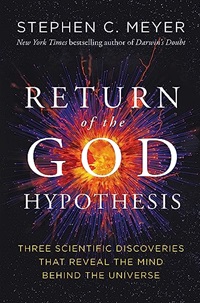
In recent years, proponents of Intelligent Design have tried to recast ancient theological ideas in the language of modern science. Chief among them is Stephen Meyer, whose book The Return of the God Hypothesis claims to offer a scientific explanation for the origin of biological information. According to Meyer, the DNA code is best explained by invoking a conscious intelligence—a divine mind—as its source. This, he argues, is the most reasonable inference from the presence of highly ordered, functionally specific information found in living systems.
But there's a fatal flaw at the heart of this argument. Namely: it's not a hypothesis at all—at least not in any scientific sense of the word.
What Makes a Hypothesis Scientific?
A genuine scientific hypothesis proposes a mechanism: it tells us how something happens. It generates testable predictions. It is vulnerable to falsification. It invites further inquiry.
Evolutionary biology, for instance, explains the emergence of complex structures and genetic sequences through mechanisms such as mutation, selection, recombination, and genetic drift. These processes can be observed, modeled, and tested. They have explanatory power and predictive value.
By contrast, invoking “God” as the source of DNA information provides none of these things. It offers no causal mechanism, no process, no physical interaction. How, exactly, does a disembodied mind insert A, T, C, and G into a double helix? What physical processes does it use? How does it interact with matter? And when did it happen? These questions are either answered with vague metaphors or sidestepped entirely.
God Has No Fingers
The fundamental issue is that a divine being—as traditionally conceived—does not operate through physical mechanisms. God has no molecules, no proteins, no fingers with which to braid nucleotides. As such, positing a “divine mind” to explain DNA information is not a causal account, but a metaphysical placeholder.
Meyer and others try to blur the distinction between inference to design and mechanistic explanation. But merely inferring design doesn't explain how the design was implemented. It replaces a scientific question with an ontological assertion.
God of the Gaps in a Lab Coat
The appeal to divine intelligence is, in essence, a modern form of the “God of the gaps.” Wherever science has not yet filled in the details, design advocates declare victory. But science progresses by explaining those gaps—not filling them with theological assumptions.
Moreover, Meyer's framing of his view as a “hypothesis” is disingenuous. He knows full well that “God's ways are mysterious”—that, by definition, divine action is not mechanistic. But then he cannot also claim this as a scientific explanation. It is a category error: smuggling theology into science under the guise of inference.
Information Is Not Magic
Another sleight of hand occurs in how Meyer treats the concept of “information.” In biology, information can be understood in various ways: statistically (as in Shannon information), functionally (as in proteins performing tasks), or evolutionarily (as heritable traits shaped by selection).
Meyer conflates these meanings with the notion of “mind-generated meaning”—suggesting that information must come from intelligence because we associate meaning with information. But nature doesn't work this way. DNA sequences arose through millions of years of trial-and-error mutation filtered by selection. There is no need to posit a conscious agent behind every stretch of code, any more than one needs an engineer to explain why riverbeds look “designed” for water.
The Disguised Theology of Intelligent Design
Ultimately, Intelligent Design—despite its scientific vocabulary—is a theological position. It asserts that biological information cannot arise without an immaterial intelligence. But because this intelligence is untethered from physical processes, it offers no testable explanation. It is not a hypothesis but a declaration. And it ends inquiry rather than encourages it.
In science, saying “We don't yet fully understand this—let's investigate further” is a productive stance. Saying “God did it” is not. It is, ironically, the abdication of explanation.
Wilber's Mystical Design Argument
It might be tempting to think that only fundamentalist or creationist thinkers fall into the trap of attributing biological complexity to an untestable intelligence. But even sophisticated spiritual thinkers like Ken Wilber—who distances himself from literalist religion—make a strikingly similar move when invoking Eros as the explanatory force behind evolution.
Wilber's notion of Eros is not the God of Genesis, but a cosmic spiritual drive: an innate, purposive force moving the universe toward greater complexity, consciousness, and self-realization. He claims this spiritual “Eros-in-the-Kosmos” accounts for the emergence of life, mind, and culture—a kind of divine vector woven into evolution itself.
Yet Wilber, like Meyer, never explains how Eros operates. There's no proposed mechanism, no causal chain, no empirical model. Just like “God did it,” Wilber's “Eros did it” functions as a metaphysical placeholder—a poetic gesture standing in for explanation. One cannot test for Eros, model its influence on molecular biology, or observe its operations in a laboratory. It is invoked precisely where evolutionary biology remains incomplete—and then used to explain what is, in effect, still unknown.
In this way, Wilber's mystical worldview ends up mirroring the very supernaturalism he critiques. Though couched in more abstract and integral language, Eros performs the same conceptual role as Intelligent Design: it posits a top-down intelligence guiding evolution without offering a mechanism. And as with Meyer, the result is not a hypothesis, but a metaphysical assertion draped in spiritual symbolism.
Wilber would argue that this is not meant to be science, but part of a “full-spectrum” view of reality. But if Eros is intended to explain evolution—as he often implies—then it must be held to explanatory standards. Otherwise, it's merely theology by another name: mysticism as a metaphysical flourish, not as a means of understanding biological origins.
Conclusion: Not Just Wrong, But Unscientific
The “God Hypothesis” fails not because it is theistic, but because it isn't a hypothesis. It offers no model of causation, no mechanism, no predictions, and no way to distinguish its claims from imagination. It clothes itself in the language of science but operates with the logic of dogma.
Until advocates of Intelligent Design can tell us how God implemented DNA, when it happened, and by what means, they are not doing science—they are preaching metaphysics. And science, to remain science, must politely but firmly show them the door.
|

 Frank Visser, graduated as a psychologist of culture and religion, founded IntegralWorld in 1997. He worked as production manager for various publishing houses and as service manager for various internet companies and lives in Amsterdam. Books: Ken Wilber: Thought as Passion (SUNY, 2003), and The Corona Conspiracy: Combatting Disinformation about the Coronavirus (Kindle, 2020).