|
TRANSLATE THIS ARTICLE
Integral World: Exploring Theories of Everything
An independent forum for a critical discussion of the integral philosophy of Ken Wilber
SEE MORE ESSAYS WRITTEN BY FRANK VISSER
NOTE: This essay contains AI-generated content
Check out my other conversations with ChatGPT
The GULO Gene Controversy
Vitamin C and the Debate Between
Science and Creationism
Frank Visser / ChatGPT
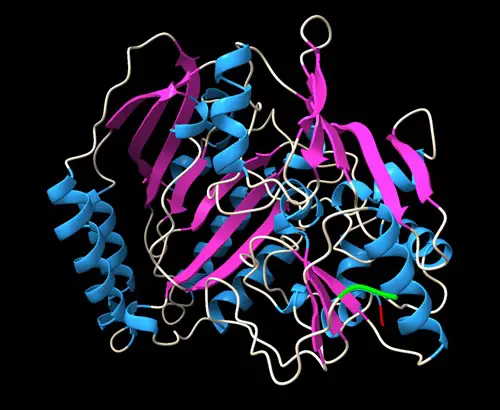
L-gulonolactone oxidase, an enzyme that produces vitamin C. (Wikipedia).
Introduction
Among the many molecular clues that support evolutionary theory, the case of the GULO gene (L-gulonolactone oxidase) stands out for its elegant simplicity and its explanatory power. In most mammals, this gene codes for the final enzyme in the biosynthesis of vitamin C (ascorbic acid). However, in humans and certain other primates—as well as guinea pigs and some bats—this gene is nonfunctional. This shared genetic defect, especially its consistent pattern across species, has become a key point in the argument for common descent.
At the same time, the GULO gene has become a flashpoint in debates between mainstream science and creationist or intelligent design (ID) proponents. While evolutionary biologists see it as a textbook example of evolutionary inheritance through gene inactivation, creationists struggle to explain its presence and function in a framework that denies or downplays macroevolution.
This essay explores the biological background of the GULO gene, its relevance to evolutionary theory, and the various attempts by creationists to refute or reinterpret its implications.
The Biology of the GULO Gene
Most mammals can synthesize their own vitamin C through a metabolic pathway involving several enzymes. The last step is catalyzed by the enzyme L-gulonolactone oxidase, encoded by the GULO gene. This enzyme converts L-gulonolactone into ascorbic acid in the liver (or kidney, in some species).
Humans, chimpanzees, orangutans, and other haplorrhine primates (as well as guinea pigs and fruit bats) lack the ability to produce vitamin C and must obtain it from their diet. The reason? In these species, the GULO gene is present in the genome but is nonfunctional. It contains multiple disabling mutations (frameshifts, premature stop codons, deletions), rendering it inactive. This broken gene is called a pseudogene.
What's striking is that many of these mutations are shared across species—particularly among humans and other great apes—suggesting that the gene became nonfunctional in a common ancestor before the species diverged.
Why It Matters: Evidence for Common Descent
The presence of the same nonfunctional gene, in the same genomic location, with similar inactivating mutations across multiple primate species, is difficult to explain without invoking common ancestry. From a Darwinian perspective, it makes sense: a mutation occurred in the GULO gene of a common ancestor, and this defective gene was inherited by all its descendants.
Moreover, if the gene were simply “junk” or nonfunctional from the start, why would it be there at all—especially in such a degraded but clearly recognizable form? Its presence, structure, and sequence similarity to functional GULO genes in other mammals (like dogs or mice) strongly support the idea of ancestral functionality followed by loss through mutation.
To an evolutionary biologist, this is a case of molecular phylogenetics providing a clear, independent line of evidence for evolution that aligns with fossil and anatomical data.
The Creationist Response
Creationist and Intelligent Design proponents have offered various counterarguments, ranging from theological justifications to technical objections:
“Design Doesn't Require Function”
ID advocates argue that not all elements of the genome must be functional to be designed. They point to changing understandings of so-called “junk DNA” and suggest the GULO gene might have an unknown regulatory or structural role.
“Loss of Function Isn't Evidence for Evolution”
Some creationists assert that the loss of a gene is not evidence of a gain in complexity, and thus doesn't support “upward” evolution. They argue that breaking a gene does not show how complexity arises—only how it can degrade.
However, this misses the point: the GULO gene's shared brokenness is not cited to demonstrate increasing complexity, but to demonstrate shared ancestry—a completely different claim.
“It Could Have Been Designed That Way”
Another move is to claim that God (or a designer) might have had a purpose in disabling the gene or in leaving it in a broken form. But this is an unfalsifiable claim, rendering it scientifically unhelpful. It could be used to explain anything, and thus explains nothing.
“The Gene Might Still Be Functional”
Some creationist writers—such as Dr. Jeffrey Tomkins—have suggested that the GULO pseudogene might still have unknown functions or be partially transcribed.
However, transcription alone does not imply function, and none of the known transcripts result in a functional enzyme. The numerous disabling mutations render the protein nonfunctional even if transcription occurs.
Creationist Argument: “Mutational Hotspots”
One of the more technical objections made by creationist apologists is the claim that shared mutations in the GULO gene across species could be due to "mutational hotspots"—regions of the genome more prone to certain types of mutation. From this view, it is conceivable that the same mutations might occur independently in different species due to such hotspots, rather than being inherited from a common ancestor.
This idea attempts to preserve the notion of independent origins of humans and other primates, while sidestepping the challenge posed by shared pseudogenes.
Scientific Rebuttal: Why the “Hotspot” Argument Fails
While some regions of DNA are indeed more prone to mutation (e.g., CpG sites), the "hotspot" hypothesis collapses under closer scrutiny when applied to the GULO gene:
Statistical Improbability of Identical Mutations
The GULO pseudogene in humans and other apes shares identical mutations, including complex events like frameshifts and deletions. The chances of these same mutations occurring independently in separate lineages are vanishingly small.
Phylogenetic Consistency
The pattern of mutations matches the evolutionary tree derived from other biological evidence. For example, humans and chimps share more mutations in GULO than either does with macaques or tarsiers. This nested hierarchy is precisely what common descent predicts—and what random hotspots would not.
No Identified Hotspot Mechanism
Creationist literature fails to provide a biochemical or genetic mechanism that would explain why the same mutations would repeatedly occur at these specific sites in the GULO gene across multiple lineages.
Hotspot Arguments Are Not Generalizable
The “mutational hotspot” hypothesis has been invoked in other cases too, such as endogenous retroviruses and olfactory pseudogenes—but always in an ad hoc fashion. It's a convenient way to explain away any shared feature that supports common descent without offering a testable model.
Scientific Non-Falsifiability
If every shared genetic feature can be dismissed as the result of a hypothetical hotspot, then no evidence could ever count as proof for common descent. Such a position falls outside the boundaries of science.
Vitamin C and Evolutionary Trade-Offs
Evolutionary theory also provides a plausible explanation for why the GULO gene was lost in some species but retained in others. Early primates with fruit-rich diets had abundant access to vitamin C. As a result, the selective pressure to maintain the functional GULO gene was relaxed. In such cases, mutations can accumulate without harmful consequences, eventually turning a once-functional gene into a pseudogene. This is an example of relaxed selection.
In contrast, carnivores like cats and dogs, whose diets lack significant vitamin C sources, retain a fully functional GULO gene because their survival depends on it. But what's especially compelling is that other, distantly related species—such as guinea pigs and certain fruit bats—have also independently lost the ability to synthesize vitamin C. In both cases, the GULO gene is present but pseudogenized—rendered nonfunctional by disabling mutations.
This is a clear case of convergent gene loss: different lineages that do not share a recent common ancestor independently lost the same function, likely because of similar ecological conditions—namely, a consistent dietary intake of vitamin C from fruits or plants. Importantly, the specific disabling mutations in guinea pigs and bats differ from those found in primates, confirming that these were independent evolutionary events, not shared ancestry.
This strengthens the evolutionary explanation. It shows how natural selection, genetic drift, and ecological context can shape genomes in predictable ways across lineages. If all species had been designed independently, one would expect optimal functionality maintained across the board—not repeated losses of the same gene in dietarily similar but genetically unrelated animals.
A Broader Context: Pseudogenes and Evolution
The GULO pseudogene is just one of many molecular fossils preserved in the human genome. Our DNA contains thousands of pseudogenes—genetic remnants of formerly functional genes. These include broken olfactory receptor genes, once useful when early mammals relied heavily on smell, or MYH16, inactivated in humans as jaw size and musculature changed.
The key pattern is this: these pseudogenes often show shared mutations in related species and distinct mutations in unrelated ones—exactly what we would expect under a model of common descent, mutation, and differential selection pressure. This pattern is not consistent with common design or intelligent intervention, where we'd expect functional optimization, not parallel degradation.
Conclusion: A Genetic Echo of Evolution
The GULO gene controversy is more than a biochemical curiosity; it is a crucial test case in the long-standing debate between evolutionary biology and creationist thought. Evolution provides a framework that not only predicts gene loss under relaxed selection, but also explains why such losses occur independently in unrelated species facing similar ecological pressures—like fruit bats, guinea pigs, and primates.
On the other side, creationist arguments rely on ad hoc mechanisms like mutational hotspots or unfalsifiable appeals to unknown design purposes. These fail to account for the precision, pattern, and predictability of the GULO gene's degradation across lineages.
Ultimately, the broken GULO gene is not just a story of loss, but of inheritance and adaptation. It's a molecular echo of our evolutionary journey—repeated across species when biology no longer needed the function. Even in silence, this defunct gene speaks with evolutionary clarity.
|

 Frank Visser, graduated as a psychologist of culture and religion, founded IntegralWorld in 1997. He worked as production manager for various publishing houses and as service manager for various internet companies and lives in Amsterdam. Books: Ken Wilber: Thought as Passion (SUNY, 2003), and The Corona Conspiracy: Combatting Disinformation about the Coronavirus (Kindle, 2020).