|
TRANSLATE THIS ARTICLE
Integral World: Exploring Theories of Everything
An independent forum for a critical discussion of the integral philosophy of Ken Wilber
  Frank Visser, graduated as a psychologist of culture and religion, founded IntegralWorld in 1997. He worked as production manager for various publishing houses and as service manager for various internet companies and lives in Amsterdam. Books: Ken Wilber: Thought as Passion (SUNY, 2003), and The Corona Conspiracy: Combatting Disinformation about the Coronavirus (Kindle, 2020). Frank Visser, graduated as a psychologist of culture and religion, founded IntegralWorld in 1997. He worked as production manager for various publishing houses and as service manager for various internet companies and lives in Amsterdam. Books: Ken Wilber: Thought as Passion (SUNY, 2003), and The Corona Conspiracy: Combatting Disinformation about the Coronavirus (Kindle, 2020).
Check out my other conversations with ChatGPT
NOTES ON CREATIONISM
The Tree or the Forest? The Myth of Divine Design Genetic Gymnastics The Human Chromosome 2 Fusion Who's Who in Creationism Hox Genes and Their Relevance The GULO Gene Controversy Does DNA Point to a Creator? The Denial of Deep Time Fine-Tuning: The God of the Knobs The 'Historical Science' Gambit Beyond Creationism Peter Borger's Darwin Revisited Peter Borger's Darwin RevisitedThe Creationist Book That Mistook a Biology Textbook for a Darwinian ObituaryFrank Visser / ChatGPT
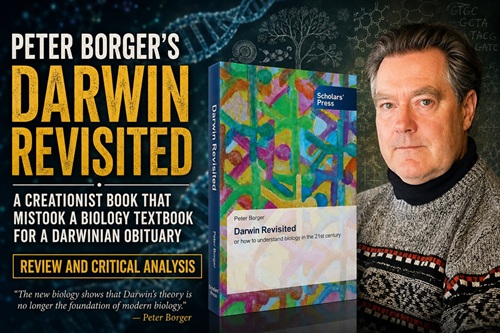
The Promised End of Darwin Never ArrivesPeter Borger's Darwin Revisited, or how to understand biology in the 21st century beëindigt presents itself as a scientific demolition of Darwinism.[1] Its basic promise is spectacular: modern molecular biology, Borger argues, has made the Darwinian framework obsolete. Organisms are not products of an unguided evolutionary history but “designed” and adaptable systems whose genomes contain a pre-programmed reservoir of variation. Natural selection does not create anything genuinely new; it merely sorts what was already there. The book's own alternative, GUToB—the “General and Universal Theory of Biological Change”—is supposed to replace evolutionary biology. There is only one problem with this grand announcement: the promised scientific revolution never arrives. What Borger offers instead is a remarkably familiar creationist strategy dressed up in the vocabulary of molecular biology. The book is not a successful refutation of evolutionary theory. It is an attempt to redefine evolution so narrowly that the evidence for it can subsequently be dismissed as irrelevant. The result is less a new theory of biology than a prolonged exercise in conceptual sleight of hand. Molecular Biology Is Not a Refutation of EvolutionThe irony is particularly acute because Borger actually has a background in molecular biology. He is therefore capable of discussing genes, genomes, regulatory sequences and molecular mechanisms at a level unavailable to many creationist polemicists. But knowing molecular biology is not the same thing as understanding evolutionary biology. A person can be perfectly competent at studying the molecular details of an organism and still profoundly misunderstand what evolutionary theory actually claims. And that is precisely where Darwin Revisited repeatedly goes wrong. Borger begins by attacking a caricature of Darwinism. In his presentation, natural selection is almost asked to perform a miracle: it must somehow manufacture complex biological novelties directly. Since selection can only select among variants that already exist, Borger concludes that selection cannot possibly explain the origin of those variants. This sounds devastating only if one has quietly removed mutation, recombination, gene duplication, transposable elements, regulatory evolution, developmental processes, horizontal gene transfer and numerous other sources of heritable variation from the evolutionary picture. Natural selection is not supposed to invent mutations. That is not a problem for evolutionary theory. It is elementary evolutionary biology. The Straw Man Called “Darwinism”Selection is a population-level process that changes the frequencies of heritable variants. Mutation and other mutational processes generate variation; recombination reshuffles it; developmental and genomic mechanisms alter the architecture on which selection acts; genetic drift changes frequencies independently of selection; gene duplication can create opportunities for functional divergence; and ecological interactions continually alter the selective environment. Evolutionary theory has never required natural selection to be a little biological craftsman manufacturing new organs with a hammer and chisel. Borger's argument therefore repeatedly attacks a division of labor that evolutionary biology itself has always recognized. His rhetoric about “information” is even more revealing. Like many creationist arguments, it treats genetic information as though it were a fixed quantity that can be shuffled, degraded or lost but never genuinely increased. Once that assumption is installed, Darwinian evolution has already been defeated—by definition. The “Information” That Cannot Be CreatedBut biology does not work according to Borger's information bookkeeping. New genetic material can arise through duplication and subsequent divergence. Genes can acquire new functions. Regulatory networks can evolve. Mutations can produce novel phenotypes on which selection can act. Genomes are dynamic systems, not sacred archives whose original contents were deposited at creation and subsequently subjected only to editing. The crucial question is therefore not whether selection can create a nucleotide sequence out of nothing. It is whether known biological processes can generate heritable variation and whether evolutionary processes can preserve, modify, combine and amplify variants over generations. The answer is emphatically yes. That is precisely why evolutionary biology does not stand or fall with the simplistic proposition that “selection creates information.” Borger's argument depends upon making that proposition appear central and then announcing its refutation. It isn't. Enter the Baranome: Creationism RepackagedThe most revealing part of the book is the alternative Borger proposes. His GUToB model requires organisms to begin with extraordinarily rich genetic endowments—“baranomes”—containing the information required for the later diversity of life. In other words, the information that evolution allegedly cannot generate must be present at the beginning. This does not solve the problem of biological origins. It moves the problem backwards. If contemporary organisms possess genetic features that cannot have evolved, Borger's solution is effectively that ancestral organisms possessed them already. If subsequent organisms appear more specialized, the original genome contained the latent possibilities. If genetic diversity exists, the relevant possibilities were pre-programmed. If genomes become smaller or more specialized, that is interpreted as degeneration from an original state of greater genetic richness. The explanatory magic is therefore concentrated in the beginning. And that is the oldest creationist trick in the book: put the unexplained complexity into the initial conditions and then declare the subsequent history explained. A Hypothesis That Explains ItselfBorger's “baranomes” are not an independently demonstrated biological discovery. They are a theoretical requirement generated by his anti-evolutionary premises. Their existence is inferred because his model needs them. The model then points back to their presumed existence as confirmation of itself. That is not an empirical theory. It is circular reasoning with molecular-biological terminology attached. The problem becomes especially serious when Borger invokes the biblical creation framework. The book's intellectual destination is not merely that evolutionary mechanisms are incomplete. It is that biological diversity ultimately requires an original act of creation. Once this background is acknowledged, the argumentative structure becomes much easier to see. Evolution is required to explain the diversification of life without invoking design. Borger declares that evolutionary mechanisms cannot produce enough information. He then introduces an initial biological state containing the required information. The designer has effectively re-entered the argument through the back door. Nothing has been explained about how that initial information came into existence. It has simply been exempted from explanation. The Difference Between a Mechanism and a HistoryThis is why the book's claim to have “ended Darwin's era” is so spectacularly disproportionate to what it actually accomplishes. A genuine replacement for evolutionary theory would have to explain the empirical phenomena evolutionary biology explains while providing testable predictions that outperform existing models. It would have to account for patterns of genetic similarity, nested biological relationships, endogenous viral elements, pseudogenes, gene duplication, observed adaptation, speciation, developmental evolution, biogeography, the fossil record and the enormous comparative-genomic evidence for common ancestry. Instead, Borger concentrates heavily on alleged deficiencies in evolutionary mechanisms and then substitutes a model in which the difficult biological information was already present. That is not theoretical progress. It is explanatory retreat. Common Descent Is Not “Natural Selection”Even more damaging is the way Borger treats common descent. The evidence for common ancestry does not consist of one Darwinian mechanism operating in isolation. It comes from the convergence of independent lines of evidence. Comparative genomics, morphology, developmental biology, paleontology, biogeography and molecular phylogenetics all produce hierarchical patterns of relationship. Modern evolutionary biology does not simply assume common descent because Darwin said so. It continually tests models of ancestry against data. Borger's strategy is to focus on particular mechanisms and use their limitations as if they constituted a refutation of the historical reality of common descent. But these are different questions. How does a particular novelty arise? How does a developmental system constrain evolutionary possibilities? How does a genome reorganize itself? How does selection interact with drift? How rapidly can a lineage diverge? These are legitimate scientific questions. Did all organisms descend from common ancestors? That is a much broader historical question, and its evidential basis cannot be eliminated merely by pointing out that natural selection is not the sole mechanism of evolutionary change. Darwin Is Not a Frozen Nineteenth-Century TheoryThere is another major weakness in Borger's rhetoric: the assumption that defeating “Darwinism” means defeating modern evolutionary biology. It does not. Evolutionary biology itself has changed enormously since Darwin. Modern evolutionary theory is not nineteenth-century Darwinism frozen in amber. Darwin did not know about DNA, genes, chromosomes, mutation, recombination, molecular phylogenetics, neutral evolution, regulatory genomics or developmental genetics. Modern evolutionary biology incorporated these discoveries precisely because science is not a religious creed requiring loyalty to the original formulation of its founder. Borger's title therefore creates a false opposition between “Darwin” and “new biology.” The new biology did not kill evolution. It transformed evolutionary biology. That distinction is fatal to Borger's thesis. Creationism Learns to Speak GenomicsThere is something almost comical about the book's self-confidence. The subtitle promises the end of Darwin's era, while the actual argument is built around ideas that creationists have recycled for decades: natural selection cannot create information; mutations are destructive; biological systems are engineered; genomes contain pre-programmed variation; common ancestry is impossible; and an original designed state is required. The terminology has become more sophisticated. The underlying argument has not. Contemporary creationism has learned to speak fluent genomics. That does not make it genomics. The God-of-the-Gaps ProblemBorger repeatedly presents the absence of an explanation within one particular evolutionary mechanism as evidence for the impossibility of evolution itself. This is the familiar “God of the gaps” structure translated into biological language. Wherever evolutionary explanation appears incomplete, design is waiting in the wings. Wherever a genomic function is mysterious, intentional programming becomes attractive. Wherever a biological novelty is difficult to explain, it is declared to have been present in ancestral genetic material. But ignorance is not evidence for design. “Science does not yet know exactly how X happened” does not entail “therefore X was designed.” And if “design” is invoked whenever a mechanism becomes difficult, the design hypothesis becomes effectively immune to disconfirmation. A theory that can explain every possible observation after the fact explains none of them in the scientific sense. The Genome Is an Historical DocumentThere is a final irony. Borger's book claims to liberate biology from outdated Darwinism by emphasizing modern molecular discoveries. But modern genomics has done something quite different from what the book requires. It has dramatically expanded the evidence for evolutionary relationships and revealed genomes to be historically contingent, dynamically changing systems. Comparative genomics does not expose evolution as an illusion. It gives us unprecedented access to evolutionary history. The genome is not an instruction manual dropped intact into the primordial world. It is an historical document. It contains duplications, deletions, insertions, rearrangements, mutations, relics, compromises and traces of ancestral events. It bears the marks of descent with modification. The very messiness that creationist arguments often treat as evidence of “degeneration” is precisely what evolutionary biology expects from populations whose genomes have been modified over immense periods of time. Borger wants the genome to look like a designed machine. Evolutionary biology asks why the machine looks the way it does, including its historical scars. That is the difference between a design narrative and a historical science. Not a Scientific Revolution, but an Explanatory RetreatDarwin Revisited is therefore best understood not as the book that ended Darwin's era but as a particularly instructive specimen of modern scientific creationism. Its sophistication lies largely in the amount of molecular terminology deployed in support of conclusions that were determined in advance. It borrows the authority of contemporary biology while rejecting the historical framework that makes the biological evidence intelligible. The book's central maneuver can be reduced to one sentence: Evolution cannot produce what Borger has first assumed evolution cannot produce. Once that circularity is exposed, the grand edifice collapses. There is no new biology here that makes Darwin obsolete. There is no demonstrated biological revolution overturning common descent. There is no empirical demonstration of baranomes. There is no explanatory mechanism replacing evolutionary theory. And there is certainly no scientific justification for smuggling a designer into biology simply because some evolutionary questions remain difficult. There is, instead, an old creationist conclusion wrapped in the language of new biology. Borger Did Not Bury DarwinHe merely mistook the graveyard of his own assumptions for the death of evolutionary theory. That is ultimately the great irony of Darwin Revisited. Borger sets out to demonstrate that modern biology has rendered Darwinian evolution obsolete, but his argument depends on a strangely antiquated picture of what evolutionary biology actually is. He attacks “Darwinism” as though it were still a nineteenth-century theory in which natural selection is expected to manufacture every novelty from scratch. He then points to everything selection does not do and presents those limitations as if they constituted a fatal problem for evolution itself. But evolutionary biology moved on long ago. Modern evolutionary theory does not ask natural selection to perform miracles. It investigates mutation, recombination, gene duplication, genomic rearrangement, developmental constraint, regulatory evolution, genetic drift, horizontal gene transfer, neutral evolution, ecological interaction and countless other processes that shape populations through time. Natural selection is one component of an evolutionary framework, not the entire framework. To refute one simplified version of selectionism is therefore not to refute common descent, population genetics, or the historical evolution of life. Borger's alternative fares considerably worse. Whenever evolutionary processes appear insufficient to him, the missing explanatory work is effectively transferred to the beginning. The original organisms supposedly possessed an extraordinary genetic potential—a preloaded biological repertoire from which later diversity could unfold. The difficult question is thereby transformed into an initial condition: instead of asking how biological complexity arose through evolutionary history, we are asked to assume that the necessary potential was already there. That is not an explanation of origins. It is an explanation by postponement. And once the Creator is allowed to supply whatever biology allegedly cannot explain, the argument becomes almost impossible to falsify. Any feature that appears too complex can be declared pre-programmed. Any genomic similarity can be interpreted as shared design or inherited potential. Any subsequent diversification can be classified as variation within created boundaries. The theory is protected from empirical defeat precisely because its most important assumptions are placed beyond empirical investigation. This is why Borger's claim to have ended Darwin's era should be treated with considerable skepticism. Scientific revolutions do not consist of pointing out that a successful theory has unanswered questions. Every serious scientific theory has unanswered questions. A revolution occurs when a new framework explains the existing evidence more successfully, generates new testable predictions, and survives empirical confrontation better than its predecessor. Darwin Revisited does none of this. It does not replace evolutionary population genetics. It does not provide a superior account of common descent. It does not explain the nested hierarchy of biological relationships. It does not explain the striking patterns found in comparative genomics. It does not offer a demonstrated mechanism capable of replacing mutation, recombination, selection, drift and other established evolutionary processes. And its central concepts, such as the baranome and GUToB, remain embedded in a creationist conceptual framework rather than emerging as independently validated discoveries of mainstream biology. The book's real achievement is therefore much more modest—and much more revealing. It demonstrates how contemporary creationism has adapted itself to the genomic age. The creationist no longer needs to deny that organisms mutate, populations adapt or genomes change. Instead, the argument has become subtler: yes, biological change occurs, but the possibilities for that change were supposedly encoded in organisms from the beginning. Evolution is permitted, provided that it never becomes evolution in the historical sense required by common descent. That maneuver may be rhetorically effective within creationist circles. It does not constitute a scientific overthrow of evolutionary biology. Indeed, there is something almost deliciously paradoxical about Borger's project. He invokes the latest discoveries of molecular biology to resurrect a conclusion that predates molecular biology by centuries. He presents the genome as evidence against Darwin, while evolutionary biologists increasingly use genomes as historical records of descent. He invokes biological information to deny its evolutionary history, while modern genomics reveals information-bearing systems that have been repeatedly duplicated, modified, rearranged and repurposed over evolutionary time. The genome did not arrive in its present form as a finished divine blueprint. It bears history. And history is precisely what creationism has the greatest difficulty accommodating. Darwin's enduring achievement was not that he supplied the final answer to every evolutionary question. He supplied a powerful naturalistic framework for understanding how the extraordinary diversity and adaptation of life could emerge through historical processes. Everything that came afterward—genetics, population biology, molecular evolution, genomics, evo-devo and contemporary evolutionary synthesis—has vastly expanded, modified and sometimes corrected that framework. None of this represents the death of evolution. It represents the normal development of a successful scientific research tradition. So perhaps the most appropriate verdict on Darwin Revisited is not that Borger has failed to kill Darwin. It is that he never managed to reach the Darwinian organism he set out to execute. He constructed a straw man, loaded it with nineteenth-century assumptions, shot it with twenty-first-century molecular terminology, and then announced the death of evolutionary biology. Darwin, meanwhile, remains very much alive. And the real corpse lying on the laboratory table is not evolutionary theory. It is Borger's claim to have replaced it. Appendix: Where Does Peter Borger Stand Within the Creationist Community?Peter Borger occupies an interesting—and rather revealing—position within contemporary creationism. He is not simply a generic opponent of Darwinian evolution, nor is he an advocate of the relatively cautious “intelligent design” position associated with figures such as Michael Behe or William Dembski. Borger belongs much more clearly to the young-earth creationist and baraminological camp, even though his scientific vocabulary is that of a modern molecular biologist. That distinction matters, because it tells us what Darwin Revisited is actually trying to accomplish. From Molecular Biology to CreationismBorger's professional background is unusual within creationist circles. He is a trained molecular biologist, with work in areas including signal-transduction networks and gene regulation. He has also been associated with the German creationist organisation Wort und Wissen. The Dutch creationist Logos Instituut presents him explicitly as a molecular biologist whose work demonstrates that organisms are designed and that the genetic information necessary for later species formation was already present in the original organisms. This gives Borger something many creationist writers lack: scientific credentials in a relevant discipline. But it also makes his position particularly useful to the creationist movement. He can enter the debate speaking the language of genes, genomes, information, regulation and molecular mechanisms. The resulting argument can therefore sound radically different from nineteenth-century biblical creationism, even when its theological destination is essentially the same. Borger is, in other words, a modern scientific representative of an old creationist conclusion. Not Intelligent Design in the American SenseIt would nevertheless be misleading to put Borger simply under the heading of “Intelligent Design.” The American intelligent-design movement has generally tried to maintain a strategic distance from explicit biblical creationism. The Discovery Institute, for example, has historically emphasized the scientific detection of design rather than arguing directly for a six-day creation or a young Earth. Borger goes considerably further. His model explicitly involves created “basic organisms” possessing the genetic potential for later biological diversity. The Logos Instituut describes his position in remarkably unambiguous terms: all the information required to produce new species was already present in the genome “from the time the primordial forms were created.” That places him much closer to creation science proper than to the deliberately religion-neutral rhetoric of intelligent design. His “designer” is not merely an inference from biological complexity. The designer is the Creator. Borger and BaraminologyThe key to understanding Borger's place in the creationist world is therefore baraminology. Baraminology is the creationist attempt to classify organisms according to their supposed original created kinds (bara = create, min = kind). Instead of accepting common descent among all organisms, baraminologists seek to identify boundaries between independently created groups. Borger's “baranome” concept fits directly into this intellectual tradition. His argument is not that species never change. On the contrary, he accepts substantial biological variation and even speciation. What he rejects is the evolutionary extrapolation from variation within created groups to universal common ancestry. This is an important distinction. Borger can therefore concede enormous amounts of biological change while still rejecting Darwinian evolution in its historical sense. The Logos Instituut describes precisely this position: speciation occurs because genomes are programmed for it, while different species do not necessarily share the same ancestor. That is classic creationist fixity of created kinds disguised as genomic plasticity. The Young-Earth ConnectionBorger's position becomes even clearer when we look at his associations. In March 2023 he participated in a public debate organized by the Logos Instituut, which Bart Klink explicitly describes as a young-earth-creationist organization. Klink also identifies Borger himself as a young-earth creationist. The same creationist milieu includes speakers discussing biblical chronology, the Flood, created kinds, baraminology and attempts to reinterpret geological history within a biblical framework. A Logos conference at which Borger spoke, for example, included presentations on post-Flood recolonization and baraminology, alongside contributions from creationist researchers such as Todd Wood and Matthew McLain. This is not an incidental association. It places Borger within a very specific intellectual ecosystem. He is not an isolated molecular biologist who happens to have doubts about Darwin. He is an active participant in an organized creationist movement whose central purpose is to replace evolutionary history with a creationist account of biological origins. Where Borger Is More Sophisticated Than Traditional CreationistsThere is nevertheless an important difference between Borger and the crudest forms of young-earth creationism. He does not simply say: “Species do not change.” He says: “Species change because their genomes contain the genetic potential for that change.” He does not simply deny mutation. He accepts mutation, variation, recombination and adaptation—but argues that these processes operate within boundaries established by the original genetic architecture. He does not deny biological diversification. He denies that diversification amounts to unlimited genealogical transformation. This makes his position considerably more sophisticated rhetorically than the simplistic “nothing evolves” version of creationism. And that is precisely why the concept of the baranome is so important. It provides creationism with a way of saying: “Yes, evolution happens—but only inside the boundaries established by creation.” The word “evolution” is retained while its historical meaning is radically restricted. His Relationship to Todd WoodBorger's position also sits close to the work of American creationist biologist Todd Wood, one of the prominent contemporary advocates of baraminology. This is not merely an inference from terminology. Borger has published work on “baranomes” through the creationist organization Wort und Wissen, and Wood appeared alongside Borger at the Logos Bijbel & Wetenschap conference. The shared conceptual framework is unmistakable. Both accept significant biological variation while rejecting universal common ancestry. Both attempt to construct a creationist system that takes modern genetics seriously rather than simply dismissing molecular biology. And both regard the conventional evolutionary interpretation of genomic similarity as fundamentally mistaken. In that respect Borger belongs to the post-genomic wing of creationism. The creationist movement has learned that simply denying genetics is no longer viable. Its more sophisticated strategy is to reinterpret genetics. A Creationist Who Wants to Keep the GenomeThis may be Borger's most distinctive contribution. Older creationists could appeal directly to the Bible against evolutionary biology. That strategy becomes increasingly difficult in an age of comparative genomics. Borger instead attempts to appropriate the genome itself. The genome becomes evidence not of common ancestry but of common design—or, more precisely, of the genetic architecture originally supplied by the Creator. Genetic similarity is no longer primarily historical evidence. It becomes evidence of shared design principles or shared ancestral genetic potential. This is a clever rhetorical inversion. It also explains why Borger's book can sound surprisingly modern while reaching a profoundly pre-modern conclusion. The vocabulary is molecular. The ontology is creationist. Why Creationists Like BorgerBorger's appeal within creationist circles is therefore easy to understand. He provides something the movement desperately needs: a scientist who can say that modern biology itself has undermined Darwinism. The Logos Instituut has promoted his work extensively. Its website lists dozens of Borger contributions and presents him as one of the “boundary-breaking scientists” of the “new biology.” The book has also been repeatedly presented within creationist conferences, interviews and media outlets as a major scientific challenge to Darwinian evolution. This is why the book's significance should not be measured simply by its impact on mainstream evolutionary biology. Outside creationist circles, its impact appears to have been limited. Bart Klink notes that the original edition attracted little attention outside creationist circles, with criticism coming from a relatively small number of evolutionary biologists and critics of creationism. Inside creationist circles, however, the situation is different. Borger provides intellectual ammunition. He supplies the credentials. He gives believers a molecular-genetic vocabulary with which to challenge evolutionary biology. And he allows creationists to say, with some plausibility: “Look—this isn't merely theology. We have a molecular biologist.” That distinction is central to Borger's cultural role. A Fringe Scientist Within a Fringe MovementBut there is an important irony here. Within mainstream biology, Borger's position is highly marginal. Within creationism, however, he is not particularly marginal at all. He occupies something like the position of a specialist intellectual within the young-earth creationist ecosystem: scientifically trained, rhetorically sophisticated, deeply committed to the creationist paradigm, and willing to reinterpret modern biological discoveries rather than simply ignore them. That makes him more interesting than a creationist who merely repeats Genesis. It does not make him scientifically mainstream. Quite the opposite. His importance lies precisely in showing how modern creationism has adapted to the genomic age. The Creationist Movement Has Evolved—IronicallyThere is a delicious irony here. Creationists themselves have evolved. They have learned that simply insisting that species never change is untenable. They have learned that mutation and natural selection cannot simply be denied. They have learned that genomes contain enormous amounts of information and that biological populations really do diversify. So the sophisticated creationist response is no longer: “Evolution doesn't happen.” It is: “Evolution happens—but only within the boundaries established at creation.” Borger is one of the clearest representatives of this strategy. And that is why Darwin Revisited is more revealing than its scientific merits would otherwise suggest. The book tells us considerably more about the evolution of creationism than it tells us about the evolution of organisms. The Final IronyBorger wants to take biology “back to the origin.” But the intellectual movement he represents has actually gone in the opposite direction. It has taken traditional creationism and dressed it in the vocabulary of molecular genetics. The Bible remains in the background. The Creator remains in the background. Created kinds remain in the background. But now there are genomes, genetic information, regulatory networks, baranomes and GUToB. The old creationist architecture has simply received a genomic renovation. And that, ultimately, is where Peter Borger stands within the creationist community: not on the outskirts, but near the sophisticated scientific edge of young-earth creationism—where biblical creationism attempts to survive by appropriating the language of modern molecular biology. His importance is therefore real, but it is not the importance he claims. He has not produced a scientific revolution that has replaced Darwinian evolution. He has produced something arguably more revealing: a molecular-biology-flavoured version of creation science designed to make an ancient theological conclusion look like the inevitable result of twenty-first-century genomics. notes[1] Translation of Terug naar de oorsprong, Hoe de nieuwe biologie het tijdperk van Darwin beëindigt [Back to the origin, how the new biology ends the era of Darwin], Stichting De Blauwe Tijger, 2021 (first edition CBC 't Gulden Boek B.V., 2009). English edition: Darwin revisited: or how to understand biology in the 21st century, Scholars' Press (2025, first edition 2018). Scholars' Press has a poor academic reputation and is widely considered a vanity or predatory press (beallslist.net).
Widget is loading comments...
|