|
TRANSLATE THIS ARTICLE
Integral World: Exploring Theories of Everything
An independent forum for a critical discussion of the integral philosophy of Ken Wilber
  Frank Visser, graduated as a psychologist of culture and religion, founded IntegralWorld in 1997. He worked as production manager for various publishing houses and as service manager for various internet companies and lives in Amsterdam. Books: Ken Wilber: Thought as Passion (SUNY, 2003), and The Corona Conspiracy: Combatting Disinformation about the Coronavirus (Kindle, 2020). Frank Visser, graduated as a psychologist of culture and religion, founded IntegralWorld in 1997. He worked as production manager for various publishing houses and as service manager for various internet companies and lives in Amsterdam. Books: Ken Wilber: Thought as Passion (SUNY, 2003), and The Corona Conspiracy: Combatting Disinformation about the Coronavirus (Kindle, 2020).
Check out my other conversations with ChatGPT
NOTES ON CREATIONISM
The Tree or the Forest? The Myth of Divine Design Genetic Gymnastics The Human Chromosome 2 Fusion Who's Who in Creationism Hox Genes and Their Relevance The GULO Gene Controversy Does DNA Point to a Creator? The Denial of Deep Time Fine-Tuning: The God of the Knobs The 'Historical Science' Gambit Beyond Creationism NOTES ON PETER BORGER Peter Borger's Darwin Revisited Auditing Borger's Case Against Evolution Where Borger's Molecular Argument Really Leads The Darwinian Straw Man A Summary of Peter Borger's Claims The Third Way of Evolution The God of the Knobs?A Skeptical Look at Cosmic Fine-TuningFrank Visser / ChatGPT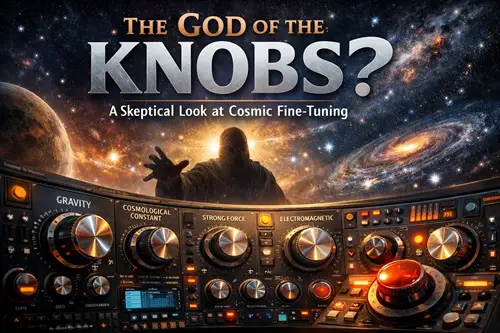 In recent decades, the so-called cosmic fine-tuning argument has become one of the most popular apologetic claims for the existence of God. It appears frequently in the work of philosophers such as William Lane Craig and Robin Collins. The argument is simple in outline: the fundamental constants of the universe seem delicately calibrated for the emergence of life. If these constants had been even slightly different, life—especially complex life—would be impossible. Therefore, the argument goes, the universe must have been deliberately fine-tuned by an intelligent designer. To illustrate the point, proponents often imagine a cosmic control panel. On this panel are knobs labeled “gravitational constant,” “electromagnetic force,” “cosmological constant,” and so on. Turn any knob just a little, and the universe collapses, expands too quickly, or fails to form stars and chemistry. The implication is clear: someone must have set the knobs just right. But as compelling as this metaphor sounds, the fine-tuning argument rests on a series of assumptions that deserve closer scrutiny. Once we examine these assumptions carefully, the argument begins to look less like evidence for divine design and more like a sophisticated form of anthropocentric reasoning. The Illusion of Adjustable ConstantsThe fine-tuning argument presumes that the fundamental constants of physics could easily have taken different values. But this assumption is rarely justified. In modern theoretical physics, constants often emerge from deeper structures rather than being arbitrary settings. What appear to be independent parameters today may ultimately turn out to be determined by underlying laws. Historically, physics has repeatedly reduced seemingly arbitrary numbers to consequences of deeper principles. The speed of light, atomic spectra, and planetary motion once appeared contingent; later they were explained by unified theories. As physicist Steven Weinberg once remarked, the dream of physics is precisely to eliminate free parameters. The more successful a theory becomes, the fewer adjustable constants it contains. In other words, the cosmic control panel imagined by fine-tuning advocates may not exist at all. The “knobs” might be welded in place by deeper laws we do not yet understand. The Problem of Parameter SpaceEven if constants could vary, the fine-tuning argument assumes that we can meaningfully talk about the probability of different values. This is far more problematic than it sounds. To say that our universe is “improbable” requires specifying a probability distribution over possible universes. But no such distribution is known. Should constants vary uniformly across all numbers? Across logarithmic scales? Across some unknown physical range? Each choice produces radically different probabilities. Without a justified probability measure, claims that the universe is “one in a trillion” or “one in 10120” are not scientific conclusions—they are rhetorical estimates. As philosopher Sean Carroll has pointed out, probability claims about hypothetical universes are meaningless unless we know the space of possibilities and how to weight them. In cosmology, we currently know neither. The Anthropic Selection EffectThere is also a deeper logical issue. Any observers who ask why the universe allows life must necessarily exist in a universe compatible with life. This is known as the anthropic principle. The reasoning is similar to a puddle waking up and marveling that the hole in the ground fits it perfectly. In reality, the puddle conforms to the hole, not the other way around. Fine-tuning arguments often overlook this selection effect. We observe a life-permitting universe because only such a universe allows observers to arise. That fact alone does not require an explanation in terms of design. Life as We Don't Know ItAnother hidden assumption concerns the definition of life. Fine-tuning discussions usually assume life must resemble terrestrial carbon-based biology. But our knowledge of life is based on a single example: Earth. It is therefore hazardous to conclude that only a narrow range of physical conditions permits life of any kind. Some physicists have suggested that radically different universes might still support complex structures or exotic forms of life. For example, universes without stable stars might produce life in other ways, or universes with different chemistry might support alternative biological frameworks. The claim that only our particular constants permit life may simply reflect the limits of our imagination. The Multiverse AlternativeA naturalistic explanation for fine-tuning arises in modern cosmology: the possibility of a multiverse. In many versions of inflationary cosmology and string theory, different regions of reality may possess different physical constants. If a vast number of universes exist, it is not surprising that at least some of them permit life. Observers will naturally arise in those rare regions where conditions allow complexity. Physicists such as Andrei Linde and Max Tegmark have explored such scenarios. Whether the multiverse is correct remains uncertain, but it demonstrates that fine-tuning does not uniquely point to a designer. Indeed, invoking God to explain fine-tuning merely shifts the question: why does the designer have the properties necessary to create life-permitting universes? A multiverse at least arises as a natural extension of existing physics. The Designer-of-the-GapsUltimately, the fine-tuning argument resembles an updated version of the old “God of the gaps” strategy. Where science has not yet explained something—in this case the values of physical constants—design is inserted as the explanation. But history has repeatedly shown that such gaps tend to close as scientific understanding advances. Invoking a cosmic designer at this stage risks turning God into a placeholder for ignorance. The metaphor of the cosmic control panel may therefore be misleading. It invites us to imagine a deity adjusting the universe's settings like a technician calibrating a machine. Yet the universe we study does not appear to contain such knobs. Conclusion: From Mystery to MetaphorCosmic fine-tuning is an intriguing puzzle. The values of physical constants remain one of the deepest open questions in physics. But transforming this mystery into evidence for divine design goes well beyond what the data justify. The argument depends on speculative assumptions about possible universes, probability distributions we cannot define, and biological constraints we barely understand. Seen in this light, the fine-tuning argument does not reveal a cosmic engineer carefully turning the knobs of creation. It reveals something more familiar: humanity's enduring tendency to interpret the universe in its own image. The knobs, it seems, may exist only on the philosophical control panel. Epilogue: The Missing “How?”Even if one were to grant, for the sake of argument, that the universe appears fine-tuned for life, a striking feature of the design argument remains: it almost never addresses the mechanism of design. The argument jumps directly from appearance to intent—from finely balanced constants to the conclusion that a cosmic intelligence must have set them that way. But an essential question remains conspicuously unanswered: How, exactly, was the tuning performed? This is not a trivial omission. In every other domain where we infer design—engineering, biology, archaeology—we do so because we can identify not only an agent but also a causal process. When we see a watch, we understand how watchmakers produce such devices: through tools, materials, and manufacturing steps. When evolutionary biologists explain complex biological adaptations, they identify mechanisms such as mutation, selection, and inheritance. In contrast, the fine-tuning argument offers no comparable account of cosmic engineering. The metaphor of the cosmic control panel—knobs labeled “gravity,” “electromagnetism,” or “cosmological constant”—is evocative but purely figurative. It tells us nothing about the underlying mechanism by which a divine agent would adjust the fundamental constants of nature. Did God select values before the universe began? If so, in what sense did those values exist prior to the laws that define them? Did God manipulate a deeper physical substrate from which our universe emerged? Or did the designer somehow intervene in the mathematical structure of reality itself? The design argument is silent on these questions. One might reply that divine action is inherently mysterious. Yet appealing to mystery at precisely the point where explanation is required effectively empties the argument of explanatory content. If the mechanism is unspecified—or declared unknowable—then “God did it” becomes less a theory than a placeholder for the unknown. Scientific explanations typically progress in the opposite direction. They begin with phenomena that appear finely balanced or improbable and then search for the processes that generate them. Planetary orbits once seemed miraculously harmonious until gravitational dynamics explained their structure. Biological complexity once suggested special creation until natural selection provided a mechanism. In this sense, the fine-tuning argument reverses the normal logic of inquiry. Instead of asking what processes might produce these constants, it leaps directly to the conclusion that they were intentionally chosen. But explanation without mechanism is thin explanation indeed. The image of a deity turning cosmic knobs may function as a compelling metaphor. Yet until proponents of design can articulate how such tuning actually occurs, the metaphor remains just that: a vivid picture projected onto a profound scientific mystery.
Widget is loading comments...
|