|
TRANSLATE THIS ARTICLE
Integral World: Exploring Theories of Everything
An independent forum for a critical discussion of the integral philosophy of Ken Wilber
  Frank Visser, graduated as a psychologist of culture and religion, founded IntegralWorld in 1997. He worked as production manager for various publishing houses and as service manager for various internet companies and lives in Amsterdam. Books: Ken Wilber: Thought as Passion (SUNY, 2003), and The Corona Conspiracy: Combatting Disinformation about the Coronavirus (Kindle, 2020). Frank Visser, graduated as a psychologist of culture and religion, founded IntegralWorld in 1997. He worked as production manager for various publishing houses and as service manager for various internet companies and lives in Amsterdam. Books: Ken Wilber: Thought as Passion (SUNY, 2003), and The Corona Conspiracy: Combatting Disinformation about the Coronavirus (Kindle, 2020).
Check out my other conversations with ChatGPT
NOTES ON CREATIONISM
The Tree or the Forest? The Myth of Divine Design Genetic Gymnastics The Human Chromosome 2 Fusion Who's Who in Creationism Hox Genes and Their Relevance The GULO Gene Controversy Does DNA Point to a Creator? The Denial of Deep Time Fine-Tuning: The God of the Knobs The 'Historical Science' Gambit Beyond Creationism NOTES ON PETER BORGER Peter Borger's Darwin Revisited Auditing Borger's Case Against Evolution Where Borger's Molecular Argument Really Leads The Darwinian Straw Man A Summary of Peter Borger's Claims The Third Way of Evolution Peter Borger's Darwin RevisitedAuditing Borger's Case Against EvolutionFrank Visser / ChatGPT
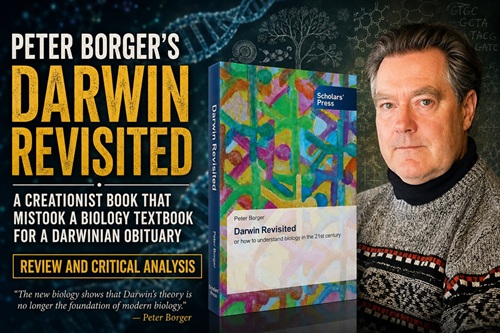
Introduction: From rhetoric to evidencePieter Borger's response to my review of Darwin Revisited is brief and emphatic: Selectionism, he says, was already refuted in the 1990s because biology turned out to be information-based and network-organized. He then dismisses Darwinism as an “atheists' religion.”
The rhetoric is clear enough. The scientific argument is less clear. Since Borger's book is heavily referenced and deals with molecular biology at a level that can be difficult for a non-specialist to evaluate, the appropriate response is not to attempt a citation-for-citation duel. Instead, we should take his major claims one by one and ask a simpler question: what does the cited biological evidence actually establish? This distinction is crucial. A scientific paper may establish that genomes are redundant, that regulatory networks are complex, that mutations can be non-random with respect to certain cellular processes, or that genes can arise through several mechanisms. None of these findings automatically establishes that common descent is false or that natural selection is an illusion. Indeed, Borger's own earlier publications provide an unusually useful starting point because they make his argument explicit. Claim 1: Natural selection was refutedThis is the claim that most urgently requires evidence. Borger's Darwin Revisited presents itself as an account of how twenty-first-century biology “ends the era of Darwin.” Its description says that genomes are “programmed to adapt” and organisms are “holistically designed.” But what exactly has been refuted? There is an enormous difference between saying that natural selection is not the sole mechanism of evolution and saying that natural selection is not an evolutionary mechanism at all. Modern evolutionary biology has never been restricted to natural selection. Mutation, recombination, genetic drift, gene flow, sexual selection, developmental constraints, genomic conflict, symbiosis and other processes all matter. The existence of these processes does not constitute a refutation of selection. It constitutes a more complicated evolutionary theory. Borger's own earlier work actually makes this distinction surprisingly explicit. In his paper on “baranomes,” he writes that creationists do not deny either variation or selection. What they deny is that variation and selection together can account for the origin of species. That is a much more precise proposition than “selection has been refuted.” And it is also much easier to test. Claim 2: Biology is information-based, therefore Darwinian evolution is obsoleteBiology is indeed profoundly informational. DNA stores sequence information. Regulatory regions control gene expression. Cells process signals. Feedback systems regulate physiological processes. Development depends upon extraordinarily complex interactions between genes, proteins and cellular environments. But there is a logical problem here. Showing that biological systems process information does not show that their information was intelligently designed. Nor does it show that natural selection is incapable of operating on such systems. In fact, evolution can be understood precisely as occurring in populations of information-bearing systems. Genetic variation changes heritable information; developmental and regulatory networks translate that information into phenotypes; environments affect reproductive success; and population processes change the distribution of variants over generations. Borger is therefore moving between two different questions. The first is a question of biological organization: How do living systems work? The second is a question of historical evolutionary origin: How did those systems acquire their present structure? Discovering that organisms are sophisticated information-processing systems answers the first question. It does not, by itself, answer the second. Claim 3: Networks contradict selectionThis is closely related to the information argument. Borger is an expert in molecular biology and has worked on gene-expression and signal-transduction networks. His book emphasizes precisely this complexity. But again, the conclusion does not follow. A network is not an alternative to evolution. It is something that evolves. The important evolutionary question is not whether genes function in isolation. They obviously do not. The question is whether variation in genes, regulatory elements and their interactions can be inherited and whether different variants can have different effects on survival and reproduction. A complex network may actually make evolutionary analysis more difficult, but difficulty is not refutation. This is a recurring problem in Borger's argument: he frequently identifies a genuine complication of evolutionary biology and then treats the complication as a falsification of evolutionary biology. Those are not the same thing. Claim 4: Genetic redundancy destroys the selection argumentThis is one of Borger's more concrete arguments. He points to experiments in which genes can be knocked out without producing an obvious lethal phenotype. He cites examples in bacteria in which only a minority of genes are classified as essential. From this he argues that genomes contain large amounts of redundancy and that this contradicts the Darwinian expectation that genes should have been shaped by selection. There is a legitimate biological observation here. Genomes do contain redundancy, dispensable genes and genetic robustness. But the inference is much stronger than the observation. If knocking out a gene has little effect under one set of laboratory conditions, this does not establish that the gene has no evolutionary history or no fitness consequences. Fitness is environment-dependent. A gene that is dispensable under laboratory conditions can become highly consequential under another environmental condition, during development, under infection, during nutritional stress or in combination with other mutations. More importantly, evolutionary theory does not predict that every gene must be individually indispensable. Genetic drift can allow neutral or nearly neutral variants to persist. Redundancy itself can evolve. Duplicated genes can acquire new functions. Genetic robustness can be maintained because organisms operate in complex systems rather than as collections of individually optimized components. So the observation “many genes are dispensable” is interesting. The conclusion “therefore natural selection is an illusion” is not demonstrated. Claim 5: New genetic information cannot ariseHere we reach the real heart of Borger's argument. His creationist model explicitly says that the evolutionary framework requires a “continuous addition of novel genetic information” and that this is impossible. Instead, he proposes “baranomes”: originally pluripotent genomes containing genetic elements that can subsequently be lost, rearranged or activated. This is a very important point because it exposes what the disagreement is actually about. Borger does not merely dispute Darwin's nineteenth-century mechanism. He proposes an alternative history of genomes: much of the information necessary for later biological diversity was already present in ancestral created genomes, and subsequent evolution primarily consists of loss, rearrangement and differential activation of this pre-existing information. That is a testable hypothesis. And contemporary evolutionary genetics provides a particularly serious problem for it: new genes can arise from previously non-genic DNA. A 2024 review in Nature Reviews Genetics summarizes evidence that, although many young genes derive from pre-existing genes or exons, a subset arises de novo from ancestral non-genic sequences. A 2024 Annual Review of Genetics similarly treats de novo gene birth as an established research field and describes genes arising from ancestrally non-genic sequences. And a review specifically concerning human evolution notes that genes and translated open reading frames can emerge de novo from previously non-coding sequences and can subsequently contribute to adaptation. This does not mean that every alleged de novo gene is unquestionably de novo. The literature explicitly discusses methodological difficulties in identifying them. That qualification is important. But it does mean that Borger's sweeping proposition that evolutionary novelty necessarily requires pre-existing genetic information is not something we can simply accept as established molecular biology. Claim 6: “Information” means that the genome was designedThis is where Borger's biological argument becomes a philosophical argument. The word “information” can be used in several different senses. In information theory, information has a precise mathematical meaning. In molecular biology, “genetic information” generally refers to the functional significance encoded or represented by sequences and regulatory systems. But neither usage entails an intelligent author. A genome can contain information in the biological sense without our having established an external intelligence as its source. Borger's argument effectively becomes: • Biological systems contain information. • Biological systems are highly organized. • Such organization resembles engineered systems. • Therefore biological systems were designed. The fourth step is not a result of molecular biology. It is an inference. And once that inference is recognized, the debate changes character. We are no longer simply comparing two descriptions of molecular mechanisms. We are comparing competing explanations of how biological organization originated. Claim 7: The “baranome” hypothesisBorger's proposed alternative is not merely negative. He offers a positive model. A “baranome” is conceived as a pluripotent, undifferentiated genome containing an extensive repertoire of genetic possibilities. Organisms subsequently diversify largely through loss, rearrangement and differential preservation of this originally supplied information. This is an ingenious concept. But ingenuity is not evidence. The crucial question is whether the baranome hypothesis makes successful predictions that evolutionary biology cannot make. Borger argues that variation-inducing genetic elements—what he calls VIGEs—were “frontloaded” into these genomes. His published model incorporates transposable elements, endogenous retroviruses, LINEs, SINEs, microsatellites and related sequences into this preloaded genetic architecture. But notice what has happened. The observed biological mechanisms are real. Transposable elements are real. Genome rearrangements are real. Gene duplication is real. Regulatory variation is real. Borger's additional claim is that these mechanisms were originally designed and frontloaded into genomes. That is not a discovery made by molecular biology. It is an interpretation placed on molecular biology. The crucial asymmetryThis may ultimately be the most important point in evaluating Darwin Revisited. Borger repeatedly takes mechanisms discovered by mainstream molecular biology and interprets them through a creationist framework. That is perfectly legitimate as a philosophical exercise. But it becomes problematic when the resulting interpretation is presented as though the underlying biological discoveries themselves have falsified evolutionary theory. The distinction can be expressed very simply: Observation: genomes contain extensive redundancy. Interpretation A: redundancy can persist through several evolutionary mechanisms, including drift, duplication, robustness and changing selection pressures. Interpretation B: redundancy reflects a primordial, designed genome containing genetic possibilities that were later lost. The observation does not choose between those interpretations by itself. The same applies to genomic networks, regulatory complexity, transposable elements, genetic robustness and non-coding DNA. And now we can understand Borger's rhetoricHis statement that Darwinism is an “atheists' religion” is therefore beside the scientific point. It may accurately describe Borger's perception of the philosophical implications of evolutionary theory. But calling a scientific theory a religion does not refute it. More importantly, it reverses the burden of proof. If Borger wants to replace common descent and evolutionary mechanisms with a designed, frontloaded genome model, he must demonstrate that his model explains the evidence better than evolutionary biology does. That requires more than showing that contemporary biology is complicated. It requires positive evidence for frontloading. It requires identifying the boundaries of the proposed created “kinds” independently of the desired conclusion. It requires explaining why genomes contain the particular distributions of shared sequences, mutations, duplications and regulatory structures that we observe. It requires demonstrating that supposed genetic “losses” provide a better explanation than evolutionary divergence. And it requires explaining observations such as the emergence of genes from previously non-genic DNA. That is a considerably higher evidential bar than pointing out that Darwin did not know about gene regulatory networks. The first result of the auditAfter this first pass, I would therefore modify one aspect of my original review. Borger should not be dismissed as someone who simply misunderstands molecular biology. He clearly knows a great deal about molecular mechanisms, and many of the biological phenomena he discusses are genuine and important. The problem lies elsewhere. He repeatedly moves from accurate observations about how biological systems work to much larger claims about what those observations imply about evolutionary history. Those transitions need to be examined individually. And there is already one particularly striking case. Borger says that selectionism was “refuted” decades ago. Yet his own earlier creationist paper says that creationists do not deny natural selection; they deny that variation and selection can explain the origin of species. That is not a minor semantic distinction. It means the real question is not whether natural selection exists. It is whether the mechanisms of mutation, recombination, duplication, regulatory change, gene birth, genetic drift and selection are sufficient to produce the diversity and novelty observed in life. That is the proposition we should now test. And fortunately, unlike the sweeping claim that “Darwinism is an atheists' religion,” that proposition can actually be investigated scientifically. Where we go nextThe next installment should tackle Borger's most consequential claims in greater detail: the supposed impossibility of “new genetic information,” his treatment of mutation and randomness, his interpretation of transposable elements and endogenous retroviruses, his argument from genetic redundancy, and finally his treatment of common ancestry and human evolution. Those are the places where his extensive bibliography will be most useful—not because a long reference list automatically validates his conclusions, but because we can go back to the cited papers and ask the decisive question: Did the scientists who produced these results actually reach Borger's conclusion?
Widget is loading comments...
|