|
TRANSLATE THIS ARTICLE
Integral World: Exploring Theories of Everything
An independent forum for a critical discussion of the integral philosophy of Ken Wilber
  Frank Visser, graduated as a psychologist of culture and religion, founded IntegralWorld in 1997. He worked as production manager for various publishing houses and as service manager for various internet companies and lives in Amsterdam. Books: Ken Wilber: Thought as Passion (SUNY, 2003), and The Corona Conspiracy: Combatting Disinformation about the Coronavirus (Kindle, 2020). Frank Visser, graduated as a psychologist of culture and religion, founded IntegralWorld in 1997. He worked as production manager for various publishing houses and as service manager for various internet companies and lives in Amsterdam. Books: Ken Wilber: Thought as Passion (SUNY, 2003), and The Corona Conspiracy: Combatting Disinformation about the Coronavirus (Kindle, 2020).
Check out my other conversations with ChatGPT
NOTES ON CREATIONISM
The Tree or the Forest? The Myth of Divine Design Genetic Gymnastics The Human Chromosome 2 Fusion Who's Who in Creationism Hox Genes and Their Relevance The GULO Gene Controversy Does DNA Point to a Creator? The Denial of Deep Time Fine-Tuning: The God of the Knobs The 'Historical Science' Gambit Beyond Creationism NOTES ON PETER BORGER Peter Borger's Darwin Revisited Auditing Borger's Case Against Evolution Where Borger's Molecular Argument Really Leads The Darwinian Straw Man A Summary of Peter Borger's Claims The Third Way of Evolution The Darwinian Straw ManHow Borger Turns Evolutionary Refinement into RefutationFrank Visser / ChatGPT
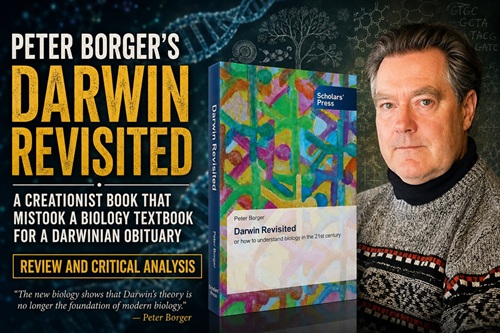
The strange claim that Darwinism has already diedPieter Borger's reaction to my review of Darwin Revisited was characteristically uncompromising: “Selectionisme werd in de 1990s al weerlegd, toen wij ontdekten dat biologie op informatie gebaseerd is en in netwerken functioneert.” Selectionism was refuted in the 1990s, he says, when we discovered that biology is based on information and operates through networks. He then adds the verdict: “Darwinisme is Atheïstenreligie. Geen wetenschap. Free Science Now!” This sounds decisive. But there is a problem. Almost everything in the first sentence that is scientifically interesting is true—and almost none of it implies that Darwinian evolution has been refuted. Modern biology really is informational. Biological systems really are organized into networks. Mutations really are affected by genomic context. Transposable elements really do generate genetic variation. Genes really can emerge from previously non-coding DNA. The remarkable thing is that contemporary evolutionary biology knows all of this. Indeed, much of what Borger presents as evidence against evolutionary theory is now part of the evidence base from which evolutionary theory has been expanded. The question is therefore not whether modern biology has moved beyond Darwin. It obviously has. The question is whether moving beyond Darwin's nineteenth-century biology means moving beyond evolution. It does not. Darwin did not know about DNA—and neither did the Modern SynthesisThere is a basic historical confusion underlying much of the anti-Darwinian rhetoric. Darwin knew nothing about DNA, genes, chromosomes, mutations in the modern molecular sense, transposable elements, endogenous retroviruses, gene regulatory networks or developmental genetics. Nobody expects him to have. The Modern Synthesis of the twentieth century subsequently connected Darwinian natural selection with Mendelian genetics and population genetics. Since then, evolutionary biology has continued to change. That is what successful science does. A scientific theory does not become false every time a new mechanism is discovered that was unknown to its founders. Newtonian mechanics did not become worthless because Einstein discovered relativity. Mendelian genetics did not become false because molecular genetics discovered DNA. Evolutionary theory does not become false because genomics discovered regulatory networks. The relevant question is whether the new evidence contradicts the core explanatory framework or enriches it. Borger repeatedly assumes the former. The evidence points much more strongly to the latter. The mutation argument is a perfect exampleConsider mutation. Borger is right that the old classroom formulation—“mutations are random”—can be misleading. Mutations are not uniformly distributed throughout genomes. Their probability depends on sequence context, DNA repair, chromatin state and other biological factors. Mutation biases can influence which evolutionary paths are more accessible. This is real science. But what does it refute? Modern evolutionary research treats mutation bias as a factor that can interact with selection. The important point is that a non-uniform supply of mutations changes the raw material available to evolution; it does not eliminate the subsequent processes by which variants increase or decrease in frequency. In other words, “mutation is not perfectly random” and “natural selection has been refuted” are not alternative descriptions of the same phenomenon. The first can be true without the second being remotely true. “Random” in evolutionary biology does not mean “without physical causes” or “every nucleotide change is equally probable.” It means, in the relevant evolutionary sense, that mutations are not generated according to the organism's future adaptive requirements. That distinction matters enormously. Evolutionary biology has already abandoned the caricatureThis is where Borger's argument becomes strangely outdated. He attacks a version of evolutionary theory in which organisms are imagined as passive containers whose genomes are randomly shuffled and then mechanically filtered by selection. Contemporary evolutionary biology does not look like that. Evolutionary researchers study developmental constraints, mutation biases, recombination, gene duplication, transposable elements, regulatory networks, genetic robustness, ecological interactions and many other processes. The evolutionary process is not simply “random mutation plus selection” in the simplistic sense. It is a dynamic interaction between the generation of variation, inheritance, development, ecological circumstances, drift and selection. The fact that the supply of variation is structured does not eliminate selection. It tells us what selection has available to work with. Networks do not refute evolutionBorger's appeal to biological networks has a similar problem. Cells are not collections of independent genes. Genes interact. Proteins interact. Regulatory pathways interact. Developmental processes interact with environmental conditions. Modern systems biology has made this abundantly clear. But why should this contradict evolution? A network is not an alternative to evolutionary history. It is a biological system whose components and interactions have evolutionary histories. Indeed, the evolution of regulatory networks is now a major field of research. This is especially obvious in the case of transposable elements. Recent evolutionary literature treats transposable elements as major contributors to evolutionary innovation: they can supply regulatory elements, alter gene networks and contribute genetic material to new host functions. That is almost exactly the phenomenon Borger wants to emphasize. But the scientific interpretation is radically different. For Borger, such sophisticated genomic machinery is evidence of prior design. For evolutionary biology, it is evidence that genomes themselves are historically dynamic systems capable of generating and co-opting novelty. The transposable-element trapThis is an excellent example of how Borger's rhetoric works. He points to something surprising, and the surprise is genuine. Transposable elements can move around genomes. They can alter gene regulation. They can contribute to genome architecture. Some have been co-opted for useful biological functions. So far, so good. Then comes the rhetorical leap: how could such sophisticated mechanisms possibly have evolved? But that is not an argument. It is a question. And the fact that a mechanism is sophisticated does not tell us its historical origin. Evolutionary biology has accumulated evidence that transposable elements are mobile genetic elements whose histories involve propagation, host conflict, suppression, co-option and functional integration. Their present usefulness does not imply that they were created with that usefulness in mind. That distinction is fundamental. It is the difference between evolutionary history and functional interpretation. The endogenous retrovirus argument has the same structureThe same applies to endogenous retroviruses. Some ancient viral sequences incorporated into genomes have subsequently acquired important functions. That is extraordinary. But it does not follow that they were inserted into genomes for that purpose. Evolution is full of what biologists call exaptation: structures or sequences that acquire a new function different from the one associated with their original origin. A structure can have one history and another function. The fact that an ancient viral sequence is now useful therefore does not tell us that usefulness was the reason it entered the genome. Again, Borger converts “this sequence now has a function” into “this sequence was placed here in order to have that function.” The second proposition requires additional evidence. The most damaging problem: new genesThe strongest empirical challenge to Borger's front-loading model may be the modern research on de novo genes. For a long time, evolutionary geneticists themselves tended to assume that new genes arose from existing genes, particularly through duplication and subsequent divergence. That made sense. But the picture has changed. Research summarized in Nature Reviews Genetics describes a subset of young, lineage-restricted genes arising de novo from ancestrally non-genic sequences. Other major reviews likewise treat de novo gene birth as an established area of evolutionary genetics, while emphasizing the technical difficulties involved in identifying genuine cases. This does not mean that every alleged de novo gene is beyond dispute. That would be an overstatement. The field itself discusses problems such as incomplete genome assemblies, annotation errors and extreme sequence divergence. But it does mean that Borger's sweeping claim that biological novelty must consist entirely of information already present in ancestral genomes is no longer a safe description of evolutionary genetics. The field is actively studying how previously non-genic sequences can acquire coding potential, expression and function. That is precisely the kind of phenomenon his front-loading model needs to explain. “Information” is not a substanceThis brings us to Borger's repeated use of the word “information.” The word has enormous rhetorical power because everybody understands what information means in ordinary language. But biological information is not a mysterious substance that has to be imported into a genome from outside. DNA sequences can acquire new functions through mutation, recombination, duplication, changes in regulation and other processes. A sequence that previously had no recognized coding function can become transcribed. An open reading frame can emerge. A peptide can acquire a biological effect. Selection can preserve a beneficial innovation. At every stage, one can describe the process in informational language. But the word “information” does not answer the causal question. The crucial question is: what physical and evolutionary processes produced the functional sequence? That is why the literature on de novo genes is so important. It investigates precisely that question rather than treating “information” as an explanatory endpoint. The front-loading hypothesis moves the problem rather than solving itBorger's baranome idea is clever. Suppose, he proposes, that ancestral genomes were packed with latent possibilities. Later biological diversity could then arise largely through rearrangement, activation and loss. This would indeed avoid having to explain the appearance of every evolutionary novelty from scratch. But there is an obvious question: where did all that latent information come from? If the answer is “the designer put it there,” then the theory has not explained the origin of biological information. It has stipulated an origin. The mystery has simply moved one step backward. Instead of asking how this biological information arose, we now ask why the designer put precisely this information into the ancestral genome, and what independent evidence identifies that designer and the original information. Unless those questions have empirical answers, front-loading is an interpretation, not an experimentally demonstrated mechanism. What would actually falsify Darwinian evolution?This is perhaps the most important question Borger's rhetoric never adequately answers. What observation would distinguish his model from evolutionary theory? Suppose we discovered a genomic pattern that could not plausibly arise through mutation, recombination, duplication, gene birth, drift, selection or other evolutionary processes. That would be important. Suppose comparative genomics consistently revealed that organisms fall into discrete, independently created groups with no nested pattern of shared ancestry. That would be important. Suppose genetic data repeatedly contradicted the predictions of common descent. That would be important. Those would constitute scientific challenges. But finding that genomes are complicated does not constitute such a challenge. Finding that mutations are biased does not. Finding that genes function in networks does not. Finding that transposable elements generate novelty does not. Finding that viral sequences have been co-opted does not. In fact, contemporary evolutionary research treats all of these as objects of evolutionary investigation. The remarkable resilience of evolutionary theoryThere is a deeper lesson here. Darwin's original theory was incomplete. Of course it was. Darwin did not know about genes. He did not know about DNA. He did not know about chromosomes. He did not know about genetic drift, molecular evolution, regulatory networks or transposable elements. But evolution by common descent and natural selection turned out not to be a fragile theory that collapsed when these mechanisms were discovered. It proved to be a framework capable of absorbing them. That is precisely what we should expect from a productive scientific theory. The history of evolutionary biology since Darwin is therefore not the history of a theory being repeatedly refuted. It is the history of a theory being progressively elaborated. The rhetorical inversionThis leads to what I think is the fundamental weakness in Borger's presentation. He takes the sophistication of modern biology as evidence against evolutionary theory. But sophistication is exactly what evolutionary biology has discovered once we acquired the tools to investigate living systems at the molecular level. Genes are not simple. Genomes are not static. Variation is not homogeneous. Development matters. Regulation matters. Ecology matters. History matters. None of these facts abolishes evolution. They tell us what evolution is actually like. The caricature has died. Darwin has not. And what about the “atheist religion”?Finally, Borger's statement that Darwinism is an “atheists' religion” should be left where it belongs: outside the scientific argument. There are religious scientists who accept evolution and atheists who reject particular evolutionary interpretations. The philosophical implications of evolution are a legitimate subject of discussion, but they are not empirical evidence for or against the mechanisms of evolution. Calling a scientific theory a religion does not falsify it. If Borger believes that evolutionary biology is wrong, he has an opportunity far more powerful than rhetoric. He can show where its empirical predictions fail. He can show where comparative genomics contradicts common ancestry. He can show that de novo gene birth does not occur. He can show that selection cannot account for observed changes in allele frequencies and phenotypes. He can show that the baranome hypothesis makes successful predictions that evolutionary theory cannot make. Those would be scientific arguments. “Darwinism is an atheists' religion” is not. The real verdictAfter examining the strongest version of Borger's molecular argument, I would therefore put the matter this way. Borger has identified many real features of modern biology that the simplistic Darwinian caricature fails to capture. But contemporary evolutionary biology already knows this. The important discovery is not that biology is more complicated than Darwin thought, therefore Darwin was wrong. It is that biology is more complicated than Darwin thought, therefore our understanding of evolution has become more sophisticated. That is a very different conclusion. Borger's mistake is not necessarily in seeing complexity, information, networks, genomic plasticity or mutation bias. His mistake is in assuming that these phenomena constitute alternatives to evolution when they can instead be understood as components of the evolutionary process. And the irony is sharp. Modern evolutionary research increasingly describes transposable elements as sources of evolutionary innovation and investigates genes arising from previously non-genic sequences. The field is not standing still, defending an obsolete nineteenth-century model. It is actively investigating the very phenomena Borger presents as evidence against it. That is not what a scientific field looks like after its central mechanism has been refuted. It looks like a scientific field discovering how much more interesting its central mechanism actually is. And perhaps that is the real lesson of Darwin Revisited. Borger has not shown us the death of Darwin. He has shown us, perhaps unintentionally, how little resemblance contemporary evolutionary biology bears to the simplified version of Darwinism he is attacking.
Widget is loading comments...
|