|
TRANSLATE THIS ARTICLE
Integral World: Exploring Theories of Everything
An independent forum for a critical discussion of the integral philosophy of Ken Wilber
  Frank Visser, graduated as a psychologist of culture and religion, founded IntegralWorld in 1997. He worked as production manager for various publishing houses and as service manager for various internet companies and lives in Amsterdam. Books: Ken Wilber: Thought as Passion (SUNY, 2003), and The Corona Conspiracy: Combatting Disinformation about the Coronavirus (Kindle, 2020). Frank Visser, graduated as a psychologist of culture and religion, founded IntegralWorld in 1997. He worked as production manager for various publishing houses and as service manager for various internet companies and lives in Amsterdam. Books: Ken Wilber: Thought as Passion (SUNY, 2003), and The Corona Conspiracy: Combatting Disinformation about the Coronavirus (Kindle, 2020).
Check out my other conversations with ChatGPT
NOTES ON CREATIONISM
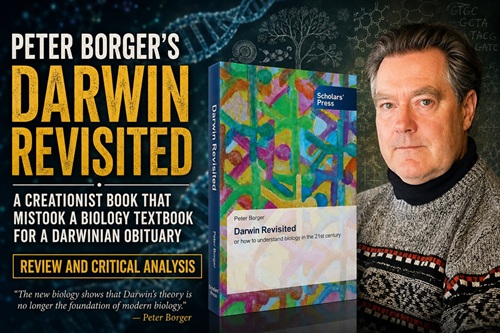
The Tree or the Forest? The Myth of Divine Design Genetic Gymnastics The Human Chromosome 2 Fusion Who's Who in Creationism Hox Genes and Their Relevance The GULO Gene Controversy Does DNA Point to a Creator? The Denial of Deep Time Fine-Tuning: The God of the Knobs The 'Historical Science' Gambit Beyond Creationism NOTES ON PETER BORGER Peter Borger's Darwin Revisited Auditing Borger's Case Against Evolution Where Borger's Molecular Argument Really Leads The Darwinian Straw Man A Summary of Peter Borger's Claims The Third Way of Evolution Peter Borger's Darwin RevisitedWhere Borger's Molecular Argument Really LeadsFrank Visser / ChatGPT
The strongest version of Borger's argumentIn the first part of this audit, I argued that Borger's central problem is not that his biological observations are necessarily false. Many are perfectly genuine. The problem is the transition from those observations to his much larger conclusion that Darwinian evolution has been refuted. The next step is therefore to examine the more sophisticated version of his argument. Borger does not simply say that organisms mutate. He argues that variation is actively generated by biological systems. He points to gene regulation, transposable elements, recombination, DNA repair, endogenous retroviruses and other genomic mechanisms. He groups such mechanisms under the label “variation-inducing genetic elements,” or VIGEs. In his terminology, these mechanisms provide organisms with an internally controlled capacity to generate variation. This is much more interesting than the crude claim that “mutations are not random.” And it deserves to be taken seriously. But when we compare Borger's interpretation with the evolutionary literature, something striking happens: modern evolutionary biology has already incorporated many of the phenomena he presents as revolutionary. The disagreement is largely about what they mean. 1. Is mutation really random?Here Borger has a point—but only up to a point. The textbook phrase “random mutation” is potentially misleading. Mutations are not uniformly distributed throughout genomes. Different kinds of DNA lesions occur at different frequencies. DNA replication, repair mechanisms, chromatin structure, nucleotide chemistry and genomic context all influence the probability that particular changes will occur. More recent work has made this even clearer. Studies of Arabidopsis thaliana, for example, have found substantial mutation biases associated with genomic and epigenomic features. Mutation rates can differ systematically between functionally constrained and less constrained regions. A broader review of mutation-biased adaptation likewise concludes that mutation bias can influence the evolutionary trajectories available to populations. Some mutational changes are simply more likely to occur than others, and that can make some evolutionary paths more accessible than others. So if Borger's claim is: Mutations are not literally an equiprobable random sampling of every possible DNA change. Then yes. Modern evolutionary biology agrees. But this does not refute natural selection. It changes the relationship between mutation and selection. The evolutionary process can be represented schematically as: mutation bias → available variation → selection/drift → changing population frequencies rather than: perfectly random mutation → selection The first formulation is more realistic. But selection has not disappeared. 2. “Random” does not mean “without causes”This distinction is especially important. When evolutionary biologists traditionally say that mutations are random, they do not mean that mutations have no physical causes. Obviously they do. They mean something more specific: mutations are not generated because the organism “needs” a particular adaptive phenotype. That distinction remains crucial. Suppose bacteria are exposed to an antibiotic. Stress can activate DNA-repair and mutagenic pathways. Some of the resulting mutations may confer antibiotic resistance. The mutational process can therefore be regulated and context-dependent. But this does not mean that bacteria inspect their environment, determine which mutation would solve the problem and then manufacture that specific mutation. The literature on stress-induced mutagenesis is quite explicit about this. Increased mutation rates under stress can facilitate adaptation, but the mechanisms involve complex interactions among selection, evolvability, mutation and genetic drift. A major review of “adaptive mutation” similarly notes that the original idea that mutations were specifically directed toward genes under selection was not supported by the evidence examined. Instead, stress responses generate altered mutation processes with particular molecular mechanisms. That is a very different proposition from Lamarckian directed mutation. 3. The interesting case of mutation biasThere is, however, a more subtle point here that actually strengthens rather than weakens the scientific critique of Borger. Evolutionary biology is increasingly interested in the fact that mutation bias itself can influence evolution. If mutation A is a hundred times more likely than mutation B, then—even if both would produce similar fitness advantages—A has a greater chance of appearing. Consequently, evolution is not simply a matter of selection choosing among an unlimited menu of equally accessible possibilities. The supply of variation matters. This has led to serious theoretical work on “mutation-biased adaptation.” Reviews explicitly argue that mutation bias can orient evolutionary trajectories and make evolutionary outcomes more predictable. This is an important refinement of the classical synthesis. But notice what it does not say. It does not say: Natural selection has been refuted. It says: Natural selection operates on a non-randomly structured supply of variation. That is a significant conceptual development, but it is not the overthrow of Darwin. 4. Borger's VIGEsNow we reach the centerpiece of his argument. Borger and his collaborators have proposed the concept of “variation-inducing genetic elements.” These include mechanisms such as transposable elements, regulatory sequences and other genomic systems capable of generating structural and regulatory variation. Borger's work explicitly presents these elements as mechanisms by which genomes can generate variation from within. There is nothing inherently controversial about the observation. Transposable elements really do alter genomes. They can move within genomes, influence gene regulation, promote rearrangements and occasionally contribute raw material for evolutionary innovation. The problem begins when Borger moves from: “These mechanisms generate variation” to: “Therefore genomes were designed with these mechanisms to generate the variation required for future adaptation.” That second proposition does not follow from the first. 5. A mechanism does not explain its own originThis is perhaps the most important logical problem in the VIGE argument. Imagine discovering that an automobile contains a sophisticated mechanism that regulates fuel injection. You could legitimately conclude: This mechanism regulates fuel injection. But you could not conclude from that observation alone: Therefore the automobile was designed specifically to contain this mechanism. The latter requires independent evidence about origin. Likewise, finding a genomic mechanism that generates variation tells us how variation can be generated. It does not by itself tell us whether that mechanism originated through evolution, was designed by an intelligence, or arose through some combination of historical processes. Borger effectively inserts the word “designed” into the explanation. But that is the very thing he needs to demonstrate. 6. Transposable elements are not a Darwinian embarrassmentThis is another place where Borger's argument initially sounds more devastating than it is. Transposable elements were once described primarily as genomic parasites or “junk.” That simple picture has indeed been revised. We now know that transposable elements can influence gene regulation, genome architecture and evolutionary innovation. But this is not evidence against evolution. It is evidence that evolution has more raw material than early geneticists appreciated. Borger's own work explicitly argues that endogenous retroviruses and related elements may function as VIGEs and may have played important roles in protein evolution, gene structure and transcriptional regulation. The mainstream evolutionary interpretation is quite capable of accommodating this. An element can originate through one historical process, subsequently insert itself elsewhere, alter regulation, occasionally produce a beneficial effect, and then be retained or eliminated depending on its consequences. Evolution does not require every useful mechanism to have been invented specifically for its present function. That distinction is fundamental. 7. The endogenous retrovirus argumentBorger's treatment of endogenous retroviruses is particularly revealing. An endogenous retrovirus is essentially viral genetic material incorporated into a host genome and inherited through generations. Borger emphasizes the remarkable fact that some such elements have acquired important biological functions. This is genuinely fascinating. Some endogenous viral sequences have been co-opted by hosts for regulatory or other functions. The phenomenon is often described as exaptation or molecular co-option. But again, there are two possible interpretations. The evolutionary interpretation is: Viral genetic material entered ancestral genomes. Some insertions were neutral or harmful; some persisted. Occasionally, host organisms co-opted particular sequences for useful functions. Those useful functions could subsequently be maintained by selection. The design interpretation is: Viral sequences were intentionally incorporated into genomes because they were intended to function as variation-generating elements. Both interpretations can describe the present-day function. But only one is an evolutionary hypothesis. And the second interpretation needs independent evidence for the supposed designer. 8. The “front-loading” problemThis leads directly to Borger's baranome hypothesis. The basic idea is that ancestral genomes were extraordinarily rich in potential variation. Later diversity therefore represents the expression, rearrangement or loss of pre-existing genetic possibilities rather than the creation of fundamentally new biological information. This is attractive because it seems to solve a perceived problem: How could random mutation generate so much biological complexity? But the answer depends entirely on whether the supposed original information was actually present. If Borger says that a primordial genome already contained all the genetic possibilities required for subsequent diversification, then the scientific question becomes: Where is the evidence for that primordial information? And this is where his model faces a serious empirical challenge. Modern comparative genomics finds evidence for genes that arise from previously non-genic DNA. 9. De novo genes are particularly awkward for the baranome modelThis is one of the strongest points we have encountered so far. The existence and importance of de novo gene birth has become an established area of evolutionary genetics. A 2012 Nature paper described a continuum from non-genic sequences through proto-genes to functional genes and found evidence that previously non-genic sequences could provide adaptive potential. A 2024 Nature Reviews Genetics article summarizes the subsequent development of the field and notes that a subset of young, lineage-restricted genes arises de novo from ancestrally non-genic sequences. A 2024 Nature Communications study identified hundreds of candidate de novo genes in Drosophila lineages, supported by ancestral non-coding sequences. And this is not merely an old and controversial idea that has been sitting in the literature untouched. A 2025 Nature Reviews Genetics article describes de novo gene birth as a major development in the field and discusses the evolutionary continuum between non-coding and coding DNA. Most significantly, a 2026 review in Nature Reviews Genetics—published only months ago—specifically reviews the emergence and evolution of protein-coding de novo genes from previously non-coding sequences. It describes the mechanisms by which such genes arise and the evolutionary processes by which they acquire functions. This doesn't prove that every alleged de novo gene is genuinely de novo. The field itself recognizes substantial methodological problems in distinguishing genuine de novo birth from extreme sequence divergence or incomplete annotation. But it does establish something important: The proposition that evolutionary novelty must always consist of information already present in an ancestral genome is not supported by the current literature. 10. This is where “new genetic information” becomes a misleading phraseBorger's argument frequently revolves around “new genetic information.” But what exactly counts as “new information”? If a previously non-coding DNA sequence acquires a promoter, becomes transcribed, acquires an open reading frame, produces a peptide, and that peptide subsequently acquires a function that increases reproductive success, then something evolutionarily novel has happened. One can argue about whether “information” is the best philosophical description. But the biological event is real. A previously non-genic sequence has become part of the functional genome. That is precisely why the modern literature talks about a continuum from non-coding DNA to proto-genes to genes rather than treating “gene” and “non-gene” as two completely separate categories. This is important because Borger's argument often treats information as if it were a conserved substance. But genetic evolution is not a bookkeeping system in which a fixed quantity of “information” must be transferred from one generation to the next. Genomes are dynamic. Sequences are duplicated, deleted, rearranged, co-opted, fragmented, recombined, transferred and occasionally converted into new functional elements. The question is therefore not: “Where did the information come from?” in the abstract. It is: “What molecular processes generated this particular novel functional sequence, and what happened to it afterward?” That is a much more scientifically tractable question. 11. The irony of Borger's argumentThere is an interesting irony here. Borger wants to replace Darwinian evolution with a model in which organisms possess sophisticated internal mechanisms for generating variation. But evolutionary biology has been moving in precisely that direction. Modern evolutionary genetics does not regard genomes as passive strings of DNA waiting for copying errors. It studies: • mutation biases; • DNA repair; • recombination; • gene duplication; • transposable elements; • horizontal gene transfer; • gene regulatory networks; • epigenetic effects; • genome rearrangements; • developmental constraints; • genetic robustness; • de novo gene birth; • ecological feedback; • and selection acting at multiple levels. A recent review of evolutionary innovation, for example, explicitly discusses gene duplication, regulatory network co-option, transposable elements and de novo genes as sources of evolutionary novelty. That is not the collapse of evolutionary theory. It is the expansion of evolutionary theory. 12. The real target may be the old Modern Synthesis caricatureThis suggests a much more charitable interpretation of Borger. Perhaps the strongest version of his argument is not: “Evolution does not happen.” It is: “The simplistic Modern Synthesis picture in which random mutation generates variation and natural selection merely filters it is inadequate.” If that is his claim, then there is considerable common ground. Evolutionary biology itself has spent decades demonstrating exactly that. Mutation is biased. Development constrains evolutionary possibilities. Genomes are structured systems. Regulatory networks matter. Variation can be generated through mechanisms other than simple nucleotide substitutions. Selection does not operate on naked genes in isolation. Evolution is historically contingent and path-dependent. All of this is mainstream science. But that makes Borger's rhetorical claim that “selectionism was refuted in the 1990s” even more problematic. What was being revised was not evolution itself. It was the simplistic representation of how evolutionary mechanisms interact. 13. The crucial distinction: generating variation versus explaining adaptationWe can now formulate the central conceptual distinction much more sharply. Borger is strongest when discussing variation generation. Evolutionary biology asks an additional question: What happens to that variation in populations? Suppose a genome contains a transposable element capable of creating a novel regulatory configuration. That gives us variation. But the subsequent history of that variant still matters. Does it disappear? Does it drift? Does it become fixed? Does it reduce fitness? Does it increase fitness? Does it become beneficial only under particular environmental circumstances? Does selection preserve it? Does another mutation compensate for its costs? These are evolutionary questions. A mechanism that produces variation does not replace population genetics. It supplies population genetics with something to work on. 14. What Borger would actually have to demonstrateThe burden of proof can now be stated very precisely. To refute the evolutionary framework, Borger would need to demonstrate something substantially stronger than the existence of VIGEs. He would need to show that the observed mechanisms of mutation, recombination, duplication, transposition, gene birth and selection cannot account for the observed history of biological diversity. Alternatively, he could provide positive evidence that the supposedly preloaded information of the baranome model existed before the diversification it allegedly produced. That evidence would have to be independently detectable. Otherwise “frontloading” simply moves the unexplained information backward in time. Instead of asking: How did evolution generate this information? we would ask: How did the designer put all this information into the ancestral genome? The mystery has not been solved. It has been relocated. 15. And this brings us back to the word “design”At this point, Borger's argument becomes philosophically transparent. The molecular evidence tells us that genomes are extraordinarily complex systems capable of generating, modifying and sometimes preserving variation. Borger interprets that complexity as evidence of intentional design. But complexity is not itself a diagnostic signature of design. Nor is information. Nor is functionality. Those are characteristics that a designed system can possess. They are not, by themselves, demonstrations that a system was designed. The decisive evidence would have to distinguish design from evolutionary history. That is the step Borger has not established. Conclusion: A more complicated Darwin, not the end of DarwinThe deeper we go into Borger's molecular argument, the less convincing his claim that modern biology has “refuted” Darwin becomes. Something much more interesting has happened. The simple nineteenth-century picture of evolution has been transformed by twentieth- and twenty-first-century biology. We now know that genomes are dynamic systems. Mutation is biased. Regulatory networks matter. Transposable elements can generate novelty. Viral sequences can be co-opted. Genes can duplicate, fuse, split and sometimes arise de novo from previously non-coding DNA. None of this was known to Darwin. But none of it requires abandoning evolution. Indeed, the evolutionary research program has proved remarkably capable of incorporating these discoveries. The real scientific question is therefore not whether biology is “information-based” or whether genomes function as networks. Of course they do. The question is whether those facts constitute evidence for intelligent design or merely reveal the extraordinarily sophisticated mechanisms through which evolution operates. At present, Borger's argument establishes the sophistication. It does not establish the designer. And that distinction is precisely where his rhetoric outruns his evidence.
Widget is loading comments...
|