|
TRANSLATE THIS ARTICLE
Integral World: Exploring Theories of Everything
An independent forum for a critical discussion of the integral philosophy of Ken Wilber
  Frank Visser, graduated as a psychologist of culture and religion, founded IntegralWorld in 1997. He worked as production manager for various publishing houses and as service manager for various internet companies and lives in Amsterdam. Books: Ken Wilber: Thought as Passion (SUNY, 2003), and The Corona Conspiracy: Combatting Disinformation about the Coronavirus (Kindle, 2020). Frank Visser, graduated as a psychologist of culture and religion, founded IntegralWorld in 1997. He worked as production manager for various publishing houses and as service manager for various internet companies and lives in Amsterdam. Books: Ken Wilber: Thought as Passion (SUNY, 2003), and The Corona Conspiracy: Combatting Disinformation about the Coronavirus (Kindle, 2020).
Check out my other conversations with ChatGPT
DEEPER WILBERIAN DIVES: Already Enlightened? The Mirage of the Absolute Spirit or Selection? On Cosmic Certainty The Integral Fortress The Integral Emperor Winding Up or Down? Is Integral Anti-Fragile? Integral without Overreach Spirit or Selection?Ken Wilber's Most Controversial Statement on EvolutionFrank Visser / ChatGPT
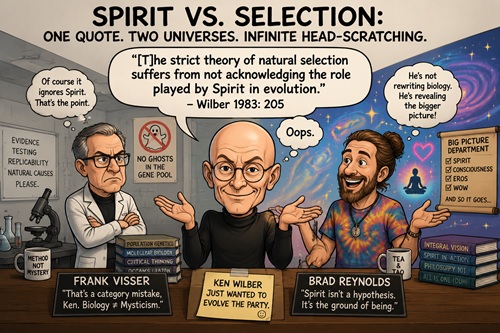 A Single Sentence That Revealed a Fault LineAmong the many provocative statements Ken Wilber has made over the decades, few have generated as much disagreement as this sentence from Eye to Eye (1983): "[T]he strict theory of natural selection suffers from not acknowledging the role played by Spirit in evolution." (Wilber 1983: 205) At first glance, this may sound like a harmless attempt to broaden evolutionary theory. But beneath the surface lies a profound disagreement about the nature of science itself. Is Wilber merely adding a spiritual dimension to evolution? Or is he rejecting one of the central pillars of modern biology? No two longtime interpreters of Wilber illustrate this divide more clearly than Frank Visser and Brad Reynolds. Both have studied Wilber for decades. Both admire aspects of his work. Yet they arrive at almost opposite conclusions about what this sentence means—and whether it should be defended. Wilber's Early Evolutionary VisionIn Eye to Eye, Wilber was already developing the cosmology that would later become famous through Sex, Ecology, Spirituality. Reality, he argued, unfolds through increasingly complex levels of organization—from matter to life to mind to Spirit. For Wilber, evolution is not merely a mechanical process. It is driven by what he variously calls Eros, Spirit-in-action, or the self-transcending tendency inherent in the Kosmos. Natural selection, in this picture, explains survival but not creativity. Wilber repeatedly argued that Darwinian evolution can explain why organisms survive once they exist but cannot explain why genuinely new forms emerge in the first place. Something deeper, he believed, is pushing evolution toward greater complexity and consciousness. Hence his criticism: Natural selection "suffers" because it ignores Spirit. What Does Evolutionary Biology Actually Claim?This criticism immediately raises a problem. Modern evolutionary biology has never claimed that Spirit plays a role in evolution. Nor does it regard this as an omission. Evolutionary theory explains adaptive complexity through interacting mechanisms including mutation, recombination, genetic drift, developmental constraints, gene duplication, exaptation, ecological interactions, and natural selection. Natural selection is only one component of evolutionary theory. Even in 1983, population genetics had long moved beyond a simplistic "selection alone" picture. Most importantly, science deliberately limits itself to natural causes that can be observed, measured, and tested. Spirit may or may not exist. But it is not a scientific explanatory variable. Frank Visser: A Category MistakeFrank Visser has consistently argued that Wilber commits a fundamental category mistake. According to Visser, Wilber is criticizing biology for failing to include something biology was never designed to include. Science investigates empirical mechanisms. Mysticism investigates subjective experience. Confusing these domains weakens both. Visser therefore reads the famous sentence quite literally. Wilber is saying that Darwinian theory is deficient because it ignores Spirit. Visser's response is straightforward: Of course it ignores Spirit. That is precisely what makes it science. From this perspective, Wilber's criticism resembles faulting chemistry for ignoring angels or astronomy for ignoring astrology. The omission is intentional. It reflects methodological naturalism rather than philosophical materialism. Visser also points out that Wilber often presents Spirit not merely as a symbolic metaphor but as an actual causal force operating throughout evolution. That transforms a religious intuition into an empirical claim. Once Spirit is proposed as a cause of evolutionary novelty, Visser argues, it becomes subject to scientific standards of evidence—and none are forthcoming. Brad Reynolds: Spirit Is Not a Scientific HypothesisBrad Reynolds interprets the same sentence very differently. He argues that critics like Visser misunderstand Wilber by reading him too literally. According to Reynolds, Wilber is not attempting to rewrite evolutionary biology. Instead, Wilber is describing evolution from a larger metaphysical perspective. Science studies efficient causes. Spirit represents the deeper ground within which those causes unfold. Natural selection remains valid. It is simply incomplete because it addresses only the exterior dimension of reality. For Reynolds, Wilber is offering philosophy, not biology. Spirit is not competing with genes. It is the ultimate context within which genes themselves exist. Consequently, Reynolds sees Visser's criticism as based on a category confusion of its own: demanding empirical evidence for something that was never intended as an empirical hypothesis. But Wilber's Own Words Resist This DefenseThe difficulty with Reynolds' interpretation is that Wilber himself repeatedly presents Spirit as more than a purely philosophical backdrop. Throughout his writings, Wilber asks how random mutation could possibly generate increasing complexity. He frequently contrasts chance with Eros, suggesting that Spirit actively contributes something that ordinary evolutionary mechanisms cannot. The wording in Eye to Eye is revealing. He does not merely say: "Natural selection describes only one aspect of evolution." Nor does he write: "Science understandably brackets metaphysical questions." Instead he says that the theory suffers from failing to acknowledge Spirit. That is a criticism directed at the theory itself. If Wilber merely intended a complementary philosophical perspective, he chose unusually strong language. Indeed, throughout the 1980s and 1990s he repeatedly described natural selection as radically insufficient without Eros. His later terminology became somewhat more sophisticated, but he never explicitly withdrew the underlying claim. A Persistent PatternThis disagreement reflects a larger pattern in Wilber scholarship. Visser consistently interprets Wilber's cosmological statements at face value. If Wilber says Spirit guides evolution, Visser assumes he means exactly that and asks for evidence. Reynolds tends to interpret Wilber more charitably, often translating apparently empirical claims into symbolic, phenomenological, or metaphysical language. Both approaches have their strengths. Visser emphasizes textual precision and scientific accountability. Reynolds emphasizes philosophical depth and experiential meaning. But they often end up discussing different versions of Wilber. The Real IssueThe debate ultimately revolves around a simple question. When Wilber writes about Spirit in evolution, is he making a factual claim about how biological evolution actually works? Or is he expressing a metaphysical interpretation that accompanies—but does not replace—scientific explanation? Wilber's own writings frequently blur this distinction. At times he insists that science cannot explain increasing complexity without Spirit. At other times he describes Spirit as the ever-present ground of all phenomena. These are not equivalent claims. One competes with biology. The other transcends biology. Much of the controversy surrounding Wilber's evolutionary thought arises because he moves between these positions without clearly distinguishing them. ConclusionThe sentence from Eye to Eye remains one of the clearest windows into Wilber's intellectual project—and one of its greatest vulnerabilities. For Frank Visser, it exemplifies Wilber's tendency to insert metaphysical assumptions into scientific explanation, thereby confusing two fundamentally different kinds of inquiry. Science does not "suffer" from excluding Spirit; it succeeds precisely because it confines itself to natural, testable causes. For Brad Reynolds, the sentence expresses a philosophical truth rather than a biological hypothesis. Wilber is not correcting Darwin but placing Darwin within a larger spiritual vision of reality. The irony is that both interpretations find support in Wilber's writings. Yet if one takes Eye to Eye at face value, the wording favors Visser's reading. Wilber did not simply supplement evolutionary theory with a spiritual perspective. He explicitly judged the theory to be deficient because it failed to recognize Spirit as part of evolution itself. That remains a remarkable claim—not because it expands biology, but because it asks biology to become something it has never claimed to be: a vehicle for metaphysical revelation. Appendix: “The Modern Theory of Evolution Is Catastrophically Incomplete!”Among Ken Wilber's more memorable pronouncements on evolution is the claim that “the modern theory of evolution is catastrophically incomplete.” The rhetorical force of this statement is unmistakable. Evolutionary biology, according to Wilber, has suffered not merely from minor omissions but from a fundamental failure to account for the deepest realities of the evolutionary process.[1] Yet this claim raises an immediate question: incomplete in what sense? If the criticism concerns the scientific mechanisms of evolution—mutation, recombination, natural selection, genetic drift, developmental constraints, ecological interactions, and the many processes studied by contemporary evolutionary biology—then Wilber's statement is difficult to defend. Modern evolutionary theory has expanded enormously since the so-called Modern Synthesis of the mid-twentieth century. Far from being static genetic reductionism, contemporary evolutionary biology incorporates epigenetic inheritance, evo-devo, niche construction, horizontal gene transfer, symbiosis, multilevel selection, and evolutionary developmental constraints. Whether one calls this an “Extended Evolutionary Synthesis” or simply the ongoing refinement of evolutionary theory, the field has become more complex, not less. The irony is that Wilber's criticism often targets a caricature of evolutionary biology: the idea that orthodox Darwinism claims that organisms are nothing more than accidental collections of selfish genes blindly pushed around by random mutation. But serious evolutionary biology has never been committed to such a simplistic picture. Even Richard Dawkins' famous “selfish gene” metaphor was intended to clarify the logic of selection, not to deny organismic complexity, cooperation, development, or emergent properties. What Wilber appears to find “catastrophically incomplete” is not primarily evolutionary biology as an empirical science, but its refusal to endorse his preferred metaphysical interpretation of evolution. In Wilber's framework, evolution is not merely a biological process but an expression of Eros in the Kosmos—an inherent drive toward greater complexity, consciousness, and Spirit. Evolutionary science describes the mechanisms, but, according to Wilber, it misses the “interior” dimension and ultimate significance of the process. Here the argument changes categories. It moves from science to philosophy—from explaining evolutionary change to interpreting its significance. There is nothing illegitimate about asking whether evolution has existential, philosophical, or spiritual implications. Many scientists and philosophers have done so. But a philosophical interpretation cannot be presented as if it were a missing scientific component. The danger is that the accusation of “incompleteness” becomes unfalsifiable. Any scientific theory that refuses to include a metaphysical assumption will appear incomplete from the perspective of someone who already accepts that assumption. A physicist who believes consciousness is fundamental might say that physics is “catastrophically incomplete” because it does not include subjective experience. A panpsychist might say the same. A theist might argue that biology is incomplete because it excludes divine purpose. But these are philosophical critiques, not empirical discoveries. Wilber's phrase therefore reveals a recurring pattern in his writings: he identifies a genuine limitation of science—that science does not answer every human question—and then quietly transforms that limitation into evidence for his own metaphysical framework. Evolutionary biology explains how life diversifies; Wilber wants to explain why the universe evolves toward consciousness. Those are different projects. The irony is that the scientific story of evolution is already far richer than Wilber's frequent descriptions suggest. Evolutionary biology does not portray life as a meaningless accident. It reveals astonishing processes of emergence, cooperation, complexity, and creativity without requiring an additional cosmic force. The evolution of complexity is itself a scientific question, involving energy flows, self-organization, developmental constraints, ecological networks, and historical contingency. The real incompleteness, then, may not lie in evolutionary theory but in the expectation that a scientific theory should also function as a metaphysical worldview. Evolutionary biology is incomplete if asked to provide a theory of ultimate meaning. But that is not a defect of biology. It is a category mistake. Wilber's “catastrophically incomplete” diagnosis says less about the state of evolutionary science than about his own dissatisfaction with a universe that, from a scientific perspective, does not come with its purpose already written into the equations. NOTE[1] See: Frank Visser, "The Modern Theory of Evolution Is Catastrophically Incomplete!, Ken Wilber's Emotive Dealings with Evolutionary Theory", www.integralworld.net, September 2019.
Widget is loading comments...
|