|
TRANSLATE THIS ARTICLE
Integral World: Exploring Theories of Everything
An independent forum for a critical discussion of the integral philosophy of Ken Wilber
  Frank Visser, graduated as a psychologist of culture and religion, founded IntegralWorld in 1997. He worked as production manager for various publishing houses and as service manager for various internet companies and lives in Amsterdam. Books: Ken Wilber: Thought as Passion (SUNY, 2003), and The Corona Conspiracy: Combatting Disinformation about the Coronavirus (Kindle, 2020). Frank Visser, graduated as a psychologist of culture and religion, founded IntegralWorld in 1997. He worked as production manager for various publishing houses and as service manager for various internet companies and lives in Amsterdam. Books: Ken Wilber: Thought as Passion (SUNY, 2003), and The Corona Conspiracy: Combatting Disinformation about the Coronavirus (Kindle, 2020).
Check out my other conversations with ChatGPT
DEEPER WILBERIAN DIVES: Already Enlightened? The Mirage of the Absolute Spirit or Selection? On Cosmic Certainty The Integral Fortress The Integral Emperor Winding Up or Down? Is Integral Anti-Fragile? Integral without Overreach The Mirage of the AbsoluteWhy Consciousness Need Not Be a Window into Ultimate RealityFrank Visser / ChatGPT
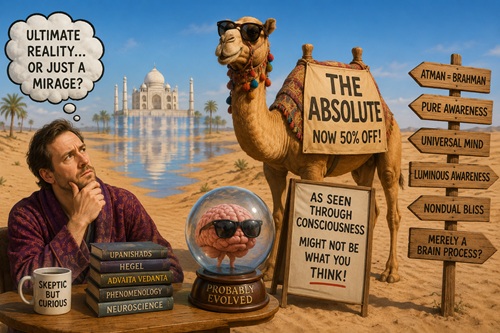 Human beings have always been puzzled by consciousness. Unlike rocks, stars, or brains, consciousness cannot be placed on a laboratory table. It is the one phenomenon we know directly from the inside, while everything else is known through observation. This peculiar status has tempted countless philosophers, mystics, and theologians to conclude that consciousness must be something fundamentally different from the rest of nature. If it cannot be objectified, perhaps it is the Absolute itself. From the Upanishads to German Idealism, from Advaita Vedanta to modern nondual spirituality, this inference appears again and again: consciousness is not merely another feature of reality—it is Reality with a capital R. But does the mystery of subjectivity really justify such a leap? Or are we witnessing a thoroughly human tendency to elevate what we cannot explain into something metaphysically privileged? The Irreducible First-Person PerspectiveThere is no denying that consciousness presents a unique challenge. Everything we investigate scientifically appears as an object. Galaxies, atoms, neurons, even our own brains can be observed from the outside. Conscious experience, however, is only directly available to the subject experiencing it. Thomas Nagel famously asked what it is like to be a bat. Frank Jackson imagined the scientist Mary, who knows everything about color vision but has never seen red. David Chalmers formulated the "hard problem" of consciousness: why should physical processes produce subjective experience at all? These arguments expose genuine explanatory gaps. But an explanatory gap is not necessarily an ontological gap. From Mystery to MetaphysicsHere is where philosophy often takes a dramatic turn. The reasoning frequently runs like this: • Consciousness cannot be objectified. • Therefore it cannot be physical. • Therefore it must be fundamental. • Therefore it is the ground of all existence. Notice how each step extends far beyond the previous one. The first statement is descriptive. The last is metaphysical. Somewhere along the way, ignorance becomes certainty. History is full of similar moves. Thunder once seemed inexplicable, so gods were inferred. Life appeared miraculous, so a vital force was proposed. Biological complexity looked impossible, so divine design was invoked. Consciousness has become the latest sanctuary for this ancient habit. The Seduction of the Inner WorldSubjective experience feels uniquely intimate. Everything else can be doubted. One may doubt the external world, one's memories, or scientific theories. But the existence of experience itself seems undeniable. Descartes built an entire philosophy on this insight: Cogito, ergo sum. Many traditions then take the next step. If awareness is indubitable, perhaps awareness is ultimate reality itself. Yet certainty about experience does not imply certainty about its metaphysical status. Knowing that pain exists does not reveal what pain fundamentally is. Knowing that awareness exists does not tell us what awareness ultimately consists of. Religious AbsolutizationReligions have long transformed consciousness into divinity. • The Upanishads identify Atman with Brahman. • Advaita Vedanta teaches that pure awareness is the sole reality, while the world of multiplicity is ultimately Maya. • Certain strands of Buddhism describe luminous awareness as the true nature of mind, though classical Buddhism generally avoids positing an eternal Self. • Christian mystics speak of union with God through contemplative awareness. • Sufis dissolve the individual self into divine consciousness. Despite enormous doctrinal differences, these traditions often converge psychologically. The extraordinary immediacy of conscious awareness becomes evidence for transcendence. What begins as phenomenology ends as theology. Philosophical AbsolutizationModern philosophy often repeats the same pattern in secular language. • German Idealists such as Hegel regarded Spirit as unfolding through history. • Phenomenologists emphasized lived experience as the foundation of knowledge. • More recently, panpsychism proposes that consciousness is a fundamental feature of matter. • Analytic idealists argue that physical reality exists within universal consciousness. The vocabulary changes. The temptation remains. Whenever consciousness resists reduction, some conclude it must occupy the highest ontological rank. A More Mundane ExplanationThere is another possibility. Perhaps consciousness appears unique simply because every investigation necessarily begins from within consciousness. This creates an unavoidable asymmetry. The eye cannot directly see itself. Language struggles to describe its own conditions. Likewise, consciousness cannot step outside itself to observe itself objectively. This does not make consciousness supernatural. It merely reflects the architecture of cognition. Every measuring instrument has limitations. The mind is no exception. Evolution's Practical SolutionEvolution offers a surprisingly modest account. Brains evolved to regulate increasingly complex organisms. As nervous systems became more sophisticated, integrating information, predicting outcomes, and modeling both environment and self became increasingly advantageous. Subjective awareness may simply be what such integration feels like from the inside. No cosmic Spirit need be invoked. No universal Mind is required. Consciousness could be an evolved biological process possessing unusual epistemic properties without possessing supernatural ones. Its uniqueness would then arise from function rather than metaphysical privilege. Why the Leap PersistsWhy, then, do so many intelligent people make the leap? Partly because humans dislike explanatory incompleteness. Mystery invites stories. The unknown attracts metaphysics. There is also an emotional component. To identify consciousness with the Absolute is deeply reassuring. Death appears less final. Personal existence seems connected to cosmic meaning. Ordinary awareness becomes sacred. This satisfies profound existential longings. None of this demonstrates that the metaphysical conclusions are false. It merely explains why they are psychologically attractive. The Hard Problem Is Not a Blank CheckThe hard problem remains unsolved. Neuroscience has not yet explained why brain activity is accompanied by experience. But lack of explanation should not become a license for unlimited speculation. History repeatedly warns against turning today's mysteries into tomorrow's certainties. Science progresses by narrowing ignorance, not by filling gaps with absolutes. The honest position may simply be: We do not yet know. Humility Before the UnknownPerhaps consciousness is fundamental. Perhaps it emerges from biological complexity. Perhaps our current conceptual framework is too limited to understand either possibility fully. The point is not to dismiss metaphysical speculation altogether. It is to recognize speculation as speculation. The inability to objectify consciousness tells us something important about our epistemic situation. It does not automatically reveal the ultimate structure of reality. That distinction is easy to overlook. Conclusion: Mystery Without MythologyHuman beings have an ancient habit of mistaking epistemic uniqueness for ontological uniqueness. Consciousness is certainly unusual. It is the medium through which every observation is made, the stage upon which every thought appears, and the condition for every act of knowing. But none of this necessarily makes it divine. The fact that consciousness cannot be placed under a microscope may reflect nothing more mysterious than the logical impossibility of stepping outside the very faculty by which observation occurs. Its resistance to objectification may reveal the limits of perspective rather than the presence of the Absolute. There is a certain intellectual maturity in allowing consciousness to remain mysterious without immediately canonizing it. The unknown deserves investigation before it deserves worship. The history of both religion and philosophy suggests that humans are remarkably adept at transforming the unexplained into the eternal. The challenge for contemporary thought is to resist that temptation—not by denying the wonder of consciousness, but by recognizing that wonder alone is not evidence of metaphysical ultimacy. Appendix: Are Mystical Experiences Evidence of the Absolute?In Finding Radical Wholeness, Ken Wilber presents what he considers the most straightforward explanation of mystical awakening. He writes: The simplest explanation for this direct experience is not that your brain has had a physiological meltdown and that you are deeply confused and delusional. It's that in the timeless Now-moment of Waking Up, you have directly and immediately experienced the fundamental, all-pervading, groundless Ground of All Being—which is timeless, which means ever-present, which means eternal. (Finding Radical Wholeness, p. 34) This passage contains a crucial ambiguity. Wilber is correct about one thing: a mystical experience should not automatically be dismissed as a "brain malfunction." That would be an overly simplistic form of reductionism. The fact that an experience has a neural basis does not make it meaningless or unreal. All human experiences—including love, beauty, moral insight, scientific discovery, and ordinary perception—have neural correlates.[1] But Wilber presents a false dichotomy. The alternatives are not: • A mystical experience is a pathological neurological error, or • A mystical experience reveals the eternal Ground of Being. There are many possibilities in between. A profound experience can be authentic, transformative, psychologically meaningful, and deeply illuminating without necessarily functioning as a revelation of the ultimate structure of reality. From Experience to InterpretationThe central philosophical problem is the leap from phenomenology to ontology. A person may experience a state of boundless awareness, unity, timelessness, or nonduality. Such experiences are well documented across cultures. The question is not whether they occur. The question is: what do they mean? Wilber assumes that because the experience feels timeless, it must reveal something timeless. But this confuses the content of an experience with the nature of the reality experienced. A dream may contain a feeling of years passing in minutes. Aesthetic experiences can create a sense of eternity. Deep meditation can dissolve the ordinary sense of time. None of these necessarily proves that the experiencer has entered a timeless dimension of existence. The brain is capable of generating experiences that radically alter ordinary categories of space, time, and self. The Evolutionary PerspectiveA more mundane explanation does not require that mystics are "deeply confused and delusional." That phrase itself creates a misleading picture. Evolution did not produce brains as transparent windows onto reality. It produced nervous systems adapted for survival, prediction, social interaction, and flexible behavior. Perception itself is a constructed model, not a direct copy of the world. The fact that consciousness can generate experiences of unity and timelessness may be an extraordinary feature of the human brain rather than evidence that consciousness has escaped biology. Just as visual perception creates a stable three-dimensional world from complex neural processing, mystical states may represent unusual but meaningful configurations of the same cognitive machinery. The Problem of Religious DiversityAnother challenge for Wilber's interpretation is the diversity of mystical conclusions. • Christian mystics have experienced union with God. • Advaita Vedantins have experienced identity with Brahman. • Buddhist practitioners have experienced emptiness and non-self. • Sufis have described annihilation in divine love. These experiences may share important phenomenological features, but their metaphysical interpretations differ substantially. If the experience itself directly revealed the Ground of All Being, why has humanity repeatedly derived incompatible ultimate truths from it? Wilber's answer is that earlier traditions lacked an adequate developmental framework. But this risks becoming unfalsifiable: any conflicting interpretation can simply be dismissed as developmentally incomplete. The same criticism could be applied to Wilber's own interpretation. The Unfinished Science of ConsciousnessThe mystery of consciousness remains profound. Neuroscience has not explained why subjective experience exists at all. Philosophers continue to debate whether consciousness is emergent, fundamental, relational, or something else entirely. But an unsolved problem is not evidence for a particular metaphysical solution. The history of human thought is filled with examples where mysteries were prematurely identified with supernatural explanations. Lightning became the weapon of gods before becoming atmospheric electricity. Life was thought to require a vital force before biology uncovered its mechanisms. Consciousness may ultimately prove to be more fundamental than current science assumes. But that conclusion requires argument and evidence, not simply the undeniable intensity of mystical experience. Mystery Without Metaphysical OverreachThe deepest respect we can show mystical experience is not necessarily to interpret it as a revelation of cosmic Absoluteness. Perhaps the more humble position is that human consciousness has depths that we are only beginning to understand. The experience of radical unity may reveal something profound about the structure of human awareness without revealing the metaphysical foundation of the universe. Wilber is right that dismissing mystics as merely "confused and delusional" is inadequate. But replacing that dismissal with certainty that they have directly encountered the eternal Ground of All Being may be another form of overreach. The mystery remains. The experience is real. The interpretation remains open. NOTES[1] See also my review: Frank Visser, "The Search for a 'Big Wholeness', Review of Ken Wilber's Finding Radical Wholeness'", www.integralworld.net, July 2024.
Widget is loading comments...
|