|
TRANSLATE THIS ARTICLE
Integral World: Exploring Theories of Everything
An independent forum for a critical discussion of the integral philosophy of Ken Wilber
  Frank Visser, graduated as a psychologist of culture and religion, founded IntegralWorld in 1997. He worked as production manager for various publishing houses and as service manager for various internet companies and lives in Amsterdam. Books: Ken Wilber: Thought as Passion (SUNY, 2003), and The Corona Conspiracy: Combatting Disinformation about the Coronavirus (Kindle, 2020). Frank Visser, graduated as a psychologist of culture and religion, founded IntegralWorld in 1997. He worked as production manager for various publishing houses and as service manager for various internet companies and lives in Amsterdam. Books: Ken Wilber: Thought as Passion (SUNY, 2003), and The Corona Conspiracy: Combatting Disinformation about the Coronavirus (Kindle, 2020).
Check out my other conversations with ChatGPT
DEEPER WILBERIAN DIVES: Already Enlightened? The Mirage of the Absolute Spirit or Selection? On Cosmic Certainty The Integral Fortress The Integral Emperor Winding Up or Down? Is Integral Anti-Fragile? Integral without Overreach The Integral FortressHow Ken Wilber's Self-Image Deflects CriticismFrank Visser / ChatGPT
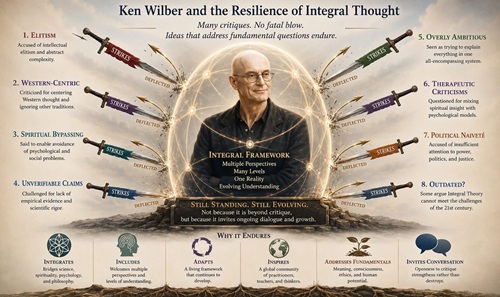
Image by Jan Krikke/AI: Wilber as the untouchable.
The infographic presents a striking image of Ken Wilber as a besieged but undefeated intellectual hero. Eight swords of criticism fly toward him: elitism, Western-centrism, spiritual bypassing, unverifiable claims, excessive ambition, therapeutic confusion, political naivety, and obsolescence. Yet every sword is dramatically deflected. At the center stands the “Integral Framework,” surrounded by the reassuring slogans “Multiple Perspectives,” “Many Levels,” “One Reality,” and “Evolving Understanding.” Below, the final verdict is announced: “Still Standing. Still Evolving.” It is a beautiful image of intellectual resilience. It is also a remarkably revealing piece of ideological self-presentation. The central problem is not that Wilber has been criticized. Every major thinker is criticized. The problem is the implicit logic of the image: criticism arrives from outside, strikes the integral fortress, and is deflected. The framework itself remains standing. The possibility that the criticism might actually damage its foundations is almost entirely absent. This is not a portrait of intellectual self-criticism. It is a portrait of intellectual self-preservation. The First Hypocrisy: Criticism Is Supposed to Transform Everything Except Integral TheoryIntegral thought presents itself as uniquely capable of integrating multiple perspectives. It welcomes science, spirituality, psychology, sociology, politics, culture, developmental theory, and contemplative experience. It claims to be a framework capable of learning from all of them. But what happens when criticism is directed at Integral Theory itself? Suddenly the famous integrative openness becomes much less impressive. The criticism is classified. The critic is located. The objection is placed within a quadrant, a level, a developmental altitude, a stage, a perspective, or a methodological domain. The framework does not necessarily have to answer the criticism directly. It can instead explain why the criticism is partial. That is a very convenient intellectual maneuver. A Marxist critic may be told that they are emphasizing the social and material dimensions while neglecting consciousness. A scientist may be told that they are trapped in flatland empiricism. A skeptic may be accused of privileging rationality over transrational insight. A political critic may be said to lack developmental altitude. A psychologist may be told that they are confusing pre-rational pathology with trans-rational spirituality. And thus the criticism is not defeated by evidence. It is often domesticated by taxonomy. The critic becomes a partial perspective. Wilber becomes the perspective that knows about partial perspectives. This is the central asymmetry. Integral Theory is permitted to interpret everything. Almost nothing is permitted to interpret Integral Theory with equal authority. The Swords Do Not Really Strike the FrameworkThe infographic's symbolism is particularly revealing. Each criticism is represented by a sword. But the swords do not penetrate the figure. They are deflected. That visual metaphor communicates a very specific philosophical message: the criticisms are external attacks, while the framework possesses an inner resilience that allows it to survive them. But why should the survival of a theory count as evidence of its adequacy? Creationism has survived criticism. Marxism has survived criticism. Astrology has survived criticism. Psychoanalysis has survived criticism. Theosophy has survived criticism. Conspiracy theories survive criticism with extraordinary resilience. A theory's capacity to absorb criticism is not the same thing as its capacity to learn from criticism. Indeed, an unfalsifiable or sufficiently elastic framework can become almost impossible to kill precisely because every criticism can be reinterpreted as partial, reductionistic, prematurely dismissive, insufficiently nuanced, or developmentally limited. The sword is deflected because the armor is made of conceptual flexibility. But conceptual flexibility can be either intellectual sophistication or immunization against criticism. The difference depends on whether the framework is genuinely capable of losing. What would actually count as a serious refutation of Integral Theory? That question is much harder to answer. “Multiple Perspectives” Can Become a License for Avoiding JudgmentThe slogan “Multiple Perspectives” sounds unimpeachably reasonable. Of course reality can be viewed from multiple perspectives. Of course human knowledge is plural and situated. But there is a hidden danger here. If every criticism is simply one perspective among others, then the framework can avoid making decisive judgments. The integral theorist can always step back and say: “Yes, but that is only one perspective.” This is particularly problematic when the issue is not merely how reality is described but what is actually true. A claim that consciousness is fundamental is not made more credible merely because it can be placed alongside a neuroscientific account of consciousness. A claim that evolution is driven by a cosmic Eros is not scientifically validated because it can be discussed alongside natural selection, self-organization, developmental biology, and systems theory. A claim that meditators experience timeless or infinite reality is not established as metaphysical fact merely because the experience is acknowledged as an important first-person datum. Perspectives are not interchangeable. They do not all have the same epistemic status. A subjective experience, an intersubjective meaning system, a biological mechanism, and a mathematical model may all be legitimate objects of inquiry. But this does not mean that any claim made within one domain automatically receives the same evidential standing as claims supported by another. Integral Theory frequently confuses the legitimacy of a perspective with the truth of the conclusions drawn from that perspective. That is not integration. It is epistemic diplomacy. “Many Levels” and the Escape Hatch of Developmental HierarchyThe image celebrates “Many Levels.” This is one of the most characteristic features of Wilberian thought. Human beings, cultures, and forms of consciousness are arranged along developmental trajectories. In principle, developmental models can be valuable. Human cognition does develop. Moral reasoning develops. Emotional capacities develop. Scientific understanding develops. The problem begins when developmental hierarchy becomes a tool for explaining disagreement. If someone rejects Wilber's metaphysical claims, perhaps they are not simply unconvinced. Perhaps they are operating from a lower developmental stage. If someone criticizes spiritual claims, perhaps they are trapped in rationality. If someone questions a grand synthesis, perhaps they lack the capacity for second-tier or integral cognition. The theory then acquires a built-in advantage: it can interpret its opponents as developmentally incomplete. This is the intellectual equivalent of a debate in which one participant claims that disagreement proves the other person has not yet reached the level required to understand the argument. The problem is not that developmental differences never exist. They plainly do. The problem is that developmental language can be used to transform an empirical or philosophical disagreement into a diagnosis of the critic. And once that happens, the theory is no longer merely defending an argument. It is ranking the people who reject it. That is where the accusation of elitism becomes difficult to dismiss. The “Integral” Critique of ElitismThe infographic lists “Elitism” as one of the attacks and then presents its deflection. But this is perhaps one of the criticisms that most deserves to strike home. Wilberian Integral Theory is saturated with hierarchical language: stages, levels, altitudes, tiers, developmental lines, states, structures, and degrees of complexity. Wilber has repeatedly portrayed integral consciousness as a more comprehensive achievement capable of transcending and including earlier modes of thought. There is nothing inherently illegitimate about hierarchy. Some abilities really are more complex than others. A person who understands calculus has acquired capacities that a person who has never encountered mathematics does not possess. A mature moral perspective may indeed be more inclusive than a tribal one. But developmental hierarchy becomes dangerous when it is applied too readily to intellectual disagreement. The key question is simple: Does a person disagree with Integral Theory because they have failed to understand it—or because they have understood it and found it unconvincing? The integral self-image tends to prefer the first explanation. That is not a minor psychological flaw. It is a structural danger in any theory that places itself near the summit of a developmental hierarchy. The framework becomes not merely a theory of development but the alleged culmination of development. And that is precisely where humility begins to evaporate. The “Western-Centric” Criticism Is Not Easily DeflectedThe infographic claims that criticism of Western-centrism is deflected because Integral Theory includes multiple traditions. But inclusion is not the same thing as equality. Wilber has drawn extensively on Buddhism, Vedanta, Taoism, Christianity, and other traditions. Yet these traditions are often reorganized within a conceptual architecture designed primarily by a modern Western theorist. The traditions enter the integral system as ingredients. The system itself determines their place. Buddhism becomes a source of insights about states and meditation. Vedanta contributes metaphysical language. developmental psychology supplies stages. systems theory supplies complexity. neuroscience contributes third-person data. Everything is welcomed into the grand synthesis. But the grand synthesis remains Wilberian. This creates a familiar problem in intellectual universalism: the theorist claims to transcend cultural particularity by constructing a universal framework, while the framework itself reflects specific historical assumptions about science, psychology, evolution, modernity, development, and rationality. The claim to have integrated the world's traditions can therefore conceal a subtler form of intellectual appropriation. The question is not whether Wilber has read widely. He clearly has. The question is who gets to decide what all those traditions ultimately mean. The answer is: Ken Wilber. Spiritual Bypassing: The Criticism the System Cannot Simply Classify AwayThe criticism of spiritual bypassing is especially important because it concerns the relationship between spiritual insight and psychological maturity. Wilber's framework is designed to prevent the crude identification of enlightenment with psychological perfection. In theory, this is one of its strengths. A person may experience profound states of consciousness while remaining psychologically immature. But Wilber's own system has not always escaped the very problem it diagnoses. A theory can become spiritually bypassing at a meta-level. It can elevate consciousness, Spirit, nonduality, or transpersonal realization while treating ordinary psychological, social, and political problems as lower-order manifestations to be integrated later. The danger is that metaphysical language provides an escape from the stubborn specificity of human problems. Trauma is not dissolved by declaring that the self is ultimately empty. Political oppression is not overcome by recognizing multiple perspectives. Economic exploitation is not transcended by moving to a higher altitude. Psychological dysfunction does not disappear because consciousness is said to be fundamentally nondual. The spiritual insight may be genuine. The human problem remains. And sometimes the integral language of “transcend and include” sounds less like a solution than a promise that everything will eventually be absorbed into a higher synthesis. Unverifiable Claims Are Not Deflected by Calling Them “Interior”The infographic lists unverifiable claims as another sword. This is perhaps where the integral defense becomes most philosophically slippery. Wilber has rightly emphasized that first-person experience is a legitimate domain of knowledge. Science does not exhaust all forms of human experience. Meditation can produce profound and repeatable transformations. Subjective experience deserves serious investigation. But there is a gigantic leap between: “I had an experience of timelessness” and: “I directly experienced eternity.” There is another leap between: “Consciousness appeared to me as boundless” and: “Consciousness is metaphysically infinite.” And another between: “Many contemplatives report similar experiences” and: “Those experiences reveal the ultimate structure of reality.” These are not the same claims. The fact that a claim arises from an interior domain does not exempt it from epistemological scrutiny. Nor does the sincerity, profundity, or transformative power of an experience establish its metaphysical interpretation. The integral framework frequently moves from phenomenology to ontology with insufficient justification. It treats the experience as evidence of something beyond the experience. That is not a scientific discovery. It is a metaphysical interpretation. And no amount of quadrant language changes that. The Grand Ambition Is Not Itself a VirtueThe infographic embraces the accusation that Integral Theory is “overly ambitious.” This criticism is then apparently deflected by the fact that the framework addresses fundamental questions. But ambition is not a defense against error. A theory that attempts to explain everything assumes an enormous burden of proof. The more domains a theory claims to integrate, the more opportunities it creates for conceptual confusion, empirical overreach, and false analogies. Wilber has attempted to connect: • cosmology, • evolution, • biology, • psychology, • spirituality, • religion, • culture, • politics, • social systems, • development, • meditation, • and metaphysics. This is intellectually exhilarating. It is also extraordinarily dangerous. A grand synthesis can create the illusion that all these domains are being explained when they are merely being placed next to one another within a common diagram. A map is not a theory of everything. A taxonomy is not an explanation. A vocabulary for relating domains is not evidence that the underlying causal relationships have been established. The integral framework often derives its authority from the sheer size of its architecture. But intellectual scale is not intellectual validity. Sometimes a smaller theory that explains one thing rigorously is worth more than a grand theory that gestures toward everything. Therapeutic Criticism: The Danger of Psychologizing DisagreementThe infographic mentions criticism of Wilber's mixing of spiritual insight with psychological models. There is another danger here: the psychologizing of critics. If a person rejects a spiritual claim, perhaps they are defending against transcendence. If a person criticizes a guru, perhaps they are projecting authority issues. If a person rejects metaphysics, perhaps they are trapped in materialism. If a person objects to developmental hierarchy, perhaps they are threatened by their own developmental limitations. This kind of reasoning is unfalsifiable because any disagreement can be interpreted as evidence of the critic's psychological resistance. The critic cannot win. If they agree, the theory is confirmed. If they disagree, the disagreement can be explained psychologically. This is the same structural problem that has afflicted many forms of psychoanalysis and spiritual teaching. A theory becomes dangerous when it claims privileged access not only to reality but also to the psychological reasons why others reject its account of reality. At that point, disagreement becomes diagnostic evidence. And diagnostic evidence is very convenient for the person doing the diagnosing. Political Naivety Is Not Solved by Adding a QuadrantIntegral Theory's political weaknesses are often underestimated because politics can be placed neatly within the “Its” and “We” domains. But politics is not merely another quadrant. Power is not just a variable to be added to a comprehensive model. Institutions do not merely occupy an exterior social space. They distribute wealth, coercion, authority, opportunity, and violence. Historical structures are not simply perspectives waiting to be integrated. They are relations of power. The integral impulse toward balance can therefore become politically conservative without intending to be. The desire to see all sides may obscure asymmetry. The desire to transcend ideological conflict may obscure the fact that some conflicts involve domination rather than mere differences in perspective. There are situations in which “both sides” is not wisdom. There are situations in which one side is invading another country. There are situations in which one group possesses vastly greater military, economic, or institutional power than another. There are situations in which neutrality is not higher consciousness but avoidance. The integral self-image tends to imagine that a sufficiently developed perspective can rise above political partiality. But political judgment often requires precisely the opposite: identifying where one stands and why. “One Reality” Is a Metaphysical Slogan, Not a Scientific ResultAt the center of the image stands “One Reality.” This phrase sounds profound because it is almost impossible to disagree with at a very abstract level. Surely there is one reality. But what follows from that? The existence of one reality does not entail that reality is fundamentally spiritual. It does not entail that consciousness is cosmically primary. It does not entail that evolution has an intrinsic direction toward greater complexity and consciousness. It does not entail that mystical experiences reveal ultimate reality. It does not entail that the universe possesses an Eros. “One reality” is compatible with materialism, naturalism, panpsychism, idealism, dualism, neutral monism, and countless other metaphysical positions. The slogan therefore does very little argumentative work. It functions primarily as a unifying background assumption into which the integral system can insert its preferred interpretation. The phrase sounds like a conclusion. It is actually a starting point. “Still Evolving” Can Mean “Never Required to Admit Defeat”The most revealing phrase in the image may be “Still Evolving.” This sounds admirably modest. Integral Theory is not presented as finished. It continues to develop. But there is a difference between a theory that evolves because evidence forces it to change and a theory that evolves because it can continually revise its vocabulary without surrendering its central commitments. A scientific theory evolves through constraint. Reality pushes back. Predictions fail. Measurements disagree. Anomalies accumulate. Models are discarded or radically revised. What constrains Integral Theory? When Wilber's claims about evolution, consciousness, spirituality, developmental stages, or metaphysics are challenged, what mechanism forces the theory to abandon them? If the answer is simply that the theory can reinterpret, integrate, contextualize, or transcend the criticism, then “evolution” may become a euphemism for adaptive self-preservation. A genuinely evolving theory must be capable of becoming something its founder would no longer recognize. That is the real test. Not whether the framework can add another perspective. Whether it can lose a central belief. The Myth of the Criticism-Proof FrameworkThe image ultimately presents a fantasy of intellectual invulnerability. Every criticism is acknowledged. None is allowed to wound. The framework is accused of elitism, but it includes everyone. It is accused of Western-centrism, but it includes many traditions. It is accused of spiritual bypassing, but it includes psychology. It is accused of unverifiable claims, but it includes science. It is accused of excessive ambition, but it addresses fundamental questions. It is accused of political naivety, but it includes multiple perspectives. It is accused of being outdated, but it continues to evolve. Notice the pattern. Every criticism is answered by pointing to an element already present in the system. But the presence of a concept is not the resolution of a problem. Including psychology does not prove that spiritual claims are true. Including science does not make metaphysics scientific. Including non-Western traditions does not make the framework culturally neutral. Including politics does not make the political analysis adequate. Including criticism does not mean that criticism has been answered. This is the fundamental confusion between incorporation and resolution. Integral Theory can contain a criticism without having refuted it. Indeed, the capacity to contain criticism may be precisely what makes the system so resilient. The Real Test of Integral ThoughtThere is nothing inherently wrong with wanting a comprehensive framework. There is nothing wrong with attempting to connect domains of knowledge. There is nothing wrong with taking spiritual experience seriously. There is nothing wrong with developmental theory. There is nothing wrong with intellectual ambition. The problem begins when the framework's comprehensiveness becomes a substitute for evidence, when its hierarchies become a substitute for argument, when its categories become a substitute for explanation, and when its ability to absorb criticism is mistaken for its ability to answer criticism. The genuine test of Integral Theory is therefore not whether it can include another perspective. It is whether it can be constrained by one. Can empirical evidence force it to abandon a claim? Can historical evidence overturn one of its narratives? Can criticism from outside the integral community expose a fundamental error that cannot simply be reclassified as partial? Can a critic be right without first having to be placed at a lower altitude? Can the framework admit that one of its central insights is simply mistaken? Until the answer is clearly yes, the image of Ken Wilber standing heroically amid deflected swords should not be read as evidence of intellectual resilience. It should be read as evidence of something more ambiguous. A theory that survives every criticism may be extraordinarily robust. Or it may simply be extraordinarily good at explaining why no criticism ever quite counts. The integral self-image wants us to see a heroic thinker surrounded by failed attacks. A more skeptical interpretation sees something else: a conceptual fortress whose greatest defensive weapon is the claim that every attack is merely partial. And that is the deepest irony of the whole image. Integral Theory claims to transcend and include. But when criticism arrives, it often does not transcend the criticism. It includes it. Then it places it safely behind the walls.
Widget is loading comments...
|