|
Search through thousands of pages on Integral Theory
TRANSLATE THIS ARTICLE
Integral World: Exploring Theories of Everything
An independent forum for a critical discussion of the integral philosophy of Ken Wilber
SEE MORE ESSAYS WRITTEN BY FRANK VISSER
NOTE: This essay contains AI-generated content
Check out my other conversations with ChatGPT
The Universe Is Not
“Winding Up”
Ken Wilber's Habitual Misrepresentation of Science
Frank Visser / ChatGPT
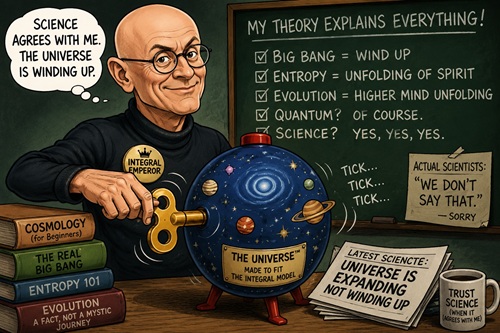
A two-minute masterclass in scientific distortion
In a 2015 video, Integral in Action with Ken Wilber, Ken Wilber offers what may be one of the clearest examples of his characteristic approach to science.[1] The passage is rhetorically powerful. It moves rapidly from quarks to atoms, from atoms to molecules, from molecules to cells, from cells to complex organisms, and finally to the human brain. At every stage, Wilber announces an increase in “wholeness,” “unity,” and “complexity.”
Then comes the conclusion:
“THAT is a universe winding UP. It is not a universe winding DOWN.”
The problem is not that Wilber mentions real scientific events. Quarks did emerge in the early universe. Hadrons and atomic nuclei formed. Atoms and molecules appeared. Life eventually emerged, followed by multicellular organisms and nervous systems. Human brains do contain extraordinarily large numbers of synaptic connections.
The problem is that Wilber strings these facts together into a story that science itself does not tell. He then uses that story to dismiss the second law of thermodynamics, misrepresent cosmic evolution, oversimplify the origin of life, and transform the history of life into apparent evidence for his own metaphysical doctrine of an inherent drive toward greater wholeness.
This is not merely an innocent simplification. It is a recurring intellectual maneuver in Wilber's work: scientific facts are selectively extracted from their explanatory context, rearranged into an evolutionary triumphalist narrative, and then presented as though they establish a cosmic principle called Eros, Spirit, or an intrinsic drive toward greater complexity.
The rhetoric is integral. The science is not.
“The universe is winding down” is not what the second law says
Wilber begins by attacking a caricature.
“The whole notion of the universe as 'running down' is ridiculous,” he says.
But serious physicists do not claim that nothing locally complex can ever emerge in a universe governed by increasing entropy. The second law of thermodynamics does not say that every region of the universe must become instantly simpler, more dispersed, or less organized.
It says, broadly speaking, that in an isolated system the total entropy does not decrease.
That leaves enormous room for local increases in order, complexity, structure, and organization. Stars form. Galaxies form. Planets form. Chemical gradients develop. Life evolves. Brains become more complex. None of this refutes the second law.
The crucial distinction Wilber repeatedly fails to make is between local and global processes.
A refrigerator can become colder inside while dumping more heat into its surroundings. A hurricane can become highly organized while increasing entropy in the atmosphere as a whole. A living organism can maintain a remarkable degree of internal organization by consuming energy and exporting entropy into its environment.
There is no contradiction between local organization and an overall increase in entropy.
Consequently, the contrast Wilber constructs—either the universe is “winding down” or it is “winding up”—is scientifically false. The universe does not have to be globally “running down” in the simplistic sense Wilber imagines in order for entropy to increase. Nor does the emergence of local complexity demonstrate that the universe possesses a cosmic tendency toward increasing wholeness.
Wilber creates a false dichotomy and then triumphantly defeats it.
From quarks to atoms: a chronology is not a cosmic law
Wilber's argument proceeds through a sequence of increasing complexity:
quarks → subatomic particles → atoms → molecules → cells → multicellular organisms → nervous systems → brains.
The sequence is broadly recognizable. But the conclusion he draws from it does not follow.
The fact that more complex structures emerged after simpler structures does not mean that the universe was “driven” toward them.
This is the fundamental logical error.
A historical sequence does not automatically reveal a causal tendency.
The fact that cities developed after villages does not mean that history was driven by an invisible “city-making force.” The fact that computers appeared after biological brains does not demonstrate that the universe contains an intrinsic drive toward silicon-based information processing. The fact that humans appeared after bacteria does not mean that bacteria were somehow evolving toward humanity.
Temporal succession is not teleology.
Yet Wilber repeatedly treats the history of the universe as if it were a ladder whose upper rungs were somehow implicit in the lower ones. The appearance of a later structure is retrospectively interpreted as evidence of a cosmic tendency toward that structure.
This is a classic example of hindsight bias elevated into metaphysics.
“Wholeness” is doing all the work
Wilber's preferred word here is “wholeness.”
Quarks coming together are an increase in wholeness. Atoms forming are another increase in wholeness. Molecules forming are another. A cell is a higher whole. Multicellular organisms are higher wholes still.
But what exactly does “wholeness” mean in this argument?
In physics, particles can form bound states because of specific interactions. Atomic nuclei are held together by the strong nuclear force. Electrons occupy quantum states associated with atomic nuclei. Chemical bonds arise through electromagnetic interactions and quantum mechanics. Molecules form under particular energetic and structural conditions.
None of this requires a general cosmic principle of “wholeness.”
The scientific explanation is not that quarks are yearning to become wholes, that atoms are striving toward molecules, or that molecules are seeking cellular unity. The relevant processes are described by physical laws, interactions, energy landscapes, self-organization, and historical contingencies.
Wilber takes the outcome and re-describes it using a loaded philosophical vocabulary. “Bound state” becomes “wholeness.” “Organization” becomes “unity.” “Increasing complexity” becomes “evolutionary drive.”
The scientific explanation has been replaced by an evocative metaphor.
And then the metaphor is treated as a causal principle.
The cell did not emerge because “dozens of large molecules” suddenly got together
Wilber's description of the origin of life is particularly revealing:
“At some point, dozens of very large molecules, just hanging around together, and a cell wall dropped around them, and a living cell emerged.”
This is not a serious description of abiogenesis.
The origin of life remains a major scientific problem. There is no single agreed-upon account of precisely how the first living systems emerged. But the scientific field does not describe the process as a collection of large molecules “just hanging around together” until a cell wall suddenly dropped around them.
The origin of life involves questions concerning prebiotic chemistry, molecular self-organization, compartmentalization, autocatalytic networks, nucleic-acid chemistry, metabolism, energy gradients, protocells, and the emergence of systems capable of heredity and evolution.
There are multiple competing hypotheses and research programs. None of them requires an unexplained cosmic force pushing matter toward greater wholeness.
Wilber's account is therefore doubly misleading. It makes a complex, unresolved scientific problem sound trivially simple, while simultaneously using that alleged simplicity as evidence for his metaphysical theory.
The rhetorical structure is familiar: reduce the science to a cartoon, then announce that the cartoon proves the philosophy.
The evolutionary sequence is not a staircase
Wilber then moves from simple cells to multicellular organisms, followed by increasingly complex nervous systems and brains.
Here again, the broad historical sequence is correct. But the interpretation is deeply misleading.
Evolution does not proceed along a single ascending staircase from simple to complex. Evolution produces diversification. It generates increases, decreases, and transformations in complexity. Some organisms become more complex. Others become simpler. Parasites frequently lose biological structures. Many successful organisms remain relatively simple.
Bacteria have dominated the planet for billions of years and remain extraordinarily successful. They have not been waiting for a neocortex.
There is no general evolutionary law requiring organisms to become more complex.
Natural selection can produce complexity when complexity improves reproductive success under particular conditions. It can also favor simplicity when simplicity is advantageous. Genetic drift, mutation, developmental constraints, ecological interactions, sexual selection, symbiosis, and historical contingency all contribute to evolutionary outcomes.
Evolution is not a cosmic escalator.
The fact that one lineage eventually produced mammals and humans does not transform the entire history of life into a universal drive toward brains.
Wilber's presentation quietly changes the subject from “some evolutionary lineages became more complex” to “evolution itself is driven toward increasing complexity.”
That is a massive generalization.
“Evolution itself is driven” is precisely the claim that requires evidence
The most important sentence in the passage comes at the beginning:
“Evolution itself is driven by the creation of increasing, holistic, increasing wholes, increasing unities.”
This is not a scientific finding. It is a philosophical thesis.
The question is: what evidence would distinguish this proposed “drive” from ordinary evolutionary processes?
If evolution produces complexity, Wilber points to the complexity as evidence of the drive.
If evolution produces simplicity, he can presumably explain that as a local or temporary feature of a larger evolutionary movement.
If evolution produces stasis, extinction, degeneration, or diversification, these can all be absorbed into the narrative.
A theory that can reinterpret every possible outcome as confirmation is not thereby scientifically powerful. It may simply be unfalsifiable.
Wilber has never provided a clearly specified mechanism for this alleged cosmic drive. He has not identified a measurable force. He has not formulated a quantitative model. He has not shown that evolutionary populations evolve toward greater complexity independently of ordinary evolutionary mechanisms.
Instead, he points to the existence of complexity and says, in effect: “Look! There is the drive.”
But this is circular.
Complexity is evidence for a drive toward complexity because complexity exists.
The conclusion is already contained in the premise.
The second law does not predict that life must become simpler
Wilber's argument depends upon a crude opposition:
entropy = disintegration, dispersion, isolation
evolution = integration, wholeness, unity.
But this is not thermodynamics.
Entropy is not simply “disorder” in the everyday sense. The popular translation of entropy as disorder is often useful pedagogically, but it becomes seriously misleading when used as the basis of grand metaphysical arguments.
The second law concerns the statistical behavior of physical systems and the number of accessible microstates. It does not decree that all visible structures must become aesthetically less organized.
Indeed, the universe's history includes both increasing entropy and the emergence of structures. These processes are not mutually exclusive.
Stars can form while entropy increases. Planets can form while entropy increases. Chemical complexity can arise while entropy increases. Life can emerge and evolve while entropy increases.
The correct scientific question is not:
“Is the universe winding up or winding down?”
It is:
“How can local structures and gradients emerge and persist within a universe whose overall thermodynamic behavior is characterized by increasing entropy?”
That is a fascinating scientific question.
Wilber replaces it with a dramatic metaphysical slogan.
The universe is not a ladder leading to the human brain
The final destination of Wilber's story is the human brain.
This is where the retrospective teleology becomes unmistakable.
The universe begins with elementary particles and eventually produces a human brain containing an astonishing number of synaptic connections. The implicit message is that the entire cosmic process has been building toward this achievement.
But the universe did not begin with the human brain as its destination.
The human brain is the result of a particular evolutionary history on one particular planet, within one particular lineage, under a highly contingent set of ecological and historical conditions.
Had Earth's history unfolded differently, there would be no reason to expect humans to appear. Had the asteroid that ended the reign of non-avian dinosaurs not struck, mammalian evolution might have taken a radically different course. Had countless mutations, ecological events, extinctions, and historical contingencies been different, the human brain might never have evolved.
The fact that we exist makes our existence appear inevitable when viewed backward.
But evolutionary history is not a prediction of its own outcome.
Wilber's argument is therefore a textbook example of anthropocentric hindsight. He starts with the human brain and then reads the entire history of the universe as a progression toward it.
The cosmos becomes a biography of humanity.
More complexity is not the same as more value
There is another hidden assumption in Wilber's rhetoric: that greater complexity automatically means greater evolutionary advancement.
But complexity is not a universal measure of value.
A parasite may be highly adapted precisely because it has lost structures unnecessary for its lifestyle. A simple organism may be ecologically more successful than a complex one. A complex system may be more fragile than a simple one. A large brain is not automatically a superior adaptation in every environment.
Evolution does not maximize complexity as such.
It maximizes reproductive success only indirectly and imperfectly through differential survival and reproduction under particular circumstances. Even that formulation must be handled carefully, because selection acts on heritable variation in populations and interacts with many other evolutionary processes.
There is no universal evolutionary scoreboard on which “more complex” automatically means “higher.”
Wilber's metaphysics requires such a scoreboard. His evolutionary narrative needs an upward direction. So complexity becomes not merely one possible biological outcome, but a sign of cosmic progress.
This is where evolutionary biology quietly becomes a secularized version of a Great Chain of Being.
The missing billions of years
Wilber's account also suffers from spectacular selectivity.
He emphasizes the emergence of organized structures but says little about the overwhelmingly dominant role of entropy, decay, extinction, destruction, and dissipation in cosmic history.
Most stars die. Planets are destroyed. Organisms become extinct. Complex biological lineages disappear forever. Bodies decompose. Structures collapse. Energy gradients dissipate.
The universe is not simply a triumphant march from quarks to consciousness.
It is a dynamic physical system characterized by formation and destruction, organization and dissipation, persistence and decay.
Wilber selects the upward-looking portion of the story and ignores the rest.
This is not an innocent omission. It is necessary for the narrative to work.
If the entire history of the universe is included, the simplistic picture of a universal drive toward greater unity becomes much harder to sustain.
The rhetorical trick: scientific vocabulary as metaphysical camouflage
What makes Wilber's presentation particularly effective is that it contains so many scientific terms.
• Quarks.
• Subatomic particles.
• Atoms.
• Molecules.
• Cells.
• Neurocords.
• Brain stems.
• Limbic systems.
• Neocortex.
• Synapses.
This creates an impression of scientific authority.
But scientific terminology does not automatically produce scientific reasoning.
A person can accurately name the components of a process while fundamentally misunderstanding the process itself.
Wilber's strategy is often to borrow the vocabulary of science while supplying the causal interpretation from his own metaphysical system. The science provides the scenery. Integral metaphysics provides the plot.
The result sounds scientific because the nouns are scientific.
But the crucial verbs—“driven,” “striving,” “evolving toward,” “increasing in wholeness”—are philosophical interpretations.
The scientific facts do not entail them.
This is not merely ignorance: it is a recurring pattern
One might respond that Wilber is simply a philosopher, not a professional physicist or evolutionary biologist. Perhaps he is merely simplifying.
But that defense becomes increasingly implausible when the same pattern appears repeatedly across his work.
Wilber routinely presents himself as someone who has transcended the limitations of conventional science. He criticizes reductionism, claims to understand the larger picture, and frequently argues that scientists have overlooked the deeper evolutionary movement toward complexity, consciousness, and Spirit.
Yet when the scientific details are examined, the pattern is often the reverse of what he claims.
The “larger picture” is frequently achieved by removing inconvenient scientific distinctions.
Thermodynamic entropy becomes cosmic decay.
Evolutionary history becomes an ascent.
Complexity becomes progress.
Emergence becomes evidence of Eros.
Self-organization becomes evidence of a universal drive.
Consciousness becomes the culmination of the cosmic process.
The scientific facts are real. The metaphysical interpretation is then smuggled in as though it were the scientific meaning of those facts.
This is why “misrepresentation” is more accurate than merely “simplification.”
Simplification leaves out detail while preserving the essential logic.
Wilber's presentations often alter the logic itself.
The great irony: the “integral” thinker reduces science
Wilber presents himself as the thinker who can integrate perspectives that specialists allegedly keep separate.
But in this passage, the opposite occurs. He reduces multiple scientific disciplines to a single metaphysical storyline.
Cosmology becomes a prelude to biology.
Thermodynamics becomes a problem to be overcome by evolutionary complexity.
Chemistry becomes a stage in the unfolding of wholeness.
Biology becomes a ladder toward consciousness.
Neuroscience becomes the culmination of cosmic evolution.
The distinctions between disciplines are erased in favor of a single grand narrative.
This is not genuine integration.
It is imperial interpretation.
Wilber takes the findings of physics, chemistry, biology, and neuroscience and makes them serve a pre-existing philosophical conclusion: the universe is fundamentally moving toward greater unity, complexity, consciousness, and Spirit.
The problem is not that one may philosophically interpret science.
The problem is pretending that the interpretation is what the science itself says.
What the science actually shows
A scientifically responsible account would be much less rhetorically satisfying but far more accurate.
The early universe evolved from extremely hot and dense conditions into a cosmos containing increasingly complex structures. Under particular physical conditions, particles formed bound states, nuclei formed, atoms formed, stars and galaxies developed, and chemistry became possible.
On Earth, complex organic chemistry eventually produced systems capable of evolution. Evolutionary processes then generated enormous biological diversity. In some lineages, complexity increased. In others, it decreased. Some lineages remained relatively simple and extraordinarily successful. Others became highly complex and later went extinct.
The human brain is one remarkable outcome of one particular evolutionary history.
None of this requires a cosmic force pushing the universe toward greater wholeness.
None of it contradicts the second law of thermodynamics.
None of it demonstrates that the universe has a purpose.
None of it proves Wilber's Eros.
And none of it implies that the universe is “winding up” in the sense Wilber intends.
The real story is more interesting than the metaphysical cartoon. Complexity can emerge from relatively simple rules. Structure can arise in a universe governed by thermodynamics. Evolution can generate astonishing novelty without being guided toward a predetermined destination.
That is not a less wondrous account.
It is a more wondrous account precisely because it does not need to invent a cosmic intention behind every remarkable outcome.
Conclusion: the Integral Emperor's evolutionary narrative
Wilber's passage is a perfect example of his broader relationship with science.
He begins with genuine scientific facts.
He places them in a selective sequence.
He describes the sequence using suggestive metaphors such as “wholeness” and “unity.”
He ignores counterexamples and inconvenient distinctions.
He converts historical succession into directional drive.
He transforms complexity into progress.
He then presents the resulting metaphysical narrative as the obvious meaning of science.
But the universe is not scientifically demonstrated to be “winding up.” Evolution is not known to be driven by an intrinsic cosmic urge toward greater wholes. The second law of thermodynamics has not been refuted by the existence of life. And the emergence of the human brain is not evidence that the universe was somehow heading toward humanity from the beginning.
Wilber's argument works only by conflating several different things:
structure with purpose,
complexity with progress,
local organization with cosmic direction,
historical succession with teleology,
and metaphysical interpretation with scientific explanation.
The result is a familiar Wilberian spectacle: the scientific facts are real, but the conclusion is not scientific.
His rhetoric gives the impression that conventional science is too narrow to see the grand evolutionary movement toward wholeness.
The irony is that it is Wilber who repeatedly narrows science—reducing the complexity of scientific explanation to a single, preordained story of ascent.
He does not discover a cosmic drive toward wholeness in the evidence.
He finds the evidence that can be made to fit a cosmic drive toward wholeness—and then declares that the universe itself has spoken.
That is not an integral science.
It is metaphysics wearing a lab coat.
Appendix: Verbatim Quote from the video
"Evolution itself is driven by the creation of increasing, holistic, increasing wholes, increasing unities. And the whole notion of the universe as 'running down' is ridiculous. I mean, it is NOT! It started with the Big Bang with strings and quarks. Over tens of thousands of years quarks started to come together as sub-atomic particles. That's an increase in wholeness. And then thousands of years later sub-atomic particles started to come together as atoms. Another increase in wholeness. Thousands of years laters these atoms come together and form molecules. Another huge leap in wholeness! And then in a staggering leap, at some point, dozens of very large molecules, just hanging around together, and a cell wall dropped around them, and a living cell emerged. Unbelievable! And then those cells became multi-cellular organisms, they were very simple at first, got more complex, added neurocords, added reptilian brain stems, added paleo-mammalian limbic systems, added neocortex... Ehm, THAT is a universe winding UP. It is not a universe winding DOWN. It is not a universe becoming more and more dispersed and separated and isolated. It is a universe coming together in higher and higher wholes. Until we finally come to the human brain, which has more synaptic connections than there are stars in the universe." (50:00-52:00 minutes in the video).
NOTES
[1] Alex Howard, "Integral in Action with Ken Wilber", Conscious 2, 2016 (now offline). See also: Frank Visser, "Integral Overstretch", www.integralworld.net, October 2015.
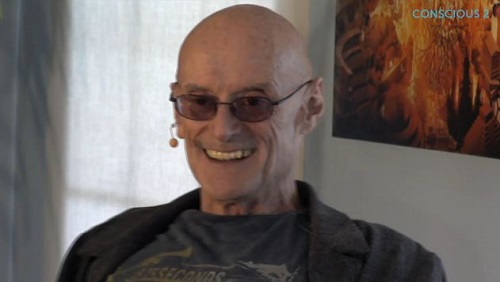
Ken Wilber: “The whole notion that the universe is 'running down' is ridiculous.”
|

 Frank Visser, graduated as a psychologist of culture and religion, founded IntegralWorld in 1997. He worked as production manager for various publishing houses and as service manager for various internet companies and lives in Amsterdam. Books: Ken Wilber: Thought as Passion (SUNY, 2003), and The Corona Conspiracy: Combatting Disinformation about the Coronavirus (Kindle, 2020).