|
TRANSLATE THIS ARTICLE
Integral World: Exploring Theories of Everything
An independent forum for a critical discussion of the integral philosophy of Ken Wilber
  Frank Visser, graduated as a psychologist of culture and religion, founded IntegralWorld in 1997. He worked as production manager for various publishing houses and as service manager for various internet companies and lives in Amsterdam. Books: Ken Wilber: Thought as Passion (SUNY, 2003), and The Corona Conspiracy: Combatting Disinformation about the Coronavirus (Kindle, 2020). Frank Visser, graduated as a psychologist of culture and religion, founded IntegralWorld in 1997. He worked as production manager for various publishing houses and as service manager for various internet companies and lives in Amsterdam. Books: Ken Wilber: Thought as Passion (SUNY, 2003), and The Corona Conspiracy: Combatting Disinformation about the Coronavirus (Kindle, 2020).
Check out my other conversations with ChatGPT
DEEPER WILBERIAN DIVES: Already Enlightened? The Mirage of the Absolute Spirit or Selection? On Cosmic Certainty The Integral Fortress The Integral Emperor Winding Up or Down? Is Integral Anti-Fragile? Integral without Overreach The 'Extremely Conventional' Evolutionary TheoristAnd the Integral Emperor's New BiologyFrank Visser / ChatGPT
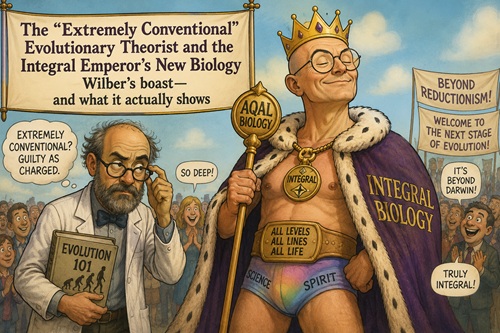
Wilber's boast—and what it actually showsIn a 2018 conversation with Corey DeVos, Ken Wilber presents himself as the scientifically sophisticated evolutionary thinker who has moved beyond the allegedly narrow and outdated views of “extremely conventional evolutionary theorists like Frank Visser.”[1] He then invokes Alfred North Whitehead, Stuart Kauffman, Ilya Prigogine, and Bruce Damer as authorities supposedly supporting his central evolutionary intuition: that there is an inherent creative drive, novelty-producing tendency, or “Eros” built into the cosmos. The passage is revealing because it compresses several different scientific subjects—evolutionary biology, nonequilibrium thermodynamics, complexity theory, and the origin of life—into one sweeping metaphysical conclusion. Wilber takes genuine scientific phenomena, attaches the label “Eros” to them, and then presents the label as though it were an explanation. But there is a remarkable irony here. Wilber portrays himself as the scientifically adventurous thinker and me, Frank Visser, as the conventional evolutionary biologist who allegedly refuses to acknowledge self-organization and novelty. Yet on the biological issues at stake, the situation is almost exactly the reverse. The “conventional” position is not that natural selection explains everything. Nor does it deny self-organization, developmental constraints, thermodynamic order, emergent properties, or the chemical origins of life. The genuinely conventional position is simply that each phenomenon should be explained at the appropriate scientific level, with its actual mechanisms specified. And that is precisely where Wilber's argument repeatedly breaks down. The transcript can be read here as a revealing specimen of a recurring Wilberian strategy: borrow the prestige of contemporary science, simplify the science into a slogan, and then use the slogan to rehabilitate a pre-existing metaphysical doctrine. The frog argument: reproduction is not a collective organismWilber begins his biological argument with an apparently devastating observation. If one asks what the first frog looked like, he says, the answer is that it could not have been a single frog. There had to be at least a male and a female. Otherwise, the frog would merely have appeared and disappeared without leaving descendants. This is not a profound discovery about the four quadrants. It is a basic fact about sexual reproduction. But it is also a poor example for the point Wilber wants to make. The existence of sexual reproduction does not mean that “the first frog” was a collective entity in the sense required by Integral Theory. It means that, at some stage in the evolutionary history of frogs, reproduction involved two individuals of different mating types or sexes. The existence of a population is not the same thing as the existence of a superorganism. Nor does sexual reproduction imply that the individual organism is biologically unintelligible in isolation. An individual frog is a physiological organism with a metabolism, developmental trajectory, nervous system, immune system, and reproductive system. Its existence depends on ecological and evolutionary relationships, but relational dependence does not erase organismic individuality. Wilber's reasoning repeatedly trades on this ambiguity. He moves from the uncontroversial proposition that organisms exist in ecological and reproductive contexts to the much stronger claim that the individual and the collective must be regarded as equally fundamental explanatory realities. But those are not the same claim. A frog population is not a frog. A mating pair is not a single frog. A reproductive community is not automatically a higher-level organism. Biological individuality is itself a scientific problem, and biology contains many different kinds of individuals, collectives, symbioses, colonies, and superorganisms. The correct response is to investigate their mechanisms—not to declare in advance that a four-quadrant ontology has been confirmed. Abiogenesis is not evolution—and neither is explained by “Eros”The transcript then shifts from the evolution of frogs to the origin of life. Wilber discusses his conversations with Bruce Damer and says that researchers working on abiogenesis should not look merely at “the first individual.” Instead, he argues, one should look at collectives and all four quadrants simultaneously.[2] Here the conceptual confusion becomes even more serious. Abiogenesis is the scientific problem of how life emerged from nonliving chemistry. Biological evolution is the subsequent historical process by which populations of living organisms change across generations. The two problems are related, but they are not identical. Natural selection, for example, cannot simply be invoked as an explanation for the origin of the first self-reproducing systems, because selection itself requires some form of heritable variation and differential persistence or reproduction. That does not mean that origin-of-life research has to be reduced to the study of a solitary “first cell.” Quite the contrary. Modern origin-of-life research investigates chemical networks, compartments, autocatalysis, mineral surfaces, energy gradients, protocells, environmental cycles, and interactions among molecular systems. The field has long understood that the transition from chemistry to biology may have involved distributed networks and collective dynamics. But this is exactly the point: origin-of-life researchers already investigate these things scientifically. They do not need the four quadrants to discover that chemistry occurs in environments, that molecules interact, or that collective phenomena can emerge. “Look at the individual and the collective” is not an origin-of-life mechanism. It is a truism. The difficult questions are much more specific. How did chemical systems acquire heritable information? How were metabolism and replication coupled? How did compartments arise? How did chemical networks become capable of evolutionary persistence? What physical and chemical processes generated increasing organizational closure? Which environments were plausible? What pathways are kinetically and thermodynamically feasible? The four quadrants answer none of these questions. Bruce Damer does not validate Integral TheoryWilber says that Damer's work incorporates integral ideas and describes a proposed early form combining individual and community-like cellular organization. He presents this as a biological realization of the Integral insight that the individual and collective dimensions arise together. Even if a particular origin-of-life model proposes structures in which compartments, chemical networks, and communities interact, this would not constitute evidence for Integral Theory. A scientific model can contain multiple levels of organization without thereby validating a philosophical framework that happens to classify them as “individual” and “collective.” This is a crucial distinction between scientific explanation and philosophical redescriptions. Suppose an origin-of-life researcher discovers that protocells exchange molecules, cooperate, compete, fuse, divide, or form communities. That would be an important biological result. But the result would be explained by chemistry, thermodynamics, molecular kinetics, ecological interaction, and evolutionary dynamics—not by the fact that somebody has placed the phenomena into an “individual/collective” box. The Integral framework contributes no distinctive causal mechanism here. It does not predict a particular molecular pathway, a specific form of compartmentalization, a reaction network, or a measurable transition from chemistry to biology. At most, it offers a vocabulary for reminding researchers that systems have multiple aspects. But science has possessed that insight for a very long time. The Kauffman maneuver: self-organization becomes “Eros”Wilber's most revealing move comes when he invokes Stuart Kauffman. “Stuart Kauffman, self-organization is built into the universe. Eros.” This is the entire argument in miniature. Kauffman has indeed argued that self-organization plays an important role in biological order and that evolutionary theory should not ignore the spontaneous emergence of structure generated by physical and chemical dynamics. His work on autocatalytic sets, fitness landscapes, complex systems, and the origins of order has been enormously influential. But Kauffman's scientific argument does not entail Wilber's metaphysical Eros. Self-organization means that ordered patterns can arise from the dynamics of systems under appropriate conditions. It does not mean that the universe possesses a cosmic desire for novelty. It does not mean that nature is striving toward higher forms. It does not mean that evolution has an intrinsic direction toward greater complexity, consciousness, or spirituality. The difference is not semantic. It is the difference between a mechanism and a metaphor. A chemical reaction network can organize itself because of the properties of its components and the constraints imposed by its dynamics. A developmental system can produce regular patterns because of gene regulatory networks, cell-cell signaling, morphogen gradients, feedback loops, and physical constraints. An ecological system can generate stable structures through interactions among organisms and their environment. None of this requires an inner cosmic impulse. Kauffman's self-organization is a research program. Wilber's Eros is an ontological postulate. The former asks how order emerges. The latter announces that order and novelty express a built-in cosmic drive. To move from one to the other is not scientific inference. It is metaphysical appropriation. Indeed, Kauffman's own position is much more interesting than Wilber's slogan. The scientific question is precisely how far self-organization can go, what forms of order it can generate, and where selection becomes necessary. The relationship between self-organization and natural selection is an empirical and theoretical problem. Calling both of them “Eros” does not solve it. Prigogine did not discover cosmic creativityWilber's use of Ilya Prigogine is even more straightforward: “Even insentient matter, when pushed far from equilibrium, jumps into a higher level of order. Eros.” This is a textbook example of how a valid scientific concept can be inflated into a metaphysical principle. Prigogine's theory of dissipative structures showed that systems far from thermodynamic equilibrium can develop organized patterns. Chemical oscillations, convection cells, reaction-diffusion patterns, and many biological processes demonstrate that order can arise in systems through energy and matter flows. Nonequilibrium conditions can indeed generate structures that would not arise in equilibrium. But this does not mean that matter “wants” order. A convection cell does not strive toward a higher level of organization. A chemical oscillator does not possess a drive toward novelty. A dissipative structure forms because the equations governing the system, together with boundary conditions, energy flows, and instabilities, permit or generate a particular dynamic regime. The distinction is elementary but fundamental. A system can produce an organized outcome without being directed toward that outcome. A whirlpool is organized. A hurricane is organized. A flame is organized. A convection cell is organized. Yet nobody needs to posit a cosmic Eros to explain why these structures arise under appropriate physical conditions. The same principle applies to biological systems. Nonequilibrium thermodynamics can help explain why living systems are able to maintain organized states through continuous energy and matter exchange. But this does not by itself explain biological adaptation, heredity, reproductive competition, or the historical accumulation of complex functional traits. The scientific literature treats dissipative structures as a real and important feature of biological systems, but precisely as physical processes with specific conditions and mechanisms. Prigogine's work showed that nonequilibrium can be a source of order; it did not demonstrate a metaphysical creative impulse operating throughout the universe. “Order out of chaos” is not a theory of evolutionWilber repeatedly invokes the phrase “order out of chaos.” The phrase sounds like an evolutionary manifesto. But it is not a substitute for evolutionary theory. Biological evolution requires more than the production of order. It requires populations, variation, inheritance, differential reproduction or persistence, and historically cumulative change. A physical system can become more organized without evolving biologically. A snowflake becomes highly ordered. A hurricane develops a coherent structure. A chemical reaction can generate oscillations. None of these processes, by themselves, constitute Darwinian evolution. Conversely, evolutionary change does not necessarily lead to greater order or complexity. Evolution can produce simplification, loss of structures, genome reduction, parasitism, specialization, and extinction. Natural selection has no general mandate to climb toward “higher” levels. This is where Wilber's rhetoric of “unfolding evolutionary unfoldings” becomes misleading. The word “evolution” is made to carry several different meanings at once: • physical self-organization, • chemical complexity, • the origin of life, • biological evolution, • increasing organismic complexity, • the emergence of consciousness, • and cultural development. Once these are placed on one grand developmental trajectory, the transitions between them can appear self-evident. But they are not. Each transition requires its own scientific explanation. The fact that a physical system can self-organize does not explain the origin of life. The origin of life does not explain biological evolution. Biological evolution does not guarantee increasing complexity. Increasing complexity does not imply consciousness. And none of these facts establishes a cosmic Eros. The “anti-probability machine” is rhetoric, not a mechanismWilber enthusiastically adopts the phrase “anti-probability machine,” apparently because it expresses the idea that life represents a jump into the improbable. But “improbable” is not an explanation. The first question is: improbable relative to what probability distribution? A particular biological organism may be extraordinarily improbable if one calculates the probability of assembling its exact molecular arrangement by randomly sampling all possible arrangements. But that calculation is usually irrelevant, because biological systems do not arise through blind sampling of all possible configurations. Chemical pathways are constrained. Physical environments are structured. Reaction networks have biases. Some states are dynamically favored. Some molecules catalyze reactions. Some structures persist longer than others. Some systems reproduce or generate descendants. The probability of a complex outcome cannot be assessed without specifying the process that generates the outcome. A snowflake's exact molecular arrangement is fantastically improbable if one considers all possible arrangements of water molecules. But snowflakes form because the physical dynamics of water constrain the possible structures. Their existence does not require an anti-probability machine. Similarly, the fact that life is complex does not imply that some force must be working against probability. The relevant scientific task is to determine which chemical pathways, environments, feedback loops, and forms of selection make the emergence and persistence of life possible. Calling this an “anti-probability machine” risks replacing the question “What mechanisms make this outcome more likely?” with the answer “There is an inherent improbability-producing principle.” That is not an explanation. It is a name for the mystery. The decisive category error: from physical tendency to biological purposeWilber's argument repeatedly commits the same category error. • Physical systems can exhibit tendencies. • Chemical systems can self-organize. • Nonequilibrium systems can generate order. • Autocatalytic networks can emerge. • Protocells can form. • Biological organisms can become increasingly complex under some evolutionary conditions. But none of these propositions entails a cosmic purpose or direction. The phrase “built into the universe” is especially dangerous here. The laws of physics are indeed built into the universe. But that does not mean that every pattern permitted by physical law is an intended destination. • Gravity permits planets. It does not strive to produce planets. • Electromagnetism permits chemistry. It does not desire life. • Chemical kinetics permits autocatalytic networks. It does not aim at organisms. • Natural selection can produce adaptation. It does not anticipate the organisms that eventually emerge. The distinction between lawful emergence and purposive striving is one of the most important distinctions in evolutionary thinking. Wilber repeatedly blurs it. What Visser's “conventional” position actually isThe accusation that I represent an “extremely conventional” evolutionary position is therefore almost comical. • If “conventional” means accepting that natural selection is a major evolutionary mechanism, then yes: I am conventional. • If it means recognizing that evolution is not adequately explained by natural selection alone, then no: I am not conventional in the caricature Wilber presents. The modern evolutionary sciences have long studied developmental constraints, self-organization, gene regulation, symbiosis, niche construction, epigenetic inheritance, ecological interactions, evo-devo, major transitions, and the physical conditions underlying biological form. A serious evolutionary theorist does not need to choose between “random Darwinian accidents” and “cosmic Eros.” That is a false dichotomy. Natural selection is not the only source of biological order. But the existence of other sources of order does not make Eros scientifically necessary. This is the central point Wilber never seems to grasp: rejecting a metaphysical explanation is not the same thing as denying the phenomenon that the metaphysics has been invented to explain. • I do not need to deny self-organization in order to reject Eros. • I do not need to deny emergence in order to reject cosmic purpose. • I do not need to deny developmental constraints in order to reject evolutionary directionality. • I do not need to deny the importance of thermodynamics in order to reject the idea that the universe is secretly striving toward higher consciousness. Indeed, the scientific position is stronger precisely because it can incorporate these mechanisms without turning them into metaphysical evidence for a preordained evolutionary trajectory. The irony of Wilber's scientific name-droppingWilber's appeal to Kauffman, Prigogine, and Damer therefore has a peculiar structure. • First, he identifies a real scientific phenomenon: self-organization, nonequilibrium order, or collective dynamics. • Second, he gives the phenomenon a spiritual name: Eros. • Third, he presents the scientific phenomenon as evidence for the spiritual name. This is circular. The argument becomes: • Nature produces novelty. • I call this Eros. • Therefore, Eros produces novelty. Or: • Systems can self-organize. • I interpret this as a cosmic drive. • Therefore, the cosmic drive is demonstrated by self-organization. But the scientific work of Kauffman and Prigogine does not support this conclusion. Their work makes the mechanisms of order more scientifically intelligible. It does not make them more spiritually mysterious. In fact, the more we understand about self-organization, the less explanatory work is left for a vague cosmic Eros to perform. Rehabilitating the “conventional” criticThe 2018 video therefore deserves to be remembered not as an example of Wilber's scientific sophistication but as a compact demonstration of his characteristic method. • A basic biological observation about sexual reproduction becomes evidence for an Integral ontology. • A plausible origin-of-life model becomes evidence that the four quadrants are foundational to abiogenesis. • Self-organization becomes Eros. • Nonequilibrium thermodynamics becomes cosmic creativity. • The emergence of complex structures becomes an “anti-probability machine.” • And the critic who objects to these metaphysical leaps is dismissed as “extremely conventional.” Yet the actual scientific position is far less dramatic and far more powerful. Biology is a multilevel science. Physical self-organization matters. Chemistry matters. Thermodynamics matters. Development matters. Ecology matters. Heredity matters. Natural selection matters. Evolutionary history matters. No single mechanism explains everything. But neither does a four-quadrant diagram. The real scientific challenge is to discover how these processes interact in concrete systems. The origin of life will not be solved by saying “individual and collective.” Evolution will not be explained by saying “Eros.” Self-organization will not be deepened by rebranding it as cosmic creativity. And the emergence of biological novelty will not be understood by treating “improbability” as a mysterious force. So, on the biological issues raised in this video, the supposed “extremely conventional evolutionary theorist” has a rather strong claim to rehabilitation. The conventionality belongs elsewhere: to the familiar habit of taking genuine scientific discoveries, stripping them of their technical conditions and limitations, and then recruiting them as witnesses for a metaphysical worldview they never actually endorsed. That is not evolutionary biology moving beyond Frank Visser. It is Ken Wilber once again moving beyond the science. Appendix: From Dawkins's Mount Improbable to Damer's “Anti-Probability Machine”The contrast between Bruce Damer's “anti-probability machine” and Richard Dawkins's famous image of “Mount Improbable” is especially revealing, because the two expressions appear to address the same problem: how can life, with its extraordinary complexity, arise without being assembled by a designer? But they point in opposite conceptual directions. Dawkins's Mount Improbable is a mechanism for dissolving the apparent improbability of biological complexity. Damer's anti-probability machine, at least as Ken Wilber presents it, risks turning improbability into a positive cosmic principle. That difference is crucial. Dawkins: the mountain is climbed by many small stepsDawkins introduced Mount Improbable as a metaphor for the apparent improbability of complex biological adaptations. Imagine a sheer cliff representing a highly complex biological structure. The probability of reaching the summit in a single random leap is effectively negligible. But evolution does not have to leap from the bottom to the top. The mountain has a gentle slope on the other side. Natural selection can move populations through a succession of small, viable, heritable modifications. Each step need not be improbable. The cumulative result can nevertheless be spectacularly improbable when viewed retrospectively. The classic example is the eye. The question “What is the probability of a fully formed modern eye appearing by chance?” is scientifically misleading. The relevant question is how a population of organisms with slightly different light-sensitive structures can undergo differential reproduction over immense periods of time. The biological pathway is not: random assembly → complete eye It is closer to: variation → differential persistence and reproduction → inherited modification → further variation → further selection The final structure may be extraordinarily improbable under a model of random assembly. But that is not the process by which it arose. Dawkins's point is therefore not that biology is “not improbable.” It is that the improbability of the final outcome is not evidence for a supernatural or cosmic force, because cumulative processes can generate highly improbable outcomes through a succession of locally accessible steps. This remains one of the most important conceptual lessons in evolutionary biology. Damer: an anti-probability machine?The phrase “anti-probability machine” sounds superficially similar. It suggests that life somehow escapes the enormous improbability of its own existence. But the expression can mean two very different things. In a scientifically legitimate sense, an “anti-probability machine” could refer to a system that biases chemical processes toward certain outcomes. Autocatalytic networks, compartmentalization, environmental cycling, energetic gradients, and molecular affinities can all make some configurations much more likely than they would be under a naïve model of random assembly. In that sense, there is nothing mysterious about an anti-probability machine. Chemistry is full of probability-shaping mechanisms. A system that catalyzes its own production, for example, is not simply waiting for a complex structure to appear through random molecular collisions. Its existing components alter the probability of subsequent reactions. Feedback changes the dynamics. Compartments concentrate reactants. Energy flows drive reactions away from equilibrium. This is precisely where the phrase could have legitimate scientific value: not as a machine that violates probability, but as a system that changes the probability landscape. The danger begins when “anti-probability” is interpreted as though it were a cosmic principle that actively pushes the universe toward life and novelty. That is where Wilber's interpretation enters. Dawkins explains improbability by a pathwayDawkins's Mount Improbable asks: What is the pathway? If the summit is unreachable in one jump, can it be reached through a series of smaller steps? This is a mechanistic question. • What intermediate forms existed? • Were they viable? • Could they persist? • Could they reproduce? • Could their properties be inherited? • Did selection amplify them? The answer to biological improbability is therefore a historical sequence. Wilber's Eros explains improbability by a principleWilber's version of the anti-probability machine asks a very different question: What is built into the universe that makes the improbable possible? His answer is Eros. But this merely relocates the problem. Why does the universe produce novelty? Because Eros. Why does life emerge? Because the universe contains an inherent improbability machine. Why does evolution generate higher forms? Because the cosmos has a creative drive. This is not a mechanism. It is a metaphysical restatement of the phenomenon requiring explanation. The question is not whether improbable structures can arise. They clearly can. The question is how. Dawkins answers with a process of cumulative selection in the biological case. Origin-of-life research investigates chemical pathways, autocatalytic networks, compartments, energy flows, and environmental conditions in the prebiotic case. “Eros” contributes no equivalent causal specification. The crucial difference: changing probabilities versus defeating probabilityThere is also an important distinction between two meanings of “anti-probability.” The first is entirely scientific: A system can alter the probability distribution of possible outcomes. This is commonplace. Catalysts alter reaction rates. Physical constraints restrict possible configurations. Feedback loops amplify some states. Selection changes the frequency of inherited variants. Environmental cycles can favor certain chemical processes over others. The second meaning is metaphysical: The universe contains a force that drives improbable novelty into existence. That is a much stronger claim, and it requires evidence of its own. The existence of self-organization does not establish it. The existence of biological complexity does not establish it. The fact that life exists does not establish it. Indeed, the scientific explanation of how systems become less randomly distributed is precisely what makes a cosmic “anti-probability force” unnecessary. Mount Improbable is a better metaphor for evolutionThere is a deeper reason Dawkins's metaphor is superior for biological evolution. Mount Improbable preserves the historical character of evolution. Evolution does not begin with the organism we know today and work backward from its apparent perfection. It proceeds through a contingent history of inherited variations, environmental pressures, developmental constraints, population dynamics, and ecological interactions. The mountain is climbed from wherever a population happens to be. There is no guarantee that evolution will reach the summit. There is no single summit. There are multiple peaks, dead ends, plateaus, and declines. Some lineages become more complex; others become simpler. Some lose structures that their ancestors possessed. Parasites can undergo massive genome reduction. Organisms can become highly specialized for narrow environments. The landscape itself changes. This is not a cosmic ascent toward novelty. It is a branching historical process. The origin of life is not simply a biological Mount ImprobableThere is, however, an important limitation to Dawkins's metaphor. Mount Improbable was designed primarily to explain the evolution of complex biological adaptations once hereditary evolution is already operating. Abiogenesis presents a different problem. Before Darwinian evolution can operate in its familiar form, there must be some system capable of reproduction, variation, and differential persistence. The origin-of-life problem therefore cannot simply be solved by saying “natural selection did it,” because the earliest prebiotic systems may have existed before anything resembling modern genetic inheritance. This is where Damer's work and other origin-of-life research become scientifically interesting. The question becomes whether chemical systems can generate conditions in which self-maintaining, compartmentalized, reproducing systems emerge. Perhaps the relevant processes involve networks rather than isolated molecules; perhaps environmental cycles and protocell communities are important; perhaps the transition to life was gradual and collective. These are serious questions. But the scientific answer must still be a mechanism. • If a chemical system creates feedback that makes certain molecular configurations more likely, then that is the mechanism. • If a compartment concentrates reactants and enhances reaction rates, that is the mechanism. • If an autocatalytic network produces more of its own components, that is the mechanism. • If a community of protocells collectively acquires properties that no individual component possesses, that is the mechanism. None of these requires the additional claim that the universe possesses an intrinsic spiritual drive toward novelty. The irony: the better the machine, the less Eros is neededThe irony is that the more scientifically successful the “anti-probability machine” becomes, the less work there is for Wilber's Eros to perform. Suppose researchers demonstrate a plausible chemical system in which: • energy flows drive reactions; • catalysts accelerate specific pathways; • autocatalytic networks reinforce their own components; • compartments concentrate molecules; • environmental cycles select for persistence; • protocells reproduce with variation; • competition and cooperation emerge. That would be a remarkable scientific achievement. But every one of those mechanisms would make the origin of life less mysterious in a specific, scientific sense. The result would not be: We have discovered Eros. It would be: We have discovered mechanisms that make previously improbable outcomes dynamically accessible. That is the difference between scientific explanation and metaphysical celebration. From Mount Improbable to a probability landscapeThe most useful synthesis is therefore not to choose between Dawkins and Damer, but to distinguish their domains. Dawkins's Mount Improbable explains how complex biological adaptations can arise through cumulative historical processes rather than one-step random assembly. Damer's “anti-probability machine,” if understood scientifically, may refer to the way prebiotic chemical systems can create feedback, concentration, catalysis, and self-maintaining organization that alter the probability of subsequent events. Both ideas can be understood mechanistically. The common principle is that probability is never assessed in a vacuum. One must specify the dynamics of the system. A complex biological structure is not assembled by randomly selecting one configuration from all imaginable configurations. It develops through a constrained evolutionary history. A prebiotic system is not necessarily generated by randomly combining all possible molecules. Chemical affinities, energy gradients, catalytic interactions, environmental cycles, and compartments constrain what can happen. In both cases, the apparent improbability of the final result can be dramatically reduced by the existence of a pathway. This is the scientific insight. The final verdict on Wilber's interpretationWilber takes this legitimate insight and adds a metaphysical surplus. Dawkins says: Do not imagine complex biological structures appearing in a single random leap. Look for cumulative pathways. Origin-of-life researchers say: Do not imagine life appearing through arbitrary molecular assembly. Investigate chemical networks, energy flows, compartments, and environmental dynamics. Wilber says: The universe contains an inherent “anti-probability machine.” This is Eros. The first two positions are research programs. The third is a philosophical interpretation imposed upon them. And this is precisely why Wilber's invocation of Damer does not rescue his evolutionary metaphysics. If the “anti-probability machine” means a concrete chemical system that biases and channels molecular processes, then it belongs to science and requires empirical investigation. If it means a cosmic principle that explains why novelty and life occur, then it is simply another name for the mystery. Dawkins's Mount Improbable teaches us not to be impressed by the improbability of the summit without examining the path upward. Damer's anti-probability machine, properly understood, may help us investigate how chemical systems create such paths in the first place. Wilber's Eros, by contrast, simply declares that the mountain wants to be climbed. NOTES[1] Ken Wilber & Corey DeVos, "How to Think Integrally", www.integrallife.com, September 19, 2018. Part 1 of this 2,5 hour video is publically available and a small part of this has been used for this review essay (from 50:00 onwards).
 [2] Bruce Damer features briefly in Wilber's latest book Finding Radical Wholeness (2024), where he is called "a really bright theorist." Damer came up with the notion of a "probability-increasing machine" (which Wilber called "anti-probability machine" in the 2018 video—most probably a mistake.) Wilber confidently adds: In other words, in order for life itself to originate, there has to be something that drives the creative emergence of higher-order entities and actively works against randomness (and against the second law of thermodynamics). The universe is not winding down; evolution occurs because there is a drive for the universe to wind up—that is, it's a probability-increasing machine. (p. 169)
Widget is loading comments...
|