|
TRANSLATE THIS ARTICLE
Integral World: Exploring Theories of Everything
An independent forum for a critical discussion of the integral philosophy of Ken Wilber
  Frank Visser, graduated as a psychologist of culture and religion, founded IntegralWorld in 1997. He worked as production manager for various publishing houses and as service manager for various internet companies and lives in Amsterdam. Books: Ken Wilber: Thought as Passion (SUNY, 2003), and The Corona Conspiracy: Combatting Disinformation about the Coronavirus (Kindle, 2020). Frank Visser, graduated as a psychologist of culture and religion, founded IntegralWorld in 1997. He worked as production manager for various publishing houses and as service manager for various internet companies and lives in Amsterdam. Books: Ken Wilber: Thought as Passion (SUNY, 2003), and The Corona Conspiracy: Combatting Disinformation about the Coronavirus (Kindle, 2020).
Check out my other conversations with ChatGPT
DEEPER WILBERIAN DIVES: Already Enlightened? The Mirage of the Absolute Spirit or Selection? On Cosmic Certainty The Integral Fortress The Integral Emperor Winding Up or Down? Is Integral Anti-Fragile? Integral without Overreach The Mirage of Cosmic CertaintyKen Wilber's Misreading of Mystical Experience, Evolution, and the Ground of BeingFrank Visser / ChatGPT
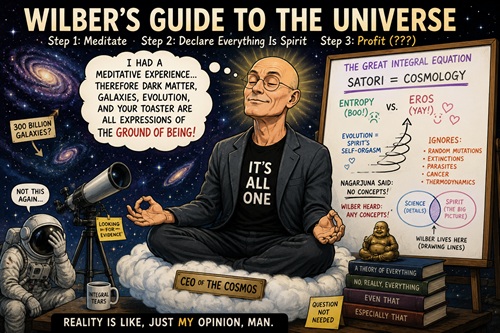 In this episode of the Ken Show, "Kosmos: An Integral Voyage", Ken Wilber attempts nothing less than a metaphysical interpretation of the cosmos.[1] Beginning with awe at the immensity of the universe, he quickly moves to familiar Integral territory: the existence of a universal Ground of Being, the epistemic authority of satori, the non-duality of emptiness and form, and the notion that evolution itself is animated by a universal Eros. His presentation is rhetorically compelling because it seamlessly interweaves authentic contemplative insights with sweeping ontological claims about reality itself. Yet this synthesis rests on a series of profound category mistakes. Wilber mistakes the phenomenology of meditation for evidence about cosmology, confuses existential certainty with epistemic certainty, ignores the constructive nature of mystical experience, and repeatedly treats subjective experience as though it directly reveals the structure of the universe. In doing so, he revives one of the oldest errors in religious philosophy: elevating altered states of consciousness into privileged sources of metaphysical knowledge. Ironically, Wilber himself eventually admits one of the central criticisms that undermines his own position. Awakening, he says, tells us nothing about astronomy, biology, chemistry, or evolution. Yet he immediately proceeds to derive precisely those cosmological conclusions from mystical realization. This tension lies at the heart of the entire lecture. Experience Is Not OntologyWilber repeatedly insists that the Ground of Being exists because contemplatives directly experience it. This argument commits a classic philosophical error. Experiences are undoubtedly real as experiences, but their interpretation is an entirely separate matter. A meditator may experience profound unity, timelessness, boundlessness, or infinite love, but none of these experiences demonstrates that reality itself possesses these properties. The inference from "I experience ultimate unity" to "ultimate unity constitutes the fabric of the universe" is logically invalid. It confuses phenomenology with ontology. The former concerns how reality appears in experience; the latter concerns what reality actually is. Modern philosophy of mind has spent decades emphasizing this distinction, yet Wilber repeatedly ignores it. His metaphysical conclusions are not derived from argument but from an unexamined leap between experience and existence. Mystical Certainty Is Not Cognitive AuthorityPerhaps Wilber's strongest rhetorical strategy is his appeal to certainty. Those who undergo satori, he argues, simply cannot doubt the reality of what they have experienced. The experience possesses an overwhelming self-evidencing quality. But certainty has never been a reliable guide to truth. Human beings can experience absolute certainty during dreams, psychotic episodes, religious conversions, psychedelic states, false memories, or near-death experiences. The feeling of certainty reveals only the intensity with which an experience is held; it says nothing about whether its interpretation corresponds to reality. Ironically, Wilber invokes William James in support of his position while overlooking James's most important caution. James acknowledged the transformative significance of mystical experiences but insisted that their authority extends only to those who have them. They cannot serve as universal evidence for metaphysical claims. Wilber appropriates James's language while disregarding his epistemological restraint. Meditation Reveals Consciousness, Not the CosmosModern contemplative neuroscience offers a far more parsimonious interpretation of mystical experience. Meditation reliably alters self-processing, body representation, temporal perception, attention, emotional regulation, and predictive processing. These changes readily explain why practitioners report timelessness, boundary dissolution, spacious awareness, and experiences of unity. None of these findings requires the existence of a universal Ground of Being. They reveal how consciousness behaves under particular conditions rather than how the universe is structured independently of consciousness. Throughout the lecture Wilber repeatedly slides from statements about experience to statements about reality. What begins as an account of consciousness quietly becomes an account of cosmology. This transition is never argued for; it is simply assumed. Nagarjuna Against WilberOne of the deepest ironies of the lecture is Wilber's repeated appeal to Nagarjuna. Nagarjuna's philosophy was designed precisely to prevent the reification of ultimate reality into a metaphysical object. Ultimate reality is neither this nor that, neither being nor non-being, neither both nor neither. Every conceptual formulation ultimately collapses. Yet Wilber immediately characterizes this supposedly ineffable reality as eternal, infinite, timeless, creative, prior to the Big Bang, and the source of evolution itself. These are precisely the kinds of positive metaphysical assertions that Nagarjuna spent his life dismantling. Wilber invokes Nagarjuna's language while abandoning Nagarjuna's method. The result is not Madhyamaka philosophy but a metaphysical absolutism clothed in Buddhist terminology. The Internal ContradictionPerhaps the most revealing moment in the lecture occurs when Wilber acknowledges that awakening tells us "bloody nothing" about atoms, molecules, evolution, astronomy, or the empirical world generally. This admission is entirely correct. Mystical realization does not teach orbital mechanics, genetics, geology, or cosmology. So this is not good news for the great traditions, but that satori tells you nothing about atoms or molecules or cells or organisms, tells you nothing about evolution, tells you nothing about those interstellar galaxies, tells you bloody nothing about relative truth. So this is hard for people who are practicing these paths of ultimate truth. It's very hard for them to accept, because when you have a big satori, a lot of people really think they've got everything covered. Yet only minutes earlier Wilber had claimed that awakening reveals an eternal Ground existing prior to the Big Bang, underlying every galaxy, and constituting the source of all existence. These are not phenomenological descriptions. They are cosmological propositions. Wilber thus simultaneously affirms and denies the epistemic reach of mystical experience. His own lecture contains the contradiction. He correctly recognizes that awakening does not generate scientific knowledge, only to use awakening as evidence for the largest scientific and metaphysical claims imaginable. From Ground to Cosmic ErosAlthough the present transcript ends before Wilber fully develops his doctrine of Eros, the foundations are already in place. The Ground of Being is not merely passive but becomes the creative source of increasing complexity throughout the universe. Evolution is interpreted as Spirit's own self-unfolding. This vision has undeniable poetic appeal, but it bears little resemblance to contemporary evolutionary theory. Biological evolution possesses no intrinsic direction toward higher consciousness. It proceeds through variation, inheritance, natural selection, developmental constraints, ecological interaction, contingency, and chance. Complexity sometimes increases, sometimes decreases, and often disappears altogether through extinction. The history of life is not an uninterrupted ascent toward greater consciousness. It is equally a history of parasites, mass extinctions, simplifications, regressions, and evolutionary dead ends. Wilber's Eros functions less as a scientific hypothesis than as a theological reinterpretation of biological history. Entropy and the Myth of "Winding Up"Wilber's account also depends upon a misleading contrast between entropy and evolution. Entropy supposedly represents the universe winding down, while evolution represents Spirit winding it up toward greater complexity. This framing misunderstands modern thermodynamics. Entropy describes the statistical tendency of closed systems toward greater disorder. The Earth, however, is not a closed system. It continuously receives enormous quantities of low-entropy energy from the Sun while radiating higher-entropy energy back into space. This constant energy flow permits the emergence of local islands of increasing organization without violating the Second Law of Thermodynamics. Evolution therefore requires no cosmic counterforce opposing entropy. Complexity emerges because thermodynamics allows self-organizing systems to arise under suitable energetic conditions. Evolution and entropy are not metaphysical opposites. Evolution is one of the many processes through which entropy itself unfolds. Wilber's cosmic Eros becomes unnecessary once contemporary thermodynamics is properly understood. The Seduction of Cosmic MeaningThe enduring attraction of Wilber's philosophy lies not primarily in its explanatory power but in its existential appeal. It offers a universe saturated with meaning. Everything belongs. Everything evolves toward greater depth. Every individual participates in Spirit's own unfolding. Even suffering becomes integrated into an overarching cosmic purpose. Such a vision is emotionally compelling. It satisfies deep psychological needs for coherence, significance, and belonging. But emotional resonance cannot substitute for philosophical justification. A meaningful universe is not necessarily a true one. Beauty is not evidence, and existential comfort is not confirmation. Meditation Without Metaphysical InflationNone of these criticisms diminishes the genuine value of contemplative practice. Meditation remains one of humanity's most sophisticated methods for investigating consciousness itself. It reveals how the sense of self is constructed, how attention shapes perception, how suffering emerges through identification, and how compassion and equanimity can be cultivated. These achievements are extraordinary. They require no metaphysical inflation. Meditation can transform consciousness without disclosing the architecture of the cosmos. The contemplative traditions are strongest when they remain faithful to phenomenology rather than attempting to become cosmology. ConclusionWilber's lecture exemplifies both the brilliance and the central weakness of Integral Theory. He articulates the existential depth of contemplative realization with remarkable eloquence, yet repeatedly mistakes first-person experience for third-person knowledge. The result is an elaborate metaphysical system built upon an epistemological confusion. Mystical experience can transform one's life without revealing the structure of the universe. Meditation may disclose the dynamics of consciousness while remaining silent about galaxies, entropy, or biological evolution. Recognizing this limitation does not diminish contemplative practice; it protects it from making claims that exceed its legitimate scope. Wilber is correct that awakening and science investigate different domains. He is mistaken in believing that the former authorizes grand cosmological conclusions. His Ground of Being, cosmic Eros, and evolutionary teleology are not discoveries yielded by meditation itself. They are philosophical interpretations projected onto contemplative experience, interpretations that remain unsupported by either contemporary philosophy of mind or modern science. The universe is no less awe-inspiring once these projections are removed. On the contrary, it becomes even more remarkable when understood as a reality that exceeds both scientific explanation and mystical imagination, inviting wonder without demanding metaphysical certainty. Appendix: Wilber's Fundamental Misunderstanding of Self-Organization and EvolutionNear the end of the lecture, Wilber makes what is perhaps his most revealing scientific error. He argues that matter has an intrinsic tendency to "wind up" toward greater complexity unless it is somehow constrained, joking that matter only "winds down" when it is "put in a box." This is presented as empirical support for his long-standing notion of Eros: an inherent drive within the universe toward increasing order, complexity, and consciousness. This is simply not how contemporary physics or evolutionary biology understands the emergence of complexity. Wilber repeatedly contrasts entropy, conceived as a universal tendency toward disorder, with evolution, conceived as an opposing tendency toward greater order. He then concludes that some intrinsic force—Eros—must be responsible for the latter. The argument appears intuitive but rests on a misunderstanding of thermodynamics. The Second Law of Thermodynamics applies to closed systems. The Earth is not a closed system but an open one, continuously bathed in a vast influx of low-entropy energy from the Sun. Because energy continually flows through the Earth system, local decreases in entropy are not only possible but expected. Hurricanes, snowflakes, convection cells, crystals, living organisms, ecosystems, and civilizations all arise because energy gradients spontaneously generate organized structures while increasing entropy globally. Modern complexity science explains this phenomenon through non-equilibrium thermodynamics, self-organization, and dissipative structures. Beginning with the pioneering work of Ilya Prigogine and greatly expanded in subsequent decades, the field has shown that ordered structures naturally emerge in systems driven far from equilibrium. No external designer or internal cosmic striving is required. Complexity is not imposed upon matter; it emerges from the lawful interaction of energy flows, feedback loops, and local interactions. Wilber appears to believe that self-organization itself points beyond physics toward an intrinsic evolutionary drive. In reality, self-organization is the very mechanism that eliminates the need for such a drive. Evolutionary biologists routinely invoke self-organization alongside natural selection, developmental constraints, niche construction, and ecological dynamics to explain biological complexity. None of these concepts presupposes that matter "wants" to become more complex. Indeed, Wilber's suggestion that there is no evolutionary biologist who rejects self-organization inadvertently undermines his own argument. Of course there is broad agreement that self-organization plays an important role in evolution. But precisely because scientists accept self-organization, they have no need to posit a metaphysical Eros directing evolution from behind the scenes. Self-organization is not evidence for cosmic purpose; it is an entirely natural process arising from the dynamics of open systems. Wilber therefore mistakes an explanatory mechanism for evidence of transcendence. Where contemporary science sees spontaneous order emerging through lawful physical processes, he sees Spirit pushing matter uphill. The distinction is crucial. Water flowing downhill naturally forms intricate river networks without "wanting" to produce watersheds. Snowflakes exhibit astonishing symmetry without possessing an intrinsic drive toward beauty. Galaxies organize into spirals through gravity, and convection cells emerge through heat gradients. Likewise, life evolves increasing complexity under suitable conditions because energy flows through living systems and selection preserves functional innovations—not because matter secretly longs to awaken. This misunderstanding reveals a recurring pattern throughout Wilber's philosophy. Whenever contemporary science successfully explains a phenomenon through emergent natural processes, Wilber redescribes the same phenomenon in spiritual language and then treats the spiritual redescription as an additional explanation. But calling evolution "Eros" adds no explanatory power whatsoever. It merely renames processes already understood in terms of thermodynamics, self-organization, and evolutionary dynamics. Ironically, Wilber often criticizes reductionism while committing an equally problematic error that might be called inflationism: the tendency to inflate natural processes into evidence for cosmic intentionality. Complexity becomes Spirit. Self-organization becomes Eros. Emergence becomes transcendence. Yet none of these reinterpretations follows logically from the science itself. Far from supporting Wilber's metaphysics, contemporary complexity science demonstrates something much more interesting: matter requires no hidden cosmic aspiration to produce astonishing levels of organization. Given persistent energy flows, appropriate boundary conditions, and enough time, complexity emerges spontaneously. The universe does not wind itself upward because it wants to. It complexifies because that is what open, far-from-equilibrium systems naturally do under the laws of physics.
THE VERBATIM “FUCK OFF” FRAGMENT ON ENTROPY AND EVOLUTION“In other words, the pure physical dimension, not even the biological, just the physical. If you take a chunk of the physical universe and cut it off and put it in a box and watch it, it will run down. And it will run down because you're not giving it room to do what it really wants to do. So for a century or so, scientists, physicists on this planet have cut things off, put them in boxes and watched them unwind. If you take a glass of water and a drop of ink and put a drop of ink in the water, it will always disperse. It will never draw up into a single drop. And that's called the second law of thermodynamics. And there are a lot of scientific materialist physicists that think that law covers everything. And it doesn't. And because if you take the stuff that you put in that physical box and you let it out for the rest of the universe, and you come back a billion years later, it'll be a cell or a multicellular organism, because that's what matter does. That's why Prigogine, who was a Nobel prize winner, I don't know, 1976, something like that... But it was brilliant because the research he did demonstrated, absolutely beyond a shadow of a doubt, that even dead, insentient matter, if you push it far from equilibrium, it'll escape its turmoil by jumping to a higher level of self-organization. Inherent, matter does that inherently. It's built into it. You don't have to do some special funky thing to get it up and running. And so that is a assumption. And so, of course, we say in integral metatheory, we say all four quadrants are operating from the beginning. Everything has an outside and an inside. And there's an individual and collective. And particularly, they do have those interiors and exteriors. And it's being driven upward. There's an Eros. It's active in basically every holon in existence, including dead, insentient matter. That's how it gets started. You don't need some special thing to get living cells out of dead molecules. They are inherently winding up. Yes, they can wind down. And if you cut something off, take a living thing, it's winding up, cut it off, kill it, put it in a box and watch it, it'll wind down. Got it. Understood. And just fuck off. So anyway, so what we've got is this inherent drive.” [44-47] NOTES[1] Ken Wilber and Corey deVos, "Kosmos: An Integral Voyage", July 16, 2019. Part 1 of this 2,5 hour video is publically available and has been used for this review essay.

Widget is loading comments...
|