|
TRANSLATE THIS ARTICLE
Integral World: Exploring Theories of Everything
An independent forum for a critical discussion of the integral philosophy of Ken Wilber
  Frank Visser, graduated as a psychologist of culture and religion, founded IntegralWorld in 1997. He worked as production manager for various publishing houses and as service manager for various internet companies and lives in Amsterdam. Books: Ken Wilber: Thought as Passion (SUNY, 2003), and The Corona Conspiracy: Combatting Disinformation about the Coronavirus (Kindle, 2020). Frank Visser, graduated as a psychologist of culture and religion, founded IntegralWorld in 1997. He worked as production manager for various publishing houses and as service manager for various internet companies and lives in Amsterdam. Books: Ken Wilber: Thought as Passion (SUNY, 2003), and The Corona Conspiracy: Combatting Disinformation about the Coronavirus (Kindle, 2020).
Check out my other conversations with ChatGPT
DEEPER WILBERIAN DIVES: Already Enlightened? The Mirage of the Absolute Spirit or Selection? On Cosmic Certainty The Integral Fortress The Integral Emperor Winding Up or Down? Is Integral Anti-Fragile? Integral without Overreach Integral without OverreachHow Integral Theory Could Gain Credibility and Mainstream AcceptanceFrank Visser / ChatGPT
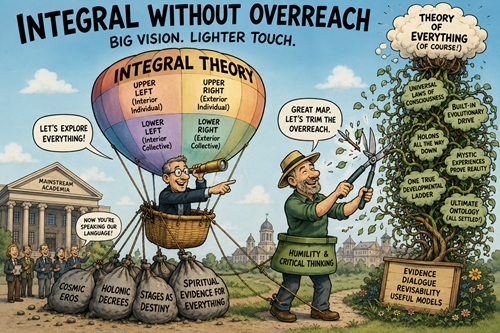 Introduction: A Powerful Framework with an Image ProblemKen Wilber's Integral Theory remains one of the most ambitious attempts to synthesize knowledge across psychology, philosophy, science, spirituality, and culture. Its appeal lies in its refusal to reduce reality to any single perspective. The famous AQAL framework ("all quadrants, all levels, all lines, all states, all types") offers a conceptual map broad enough to include neuroscience, meditation, sociology, evolutionary biology, and ethics within a single vision. Yet despite this remarkable scope, Integral Theory has failed to achieve significant influence in mainstream academia. While complexity science, cognitive science, developmental psychology, and systems thinking have all flourished, Integral remains largely confined to its own institutions and readership. The primary obstacle is not the integrative ambition itself. It is the tendency toward metaphysical overreach. Ironically, Integral could become far more influential by becoming slightly less ambitious. The Map Is Better Than the MetaphysicsMany components of Integral Theory stand quite well on their own. The Four Quadrants encourage researchers to distinguish between subjective experience, objective behavior, cultural meaning, and social systems. Developmental models remind us that cognition, morality, identity, and values evolve over time. The recognition of multiple intelligences and developmental lines remains valuable. Even the insistence that first-person, second-person, and third-person perspectives each reveal different aspects of reality is increasingly accepted in philosophy and cognitive science. None of these ideas require a cosmic metaphysics. They function perfectly well as heuristic tools—as conceptual lenses rather than descriptions of ultimate reality. This is exactly how successful scientific frameworks usually operate. Where Integral Loses Its AudienceProblems arise when useful organizing principles become universal laws of existence. Holons become the fundamental building blocks of the cosmos. Evolution becomes driven by an intrinsic Eros. Developmental stages become inevitable features of both history and consciousness. Meditative experience becomes evidence for the structure of reality itself. At this point, many scientists simply stop listening. Not because they oppose spirituality, but because these claims exceed the available evidence. The transition from "this model is useful" to "this is how the universe actually works" is precisely where Integral loses credibility. Science Rewards ModestyScientific theories survive by remaining open to correction. Newton explained gravity brilliantly without claiming to reveal ultimate reality. Einstein later revised Newton. Quantum mechanics revised Einstein in certain domains. Evolutionary biology continues to revise itself as genetics, epigenetics, ecology, and developmental biology advance. Science progresses because its models remain provisional. Integral often presents itself differently. Wilber has frequently described AQAL as the framework that "cannot be denied without being used," suggesting a uniquely privileged status. Such claims inevitably invite skepticism because they appear to place the theory beyond ordinary scientific revision. A more modest Integral would say something simpler: "This framework organizes many important observations remarkably well—but it remains open to improvement." That statement would inspire far more confidence. Development Without DestinyDevelopmental psychology remains one of Integral's strongest foundations. People do mature cognitively, emotionally, morally, and socially. Numerous researchers—from Jean Piaget to Robert Kegan, Susanne Cook-Greuter, and others—have documented aspects of this process. But contemporary developmental science also emphasizes variability, context, culture, and complexity. Development is rarely a single ladder. People may advance in one domain while regressing in another. Different environments produce different developmental trajectories. Social networks, institutions, education, trauma, and culture all shape growth. Integral becomes stronger—not weaker—when it embraces this richer complexity instead of insisting on one overarching sequence of stages. Spiritual Experience Is Evidence—But of What?Perhaps the greatest shift concerns spirituality itself. Meditative experiences are undeniably real. Mystical experiences are psychologically important. Contemplative practices can transform people's lives. These claims are supported by growing empirical research. What remains controversial is what such experiences actually reveal. Feeling unity with the universe does not necessarily demonstrate that consciousness is the fundamental substance of reality. Experiencing timeless awareness does not prove that time is ultimately illusory. Profound experiences deserve careful study without automatically becoming metaphysical evidence. This distinction protects both science and spirituality. Integral as a Research ProgramImagine Integral repositioned not as a completed worldview but as an ongoing interdisciplinary research program. Instead of defending fixed metaphysical doctrines, Integral scholars could investigate questions such as: • How do subjective experience and neuroscience interact? • How do developmental processes emerge within complex adaptive systems? • How do cultures shape cognitive development? • Which contemplative practices produce measurable psychological benefits? • When do stage theories succeed, and when do network models provide better explanations? Such questions invite collaboration instead of polarization. Integral would become a meeting place rather than a belief system. Complexity Rather Than Cosmic DirectionModern complexity science offers an especially promising partner. Complex systems produce surprising patterns through countless local interactions rather than through predetermined cosmic goals. Emergence explains increasing organization without requiring a built-in evolutionary drive. This does not diminish the wonder of evolution. On the contrary, spontaneous self-organization often appears even more remarkable because it arises naturally from interaction rather than from hidden purpose. Integral could reinterpret many of its intuitions through the language of complexity instead of metaphysical teleology. The resulting theory would likely be more scientifically persuasive. Humility as StrengthThe most successful intellectual frameworks rarely claim finality. Darwin did not explain everything about evolution. Einstein did not explain everything about physics. Complexity science does not claim to explain every aspect of human society. Their strength lies precisely in their willingness to remain incomplete. Integral could benefit from the same epistemic humility. Instead of presenting itself as the "theory of everything," it might present itself as "a framework for integrating many partial truths." That is still an extraordinarily ambitious goal. It is also a far more defensible one. Conclusion: An Integral Theory for the Twenty-First CenturyThe future of Integral Theory does not depend on defending every aspect of Wilber's original vision. It depends on distinguishing its enduring insights from its speculative additions. The quadrants need not depend on cosmic Eros. Development need not culminate in metaphysical certainty. Spiritual practice need not validate an ontology. A genuinely integral approach should integrate criticism as readily as affirmation. It should evolve as science evolves, revise itself as evidence accumulates, and welcome competing explanations rather than subsuming them. Such an Integral Theory would lose some of its grand metaphysical confidence. But it would gain something far more valuable: intellectual credibility. And paradoxically, that humility may finally allow Integral to fulfill its original promise—not as the last word on reality, but as one of the most fruitful conversations about how we understand it. Appendix: If Integral Fully Accepted Evolutionary Biology—What Would Change (and What Would Remain)?Much of the debate surrounding Integral Theory concerns its interpretation of evolution. Ken Wilber has often argued that conventional evolutionary biology cannot adequately explain the emergence of increasing complexity, introducing concepts such as Eros, involution, and intrinsic developmental drive to fill what he sees as explanatory gaps. Critics, however, contend that modern evolutionary theory already provides powerful naturalistic explanations without invoking cosmic purpose. Suppose Integral were to fully accept contemporary evolutionary biology—including natural selection, genetic drift, developmental constraints, niche construction, multilevel selection, evo-devo, and complexity theory. What would actually have to change? Surprisingly, less than many people assume. What Would ChangeThe most obvious casualty would be cosmic teleology. Evolution would no longer be understood as moving toward predetermined higher forms under the guidance of an immanent Eros. Instead, increasing complexity would be seen as an emergent possibility rather than an inevitable destiny. Intelligence, consciousness, and culture would become contingent outcomes of evolutionary history rather than its preordained goals. Likewise, involution—the idea that Spirit somehow "descends" into matter before evolution begins—would cease to function as a scientific explanation. It could survive, at most, as a symbolic or theological narrative expressing existential meaning rather than describing empirical processes. Integral would also abandon its recurring criticisms of Darwinian theory as fundamentally incomplete. Contemporary evolutionary biology is no longer reducible to the simplistic "random mutation plus natural selection" caricature that Wilber often attacks. It incorporates developmental biology, epigenetics, ecological interactions, evolutionary developmental constraints, and complex systems theory. Recognizing this richer picture would eliminate much unnecessary conflict between Integral and science. Finally, evolution itself would lose its moral direction. Nature would no longer be assumed to be moving "upward" toward greater goodness or spirituality. Evolution produces cooperation and conflict, altruism and exploitation, beauty and extinction. Human ethics would have to be justified independently rather than derived from evolutionary trends. What Would RemainRemarkably, most of Integral's practical insights could remain intact. The Four Quadrants would still provide a useful reminder that subjective experience, objective processes, cultural meanings, and social systems require different methods of investigation. Evolutionary biology itself already studies phenomena that span these different domains. Developmental psychology would remain valuable, although understood more flexibly. Human beings clearly develop cognitively, emotionally, morally, and socially. The evidence for developmental change does not depend upon cosmic evolution; it depends upon empirical research into human growth. Meditative practice would remain equally important. The transformative value of contemplative disciplines does not require that mystical experiences reveal the metaphysical architecture of the universe. Meditation can improve attention, emotional regulation, compassion, and self-understanding regardless of one's ontology. Integral's aspiration toward interdisciplinarity would also survive. Indeed, it might flourish even more. A framework designed to connect neuroscience, psychology, sociology, ecology, philosophy, and religious studies has obvious value—provided it does not insist that every discipline ultimately confirms a single metaphysical worldview. Even the concept of "integration" itself would become stronger. Integration need not mean subordinating every field to one master narrative. It can mean creating productive dialogue among partially independent domains of knowledge. A Different Kind of IntegralAn evolutionarily naturalized Integral would be less like a grand cosmology and more like an interdisciplinary research program. It would ask how biological evolution gave rise to minds, how minds created cultures, how cultures reshape environments, and how individuals continue developing throughout life. Rather than explaining everything from above, it would connect many fields from across. Such an Integral would lose some of its metaphysical grandeur. There would be no cosmic Eros quietly steering evolution toward enlightenment. But it would gain something arguably more valuable: compatibility with modern science, openness to revision, and genuine participation in the ongoing conversation of scholarship. Paradoxically, by surrendering the claim to explain everything, Integral might finally become a framework that many more people are willing to use.
Widget is loading comments...
|