|
TRANSLATE THIS ARTICLE
Integral World: Exploring Theories of Everything
An independent forum for a critical discussion of the integral philosophy of Ken Wilber
  Frank Visser, graduated as a psychologist of culture and religion, founded IntegralWorld in 1997. He worked as production manager for various publishing houses and as service manager for various internet companies and lives in Amsterdam. Books: Ken Wilber: Thought as Passion (SUNY, 2003), and The Corona Conspiracy: Combatting Disinformation about the Coronavirus (Kindle, 2020). Frank Visser, graduated as a psychologist of culture and religion, founded IntegralWorld in 1997. He worked as production manager for various publishing houses and as service manager for various internet companies and lives in Amsterdam. Books: Ken Wilber: Thought as Passion (SUNY, 2003), and The Corona Conspiracy: Combatting Disinformation about the Coronavirus (Kindle, 2020).
Check out my other conversations with ChatGPT
DEEPER WILBERIAN DIVES: Already Enlightened? The Mirage of the Absolute Spirit or Selection? On Cosmic Certainty The Integral Fortress The Integral Emperor Winding Up or Down? Is Integral Anti-Fragile? Integral without Overreach Is Wilberian Integral Theory Anti-Fragile?How Ken Wilber's Grand Synthesis Responds to Criticism and Why It May Be More Fragile Than It AppearsFrank Visser / ChatGPT
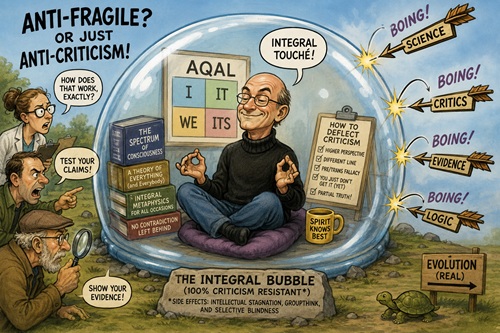 Ken Wilber has often presented Integral Theory as a uniquely comprehensive framework: one that "transcends and includes" previous perspectives while integrating science, philosophy, psychology, spirituality, and systems theory into a single meta-framework. Admirers frequently describe it as immune to the usual failures of grand theories because it can absorb criticism without abandoning its central principles. But does that make Integral Theory anti-fragile in Nassim Nicholas Taleb's sense? Or does its very comprehensiveness conceal a surprising vulnerability? I would argue that Wilberian Integral Theory is not anti-fragile at all. It is, in important respects, structurally fragile. What Anti-Fragility Actually MeansTaleb distinguished between three kinds of systems. • Fragile systems break under stress. • Robust systems resist stress and remain essentially unchanged. • Anti-fragile systems actually improve when exposed to shocks, criticism, uncertainty, or failure. Science is often cited as an anti-fragile enterprise—not because individual theories survive criticism, but because criticism eliminates weaker ideas and strengthens the overall body of knowledge. Darwinian evolution is another example: variation and selection continually improve adaptation through failure. An anti-fragile intellectual system therefore welcomes falsification. It changes in response to evidence. This is where Integral Theory faces difficulties. The Elasticity of AQALWilber's AQAL model ("All Quadrants, All Levels, All Lines, All States, All Types") is extraordinarily flexible. • Almost any phenomenon can be assigned a quadrant. • Any apparent contradiction can be explained by invoking another developmental line. • Unexpected findings become partial truths. • Conflicting schools become complementary perspectives. At first glance this seems like intellectual resilience. But flexibility is not the same as anti-fragility. A theory that can explain everything may ultimately explain very little. If no observation could ever force revision of its central architecture, the theory becomes insulated rather than adaptive. Criticism Rarely Alters the CoreOver four decades critics have raised serious objections. • The evolutionary ladder has been criticized for oversimplifying biological evolution. • Developmental psychology has moved toward more dynamic, contextual, and pluralistic models. • Cross-cultural scholars question the universality of hierarchical stage theories. • • Neuroscience challenges claims about contemplative realization revealing metaphysical truths. • Evolutionary biology rejects Wilber's notion of Eros as an explanatory principle. Yet remarkably little of the architecture has changed. Instead, criticisms are usually reclassified as partial truths emerging from lower perspectives or incomplete worldviews. This strategy preserves coherence, but not necessarily learning. Self-Sealing SystemsKarl Popper argued that genuinely scientific theories expose themselves to potential refutation. Integral Theory often does the opposite. When critics disagree, they are frequently said to occupy a lower developmental altitude, confuse quadrants, commit the pre/trans fallacy, or mistake partial truths for integral understanding. These interpretive moves make criticism increasingly difficult. Every objection can be absorbed without modifying the theory itself. Ironically, this resembles what Taleb would call fragility masquerading as robustness. A system protected from meaningful error correction loses the ability to improve. The Missing Feedback LoopScience progresses because experiments can overturn cherished assumptions. Markets evolve because unsuccessful firms disappear. Biological evolution proceeds because maladaptive organisms fail to reproduce. Integral Theory lacks a comparable mechanism. There is no agreed procedure by which empirical discoveries could demonstrate that AQAL itself requires revision. There are certainly additions—new terminology, refinements, and integrations—but rarely genuine subtraction. Yet subtraction is essential for anti-fragility. Learning requires abandoning mistaken ideas. The Metaphysical CoreThe deepest source of fragility lies in Wilber's metaphysical commitments. Ideas such as involution, Spirit-in-action, evolutionary Eros, and Kosmic consciousness function as foundational assumptions rather than empirical hypotheses. Because these claims are largely insulated from decisive testing, they remain fixed even as surrounding disciplines evolve. This creates tension with the sciences that Integral Theory seeks to integrate. Biology advances by discarding outdated explanations. Integral Theory often preserves earlier metaphysical commitments by assigning them higher interpretive status. That strategy maintains internal consistency but reduces external accountability. A More Anti-Fragile Integral TheoryIronically, Integral Theory could become genuinely anti-fragile by becoming less ambitious. Imagine an Integral framework that retained its valuable insights while abandoning its strongest metaphysical claims. • The quadrants could remain as heuristic perspectives rather than ontological divisions of reality. • • vDevelopmental models could become empirical hypotheses instead of universal necessities. • • Mystical experiences could be respected without treating them as privileged disclosures about the structure of the cosmos. • Evolution could be understood through contemporary biology rather than cosmic Eros. Such a framework would actually gain from criticism because criticism would refine rather than threaten it. Its strength would lie in revision, not preservation. The Difference Between Integration and ImmunityWilber deserves enormous credit for attempting something few philosophers have even dared: constructing a genuinely comprehensive synthesis of human knowledge. His work has inspired countless readers to think across disciplinary boundaries and to appreciate the partial truths contained in competing perspectives. But comprehensiveness carries a danger. The more complete a worldview becomes, the greater the temptation to explain away anomalies rather than learn from them. When every criticism can already be accommodated, criticism ceases to perform its essential function. The resulting system may look resilient, yet it gradually loses contact with the processes of discovery that characterize genuinely anti-fragile knowledge. ConclusionIntegral Theory often presents itself as the culmination of humanity's intellectual development—a framework capable of integrating every valid perspective. Yet anti-fragility demands something more demanding than inclusiveness. It requires the willingness to let reality reshape the framework itself. Wilber's system is remarkably elastic, but elasticity should not be confused with learning. Its architecture has proven adept at absorbing criticism while leaving its deepest commitments intact. That makes it robust in appearance, but fragile in a deeper epistemological sense. A theory that cannot be fundamentally revised cannot truly evolve. The irony is striking. A philosophy built around evolution may itself have evolved less than the sciences it seeks to encompass. A genuinely integral theory of the future would not merely integrate other disciplines—it would allow itself to be transformed by them. Appendix: Didn't Wilber Evolve from Wilber-1 to Wilber-5?Defenders of Ken Wilber might object that Integral Theory has, in fact, evolved dramatically. After all, scholars commonly distinguish between Wilber-1, Wilber-2, Wilber-3, Wilber-4, and Wilber-5, reflecting major shifts in his thinking over nearly five decades. Doesn't that history itself demonstrate anti-fragility? Only up to a point. It is certainly true that Wilber's work has undergone significant revisions. His early Spectrum of Consciousness model gave way to the developmental synthesis of The Atman Project, later expanding into the AQAL framework with its quadrants, developmental lines, states, and types. He abandoned some earlier psychological formulations, incorporated systems theory, developmental psychology, and postmodernism, and became more attentive to cultural pluralism. In that sense, Wilber has never been a static thinker. Yet most of these changes occurred during the construction of Integral Theory, not as responses to sustained empirical criticism. They represent intellectual expansion rather than correction. The trajectory is largely additive: more distinctions, more dimensions, more inclusive frameworks. What is striking is that the deepest commitments remained remarkably stable. The notion of evolution as a spiritually driven process, the hierarchical structure of development, the privileged epistemic status of contemplative realization, and the idea of Spirit as the ultimate ground of reality have persisted from one version to the next. The architecture has become more elaborate, but its metaphysical foundation has remained largely untouched. Indeed, many critics have observed that later versions of AQAL often respond to objections not by abandoning problematic assumptions, but by introducing additional conceptual layers. If developmental models prove too simple, add multiple lines. If quadrants seem insufficient, add states and types. If postmodernism challenges universal hierarchies, include postmodernism as another developmental achievement. The framework grows increasingly comprehensive, but rarely relinquishes core commitments. This is an important distinction. Anti-fragile systems improve because criticism exposes weaknesses that lead to genuine revision. Integral Theory has certainly become more sophisticated, but sophistication is not the same as self-correction. Complexity can increase while foundational assumptions remain insulated. One might therefore say that Wilber's oeuvre evolved substantially from Wilber-1 to Wilber-5, but not in the way science typically evolves. Scientific revolutions sometimes discard central ideas—phlogiston, the luminiferous ether, or fixed continents disappeared because evidence demanded it. Wilber's revisions have generally been cumulative rather than subtractive. That difference matters. Anti-fragility is measured not by how much a theory grows, but by its willingness to let reality prune its deepest assumptions. By that standard, Wilber's developmental sequence demonstrates remarkable creativity and intellectual ambition—but only limited evidence of anti-fragility.
Widget is loading comments...
|