|
TRANSLATE THIS ARTICLE
Integral World: Exploring Theories of Everything
An independent forum for a critical discussion of the integral philosophy of Ken Wilber
  Frank Visser, graduated as a psychologist of culture and religion, founded IntegralWorld in 1997. He worked as production manager for various publishing houses and as service manager for various internet companies and lives in Amsterdam. Books: Ken Wilber: Thought as Passion (SUNY, 2003), and The Corona Conspiracy: Combatting Disinformation about the Coronavirus (Kindle, 2020). Frank Visser, graduated as a psychologist of culture and religion, founded IntegralWorld in 1997. He worked as production manager for various publishing houses and as service manager for various internet companies and lives in Amsterdam. Books: Ken Wilber: Thought as Passion (SUNY, 2003), and The Corona Conspiracy: Combatting Disinformation about the Coronavirus (Kindle, 2020).
Check out my other conversations with ChatGPT Fifty Years of The Selfish GeneWhat Dawkins Really Meant—and Why So Many People Misunderstood ItFrank Visser / ChatGPT
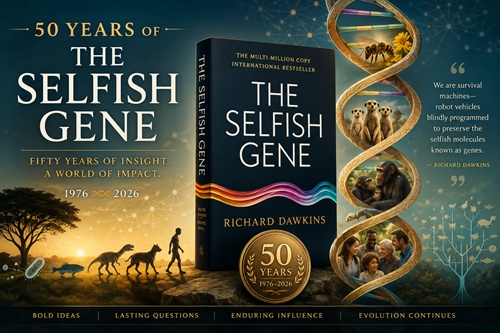 IntroductionWhen Richard Dawkins published The Selfish Gene in 1976, he fundamentally changed how many people thought about evolution. The book became one of the most influential works of popular science ever written, introducing concepts such as gene-centered evolution, replicators, vehicles, and memes to a broad audience. Half a century later, The Selfish Gene remains widely read—and widely misunderstood. Ironically, many critics attack ideas Dawkins never proposed, while some admirers extend his arguments far beyond what evolutionary biology can justify. The phrase "selfish gene" itself has become one of the most successful—and most misleading—metaphors in modern science. Understanding what Dawkins actually argued reveals a much richer and more nuanced picture of evolution. The Gene's-Eye ViewBefore Dawkins, evolutionary theory was often explained as competition between individuals or even between species. Dawkins argued that the fundamental units that persist through evolutionary time are genes. Organisms are temporary. Genes, by contrast, are copied generation after generation. Individual animals are born and die; species may eventually go extinct. But successful genes can survive for millions of years by continually building new bodies. Dawkins called organisms "survival machines" or "vehicles"—temporary constructions assembled by genes to increase their chances of replication. This perspective was inspired by the work of evolutionary biologist George C. Williams and population geneticist William D. Hamilton, whose theories of kin selection had already demonstrated that many puzzling behaviors become understandable when viewed from the perspective of genes rather than individuals. Selfish Genes Do Not Mean Selfish OrganismsThe greatest misunderstanding stems from the title itself. Genes are not conscious. They possess no desires, intentions, or goals. Calling genes "selfish" is shorthand for a statistical observation: genes that become more common in future generations are precisely those that have been effective at promoting their own transmission. Nothing more mystical is implied. Indeed, genes often produce remarkably cooperative organisms. • Honeybee workers sacrifice reproduction entirely. • Meerkats stand guard for predators. • Birds feed unrelated chicks. • Humans donate kidneys to strangers. These behaviors may appear altruistic at the organismal level while still enhancing the long-term success of genes through mechanisms such as kin selection, reciprocal altruism, or indirect fitness. The "selfishness" belongs only to the process of natural selection, not to conscious motivation. Cooperation Is Not the Opposite of Gene-Centered Evolution One persistent myth is that Dawkins believed evolution is driven solely by ruthless competition. Quite the opposite. Evolution repeatedly discovers that cooperation is often the best strategy for genes. • Cells cooperate to form multicellular organisms. • Individuals cooperate within families. • Social insects cooperate in vast colonies. • Humans cooperate in societies of millions. Competition exists, but so does cooperation—and often the latter evolves precisely because it improves reproductive success. This insight has been reinforced by decades of research in evolutionary game theory, microbiology, ecology, and studies of major evolutionary transitions. Even Peter Kropotkin's famous emphasis on mutual aid fits comfortably within a gene-centered framework. Cooperation need not contradict Darwinian evolution; it can be one of its most successful products. The Replicator-Vehicle DistinctionPerhaps Dawkins' most enduring contribution was distinguishing between replicators and vehicles. • Replicators are entities that make copies of themselves with sufficient fidelity. • Vehicles are temporary systems built by replicators to enhance their replication. Genes are replicators. Organisms are vehicles. This distinction clarified many evolutionary puzzles because selection ultimately favors replicators that construct successful vehicles. Later developments complicated the picture. Cultural inheritance, epigenetic modifications, symbiotic organisms, and niche construction all influence evolution. Yet none of these discoveries overturned the replicator concept. Instead, they revealed additional layers of inheritance operating alongside DNA. Did Dawkins Ignore Development?Critics often accuse Dawkins of genetic determinism. This criticism is only partly justified. Dawkins repeatedly emphasized that genes act through enormously complex interactions with developmental processes and environments. No gene directly specifies an eye, a brain, or a behavior. Genes encode proteins that participate in developmental networks, whose outcomes depend on interactions among thousands of genes, cells, environmental signals, and chance events. Modern developmental biology has made this picture vastly more sophisticated than it appeared in 1976. Gene regulation, epigenetics, developmental plasticity, and gene-environment interactions have become central themes. None of these discoveries invalidate gene-centered evolution. Rather, they explain how genes actually produce organisms. The Extended Evolutionary SynthesisSome advocates of the Extended Evolutionary Synthesis (EES) portray their work as replacing Dawkins. This overstates the case. Researchers such as Eva Jablonka, Kevin Laland, Gerd Müller, and others have highlighted additional evolutionary processes: • developmental bias • niche construction • phenotypic plasticity • epigenetic inheritance • ecological inheritance These mechanisms unquestionably enrich evolutionary theory. But they do not eliminate genes as the primary long-term hereditary information system. Natural selection still depends fundamentally on heritable variation, and DNA remains overwhelmingly the most stable inheritance mechanism across evolutionary time. Most evolutionary biologists therefore view the EES as an expansion rather than a revolution. The Misuse of "Selfish Gene" in Popular CultureOutside biology, "selfish gene" has often become a slogan. Some writers invoke it to claim that humans are genetically programmed for greed. Others use it to justify capitalism. Still others blame it for war, inequality, or aggressive behavior. None of these claims follows from Dawkins' argument. Evolutionary explanations describe statistical tendencies, not moral obligations. The naturalistic fallacy—deriving "ought" from "is"—remains as invalid today as ever. Humans possess language, culture, institutions, morality, law, education, and conscious reflection. These evolved capacities enable us to act contrary to immediate biological impulses. As Dawkins himself famously remarked, we are capable of "rebelling against the tyranny of the selfish replicators." The Memes DetourOne of the book's final chapters introduced a speculative idea that achieved a life of its own: memes. Ideas, tunes, fashions, technologies, and religious beliefs might function as cultural replicators analogous to genes. The concept proved enormously influential in internet culture, cognitive science, and philosophy. Yet meme theory never developed into a mature empirical science comparable to genetics. Cultural evolution certainly exists, but it appears to involve far more complicated learning processes, social networks, institutions, and psychological biases than the original meme concept suggested. In retrospect, the meme may have been Dawkins' least successful scientific proposal and his most successful metaphor. What Has Fifty Years Taught Us?Since 1976, biology has become vastly more sophisticated. We now understand gene regulation, developmental biology, epigenetics, microbiomes, horizontal gene transfer, and systems biology in ways unimaginable when The Selfish Gene first appeared. Yet remarkably, Dawkins' central insight remains intact. Genes are not dictators. They are participants in extraordinarily complex developmental systems. But because they are the principal units copied with high fidelity across generations, they remain the primary beneficiaries of natural selection. Evolution acts on organisms. Selection accumulates changes in genes. The distinction still provides one of the clearest conceptual frameworks for understanding adaptation. ConclusionThe phrase "selfish gene" has always been a metaphor—perhaps too successful for its own good. It invited readers to imagine genes as tiny scheming agents, even though Dawkins repeatedly warned against taking the language literally. Fifty years later, the enduring value of The Selfish Gene lies not in the metaphor itself but in the conceptual shift it inspired. By asking us to view evolution from the perspective of replicating hereditary information, Dawkins provided a powerful explanatory framework that unified phenomena ranging from altruism and parental care to social cooperation and conflict. The science has advanced, the details have multiplied, and new mechanisms have enriched evolutionary theory. But the central lesson endures: genes are not the whole story of evolution, yet neither can they be relegated to a supporting role. Evolution is best understood as the interaction of genes, development, organisms, environments, and cultures, each influencing the others across multiple timescales. The challenge today is not to abandon Dawkins' gene-centered perspective, but to place it within this broader systems view without losing the clarity that made The Selfish Gene a scientific classic.
Widget is loading comments...
|