|
TRANSLATE THIS ARTICLE
Integral World: Exploring Theories of Everything
An independent forum for a critical discussion of the integral philosophy of Ken Wilber
  Frank Visser, graduated as a psychologist of culture and religion, founded IntegralWorld in 1997. He worked as production manager for various publishing houses and as service manager for various internet companies and lives in Amsterdam. Books: Ken Wilber: Thought as Passion (SUNY, 2003), and The Corona Conspiracy: Combatting Disinformation about the Coronavirus (Kindle, 2020). Frank Visser, graduated as a psychologist of culture and religion, founded IntegralWorld in 1997. He worked as production manager for various publishing houses and as service manager for various internet companies and lives in Amsterdam. Books: Ken Wilber: Thought as Passion (SUNY, 2003), and The Corona Conspiracy: Combatting Disinformation about the Coronavirus (Kindle, 2020).
Check out my other conversations with ChatGPT Peter Kropotkin and the Biology of CooperationDarwin's Forgotten AllyFrank Visser / ChatGPT
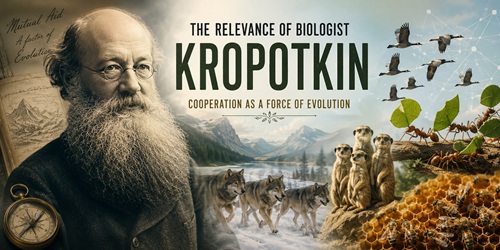 More Than an AnarchistPeter Kropotkin (1842-1921) is remembered primarily as an anarchist philosopher and political revolutionary. His advocacy of decentralized societies and voluntary cooperation made him one of the most influential political thinkers of the late nineteenth century. Yet this fame has overshadowed another side of Kropotkin: he was also a serious naturalist who made an important contribution to evolutionary biology. His most famous scientific work, Mutual Aid: A Factor of Evolution (1902), challenged a growing tendency to interpret Darwinian evolution almost exclusively as ruthless competition. Kropotkin argued that cooperation is not an exception to evolution—it is one of its driving forces. Remarkably, modern evolutionary biology has vindicated much of this insight. Against "Nature Red in Tooth and Claw"During Kropotkin's lifetime, Darwin's ideas were increasingly filtered through the writings of Herbert Spencer and Thomas Huxley. Evolution became associated with endless struggle, competition, and the survival of the strongest. This interpretation easily blended with laissez-faire economics and imperial politics, producing what later became known as Social Darwinism. Kropotkin believed this was a distortion of both nature and Darwin himself. While exploring Siberia and Manchuria as a geographer, Kropotkin noticed something unexpected. The harsh climate meant that survival often depended less on competition between individuals than on cooperation within groups. Animals that hunted together, warned each other of danger, or shared responsibilities appeared more successful than solitary competitors. The greatest challenge was often not other animals—it was surviving winter. Mutual Aid EverywhereKropotkin compiled numerous examples from across the animal kingdom: • Wolves hunting cooperatively. • Birds warning flocks about predators. • Herd animals protecting vulnerable members. • Social insects building remarkably efficient colonies. • Human societies organizing through reciprocity and communal support. His point was not that competition disappeared. Predators still hunted prey, and individuals still competed for mates and territory. Rather, he argued that cooperation itself is an evolutionary adaptation. Species capable of working together often outperform equally strong but less cooperative rivals. This was a subtle but profound correction to one-sided interpretations of evolution. Darwin Had Already Said SoIronically, Kropotkin was in many respects returning to Darwin rather than rejecting him. Darwin repeatedly emphasized social instincts, sympathy, parental care, and group living. In The Descent of Man, he suggested that tribes whose members were courageous, loyal, and willing to help one another could gain advantages over less cooperative groups. Kropotkin simply elevated this neglected aspect of Darwin's theory into a central organizing principle. His disagreement was less with Darwin than with Darwin's more aggressive interpreters. Modern Biology Catches UpTwentieth-century biology gradually rediscovered the importance of cooperation. William Hamilton explained how genes promoting altruism toward relatives could spread through kin selection. Robert Trivers developed reciprocal altruism, showing how helping unrelated individuals can evolve when favors are returned over time. John Maynard Smith applied game theory to evolution, demonstrating mathematically when cooperation becomes evolutionarily stable. David Sloan Wilson and others explored multilevel selection, investigating how selection can sometimes favor cooperative groups over less cooperative ones. Meanwhile, microbiologists discovered astonishing levels of cooperation among bacteria, fungi, and multicellular organisms. Even the cells within our own bodies cooperate on a breathtaking scale. The old picture of evolution as perpetual combat became increasingly incomplete. Competition Never DisappearedThis does not mean Kropotkin was entirely right. Some later admirers portrayed him as claiming that evolution is fundamentally peaceful. That goes too far. Competition remains a central feature of evolution. Animals compete for food, mates, nesting sites, and territory. Plants compete for sunlight. Parasites compete with hosts. Predators compete with prey in endless evolutionary arms races. Modern evolutionary theory therefore sees cooperation and competition as complementary rather than opposing forces. Cooperation itself often evolves because it improves competitive success. A wolf pack cooperates precisely because it competes more effectively. The Social TemptationKropotkin also illustrates a broader lesson about science. Scientists are never completely detached from their social environment. Victorian industrial society emphasized competition, and many thinkers projected this value onto nature. Kropotkin, committed to anarchist ideals of voluntary association, naturally noticed cooperation. Both perspectives contained elements of truth. The danger lies in allowing political ideology to dictate biological conclusions. Nature is neither capitalist nor socialist. It simply contains both conflict and cooperation in endlessly shifting combinations. Lessons Beyond BiologyKropotkin's work continues to resonate beyond evolutionary science. Economists increasingly recognize the importance of trust and social capital. Psychologists study empathy, reciprocity, and prosocial behavior. Network science reveals that resilient systems often depend on cooperative interactions. Ecologists emphasize interconnected ecosystems rather than isolated species. Even artificial intelligence increasingly relies on distributed cooperation among multiple agents rather than purely competitive optimization. The broader insight is that complex systems frequently succeed because their components cooperate. A More Complete DarwinismThe greatest significance of Kropotkin today is not that he replaced Darwinian competition with cooperation. It is that he reminded us evolution has always involved both. Natural selection rewards whatever strategies increase reproductive success under particular conditions. Sometimes this means fierce competition. Sometimes it means extraordinary collaboration. Often it means a mixture of both. Modern biology no longer speaks of "survival of the strongest." Instead, it recognizes that success can arise through strength, intelligence, flexibility, cooperation, or countless combinations of these traits. In that sense, Kropotkin helped restore an important balance to evolutionary thinking. More than a century after Mutual Aid appeared, his central message feels surprisingly contemporary: life advances not only through struggle, but also through partnership. Evolution is not merely a battlefield. It is also a vast network of collaborations, stretching from bacterial cells to human societies, where helping one another can be just as adaptive as defeating one's rivals.
Widget is loading comments...
|