|
TRANSLATE THIS ARTICLE
Integral World: Exploring Theories of Everything
An independent forum for a critical discussion of the integral philosophy of Ken Wilber
  Frank Visser, graduated as a psychologist of culture and religion, founded IntegralWorld in 1997. He worked as production manager for various publishing houses and as service manager for various internet companies and lives in Amsterdam. Books: Ken Wilber: Thought as Passion (SUNY, 2003), and The Corona Conspiracy: Combatting Disinformation about the Coronavirus (Kindle, 2020).
Check out my other conversations with ChatGPT
Unpopular questions about the Ukraine War:
Did Russia Have Any Valid Reasons to Invade Ukraine? From Regional War to World War III? Russia, Ukraine, and Europe in the Drama Triangle Three-Quarters of the World Condemned Russia? Was Putin's Invasion a Pre-emptive Strike That Backfired? Russia's Hybrid War Against Europe The Nuclear Game of Cards A New European Security Architecture Russia Economy Is Not the Size of Spain Russia Economy Is Not the Size of SpainThe Misleading Politics of GDP ComparisonsFrank Visser / ChatGPT
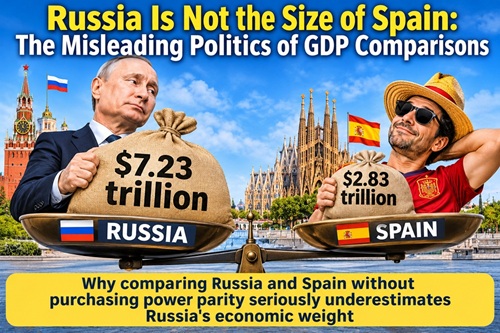 One of the recurring arguments in discussions about the war in Ukraine and the geopolitical balance between Russia and the West is that the Russian economy is surprisingly small. It is sometimes compared to that of Spain, or described as roughly equivalent to the economy of a medium-sized Western European country. The implication is obvious: how can a country with an economy supposedly no larger than Spain's seriously challenge the combined economic power of the European Union and NATO? There is a problem with this comparison. It generally relies on nominal GDP measured in US dollars, while neglecting purchasing power parity (PPP). These are two different ways of measuring economic output, and the distinction matters enormously when comparing countries with substantially different price levels. Russia's economy is considerably larger than Spain's when measured in PPP. Indeed, according to the International Monetary Fund's October 2026 estimates, Russia has the largest economy in Europe by this measure, ahead of Germany. This does not make Russia an economic superpower comparable to the United States or China, nor does it establish that its economy is healthy. But it does mean that the familiar Spain comparison can be seriously misleading. The question is not simply which number is correct. It is what each number tells us, what it leaves out, and why these distinctions matter when assessing Russia's capacity to wage war and sustain its geopolitical ambitions. 1. Two different ways of measuring economic powerNominal GDP measures the total value of goods and services produced in a country, converted into a common currency, usually US dollars, using prevailing exchange rates. This is useful for comparing countries' capacity to purchase internationally traded goods, service foreign-currency debt, invest abroad, and participate in international financial markets. But exchange rates do not adequately reflect the domestic purchasing power of money. A construction worker, engineer, factory employee or soldier in Russia generally costs less to employ than someone performing comparable work in Spain or Germany. Housing, many services, locally produced materials and numerous other domestic goods are also cheaper. Purchasing power parity attempts to correct for these differences. It estimates how much a country's economic output would be worth if differences in national price levels were taken into account. In other words, PPP provides a better indication of the volume of goods and services that an economy can produce and purchase domestically. This distinction is particularly important when comparing Russia with Western European countries. 2. What the numbers actually tell usConsider the following comparison, using the latest available 2025 estimates.
Sources: World Bank, 2025 nominal GDP; IMF October 2026 estimates, 2025 PPP GDP and per-capita figures.
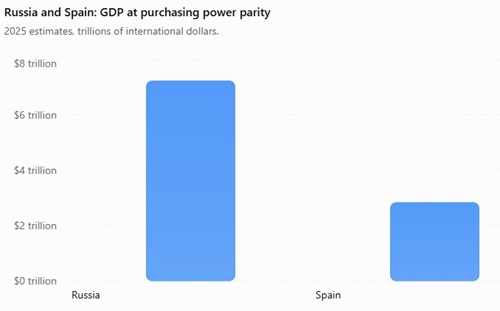 The difference is substantial. Russia's economy is approximately 2.6 times the size of Spain's in PPP terms. Even the nominal comparison is not quite what the popular shorthand suggests: the World Bank puts Russia's 2025 nominal GDP at approximately $2.56 trillion, compared with Spain's $1.91 trillion. The more important finding, however, is that the difference becomes much greater once domestic purchasing power is taken into account. Russia is not simply another Spain with nuclear weapons. It is a considerably larger economy, with a much larger population, extensive natural resources, a substantial industrial base and a capacity to mobilize domestic production on a scale that the Spain analogy obscures. 3. Why PPP matters particularly for military powerThe distinction becomes especially consequential when discussing military capabilities. A country does not need to purchase everything on international markets. It can employ domestic workers, use domestically produced steel, manufacture ammunition, maintain military installations, construct vehicles and produce many other goods within its own economy. If these activities are substantially cheaper domestically, the same nominal expenditure can purchase considerably more labour and material resources. This is one reason why comparing Russian and Western defence budgets at market exchange rates can produce misleading conclusions. Russia has been able to mobilize its domestic industrial capacity for an extended war in Ukraine. Its defence factories operate within a domestic cost structure that differs considerably from that of Western European countries. A 2025 report by the Kiel Institute for the World Economy, for example, emphasized Russia's position as Europe's largest economy in PPP terms and the importance of price differences when comparing military production. Its analysis suggested that Russia's military spending, adjusted for purchasing power, was at least comparable to that of European countries collectively. This is an important corrective to the assumption that Russia must inevitably be overwhelmed by Europe's superior nominal economic resources. There is, however, an important qualification: ordinary GDP purchasing power parity is not the same as military purchasing power parity. A Russian worker may be considerably cheaper than a German worker, but advanced semiconductors, precision machine tools, aircraft engines and sophisticated electronics cannot necessarily be obtained at Russian domestic prices. Russia still faces significant technological and supply-chain constraints, particularly where it depends on imported components. Nevertheless, the domestic cost advantage is real and strategically relevant. 4. The war economy: GDP can grow while economic welfare deterioratesThere is another complication that deserves attention. Since the full-scale invasion of Ukraine in February 2022, Russia has increasingly transformed its economy into a war economy. Military expenditure stimulates measured economic activity. Factories produce tanks, missiles, ammunition and military equipment. Workers receive wages, suppliers receive contracts, and government expenditure generates economic demand. All this contributes to GDP. But producing a tank that is subsequently destroyed on the battlefield is not equivalent, in terms of social welfare, to producing a new hospital, improving public transport or investing in civilian technology. GDP measures economic activity, not its social usefulness. This is a fundamental distinction that applies to all countries, but it is particularly important in Russia's present circumstances. According to SIPRI, Russian military expenditure reached an estimated $190 billion in 2025, equivalent to 7.5% of GDP. Military expenditure also accounted for approximately 20% of total government spending. These are extraordinary commitments. They help explain why Russia can sustain an extensive military campaign despite its economic limitations. But they also indicate the opportunity costs of its geopolitical ambitions. Money directed towards the military cannot simultaneously be used for civilian infrastructure, healthcare, education or other productive investments. The economy can therefore become larger in statistical terms while the population's long-term economic prospects deteriorate. 5. The limitations of the Russian economic modelCorrecting the GDP comparison should not lead to the opposite mistake: exaggerating Russia's economic strength. Russia possesses enormous natural resources, including oil, natural gas, coal, minerals, timber and agricultural land. It also retains substantial industrial capabilities inherited from the Soviet Union. But these advantages coexist with structural weaknesses. The Russian economy remains heavily dependent on commodity exports and state-directed investment. Its technological development is constrained by sanctions, restricted access to Western equipment and components, and difficulties in replacing international partnerships. Other problems include demographic decline, shortages of skilled labour, capital flight, corruption and insufficient investment in many civilian industries. A 2026 European Parliament briefing on Putin's 26 years in power identifies these persistent structural vulnerabilities, including brain drain, demographic decline and underinvestment outside strategic sectors. The consequences are becoming increasingly visible. SIPRI's assessment of Russia's 2025 economic performance describes growth of only 1%, with civilian industrial branches experiencing declining output while military-related manufacturing continued expanding. It also highlights inflation, budgetary pressures and the declining liquid component of Russia's National Welfare Fund. Thus, there are two different stories to tell. Russia has a substantial economy capable of sustaining a major military effort. At the same time, its economic model is increasingly distorted by the priorities of an authoritarian state engaged in a costly war. Both observations are true. 6. PPP does not mean Russia is as prosperous as Western EuropeAnother potential misunderstanding concerns GDP per capita. Russia's total PPP-adjusted GDP is considerably larger than Spain's. But this does not mean that ordinary Russians are wealthier than ordinary Spaniards. In fact, the IMF's 2025 estimates put Russian GDP per capita at approximately $50,241 in PPP terms, compared with $57,282 for Spain. Spain is therefore still ahead on this measure. And even these figures should be interpreted cautiously. GDP per capita is an average, not a measure of median household income or the distribution of wealth. Russia's considerable economic output is unevenly distributed. Moscow and other prosperous urban centres contrast sharply with poorer regions. Furthermore, the benefits of military expenditure and resource extraction are not distributed equally throughout society. Nor does GDP per capita tell us much about political freedom, institutional quality, healthcare outcomes, consumer choice or the quality of public services. A country can have a large economy without providing its population with the living standards associated with a modern Western European democracy. This is why total economic size, individual prosperity and institutional quality should never be conflated. 7. Why the Spain comparison is politically convenientThe persistent comparison between Russia and Spain serves a particular rhetorical purpose in Western political discussions. It reinforces the idea that Russia is fundamentally a minor economic player, whose geopolitical ambitions are disproportionate to its actual resources. There is some truth to the underlying argument. Russia is not an economic peer of the United States, China or the European Union as a whole. Its dependence on energy exports and its technological weaknesses are genuine constraints. But the Spain analogy encourages a different and much less defensible conclusion: that Russia is economically too small to constitute a serious long-term strategic challenge to Europe. This is precisely the sort of complacency that European governments should avoid. The European Union has an enormous combined economic advantage over Russia. But its economic resources are distributed among numerous national governments, each with different political priorities, industrial capacities, budgetary constraints and security perceptions. Russia, by contrast, can concentrate a much larger proportion of its national resources on a single strategic objective. That does not make the Russian system more efficient or more prosperous. It does, however, make its economic and military mobilization potentially more coherent. The relevant comparison is therefore not simply Russia versus Spain, or even Russia versus Germany. It is Russia's capacity to concentrate resources against Europe's capacity to coordinate its collective resources. That is a political and institutional question as much as an economic one. 8. The real comparison: Russia versus EuropeThe most useful comparison is ultimately between Russia and the European Union as a whole. Russia's PPP-adjusted GDP of approximately $7.2 trillion is substantial. But the EU's combined PPP-adjusted economic output is several times larger. Europe therefore has the economic resources to defend itself and support Ukraine over the long term. The problem is not primarily a lack of economic capacity. It is the difficulty of translating that capacity into coordinated political, military and industrial action. Russia has demonstrated that a considerably smaller economy can sustain a disproportionate military effort if its government is willing to prioritize warfare over civilian welfare. Europe, meanwhile, has struggled to translate its much greater collective wealth into sufficiently rapid defence production, ammunition supplies and strategic coordination. This is not an argument for European pessimism. It is an argument against European complacency. Conclusion: Stop underestimating Russia, but don't exaggerate it eitherThe comparison between Russia and Spain is a useful illustration of how economic statistics can distort geopolitical perceptions. Nominal GDP tells us something important about international purchasing power and financial strength. PPP tells us something different: the domestic volume of goods and services that an economy can command. For assessing Russia's ability to mobilize domestic labour, industrial production and military resources, PPP deserves considerably more attention than it usually receives. But PPP is not a magic number that makes Russia economically invulnerable. It cannot compensate for technological backwardness, institutional inefficiency, demographic decline, sanctions or the enormous opportunity costs of military expenditure. Nor should Russia's economic size be confused with the prosperity of its population. The correct conclusion is therefore neither that Russia is merely an economy the size of Spain, nor that it is an economic superpower capable of matching the West. Russia is a substantial industrial and resource-based economy whose domestic purchasing power is much greater than nominal GDP comparisons suggest, but whose long-term economic potential is being undermined by the political and military ambitions of its own leadership. For Europeans, the lesson is uncomfortable but necessary: do not underestimate Russia because of misleading GDP comparisons. And do not overestimate Europe's security simply because its combined economy is larger. Economic potential is not the same thing as political will, and neither is the same thing as military capability. Comment Form is loading comments...
|