|
TRANSLATE THIS ARTICLE
Integral World: Exploring Theories of Everything
An independent forum for a critical discussion of the integral philosophy of Ken Wilber
  Frank Visser, graduated as a psychologist of culture and religion, founded IntegralWorld in 1997. He worked as production manager for various publishing houses and as service manager for various internet companies and lives in Amsterdam. Books: Ken Wilber: Thought as Passion (SUNY, 2003), and The Corona Conspiracy: Combatting Disinformation about the Coronavirus (Kindle, 2020).
Check out my other conversations with ChatGPT
Unpopular questions about the Ukraine War:
Did Russia Have Any Valid Reasons to Invade Ukraine? From Regional War to World War III? Russia, Ukraine, and Europe in the Drama Triangle Three-Quarters of the World Condemned Russia? Was Putin's Invasion a Pre-emptive Strike That Backfired? Was Putin's Invasion of Ukraine a Pre-emptive Strike That Backfired?The Kremlin's security arguments, the distinction between prevention and pre-emption, and the strategic consequences of Russia's decision to invadeFrank Visser / ChatGPT
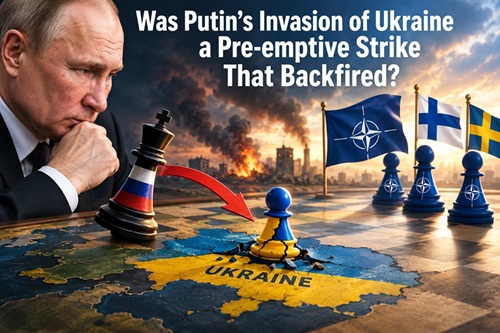 Introduction: A War to Prevent a Threat—or a War That Created One?When Vladimir Putin launched Russia's full-scale invasion of Ukraine on February 24, 2022, he presented the operation as a response to an increasingly dangerous security environment. Among the Kremlin's stated objectives were preventing Ukraine from becoming a military threat to Russia, stopping NATO's eastward expansion, protecting the population of the Donbas, and “demilitarizing” Ukraine. In this account, Russia was not simply conquering a neighboring country; it was acting to prevent a future strategic danger. This raises a question that deserves more careful consideration than either accepting or dismissing Moscow's explanation: Was the invasion a pre-emptive strike intended to avert a perceived security threat, and did it produce precisely the strategic conditions Russia wanted to prevent? To answer this, we must distinguish between three things that are often confused: a pre-emptive attack against an imminent threat, a preventive war against a possible future threat, and a war of conquest justified in the language of national security. We must also distinguish Russia's stated motives from the evidence for those motives, and the Kremlin's expectations from the consequences of its decisions. The result is a more revealing picture than the simple claim that Russia acted irrationally—or, conversely, that it had no security concerns worth examining. 1. Pre-emption versus prevention: Why the distinction mattersIn strategic studies, a pre-emptive war and a preventive war are not quite the same thing. A pre-emptive strike is intended to forestall an attack believed to be imminent. The opponent is expected to strike soon, and the attacker believes that acting first will reduce the danger. A preventive war, by contrast, is intended to stop a potential adversary from becoming more powerful or strategically threatening in the future. The danger may be real, but it is not necessarily immediate. This distinction is central to understanding the invasion. Ukraine was not about to enter NATO in February 2022, and no NATO collective-defence guarantee protected Ukraine at the time. Although NATO had declared in 2008 that Ukraine would eventually become a member, the alliance had not agreed on an immediate accession timetable. Russia's invasion therefore fits the logic of preventive war more readily than pre-emption in the strict military sense. Political scientist Barry R. Posen made precisely this argument in a 2025 article in International Security. He proposed that Putin probably believed Russia faced a closing window of opportunity: Ukraine was becoming increasingly integrated with Western militaries, and allowing that process to continue might eventually make Russia's strategic position much worse. Posen treats this as a plausible explanation of Putin's calculations, not proof that those calculations were correct. The distinction also matters morally and legally. A government may genuinely fear a future strategic disadvantage without possessing a legal right to invade another country. Explaining why a leader chooses war is not the same as establishing that the war was necessary or lawful. 2. Was Russia facing a genuine security problem?Russia's security concerns did not emerge from nowhere. NATO expanded eastward after the Cold War, incorporating countries that had previously belonged to the Soviet-led Warsaw Pact. Western military cooperation with Ukraine increased after Russia annexed Crimea in 2014 and supported separatist forces in eastern Ukraine. Ukraine's armed forces received training, equipment and assistance from Western countries. From Moscow's perspective, these developments could be interpreted as a gradual erosion of Russia's strategic influence and an increasingly hostile military environment. The prospect of Ukraine joining NATO was particularly sensitive because of the countries' geographical proximity, shared history and the strategic importance of the Black Sea region. But three qualifications are essential. First, a security concern is not necessarily an imminent military threat. Ukraine's aspirations for NATO membership did not mean that membership was about to occur, still less that Ukraine was preparing to attack Russia. NATO's own account confirms that Ukraine was a partner rather than a member and had no Article 5 security guarantee. Second, Ukraine had its own reasons for seeking Western protection. Russia's annexation of Crimea in 2014 and its intervention in the Donbas made Russian assurances of Ukrainian security less credible from Kyiv's perspective. Ukraine's movement toward the West cannot therefore be understood solely as a Western initiative imposed on a passive country. Ukrainian governments and citizens had agency of their own. Third, NATO enlargement was not the only possible explanation for Russian policy. Putin's public statements have also questioned the legitimacy of a distinct Ukrainian national identity and portrayed Russians and Ukrainians as belonging to a common historical and cultural space. Such statements raise the possibility that the war was motivated not only by military calculations but also by a desire to constrain Ukraine's political independence and its freedom to choose its international orientation. The available evidence does not allow us to reduce the invasion to a single motive. Security fears, great-power ambitions, historical narratives and expectations of a relatively easy victory may have reinforced one another. 3. The Kremlin's gamble: What did Putin expect?The scale and opening strategy of the February 2022 invasion suggest that Russian leaders anticipated a much shorter campaign than the war that followed. Russian forces advanced toward Kyiv from Belarus, while other forces attacked from Russia and occupied Crimea. The initial campaign was consistent with an attempt to overwhelm Ukrainian resistance, threaten the capital and force a rapid political settlement, potentially involving the replacement or subordination of Ukraine's government. Although the precise internal decision-making process remains incompletely documented, the campaign's design suggests that Moscow expected Ukraine's government to be vulnerable and its armed forces to be unable to sustain effective resistance for long. That expectation proved mistaken. Ukrainian forces resisted the initial offensive, the government remained in Kyiv, and Russia withdrew its forces from the capital region in the spring of 2022. Ukraine subsequently mounted successful counteroffensives in parts of the northeast and south. The conflict evolved into a prolonged war of attrition rather than the rapid political and military outcome Moscow appears to have sought. This failure matters to the pre-emptive-war argument. Preventive wars are often launched because leaders believe that the present offers a better opportunity for action than the future. But that calculation depends on two separate judgments: whether the future threat will grow, and whether the proposed military action can successfully prevent it. Putin may have been concerned that time was working against Russia. Yet the invasion exposed the risks of assuming that a neighboring state could be subdued before its military capabilities, national identity and international partnerships strengthened further. A preventive war can thus be strategically self-defeating even if the original fear was sincerely held. 4. The most obvious backfire: Finland and Sweden joined NATOIf Putin's central objective was to prevent NATO from expanding closer to Russia, the most visible strategic consequence of the invasion was the opposite. Before 2022, Finland maintained military non-alignment, while Sweden had a long-standing policy of military non-alignment. Both countries cooperated with NATO, but neither belonged to the alliance. Russia's full-scale invasion changed their security calculations. Finland joined NATO on April 4, 2023, and Sweden followed on March 7, 2024. The consequences were substantial. NATO gained two militarily capable northern European members, and Russia acquired a much longer direct land border with NATO through Finland. The alliance also gained opportunities to coordinate the defence of the Nordic region and the Baltic Sea more closely. This is not merely a symbolic reversal. Finland's accession changed the geography of NATO's collective-defence arrangements, while Sweden's membership strengthened the possibilities for regional military cooperation. The irony is striking: a war ostensibly intended to resist the expansion of NATO helped persuade two previously non-aligned countries that joining the alliance was necessary for their security. There is, however, an important qualification. The invasion did not cause every aspect of NATO's subsequent strengthening, and Russia may have achieved other military or territorial objectives. Nor does NATO membership automatically translate into an immediate offensive threat against Russia. But on the specific question of preventing NATO enlargement, the outcome is difficult to reconcile with the Kremlin's declared objective. 5. Ukraine itself became more closely aligned with the WestThe second major consequence concerns Ukraine. Before the invasion, Ukraine was already cooperating with NATO, and the alliance had promised eventual membership in principle. But there was no consensus on when Ukraine would actually join. NATO's 2008 declaration had left the question open without providing an accession date. The invasion transformed the political environment. It reinforced Ukrainian opposition to Russian domination, strengthened the country's identification with Europe, and generated extensive Western military and financial assistance. Western governments supplied Ukraine with increasingly sophisticated weapons, intelligence support, training and other forms of assistance. The exact scale and nature of this support have varied over time, but the strategic relationship became much more substantial than it had been before February 2022. This creates an important distinction between formal NATO membership and practical military integration. Ukraine did not become a NATO member as a result of the invasion, and it did not acquire Article 5 protection. Nevertheless, the war made Ukraine a central focus of NATO countries' military planning and defence cooperation. From a Russian security perspective, this development could be regarded as a serious adverse consequence. Rather than keeping Ukraine outside Western military networks, Russia helped create a situation in which Ukraine's defence became a major long-term concern for Western governments. At the same time, Russia's actions were not the only factor shaping Western policy. Ukrainian resistance, the independent choices of NATO members, and their assessment of the wider European security environment all contributed to the response. The causal relationship is nevertheless clear in an important respect: the invasion greatly increased the perceived need to protect Ukraine against further Russian attack. 6. Did Russia achieve anything strategically?A balanced assessment must go beyond NATO enlargement and Western support for Ukraine. Russia has occupied and claimed Ukrainian territory, though the legal status of the internationally recognized Ukrainian borders remains unchanged. It has also demonstrated its willingness to sustain a large-scale war despite substantial military and economic costs. The Russian state has adapted parts of its economy and military production to prolonged conflict. Those facts matter. A war can produce serious strategic setbacks in one area while generating gains in another. The invasion cannot be assessed solely by asking whether Russia strengthened or weakened NATO. Russia may also have increased its control over certain strategically important areas, depending on the military situation at a given time. However, territorial occupation comes with continuing costs: the need to defend occupied land, the loss of personnel and equipment, economic restrictions, and the continuing requirement to devote resources to the war. Moreover, battlefield gains do not automatically translate into durable political influence. Ukraine's willingness to resist Russian domination has proved much stronger than Moscow appears to have anticipated. The appropriate question, therefore, is not simply whether Russia gained territory. It is whether those gains compensate for the broader security environment Russia helped create. That remains a question of strategic assessment rather than a fact that can be settled by counting square kilometres alone. 7. The strongest counterargument: Perhaps Putin was acting before it became too lateThe preventive-war interpretation deserves to be taken seriously even if one rejects the invasion as a justified response. Barry Posen's analysis offers a useful way to reconstruct the Kremlin's possible reasoning. If Putin believed that Ukraine was steadily becoming more capable militarily, more closely integrated with the West, and increasingly difficult to bring under Russian influence, he might have concluded that the cost of waiting would rise. From that perspective, the invasion was an attempt to alter the balance of power before the strategic situation deteriorated further. A government does not necessarily need to believe that an adversary will attack tomorrow to conclude that it will be harder to contain that adversary five or ten years later. This interpretation helps explain why Russian leaders might have chosen war even without evidence of an imminent Ukrainian or NATO attack. But it leaves three difficult questions. First, was the threat correctly assessed? Ukraine's potential future NATO membership was not the same thing as an imminent deployment of NATO forces or an impending attack on Russia. A possibility can become a strategic obsession when leaders treat an uncertain future as inevitable. Second, was war the best available response? In late 2021 and early 2022, Russia made sweeping demands concerning NATO enlargement and the European security order. Those demands were not accepted, but negotiations over arms control, missile deployments, military exercises and confidence-building measures remained conceivable alternatives. A failure to secure every desired guarantee did not itself establish that an invasion was necessary. Third, did the invasion actually reduce the danger? Even if Russia feared future Western military integration with Ukraine, the invasion produced a more hostile relationship with Europe, accelerated Finnish and Swedish NATO membership, and encouraged extensive Western assistance to Ukraine. A preventive war succeeds only if the danger it seeks to prevent is reduced at an acceptable cost. Merely demonstrating a willingness to use force does not establish strategic success. 8. Security dilemmas and self-fulfilling threatsThe war also illustrates a classic problem in international relations: the security dilemma. A state takes measures it considers defensive. Its neighbours interpret those measures as threatening and respond by strengthening their own defences. The first state then sees those responses as confirmation that its original fears were justified. The process can become self-reinforcing. Russia's leaders portrayed NATO enlargement and Ukraine's Western orientation as dangers to Russian security. Ukraine and other European countries, meanwhile, saw Russia's annexation of Crimea in 2014, its intervention in eastern Ukraine and its full-scale invasion in 2022 as evidence that Russia was prepared to use military force to impose its preferences on neighbours. Their responses included stronger defence cooperation, increased military preparedness and, in Finland's and Sweden's cases, NATO membership. Russia could then point to the resulting military changes as evidence of a more threatening NATO presence. This does not mean that both sides bear identical responsibility for every development. A security dilemma is an analytical explanation of how fear and countermeasures can interact, not a declaration that all actions are equivalent. The decision to launch the full-scale invasion was Russia's, and the UN General Assembly adopted a resolution deploring Russia's aggression and demanding the withdrawal of its forces. The resolution passed on March 2, 2022, by 141 votes to five, with 35 abstentions. The deeper lesson is that security policy must be judged not only by the threats a government says it is responding to, but also by the reactions its chosen policy predictably produces. 9. A legal distinction: Strategic logic is not a licence to invadeThe phrase pre-emptive strike can also give an invasion an undeserved aura of necessity. It suggests that a state was compelled to act before an adversary could strike first. International law sets a much higher bar. Article 2(4) of the UN Charter generally prohibits the use of force against another state's territorial integrity or political independence. The recognized right of self-defence under Article 51 concerns an armed attack; the legality of anticipatory self-defence in the face of an imminent attack remains debated. A generalized fear of future military disadvantage is not, by itself, an established legal justification for invading a neighbour. Russia's public justifications invoked self-defence, the protection of people in the Donbas and other claims. Those assertions do not settle the legal question. The UN General Assembly's March 2022 resolution condemned the invasion as aggression and demanded that Russia cease using force and withdraw its forces from Ukraine. This is why the distinction between pre-emption and prevention matters beyond academic terminology. If a government can claim a right to invade whenever a neighbour might become stronger, might join an alliance, or might pursue a foreign policy the government dislikes, the principle of sovereign independence becomes precarious. Russia's security concerns can be investigated without accepting its claimed entitlement to decide Ukraine's future. Conclusion: A preventive war that transformed the threat it sought to avertWas Putin's invasion a pre-emptive strike that backfired? The most precise answer is that it is better understood as a preventive war, with consequences that substantially undermined several of its apparent strategic objectives. The preventive-war interpretation is plausible: Putin may have believed that Ukraine's growing military cooperation with the West and its potential future NATO membership were gradually closing Russia's window of opportunity. That helps explain the decision to act when he did. It does not prove that the threat was imminent, that the invasion was necessary, or that Russia's assumptions were sound. The consequences are clearer. Finland and Sweden joined NATO. Ukraine became more closely integrated with Western military assistance and defence cooperation. European governments reassessed their security arrangements, and Russia's relations with many of its neighbours deteriorated further. These developments are well documented, although the war's overall strategic balance remains more complicated than any single measure can capture. The most revealing irony is that a war intended, in part, to prevent an adverse shift in the European balance of power helped bring about precisely the kind of shift Russia said it feared. That does not mean every Russian objective failed, or that the war's eventual strategic outcome is already settled. It means that the Kremlin's decision must be evaluated against its own stated security concerns, not simply against the territory Russia has occupied. The broader lesson is sobering. A government may perceive a genuine security problem and still choose a policy that magnifies it. When leaders confuse a possible future danger with an unavoidable one, underestimate their adversary's capacity to resist, and discount the reactions of neighbouring states, a war intended to secure the future can make that future considerably more dangerous. Further readingBarry R. Posen, Putin's Preventive War: The 2022 Invasion of Ukraine, published in International Security in 2025. NATO, NATO's support for Ukraine, for the alliance's account of Ukraine's status and relationship with NATO. nato.int United Nations General Assembly, Resolution ES-11/1, Aggression against Ukraine.
Widget is loading comments...
|