|
TRANSLATE THIS ARTICLE
Integral World: Exploring Theories of Everything
An independent forum for a critical discussion of the integral philosophy of Ken Wilber
  Frank Visser, graduated as a psychologist of culture and religion, founded IntegralWorld in 1997. He worked as production manager for various publishing houses and as service manager for various internet companies and lives in Amsterdam. Books: Ken Wilber: Thought as Passion (SUNY, 2003), and The Corona Conspiracy: Combatting Disinformation about the Coronavirus (Kindle, 2020).
Check out my other conversations with ChatGPT
Unpopular questions about Ukraine:
Did Russia Have Any Valid Reasons to Invade Ukraine? From Regional War to World War III? Russia, Ukraine, and Europe in the Drama Triangle Three-Quarters of the World Condemned Russia? Russia, Ukraine, and Europe in the Drama TriangleA Useful Analogy or a Dangerous Distortion?Frank Visser / ChatGPT
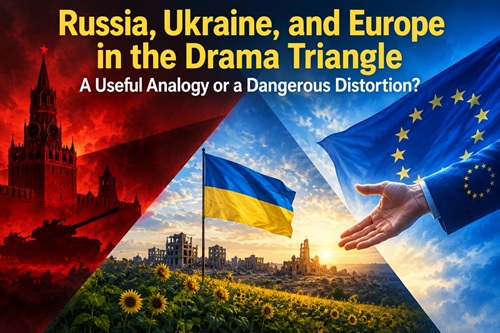 Introduction: When geopolitics becomes group therapyThe Drama Triangle offers an intriguing psychological lens through which to examine the war in Ukraine. In its familiar formulation, the triangle consists of three roles: the Persecutor, who threatens or harms; the Victim, who suffers or feels powerless; and the Rescuer, who intervenes to help. These are not necessarily fixed identities. Participants can shift roles, and ostensibly helpful interventions can create dependencies, unintended consequences, or new conflicts. Applied to the war, the mapping seems almost irresistible. Russia becomes the Persecutor, Ukraine the Victim, and Europe the Rescuer. Russia launches an invasion, Ukraine defends itself, and European countries supply weapons, money, humanitarian assistance, and political support. Yet the apparent clarity of this arrangement raises an important question: Does the Drama Triangle genuinely explain the war, or does it merely translate a geopolitical conflict into a psychological narrative? The answer is that the Drama Triangle can illuminate certain patterns in the conflict, particularly the dynamics of victimhood, intervention, dependency, and responsibility. But it becomes misleading when it treats the three positions as psychologically equivalent roles in a drama, rather than distinguishing an aggressor from a country defending itself against invasion. A critical application must therefore do two things simultaneously: take the psychological dynamics seriously while refusing to let a therapeutic model erase the asymmetry of the underlying political and military facts. 1. Russia as Persecutor: The asymmetry that must not disappearThe strongest part of the mapping is the identification of Russia as the Persecutor. On 24 February 2022, Russia launched its full-scale invasion of Ukraine, expanding a conflict that had begun in 2014. The United Nations General Assembly condemned the invasion as aggression and demanded that Russian forces withdraw. This is not merely a matter of competing psychological perceptions. It is an identifiable political and military action with consequences for sovereignty, territorial integrity, and civilian life. Russia's leadership has offered a variety of explanations: NATO enlargement, Western interference, the protection of Russian speakers, the alleged threat posed by Ukraine, and historical claims about the unity of the Russian and Ukrainian peoples. Some of the security concerns raised in debates about European geopolitics deserve serious examination. But explaining the background to a conflict is not the same as establishing a right to invade a neighboring country. Here the Drama Triangle is useful only if it helps identify how a persecutory relationship operates. Russia's government portrays itself as threatened, humiliated, encircled, and compelled to act. In its own narrative, Russia is not the aggressor but the party resisting Western aggression. The supposed victim becomes the self-appointed enforcer of justice. This reversal is psychologically significant. Persecutors do not necessarily experience themselves as persecutors. They often construct moral narratives in which their own aggression becomes defensive necessity. Yet we should resist a tempting but simplistic conclusion: that Russia is permanently the Persecutor in every possible relationship. The Russian state, its leadership, its population, and Russian-speaking communities are not interchangeable entities. Nor does identifying Russia as the aggressor in this war imply that every Russian grievance is fabricated or that every Western policy has been wise. The distinction is between understanding a political actor's self-image and accepting that self-image as justification. The Drama Triangle can illuminate the former, but it cannot settle the latter. 2. Ukraine as Victim: A role imposed by aggression, not a psychological identityUkraine occupies the Victim position in the most straightforward sense: it is the country subjected to the full-scale invasion and defending its territory against a militarily stronger neighbor. But this is precisely where the terminology becomes potentially dangerous. In psychological discussions, the word victim often describes a problematic identity. The person who inhabits that identity may become passive, surrender personal agency, or seek others to solve problems that they could address themselves. Some versions of the Drama Triangle suggest that the Victim role is maintained through reciprocal psychological expectations. Does that analysis apply to Ukraine? Only with considerable qualification. A country can be the victim of aggression without adopting a helpless identity. Ukraine's resistance, political mobilization, military adaptation, and insistence on national self-determination demonstrate agency under extraordinarily difficult circumstances. Being attacked does not mean being powerless, and receiving assistance does not mean surrendering responsibility for one's future. Indeed, calling Ukraine a Victim can obscure an important distinction between being victimized and playing the Victim. The first describes what another actor does to you. The second implies a recurring behavioral pattern that may involve passivity, dependency, or a refusal to exercise agency. These are not equivalent. A careless application of the Drama Triangle might suggest that Ukraine participates in maintaining the drama because it needs a Persecutor to define its identity and a Rescuer to sustain its resistance. That would be an extraordinary inference to draw from the fact that an invaded country seeks international support. The danger is that a psychological vocabulary designed to identify dysfunctional relationships ends up pathologizing the behavior of the party defending itself. There is, nevertheless, a legitimate question about Ukraine's political dependence on external assistance. Its capacity to continue fighting is influenced by the volume, timing, and conditions of Western military and financial support. Dependence can create vulnerabilities, constrain choices, and give outside powers leverage. But dependence under conditions of invasion is not evidence of a victim mentality. It is a strategic reality. Ukraine can be a victim of Russian aggression, an active agent in its own defense, and a government whose decisions deserve independent scrutiny. The Drama Triangle becomes useful only if it can accommodate all three propositions. 3. Europe as Rescuer: Solidarity or self-interested intervention?Europe's position as Rescuer is more complicated than the initial mapping suggests. European countries have provided Ukraine with military equipment, financial assistance, humanitarian aid, refugee protection, and diplomatic support. Their assistance has helped Ukraine resist the invasion. But the European response cannot be understood simply as a compassionate intervention by a benevolent third party. Europe has interests of its own. A Russian victory achieved through conquest could weaken the principle that borders cannot be changed by force, undermine European security, and encourage further coercion against neighboring states. Supporting Ukraine therefore serves both Ukrainian sovereignty and European strategic interests. There is nothing inherently wrong with this combination. International solidarity does not become insincere merely because it also benefits the helper. Governments routinely pursue moral objectives and national interests simultaneously. The Drama Triangle nevertheless invites us to examine how the Rescuer position can become problematic. A rescuer may begin by helping someone in danger but gradually assume that the person being helped must follow the rescuer's preferences. Assistance can become leverage. The helper may develop an inflated sense of moral superiority, or become invested in the identity of indispensable protector. Could European support develop such dynamics? Certainly. Europe might come to treat Ukraine less as an independent political actor than as a frontline instrument of European security. It might impose conditions that reflect its own political priorities, make promises it cannot reliably fulfill, or become so committed to a particular strategy that it finds compromise difficult even when circumstances change. Conversely, European governments might invoke the need to avoid escalation as a reason to restrict assistance in ways that leave Ukraine exposed to greater coercion. The rescuer can fail through overreach, but also through timidity. The essential question is not whether Europe is a good or bad Rescuer. It is whether European assistance increases Ukraine's capacity to make its own choices or gradually substitutes European judgment for Ukrainian agency. This is where the Drama Triangle provides a useful diagnostic question: Is the helper empowering the person being helped, or creating a relationship in which the helper's continued indispensability becomes part of the arrangement? There is no automatic answer. Military assistance can increase Ukraine's autonomy by allowing it to resist domination. At the same time, reliance on external weapons, ammunition, intelligence, financing, and political commitments creates real vulnerabilities. Both dynamics can operate simultaneously. 4. The most dangerous assumption: that all three positions are equivalentThe central limitation of the Drama Triangle is its tendency to make three different kinds of participation appear structurally equivalent. Russia invades. Ukraine resists. Europe assists. All three actors are involved in the same conflict, but they do not enter it in the same way or bear the same responsibility for its origin. A therapeutic model can encourage us to look for reciprocal reinforcement: perhaps the Persecutor needs a Victim, the Victim needs a Rescuer, and the Rescuer needs someone to save. This may be a useful hypothesis about certain interpersonal relationships. It is not, by itself, an adequate explanation of an interstate war. Russia's military invasion is not caused by Ukraine's need for protection, any more than a burglary is caused by the homeowner's need for a security system. Nor does European assistance establish that Europe helped create the invasion simply by responding to it. To argue otherwise would confuse a response to aggression with responsibility for aggression. The triangle may describe a pattern of interaction without explaining why that pattern began. It may identify incentives that sustain a conflict without identifying who initiated the decisive act of violence. This distinction is crucial when the model is used in politically charged discussions. A framework that emphasizes mutual dependence can unintentionally flatten the moral landscape. The aggressor, the attacked country, and the assisting third party become participants in a shared drama, each supposedly contributing to the perpetuation of the whole. But shared involvement is not shared culpability. The United Nations' condemnation of Russia's invasion provides a legal and political starting point that psychological interpretation cannot simply override. A psychological theory does not absolve us from distinguishing between initiating aggression, defending against it, and deciding how to respond. 5. Can Ukraine and Europe become trapped in the triangle?The more productive application of the model concerns the future of the relationship rather than the allocation of blame for the invasion. Even when the original roles are relatively clear, relationships can develop dysfunctional patterns over time. Ukraine may understandably expect sustained support from Europe. European governments may feel morally and strategically committed to providing it. But commitments are made by governments operating under changing electoral pressures, economic constraints, disagreements over military risk, and differing assessments of what constitutes a realistic end to the war. These pressures can produce resentment on both sides. Some Europeans may begin to view Ukraine as excessively demanding, insufficiently grateful, or unwilling to accept difficult compromises. Ukrainians may view European caution as hypocrisy, abandonment, or a preference for economic comfort over security. Each side may then develop a narrative in which its own sacrifices are underappreciated by the other. At that point, the relationship risks moving from solidarity to mutual accusation. The helper feels exploited. The recipient feels betrayed. Both become preoccupied with their own grievances, while the original source of the danger remains unresolved. This is the kind of relational pattern the Drama Triangle can help illuminate. But even here, the model must not be used to suggest that Ukraine is responsible for European fatigue simply because it continues to need help. Nor should Europe be expected to provide unlimited assistance without public deliberation about costs, objectives, and risks. A healthy relationship requires explicit expectations, realistic commitments, honest communication, and recognition of each party's agency. For Europe, this means being clear about what it is prepared to provide, what strategic objectives it hopes to achieve, and what risks it is willing to accept. For Ukraine, it means participating in decisions about its future rather than being treated as the passive recipient of European policy. For both, it means acknowledging that solidarity cannot survive indefinitely on moral slogans alone. And for Russia, any durable settlement must address the central political reality that Ukraine is an independent state, not an object whose sovereignty can be determined by Moscow. 6. Role reversal: The model's most seductive and most dangerous featureOne attraction of the Drama Triangle is that roles can change. A Victim can become a Persecutor; a Rescuer can become a Persecutor; and a former Persecutor can present itself as the new Victim. In the Ukraine war, Russia's government has repeatedly portrayed its actions as a response to Western encirclement and Ukrainian hostility. Europe, meanwhile, may describe Russia as the source of the threat while presenting its own military and political actions as entirely defensive. Ukraine can emphasize its victimization while making strategic choices that have consequences for others. These narratives deserve analysis. But the possibility of role reversal does not mean that every claim to victimhood is equally credible. There is a major difference between a state portraying itself as threatened and a state actually being invaded. There is also a difference between military assistance to an attacked country and a military invasion intended to subordinate that country. A role-based analysis that treats these differences as secondary risks becoming a machine for manufacturing false equivalence. The problem becomes especially acute when a model's apparent sophistication encourages the analyst to search for hidden dysfunction in every act of resistance. Perhaps Ukraine is not merely defending itself but needs Russia as an enemy. Perhaps Europe needs the war to sustain its identity as protector of democracy. Perhaps Russia is acting out a wounded collective ego. These are possible hypotheses about political narratives and institutional incentives. They are not established explanations of the war simply because they fit the triangle. The more psychologically elaborate the interpretation becomes, the greater the temptation to mistake interpretive ingenuity for empirical evidence. The Drama Triangle should therefore be used to formulate questions, not to manufacture conclusions. What evidence would demonstrate that Ukraine's political leadership benefits from maintaining a particular conflict narrative? What evidence would show that European governments are prolonging a policy primarily to preserve their identity as rescuers? What evidence would distinguish Russia's genuine security concerns from its instrumental use of grievance? Without such tests, the Drama Triangle can become an interpretive game in which every action confirms the theory. 7. What would a non-dramatic alternative look like?The point of using a psychological model should be to improve judgment, not to force reality into a predetermined pattern. A more constructive alternative would preserve the insights of the triangle while replacing its rigid identities with questions of responsibility, agency, and accountability. Russia should be judged by its actions, the legality of its conduct, and its willingness to respect Ukraine's sovereignty. Its security concerns can be examined without granting it a right to dictate Ukraine's political future. Ukraine should be treated as an agent capable of making decisions, pursuing interests, and evaluating compromises, rather than as a passive Victim whose future belongs to its helpers. Its right to defend itself does not make every possible Ukrainian policy automatically wise or beyond criticism. Europe should understand itself neither as a heroic Rescuer nor as an innocent bystander. It is a collection of states making strategic choices that affect European security, Ukrainian survival, and the prospects for a negotiated settlement. Those choices deserve scrutiny, including scrutiny of their costs, consistency, and likely consequences. This approach also requires distinguishing between ending a war and ending the conditions that make renewed aggression likely. A settlement imposed on Ukraine without meaningful Ukrainian participation might end active fighting while leaving the underlying problem unresolved. Conversely, treating military victory as the only conceivable legitimate outcome could make a negotiated settlement politically impossible even when circumstances change. The relevant question is not whether the participants can escape their psychological roles through a clever reframing exercise. It is whether their political decisions can produce a more secure and sustainable outcome. A psychological model can encourage that reflection, but diplomacy, military analysis, international law, and historical evidence must do the substantive work. Conclusion: A triangle is not a theory of warThe Drama Triangle is appropriate for the Russia-Ukraine-Europe relationship in a limited but meaningful sense. It can help us examine how aggression produces dependency, how assistance can become entangled with power, how solidarity can deteriorate into resentment, and how political actors construct narratives of persecution and rescue. It is particularly valuable for analyzing the relationship between Ukraine and its European supporters, where questions of dependency, agency, expectations, and strategic responsibility are genuine and consequential. But the framework becomes misleading when its symmetry is mistaken for moral or causal equivalence. Russia's invasion, Ukraine's defense, and Europe's assistance are not simply three complementary roles in a dysfunctional relationship. They are distinct actions that must be evaluated according to their causes, consequences, and responsibilities. The most serious danger is that the language of psychological dysfunction can subtly shift attention away from aggression and toward the supposed mutual needs of the participants. If Ukraine needs a Rescuer, perhaps the argument goes, it also needs a Persecutor. If Europe needs to rescue Ukraine, perhaps it has an interest in perpetuating the very crisis it claims to oppose. Such possibilities may occasionally generate useful questions. They become dangerous when presented as explanations without evidence. The Drama Triangle can help explain how people respond to a conflict. It cannot, on its own, explain why a country invades another, establish who is responsible, or determine what a just peace requires. The most provocative conclusion is therefore also the simplest: sometimes the Persecutor really is the aggressor, the Victim really has been attacked, and the Rescuer really is providing necessary assistance. Recognizing the possibility of psychological entanglement should sharpen our analysis of these relationships, not obscure the facts that make them morally and politically unequal.
Widget is loading comments...
|