|
TRANSLATE THIS ARTICLE
Integral World: Exploring Theories of Everything
An independent forum for a critical discussion of the integral philosophy of Ken Wilber
  Frank Visser, graduated as a psychologist of culture and religion, founded IntegralWorld in 1997. He worked as production manager for various publishing houses and as service manager for various internet companies and lives in Amsterdam. Books: Ken Wilber: Thought as Passion (SUNY, 2003), and The Corona Conspiracy: Combatting Disinformation about the Coronavirus (Kindle, 2020).
Check out my other conversations with ChatGPT
Unpopular questions about Ukraine:
Did Russia Have Any Valid Reasons to Invade Ukraine? From Regional War to World War III? Russia, Ukraine, and Europe in the Drama Triangle Three-Quarters of the World Condemned Russia? From Regional War to World War III?The Dangerous Escalation of the Ukraine ConflictFrank Visser / ChatGPT
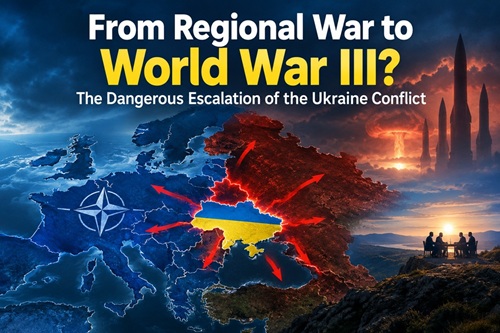 Introduction: The Unthinkable Is Not the ImpossibleThe war in Ukraine has confronted Europe with a question many people had relegated to the history books: could a regional conflict between Russia and Ukraine escalate into a direct confrontation between nuclear-armed great powers, eventually producing a third world war? The question deserves neither sensationalism nor complacency. World War III is not an inevitable destination of the war, and the mere existence of nuclear weapons does not mean that their use is imminent. Yet the possibility of escalation cannot be dismissed simply because all the parties involved understand how catastrophic such a conflict would be. History offers a sobering lesson: governments can recognize the dangers of war and still stumble into confrontations they subsequently struggle to control. The central danger is not necessarily that Moscow, Washington, Brussels, or Kyiv deliberately wants a world war. It is that their competing objectives, incompatible threat perceptions, military commitments, and political pressures could produce a chain of decisions whose cumulative consequences no participant originally intended. The appropriate question, therefore, is not whether World War III will happen. Nobody can responsibly know that. It is how the war could escalate, which assumptions might make escalation more likely, and what political and military safeguards could prevent a regional catastrophe from becoming a global one. 1. The Fundamental Asymmetry: Ukraine's Survival and Russia's Great-Power AmbitionsThe war begins with a fundamental asymmetry of interests. Ukraine is fighting to preserve its independence, territory, and right to determine its own political future. Russia, having launched its full-scale invasion in February 2022, has pursued objectives that have included territorial acquisition and the subordination of Ukraine's strategic choices. For Kyiv, the stakes are existential in a straightforward national sense. Defeat could mean further territorial losses, a weakened state, continuing vulnerability to Russian coercion, or the loss of meaningful sovereignty. For Moscow, the war has become entangled with the credibility of the Russian state, the authority of its leadership, its conception of regional security, and its ambition to prevent Ukraine from becoming firmly integrated into Western institutions. This asymmetry complicates diplomacy. A compromise that one government considers a tolerable adjustment may appear to the other as a threat to its fundamental interests. Leaders who fear that concessions will invite future aggression may prefer continued fighting to an agreement they consider insecure. Leaders who fear defeat may accept greater military risks rather than acknowledge failure. But recognizing Russia's security concerns is not the same as accepting its right to dictate Ukraine's future. Nor does recognizing Ukraine's legitimate interest in self-defense eliminate the need to consider the wider risks of military confrontation between Russia and NATO. The distinction matters because a policy can be defensible in principle while still carrying serious escalation risks in practice. Supporting Ukraine's independence and assessing the dangers of particular methods of support are not mutually exclusive positions. 2. How a Regional War Could Become a Great-Power WarA world war need not begin with a formal declaration of hostilities. It could emerge through a sequence of limited confrontations, retaliatory actions, and misinterpretations. One possible pathway would involve a Russian attack that kills NATO personnel or strikes military infrastructure on NATO territory. An accidental missile impact, a deliberate but limited strike, or an attack whose origin initially remains uncertain could create pressure for a military response. NATO governments would face a difficult choice between demonstrating that attacks on their territory have consequences and avoiding measures that might trigger a broader conflict. A second pathway could involve the expansion of direct combat between Russian forces and Western personnel. Western countries have provided Ukraine with weapons, training, intelligence, and other forms of assistance. Such support does not automatically make NATO a direct belligerent in the war. Nevertheless, as the military relationship deepens, the potential for a confrontation involving personnel, command arrangements, or military assets becomes a matter of strategic concern. A third pathway would involve attacks on critical infrastructure, including communications systems, energy networks, satellites, or undersea cables. Such incidents could produce serious economic and military consequences without immediately making their perpetrators or intentions clear. Governments might interpret an ambiguous event as the opening move of a larger campaign and respond before the evidence is conclusive. Cyberattacks introduce an additional complication. A disruption of military communications or civilian infrastructure could be mistaken for preparation for a physical attack. Conversely, an operation intended to remain below the threshold of armed conflict might cause effects that its organizers did not anticipate. None of these scenarios makes world war inevitable. Each illustrates how a conflict can cross political and military thresholds without any participant having consciously decided to begin a global war. 3. The Nuclear Shadow: Deterrence and the Risk of Catastrophic MiscalculationNuclear weapons occupy a peculiar position in international politics. They are intended to deter attacks by making their consequences intolerable, yet their existence also means that certain mistakes could have consequences on an unprecedented scale. Russia has repeatedly invoked its nuclear capabilities during the Ukraine war. Western governments, meanwhile, have sought to support Ukraine while avoiding a direct NATO-Russia war. Both sides have reasons to preserve this boundary, even as they disagree profoundly about where it lies. Nuclear deterrence can restrain escalation, but it does not provide an infallible safety mechanism. It depends on leaders correctly interpreting the other side's intentions, maintaining reliable communications, distinguishing conventional preparations from nuclear preparations, and retaining sufficient time to make decisions under pressure. The danger becomes especially acute during a fast-moving military crisis. A conventional strike against a command facility might be interpreted as an attempt to disable nuclear retaliation. An exercise could be mistaken for preparation for an attack. A warning system could produce ambiguous information at precisely the moment when political leaders feel compelled to act. There is also a danger in assuming that nuclear threats are either entirely empty or automatically decisive. A threat may be intended to influence an adversary's behavior without any immediate intention to use nuclear weapons. But even a coercive threat can create uncertainty about the circumstances in which a government might actually resort to them. It is therefore essential to distinguish between nuclear rhetoric, changes in military readiness, actual preparations for use, and the use of nuclear weapons itself. These are not interchangeable indicators. Treating every threatening statement as proof that nuclear war is imminent encourages panic; dismissing all such statements as mere bluff encourages complacency. The relevant lesson is that deterrence must be managed, not simply trusted. 4. The Escalation Trap: Why Every Side Can Believe It Is Acting DefensivelyOne of the most dangerous features of international conflict is that adversaries often describe their own actions as defensive while interpreting the other side's actions as offensive. Russia has presented NATO's eastward enlargement and Western military support for Ukraine as threats to Russian security. NATO governments and Ukraine, in turn, point to Russia's invasion, territorial seizures, and military coercion as reasons to strengthen Ukraine's defenses and reinforce European security. These competing narratives cannot be treated as equally justified descriptions of events. Russia's stated security concerns do not erase its decision to invade Ukraine, and the existence of NATO does not establish that Russia had no alternative to war. At the same time, dismissing Russian threat perceptions as irrelevant would be strategically unwise if the objective is to prevent further escalation. The problem is a security dilemma: measures one side regards as necessary protection can appear threatening to the other, prompting countermeasures that reinforce the original fears. Suppose Western governments increase military assistance because they fear a Russian breakthrough. Moscow might interpret that assistance as evidence that NATO intends to weaken Russia permanently. It could then intensify attacks or widen its campaign. Western governments, seeing this escalation, might increase their assistance further. Each side could regard its own action as a response to the other's aggression, while the overall confrontation becomes more dangerous. This dynamic does not imply that the parties bear equal responsibility for the war. It means that responsibility for initiating a conflict and responsibility for managing the risks of escalation are different questions. A government can be right about the origins of a war and still make a dangerous decision about how to respond to it. Moral clarity about aggression does not automatically produce strategic wisdom. 5. The Danger of Escalation by IncrementThe most consequential decisions are not always the most dramatic. Escalation may occur gradually, with each new measure presented as a limited adjustment to changed circumstances. A weapon system is supplied because existing systems have proved insufficient. Its use is permitted under new conditions because the battlefield has changed. Intelligence cooperation deepens because Ukraine needs better warning and targeting information. A retaliatory operation is expanded because the previous response failed to deter further attacks. Each step may appear reasonable when considered in isolation. Yet the cumulative effect can alter the nature of the conflict. This is the logic of the escalation ladder. Governments may believe they can control the intensity of a confrontation by moving upward one rung at a time. Their adversaries, however, may interpret those movements differently. What one government calls a limited signal may look to another like preparation for a decisive attack. There is no universal threshold at which military assistance suddenly becomes war, nor does every increase in assistance produce an equivalent increase in danger. The type of weapon, its intended use, the role of foreign personnel, the location of operations, and the adversary's interpretation all matter. The danger lies in the belief that escalation can always be calibrated with precision. In a complex war, governments cannot fully control how their actions will be interpreted, how their adversaries will respond, or what unintended consequences will follow. The more a policy depends on the assumption that the other side will recognize and respect carefully intended limits, the more important it becomes to establish reliable channels for clarifying those limits. 6. Why Political Leaders May Find Compromise DifficultWars are not fought only on battlefields. They are also fought in domestic politics, where leaders must answer to publics, legislatures, military establishments, allies, and their own political constituencies. For Ukraine, a settlement that leaves occupied territory under Russian control could be viewed as an intolerable sacrifice, particularly by those who have endured occupation, displacement, and the deaths of relatives. Any Ukrainian government would have to consider whether an agreement would genuinely secure the country's future or merely provide Russia with an opportunity to prepare for another attack. For Russia, accepting a settlement that falls far short of its declared objectives could carry political costs. A government that has justified enormous sacrifices in the name of national security and historical necessity may find it difficult to explain why those sacrifices did not achieve the promised results. Western governments face their own constraints. Some voters demand stronger support for Ukraine; others oppose continued expenditure or fear direct confrontation with Russia. Political leaders may be reluctant to appear weak, abandon an ally, or acknowledge that a policy has failed to achieve its aims. These pressures can make continued fighting politically easier than compromise, even when compromise might reduce the long-term risks. There is a further danger in public rhetoric that portrays any negotiation as appeasement or any concession as betrayal. Diplomacy does not require pretending that aggression was justified. It requires finding arrangements that can reduce violence and make renewed aggression less likely. A ceasefire, for example, need not settle every territorial dispute or resolve the fundamental disagreement over Ukraine's future. It might nevertheless save lives and create room for negotiations, monitoring, prisoner exchanges, humanitarian arrangements, and security guarantees. Its value would depend on its terms, enforcement, and durability. The alternative to an imperfect agreement is not necessarily a just and decisive victory. It may be a longer war with greater human costs and a larger risk of international escalation. 7. The Western Dilemma: Deterrence Without Direct WarWestern governments face a genuine strategic dilemma. If they provide too little support, Ukraine may become more vulnerable to defeat or coercion. If they expand their involvement without adequate safeguards, they may increase the risk of direct confrontation with a nuclear-armed Russia. Neither risk can be eliminated simply by choosing a slogan. The argument for continued support emphasizes Ukraine's right to defend itself, the consequences of allowing territorial conquest to succeed, and the possibility that a Russian victory would encourage further coercion. From this perspective, insufficient support could prolong insecurity rather than prevent it. The argument for greater restraint emphasizes the possibility that expanding military involvement could produce a direct NATO-Russia conflict, with consequences extending far beyond Ukraine. From this perspective, a policy that focuses only on battlefield outcomes may underestimate the danger of a wider war. Both arguments raise real strategic questions. Neither should be used as a substitute for examining the specific consequences of a particular policy. The practical challenge is to distinguish between measures that strengthen Ukraine's capacity to defend itself and measures that create additional pathways to direct great-power combat. That distinction cannot always be drawn cleanly, but it should remain central to policy deliberations. Deterrence requires credible commitments. Crisis management requires limits, communication, and a willingness to avoid unnecessary confrontations. A sustainable strategy must consider both. 8. The Missing Ingredient: Diplomacy Before the EmergencyDiplomacy is often treated as something governments pursue after military pressure has exhausted the alternatives. That is a dangerous approach when nuclear powers are involved. Diplomatic engagement need not imply trust, friendship, or agreement about the origins of the war. States routinely communicate with adversaries whose actions they condemn. Indeed, the more hostile the relationship, the more valuable reliable communication may become. Several safeguards deserve particular attention: maintaining military-to-military communication channels; establishing procedures for rapidly investigating incidents involving NATO and Russian forces; clarifying the consequences of attacks on NATO territory; preserving communication about nuclear doctrine and military exercises; and creating practical mechanisms for deconfliction. Such measures do not guarantee peace. Nor should they become excuses for abandoning Ukraine's security or accepting unlimited Russian demands. Their purpose is narrower and more urgent: to reduce the likelihood that an accident, misinterpretation, or limited attack produces a chain reaction. Diplomatic channels are most valuable when relations are deteriorating, not only when relations are improving. Waiting until a crisis has already become acute means attempting to establish trust and communication at the moment when fear, anger, and time pressure are greatest. Negotiations over the war itself are more difficult. Any durable settlement would have to confront territorial disputes, Ukraine's security, Russia's future relationship with its neighbors, and the problem of ensuring that a pause in fighting does not simply precede another invasion. There are no easy solutions to these questions. But difficulty is not a reason to abandon the search for arrangements that reduce the risk of catastrophe. 9. The Warning Signs Worth WatchingResponsible discussion of World War III should distinguish between ordinary wartime escalation and developments that might indicate a more dangerous confrontation. A major change would be sustained direct combat between Russian and NATO forces, rather than isolated incidents that are rapidly contained. Another would be explicit, credible changes in nuclear readiness accompanied by other signs of preparations for possible nuclear use. A breakdown of crisis communication, especially during a serious military incident, would also be concerning. Attacks on NATO territory, repeated cross-border incidents, mobilization beyond the existing theater of war, or evidence that either side is preparing for a broader confrontation would warrant careful scrutiny. So would the collapse of established safeguards for avoiding accidental military encounters. No single indicator proves that a world war is approaching. Military movements may have several explanations, public statements can be intended as coercive signals, and intelligence assessments can be incomplete. The significance lies in combinations of developments, their context, and how governments respond. Public discussion should therefore resist two temptations: interpreting every alarming headline as evidence of imminent world war, and dismissing every warning because earlier predictions proved exaggerated. Sound judgment requires distinguishing evidence from speculation and reassessing conclusions as circumstances change. The point of monitoring escalation is not to cultivate fear. It is to recognize dangerous developments early enough for political leaders to intervene. 10. What World War III Would Actually MeanThe phrase World War III is often used loosely, as though it were simply a larger version of the existing war. That understates the possible consequences. A direct NATO-Russia war could spread across several military theaters, disrupt global trade, damage critical infrastructure, and pull additional states into hostilities. Even without nuclear weapons, the resulting destruction could be enormous. If nuclear weapons were used, the consequences would depend on the scale, targets, and number of detonations. A limited nuclear exchange would still cause catastrophic immediate harm, including blast injuries, burns, radiation exposure, and long-term disruption. A larger exchange could produce destruction on a scale that overwhelms emergency services, devastates cities, and disrupts food production and the global economy. The possibility of wider climatic effects would depend on the scale and circumstances of the exchange. Europe would be particularly exposed to a direct confrontation between Russia and NATO, but the consequences would not stop at Europe's borders. Global supply chains, energy markets, financial systems, and food security could all be affected. Countries far from the battlefield could experience severe economic and humanitarian repercussions. This is why the prevention of direct great-power war cannot be treated as a secondary concern to be considered only after every other objective has been pursued. It is a fundamental responsibility of governments whose decisions can expose millions of people to consequences they have no power to control. Yet the magnitude of the danger should not be used to suggest that Ukraine must simply surrender to avoid it. A world in which nuclear threats routinely compel smaller states to abandon their independence would carry its own profound risks. The challenge is to protect Ukraine's security while preventing the conflict from becoming a direct war between nuclear powers. Conclusion: Neither Panic Nor ComplacencyThe possibility that the Ukraine war could escalate into World War III is real, but it is not a prediction that such an outcome is inevitable or imminent. The distinction between possibility, probability, and inevitability is essential. Nuclear deterrence, the enormous costs of direct confrontation, and the interests governments have in avoiding catastrophe all act as restraints. At the same time, deterrence can fail, leaders can miscalculate, and political commitments can narrow the room for retreat. A conflict does not need to begin with a deliberate decision to start a world war in order to end in one. The appropriate response is neither to frighten the public with unsupported predictions nor to reassure it with claims that nuclear-armed governments will always behave rationally. It is to take escalation risks seriously, examine military policies in their full strategic context, preserve channels of communication, and pursue diplomatic arrangements that reduce the likelihood of direct confrontation. Above all, we should reject the comforting assumption that because no major power wants a world war, no world war can occur. The history of international conflict offers no such guarantee. The grim paradox is that preventing a wider war requires two commitments at once: refusing to treat aggression as an acceptable way to determine the fate of nations, and refusing to let the pursuit of any military or political objective become detached from the consequences of escalation. The war in Ukraine is first and foremost a catastrophe for the people who live through it. But its trajectory also tests the ability of nuclear-armed states to manage conflict without destroying the conditions for their own survival. The responsible objective is not victory at any imaginable cost, nor peace at any price. It is a settlement that protects Ukraine's ability to exist as a sovereign country while reducing the danger that a regional war becomes a global disaster. That is not an easy balance to achieve. It is precisely because it is difficult—and because the consequences of failure could be irreversible—that it deserves sustained, sober, and urgent attention.
Widget is loading comments...
|