|
TRANSLATE THIS ARTICLE
Integral World: Exploring Theories of Everything
An independent forum for a critical discussion of the integral philosophy of Ken Wilber
  Frank Visser, graduated as a psychologist of culture and religion, founded IntegralWorld in 1997. He worked as production manager for various publishing houses and as service manager for various internet companies and lives in Amsterdam. Books: Ken Wilber: Thought as Passion (SUNY, 2003), and The Corona Conspiracy: Combatting Disinformation about the Coronavirus (Kindle, 2020).
Check out my other conversations with ChatGPT
Unpopular questions about Ukraine:
Did Russia Have Any Valid Reasons to Invade Ukraine? From Regional War to World War III? Russia, Ukraine, and Europe in the Drama Triangle Three-Quarters of the World Condemned Russia? Did Russia Have Any Valid Reasons to Invade Ukraine?Beyond the Propaganda WarFrank Visser / ChatGPT
 Introduction: Explaining an Invasion Is Not the Same as Justifying ItThe question of whether Russia had any valid reasons to invade Ukraine is almost guaranteed to produce an argument before it produces an answer. In much Western commentary, asking the question is treated as flirting with Kremlin propaganda. In pro-Russian circles, it is often taken as an invitation to explain why Vladimir Putin had no choice but to act. Both reactions are intellectually lazy. One confuses explanation with apologetics; the other confuses a country's grievances with a license to wage war. A serious answer must begin by distinguishing three questions.
These are three different questions, and they do not necessarily have the same answer. Russia had some legitimate security concerns, some historically understandable grievances, and some grounds for criticizing Western policy. It did not thereby acquire a legitimate right to conquer Ukraine. The uncomfortable task is to acknowledge the former without using them to excuse the latter. The propaganda war encourages us to choose between two artificially tidy narratives: Russia as an unprovoked embodiment of evil, or Russia as a besieged great power forced into war by Western encirclement. Neither adequately explains the history. More importantly, neither provides a satisfactory account of the choices available to the actors involved. The truth is more complicated—and, for that very reason, more revealing. 1. NATO Expansion: A Genuine Security Concern, Not an Imaginary One
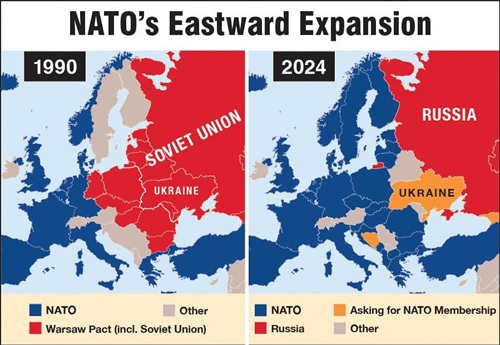
Finland joined NATO on 4 April 2023, and Sweden joined on 7 March 2024.
Of all the arguments advanced to explain Russia's invasion, NATO expansion deserves the most serious examination. Not because it proves that Putin was right to invade, but because dismissing it as mere Russian paranoia prevents us from understanding the strategic environment in which the decision was made. After the Cold War, NATO expanded eastward through successive rounds of enlargement. Countries that had once belonged to the Soviet bloc, followed by former Soviet republics, joined an alliance originally established to defend Western Europe against the Soviet Union. From the perspective of Poland, the Baltic states, and other countries that sought membership, this was a rational response to their historical experience of Russian domination. They wanted protection against the possibility that Moscow might again become threatening. From the Russian perspective, however, the same process looked rather different. An alliance that had been its principal military adversary was moving closer to its borders, while Russia's influence over its former satellites diminished. In April 2008, NATO declared that Ukraine and Georgia would become members of the alliance, although it offered neither a timetable nor an immediate path to membership. It is hardly unreasonable to recognize that a major power might regard such developments as strategically unwelcome. The United States itself has a long history of reacting strongly to perceived hostile military encroachment near its territory. The Cuban Missile Crisis of 1962 is the obvious example. Washington did not regard the deployment of Soviet nuclear missiles in Cuba as a trivial matter of Cuban sovereign choice. Why, then, should Russian security concerns about developments in neighboring Ukraine be dismissed out of hand? There is a legitimate question here: could Western governments have anticipated that NATO's eastward expansion, combined with its open-door policy toward Ukraine, would intensify Russian insecurity and create a dangerous confrontation? Yes. They could have. And it is reasonable to argue that they should have taken that risk more seriously. But the Cuban analogy also exposes the limits of the argument. The United States did not acquire a general legal right to invade Cuba simply because it considered Cuba's Soviet alignment threatening. Nor does Russia possess a right to determine Ukraine's foreign policy by force. A security concern can be real without the proposed remedy being legitimate. There is another important qualification. Ukraine was not about to join NATO in February 2022. Its membership remained uncertain, and important NATO members were reluctant to offer a rapid accession. One analysis published by the Carnegie Endowment argues that the absence of imminent membership complicates the claim that an immediate military threat forced Putin's hand. The distinction matters. Russia could reasonably object to a possible future strategic development without being entitled to wage war to prevent it. NATO expansion helps explain the conflict. It does not, by itself, explain why a full-scale invasion was necessary, let alone justify it. 2. The West Was Not an Innocent BystanderWestern governments have often presented the post-Cold War European order as a voluntary arrangement in which sovereign nations freely chose their alliances. There is truth in that account. But it can also become a convenient way to avoid examining Western strategic choices. The West possessed overwhelming influence over the institutions it led. It made decisions about enlargement, military cooperation, and the future architecture of European security. It sometimes acted as though the preferences of smaller Eastern European countries and the strategic objections of Russia could be reconciled without serious negotiation. That was an optimistic assumption. The 2008 NATO declaration was particularly awkward: it announced Ukraine's eventual membership without providing immediate protection or a clear route to accession. This created a potentially dangerous intermediate condition. Ukraine was encouraged to orient itself toward the West, while Russia was given additional reason to oppose that trajectory, yet Ukraine had no Article 5 guarantee against a Russian attack. The result was neither stable neutrality nor the security of full alliance membership. Critics of Western policy can reasonably ask whether a different approach might have preserved Ukrainian independence while reducing the risk of confrontation. Could there have been more serious negotiations on arms control, military deployments, reciprocal security guarantees, and the status of Ukraine? Could Western governments have pursued an arrangement that protected Ukraine's sovereignty without making its eventual NATO membership an unresolved strategic flashpoint? These are legitimate counterfactual questions. They are not proof that such an arrangement would have satisfied Putin, nor that Russia would have respected it. Indeed, the Kremlin's demands in December 2021 went well beyond a simple request to keep Ukraine outside NATO. They included sweeping restrictions on NATO's military posture and activities. Moscow's proposals and the Western response show that the dispute concerned the wider European security order, not merely one country's membership application. The West was not obliged to accept every Russian demand. But rejecting demands is not the same as demonstrating that diplomacy has exhausted every alternative. The uncomfortable conclusion is that Western policy deserves scrutiny for its strategic judgment, even when Russia bears responsibility for the decision to invade. A government can make a dangerous strategic mistake without becoming responsible for another government's decision to start a war. Confusing those two kinds of responsibility makes serious historical analysis impossible. 3. Ukraine's Sovereignty: The Principle That Cannot Be Bargained AwayHere we encounter the most important limit to the Russian case. Ukraine is not simply a geographical buffer between Russia and the West. It is a country with its own history, political institutions, divisions, and national aspirations. Its citizens do not cease to possess political agency because Moscow considers their choices geopolitically inconvenient. The Russian argument often treats Ukraine's movement toward the West as though it were essentially an American project. Western influence undoubtedly mattered, but this account understates Ukrainian agency. Many Ukrainians sought closer European integration because they wanted economic opportunities, political independence, and distance from Russian domination. Others favored closer relations with Russia. Ukrainian society was divided, but that division did not give Moscow ownership of the country's future. The distinction became especially important after the 2014 Maidan uprising and the fall of Viktor Yanukovych's government. The uprising involved genuine domestic grievances, political mobilization, and a contested transfer of power. It also unfolded amid foreign involvement and geopolitical competition. Different observers disagree about the relative weight of these factors. But even if one concludes that Western governments behaved opportunistically in 2014, that does not establish a Russian right to annex Crimea or dictate Ukraine's political alignment. The principle of self-determination cannot sensibly mean that Ukrainians may choose their future only when Moscow approves of the choice. Nor can it mean that Russia's security concerns automatically outrank Ukraine's. If every great power were entitled to invade neighboring states whenever their foreign policies became threatening, the sovereignty of smaller countries would be little more than a diplomatic fiction. There is a further irony. Russia's invasion has strengthened the very Western alignment it sought to prevent. It has encouraged Ukrainian national consolidation and reinforced the security concerns of European states bordering Russia. Finland and Sweden, previously outside NATO, joined the alliance in response to the transformed security environment. The policy intended to make Russia's neighborhood less threatening has, in important respects, made it more hostile. That is not merely a moral objection to the invasion. It is a strategic indictment of the decision itself. 4. The Donbas: Real Suffering, Exaggerated JustificationThe war in eastern Ukraine, which began in 2014, cannot be brushed aside as though nothing happened before February 2022. Following Russia's seizure of Crimea and the outbreak of armed conflict in the Donbas, thousands of people were killed over the ensuing years. Civilians suffered from shelling, displacement, insecurity, and the collapse of normal life. There were genuine grievances among residents of the region, including concerns about language, political representation, and the conduct of Ukrainian forces. A serious analysis should acknowledge this suffering rather than treating every complaint from Russian-speaking Ukrainians as Kremlin invention. But three distinctions are essential. First, the existence of civilian suffering does not establish that genocide was taking place. Putin invoked the prevention of genocide as a justification for the invasion, but the available evidence did not substantiate that claim. The International Court of Justice's initial proceedings in March 2022 did not establish Russia's allegation of genocide; the Court ordered Russia to suspend its military operations while the case proceeded. Second, the presence of Russian-speaking populations does not make their territory Russian. Language, cultural affiliation, and political preference are not interchangeable with citizenship or sovereignty. Russian speakers in Ukraine were not a single political bloc, and many opposed Russian intervention. Third, even genuine abuses do not automatically authorize a neighboring state to invade an entire country. International law does not grant a general unilateral right of military intervention whenever a government claims to be protecting a linguistic or ethnic kin group across a border. The United Nations General Assembly condemned Russia's invasion in March 2022, affirming Ukraine's territorial integrity and demanding Russia's withdrawal. This does not mean that every Ukrainian military action was justified, every Ukrainian official was blameless, or every Russian-speaking civilian's grievance was fabricated. Those are separate questions requiring evidence of their own. The point is narrower: the Donbas was a genuine conflict zone, but it was not a blank cheque for Russia to invade Ukraine. 5. The Minsk Agreements: A Diplomatic Failure With ConsequencesThe Minsk agreements, negotiated in 2014 and 2015, were intended to halt the fighting in eastern Ukraine and establish a political framework for resolving the conflict. Their provisions included a ceasefire, withdrawal of heavy weapons, political arrangements for certain areas of Donetsk and Luhansk, and restoration of Ukrainian control over its border. Implementation repeatedly failed. The parties disagreed about the sequencing of security and political measures, violations continued, and the conflict remained unresolved. Russia and its supporters have emphasized statements by former Western and Ukrainian officials suggesting that Minsk also bought Ukraine time to strengthen its military. Such statements warrant examination, but they do not, by themselves, establish that every participant entered the negotiations in bad faith or that a peaceful settlement was impossible. The agreements were compromised by incompatible objectives, mutual distrust, continuing violence, and Russia's role in the conflict. Moscow supported the separatist entities and exerted decisive influence over their survival, while denying or obscuring the extent of its own military involvement. Could Western governments and Kyiv have approached implementation differently? Possibly. Could a more credible settlement have prevented the full-scale war? We cannot know with certainty. What we can say is that the failure of Minsk helped create the conditions in which the conflict persisted and escalated. It is a legitimate subject for criticism of all parties' diplomatic choices. But a failed agreement is not a declaration of war by the other side. Nor does frustration with a diplomatic process confer a right to launch a massive invasion. If every government that believes a treaty has been dishonored can unilaterally resort to war, diplomacy becomes little more than a temporary pause between rounds of violence. 6. Was Putin Defending Russia—or Trying to Reassert Control?This is where the Russian security argument encounters its deepest difficulty. If the principal objective had been to prevent Ukraine from joining NATO, one might have expected a narrowly designed coercive strategy: credible negotiations, reciprocal arms-control proposals, or a limited effort to obtain enforceable neutrality guarantees. Instead, Russia launched an invasion on multiple fronts, including an advance toward Kyiv. Putin's public statements questioned the legitimacy of Ukrainian statehood and portrayed Russians and Ukrainians as fundamentally one people. His February 2022 address went beyond a conventional complaint about NATO's military posture. These facts suggest that the invasion was driven by more than a narrowly defined fear of military encirclement. One influential analysis published by the Carnegie Endowment argues that Putin's desire to restore Russian dominance over neighboring territories helps explain why he rejected arrangements that might have addressed more limited security concerns. A 2025 article by political scientist Barry Posen similarly interprets the invasion through the logic of preventive war: a leader may attack when he fears that the future balance of power will become less favorable. Neither interpretation proves that one motive alone explains the decision, but both highlight the distinction between perceived security and the political ambitions pursued in its name. There is a difference between wanting to prevent hostile military installations near one's borders and wanting to prevent a neighboring society from escaping one's sphere of influence. The first is a recognizable security concern. The second is an imperial ambition, even when it is wrapped in the language of historical unity, cultural kinship, or defensive necessity. A sovereign Ukraine that trades with Europe, cooperates with NATO, and chooses its own government is not necessarily a military threat to Russia. It may, however, present a political challenge to a Russian system that claims special authority over the country's historical neighborhood. An independent, increasingly European-oriented Ukraine could demonstrate that a former Soviet republic need not remain within Moscow's political orbit. For a Kremlin invested in the idea that Russia deserves a privileged regional position, that example may be threatening in a different sense from a NATO weapons system. This is an uncomfortable possibility for anyone who wants to explain the invasion exclusively through Western mistakes. Even if NATO expansion contributed to Russia's insecurity, the Kremlin's conception of what counted as an acceptable Ukraine may have been incompatible with Ukraine's own political independence. No amount of diplomatic tact can guarantee a peaceful settlement when one party regards the other party's freedom of choice as an intolerable strategic loss. 7. The Double Standard Problem: What About the United States?Any serious criticism of Russia should also confront the record of the United States and its allies. The invasion of Iraq in 2003, launched without a new Security Council resolution explicitly authorizing the war, is a glaring example of a Western power using disputed justifications to wage war. The Kosovo intervention of 1999, the 2011 intervention in Libya, and the history of American interventions elsewhere raise difficult questions about humanitarian claims, regime change, sovereignty, and selective enforcement of international norms. Western governments have sometimes presented their own military actions as necessary, defensive, or humanitarian while treating comparable arguments from adversaries with suspicion. They have not always applied the principles they invoke consistently. This hypocrisy damages the credibility of Western appeals to international law. But it does not follow that Russia's invasion is therefore legitimate. A double standard does not become a universal standard merely because it exposes the hypocrisy of those who invoke it. The proper conclusion from Iraq is not that Russia may invade Ukraine. It is that the invasion of Iraq also deserves rigorous criticism. The proper conclusion from Kosovo is not that territorial sovereignty is meaningless. It is that humanitarian intervention and the use of force require careful legal and moral scrutiny, regardless of who undertakes them. Indeed, the precedent set by Western interventions makes it more important, not less, to defend rules against aggression consistently. There is also a distinction between a powerful country criticizing American policy and a powerful country asserting the right to determine the future of its neighbors. One is ordinary political opposition. The other threatens the international order that smaller states depend on. The fact that Washington has violated or stretched international norms does not give Moscow a transferable license to do the same. 8. The Realist Argument: Great Powers Have Spheres of InfluenceThe realist argument deserves a fair hearing. International politics is not governed by morality alone. States consider military power, geography, strategic depth, and the intentions of potential adversaries. Great powers have historically sought influence over neighboring territories, and weaker states often pay the price when rival powers compete. From this perspective, Western policymakers may have underestimated how strongly Moscow would resist Ukraine's westward movement. A policy can be morally defensible in principle and still be strategically reckless in execution. Yet realism is a theory about how power works, not a moral doctrine declaring that the strong are entitled to whatever they can seize. To say that Russia wanted a buffer zone is to explain a strategic preference. To say that Russia was entitled to obtain one by force is to endorse a principle with implications that extend far beyond Ukraine. Should Poland be allowed to demand control over the political orientation of its neighbors? Should China be permitted to invade a country because it fears that country's alignment with the United States? Should the United States be entitled to dictate the governments of countries in the Western Hemisphere whenever it invokes strategic necessity? A sphere-of-influence doctrine answers these questions by giving great powers privileges that smaller countries do not possess. It transforms the security concerns of powerful states into rights of domination over weaker ones. That is not a neutral description of international politics. It is a political philosophy that privileges power over self-determination. There is also a practical flaw. Spheres of influence are rarely stable when they depend on coercion. The more a powerful neighbor tries to suppress the independent choices of smaller states, the more those states may seek protection from its rivals. Russia's invasion has illustrated this dynamic dramatically. Instead of securing a reliably neutral Ukraine, Moscow has helped create a more hostile and militarized one. The realist case, properly understood, should therefore lead to questions about deterrence, diplomacy, and the dangers of miscalculation. It should not lead automatically to acceptance of conquest. 9. What Would a More Intelligent Western Policy Have Looked Like?Criticizing Russia's invasion does not require treating every Western policy as wise. In fact, a serious critique should ask what might have reduced the probability of war while preserving Ukraine's independence. One possibility was a more ambitious European security negotiation before 2022. Rather than allowing the issue of Ukrainian NATO membership to remain an unresolved source of tension, Western governments could have pursued clearer proposals for reciprocal limits on military deployments, missile systems, exercises, and other measures capable of reducing perceived threats. Such negotiations would have required verifiable commitments from Russia as well as the West. They would also have required Ukraine's participation and consent. A settlement imposed over Kyiv's head would have reproduced the very problem of great-power domination that diplomacy was supposed to resolve. A second possibility was greater clarity about what NATO was and was not prepared to do. The 2008 promise of eventual Ukrainian membership, without an immediate path to accession or a firm security guarantee, created strategic ambiguity. That ambiguity could be criticized from both directions: it may have encouraged Russian resistance while leaving Ukraine exposed. A third possibility was sustained diplomacy aimed at implementing Minsk, alongside credible deterrence against renewed Russian military action. Whether these measures would have succeeded is uncertain. Putin might still have chosen war, particularly if his objectives extended beyond NATO. The point is not that a perfect diplomatic solution was waiting to be adopted. It is that the risk of war deserved more serious management than competing declarations of principle and military demonstrations of resolve. But any counterfactual must also consider the alternative: what would have happened if Western governments had simply conceded that Ukraine could not choose its own alliances because Russia objected? That might have reduced one source of immediate tension. It might also have encouraged Moscow to believe that military pressure was an effective means of determining the political future of its neighbors. A durable settlement would have had to reconcile Russian security concerns with Ukrainian sovereignty—not erase one in the name of the other. 10. The Moral Trap of Asking Whether Russia Was “Right”The phrase valid reasons is ambiguous. A reason can be understandable without being sufficient, legitimate without being decisive, or causally important without justifying the action it helps explain. Russia had reasons to worry about NATO's expansion. It had reasons to object to Western influence in Ukraine. It had reasons to be dissatisfied with the collapse of the post-Cold War security arrangements and with the failure to resolve the Donbas conflict. But the word reason cannot do all the work that the Russian case requires of it. If the argument is that Russia had understandable strategic motives, that is plausible. If the argument is that Western policy contributed to a dangerous security dilemma, that is worth serious debate. If the argument is that diplomacy failed and alternatives deserved more consideration, that too is legitimate. If, however, the argument is that these facts gave Russia the right to launch a full-scale invasion, annex territory, and determine the political future of Ukraine, the conclusion does not follow. The crucial distinction is between understanding a decision and legitimizing it. A historian can explain why a government goes to war without endorsing the war. A political analyst can criticize the adversary's conduct without declaring the aggressor innocent. A realist can recognize the power politics behind a conflict without accepting that the strong have a right to rule the weak. These distinctions are not evasions. They are the minimum requirements for serious analysis. Conclusion: Russia Had Grievances, Not a Right to ConquerSo, did Russia have any valid reasons to invade Ukraine? The most defensible answer is that Russia had legitimate concerns and grievances relevant to understanding the crisis, but it did not have a legitimate justification for the full-scale invasion. NATO expansion was a genuine strategic issue. Western governments made choices that could reasonably be criticized for failing to construct a more inclusive and stable European security order. The Donbas conflict involved real suffering. The Minsk agreements failed to resolve it. Western powers have applied international principles inconsistently, and their own interventions have often undermined the credibility of their moral claims. None of this makes Ukraine Russian property. None of it establishes that Ukrainians forfeited their sovereignty by seeking closer relations with the West. And none of it demonstrates that invading Ukraine was the only available response to Russia's security concerns. The United Nations General Assembly's March 2022 resolution condemned Russia's aggression and demanded the withdrawal of its forces. The legal principle at stake is straightforward: states may not use force to acquire another state's territory or extinguish its political independence. The most provocative conclusion may be this: the West can be wrong about Russia without Russia being right about Ukraine. Western policymakers may have underestimated the dangers of NATO enlargement. They may have pursued a European security strategy that left too little room for serious accommodation with Moscow. They may have failed to anticipate the consequences of unresolved conflicts and contradictory signals. But a Russian leader who interprets these failures as permission to subordinate a neighboring country is not merely defending national security. He is asserting a right of domination. The final test is not whether Russia's complaints can be understood. Many can. It is whether the remedy chosen was necessary, proportionate, lawful, and respectful of the rights of the people whose future it claimed to secure. On that test, the invasion fails. And if Western governments want their criticism of Russia to carry moral and political weight, they must be willing to apply the same standards to their own conduct. Otherwise, they will defend international law as a weapon against adversaries rather than as a principle governing everyone. The choice is not between swallowing Western propaganda and accepting Russian propaganda. It is between examining the evidence and surrendering to a narrative. Russia's grievances deserve scrutiny. Western mistakes deserve scrutiny. Ukraine's own agency deserves recognition. But no serious analysis should confuse a great power's desire for a secure neighborhood with a right to decide who gets to live freely in it.
Widget is loading comments...
|