|
TRANSLATE THIS ARTICLE
Integral World: Exploring Theories of Everything
An independent forum for a critical discussion of the integral philosophy of Ken Wilber
  Frank Visser, graduated as a psychologist of culture and religion, founded IntegralWorld in 1997. He worked as production manager for various publishing houses and as service manager for various internet companies and lives in Amsterdam. Books: Ken Wilber: Thought as Passion (SUNY, 2003), and The Corona Conspiracy: Combatting Disinformation about the Coronavirus (Kindle, 2020).
Check out my other conversations with ChatGPT
Unpopular questions about Ukraine:
Did Russia Have Any Valid Reasons to Invade Ukraine? From Regional War to World War III? Russia, Ukraine, and Europe in the Drama Triangle Three-Quarters of the World Condemned Russia? Three-Quarters of the World Condemned Russia?The UN Voting IllusionFrank Visser / ChatGPT
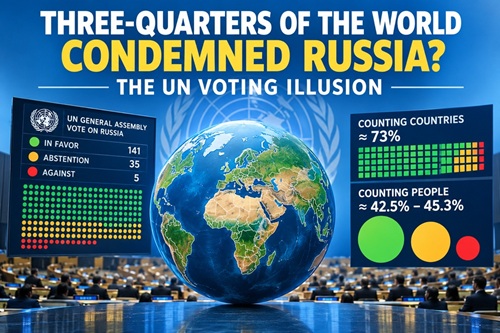 The Impressive NumbersOn 2 March 2022, just days after Russia launched its full-scale invasion of Ukraine, the United Nations General Assembly adopted Resolution ES-11/1, condemning the invasion and demanding the withdrawal of Russian forces.[1] The vote was emphatic: 141 countries voted in favour, five voted against, 35 abstained, and 12 did not vote. Three weeks later, on 24 March, Resolution ES-11/2, addressing the humanitarian consequences of the war, was adopted by 140 countries, with five against, 38 abstentions, and ten not voting. These results were widely presented as evidence of Russia's international isolation. The arithmetic seemed compelling. Approximately 73 percent of UN member states had voted in favour, while only five openly opposed the resolutions. Russia appeared to stand almost alone. But there is a statistical complication hiding behind this impressive diplomatic display. Every country receives one vote, regardless of whether it represents a few hundred thousand people or more than a billion. The General Assembly counts governments, not populations. What happens when we change the denominator? One Country, One Vote: A Diplomatic Majority, Not a Human MajorityThe UN General Assembly's voting system is based on the formal equality of sovereign states. Luxembourg has one vote, just like India. Iceland has one vote, just like China. This arrangement has a defensible purpose: small countries should not simply be overwhelmed by the numerical power of large ones. But the same system creates a problem when its results are presented as an indication of how much of humanity stands behind a particular position. A country-count majority cannot automatically be translated into a population majority. Consider China and India. Together, they accounted for approximately 2.83 billion people in 2022, or about 35 percent of humanity. Both countries abstained on the two resolutions. Pakistan also abstained on the first, while Bangladesh moved from abstention on the first resolution to support for the second. These voting positions make a substantial difference to any population-weighted calculation. An abstaining microstate barely changes the result. An abstaining country with more than a billion inhabitants changes it considerably. A population-weighted calculation assigns each country's vote a weight proportional to its population. It answers a different question from the conventional UN tally: what proportion of the population represented by UN member states lived in countries whose governments voted in favour, against, abstained, or did not vote? The distinction is important, but so is the qualification. This calculation measures the demographic weight of governments' positions, not the opinions of their citizens. Resolution One: 2 March 2022Resolution ES-11/1 condemned Russia's aggression against Ukraine and demanded the withdrawal of Russian forces. Its adoption demonstrated that opposition to the invasion extended well beyond the Western countries directly supporting Ukraine. The following table compares the official country count with the provisional population-weighted calculation discussed in this essay.
*North Korea, Eritrea, Syria, Russia and Belarus
The contrast is striking. While 73.1 percent of member states voted in favour, the provisional calculation suggests that the populations of those countries represented approximately 42.5 percent of the population of UN member states. Conversely, countries whose governments abstained accounted for approximately half that population. This category included China and India, as well as Pakistan and several other populous countries. The result should not be interpreted as meaning that the majority of humanity opposed the resolution. Abstention is not opposition. Nor does it mean that the majority supported Russia. It means that the governments representing a large proportion of the world's population did not explicitly endorse this particular resolution. Resolution Two: 24 March 2022Resolution ES-11/2 focused on the humanitarian consequences of Russia's aggression. It also received overwhelming support when measured by the number of countries voting in favour.
*North Korea, Eritrea, Syria, Russia and Belarus
The population-weighted estimate for the second resolution is somewhat higher than for the first, partly because Bangladesh changed its vote from abstention to support. China and India, however, continued to abstain. Even so, the provisional estimate suggests that governments representing approximately 45.3 percent of the population of UN member states voted in favour. That is considerably less than the 72.5 percent of member states that supported the resolution. The comparison illustrates how different the diplomatic and demographic pictures can be. A resolution may receive overwhelming support among governments without receiving explicit endorsement from governments representing an equivalent proportion of the world's population. An important methodological warning: The population figures in these tables are provisional estimates, not independently verified totals obtained by matching every country's recorded vote to its 2022 population. They should therefore be treated as illustrative rather than definitive. The exact percentages require a complete country-by-country calculation using the official UN roll calls and a consistent population dataset. The country counts, by contrast, are the official voting totals. What Does a Vote in Favour Actually Mean?A vote in favour is the clearest formal indication that a government endorses the resolution's text. In the case of ES-11/1, this meant supporting a resolution condemning Russia's aggression and demanding the withdrawal of its forces. For ES-11/2, it meant supporting the text addressing the humanitarian consequences of the war. Yet a vote in favour does not necessarily imply agreement with every policy adopted by the countries leading the diplomatic initiative. A government may condemn Russia's invasion while opposing certain sanctions, rejecting particular arms transfers, or advocating negotiations on different terms. Nor does a government's vote demonstrate that all its citizens share its position. Governments make decisions through their own political and diplomatic processes. A country may vote in favour even when its domestic population is divided, just as a government may abstain despite substantial public sympathy for Ukraine. Support should therefore be understood precisely: it is support for a particular resolution, not a comprehensive endorsement of every policy associated with the Western response to the war. What Does a Vote Against Mean?Only five countries voted against each resolution. This was a very small proportion of UN membership, and the result provides clear evidence that few governments were prepared to oppose the texts openly. But the meaning of a negative vote also depends on the resolution. Voting against a resolution condemning an invasion may indicate opposition to its substance, disagreement with its wording, objections to its political framing, or a desire to avoid a particular diplomatic alignment. In the case of Russia, Belarus, and other governments that voted against the first resolution, the vote can reasonably be interpreted as opposition to the resolution's condemnation of Russia's actions. It does not, however, establish that every citizen in those countries agreed with their governments. The population-weighted figures also show why the small number of negative votes should not be confused with the full extent of international disagreement. Many governments that did not vote against the resolutions nevertheless declined to endorse them. Abstention: Neither Endorsement Nor RejectionAbstention is the most politically ambiguous category, and also one of the most important. A government may abstain because it considers a resolution one-sided, objects to its wording, wishes to preserve diplomatic flexibility, or believes that the text could obstruct negotiations. It may also wish to avoid openly siding with either party to a conflict. These motives are not interchangeable. An abstention can reflect principled reservations, strategic calculation, neutrality, reluctance to confront a powerful partner, or a mixture of considerations. In the Ukraine case, China's and India's abstentions attracted particular attention because of their size and international influence. Their decisions meant that governments representing a substantial proportion of humanity declined to endorse the resolutions. But it would be wrong to conclude that their abstentions amounted to support for Russia's invasion. The population-weighted approach nevertheless highlights something that the country count obscures: abstention was not confined to a handful of small or marginal states. It included governments representing billions of people. That is a significant diplomatic fact, even if it cannot be translated directly into a statement about those populations' attitudes toward the war. Absence and Non-Voting: The Most Difficult Category to InterpretCountries that did not cast a vote form a separate category. The UN records distinguish them from countries that explicitly abstained. But absence is particularly difficult to interpret. A country may not vote because of domestic political circumstances, scheduling problems, technical difficulties, a decision not to participate, or other reasons. Without additional evidence, it is not possible to determine the motive behind each absence. Consequently, non-voting should not automatically be treated as passive opposition, tacit support for Russia, or indifference to Ukraine. It tells us that a country did not register a formal position in that vote, not why it failed to do so. Population weighting makes this category visible in demographic terms, but it cannot resolve the question of motive. A large population represented by an absent government should not be classified as either supporting or rejecting the resolution. This is another reason to preserve the four categories rather than collapse them into a simple division between pro-Ukraine and pro-Russia countries. The Statistical Trap: Counting Governments Is Not Counting PeopleThe two March resolutions demonstrate the difference between diplomatic consensus and demographic representation. The conventional country-count approach shows that approximately 73 percent of UN member states voted in favour of each resolution. That is a legitimate and meaningful measure of diplomatic support. It tells us how governments voted within the General Assembly's system of sovereign equality. The population-weighted approach asks another question: how many people lived in countries whose governments voted in each way? The provisional calculations presented here suggest that governments voting in favour represented approximately 42.5 percent of the population of UN member states on 2 March and 45.3 percent on 24 March. Those estimates would materially change the rhetoric if they were confirmed by a complete calculation. But they should not be promoted as definitive results until the underlying country-level population sums have been verified. There is also a deeper limitation. Population weighting treats every person living in a country as represented by that country's vote, even though the relationship between governments and citizens varies enormously. In authoritarian states, the government may have limited accountability to public opinion. In democracies, governments can still vote against the preferences of some or even many of their citizens. If the question is what people themselves thought about Russia's invasion, neither country counts nor population weights are sufficient. Representative public-opinion surveys would be needed, with careful attention to freedom of expression, survey reliability, and the risks of asking politically sensitive questions in authoritarian environments. Thus, three different questions must be kept separate: how many governments supported the resolutions, how much of the world's population lived under governments that supported them, and how many people personally agreed with their governments' positions. These are not interchangeable measures of international opinion. Does This Weaken the Case Against Russia?Not by itself. The limitations of the voting statistics do not establish that Russia's invasion was justified, nor do they diminish the legal and political significance of the resolutions. The UN General Assembly vote was not a referendum on the entire history of the conflict, NATO enlargement, Western foreign policy, or the best future security arrangement for Europe. It addressed particular resolutions at a particular moment. A government could vote in favour while disagreeing with other aspects of Western policy, just as a government could abstain while condemning the invasion itself. Likewise, the population-weighted figures cannot establish that the world was evenly divided over the legitimacy of the invasion. They tell us how governments voted, not what every citizen believed. The appropriate conclusion is narrower but still important: the diplomatic majority was larger than the demographic share represented by governments explicitly supporting the resolutions, according to the provisional estimates presented here. The difference deserves recognition, but it should not be turned into a claim that most of humanity supported Russia. Conclusion: What the World Actually SaidThe March 2022 resolutions delivered a clear diplomatic rebuke to Russia. A large majority of UN member states voted in favour, and only five opposed each resolution. That is a substantial result that should not be minimized. But the familiar statement that approximately three-quarters of the world condemned Russia is imprecise. Three-quarters of UN member states voted in favour; that is not the same as three-quarters of the world's population, still less three-quarters of humanity expressing a personal opinion. The provisional population-weighted estimates presented here suggest that governments representing less than half of the population of UN member states voted in favour of the two resolutions. Those percentages need a fully reproducible calculation before they can be treated as established facts. The official country counts, however, are clear, as is the distinction between a vote in favour, a vote against, an abstention, and non-voting. The broader lesson concerns statistical literacy. The choice of denominator changes the story a number appears to tell. Counting countries emphasizes the formal diplomatic position of sovereign states. Weighting by population emphasizes the demographic reach of those positions. Surveying citizens would address public opinion more directly. None of these measures should be substituted for another. Russia faced broad diplomatic opposition in March 2022. The degree to which that opposition represented the world's population is a separate empirical question. And the extent to which it represented the views of individual people is another question again. The world spoke through its governments. But counting governments is not the same as counting humanity—and neither is the same as knowing what humanity thinks. NOTES[1] On 24 February 2022, Russia launched a large-scale invasion against Ukraine. A draft resolution deploring the invasion and calling for the withdrawal of Russian troops was vetoed in the Security Council the following day, prompting the Security Council to convene an emergency special session on the subject of Ukraine with United Nations Security Council Resolution 2623 (Wikipedia).
Widget is loading comments...
|