|
TRANSLATE THIS ARTICLE
Integral World: Exploring Theories of Everything
An independent forum for a critical discussion of the integral philosophy of Ken Wilber
  Frank Visser, graduated as a psychologist of culture and religion, founded IntegralWorld in 1997. He worked as production manager for various publishing houses and as service manager for various internet companies and lives in Amsterdam. Books: Ken Wilber: Thought as Passion (SUNY, 2003), and The Corona Conspiracy: Combatting Disinformation about the Coronavirus (Kindle, 2020).
Check out my other conversations with ChatGPT
Unpopular questions about the Ukraine War:
Did Russia Have Any Valid Reasons to Invade Ukraine? From Regional War to World War III? Russia, Ukraine, and Europe in the Drama Triangle Three-Quarters of the World Condemned Russia? Was Putin's Invasion a Pre-emptive Strike That Backfired? Russia's Hybrid War Against Europe The Nuclear Game of Cards A New European Security Architecture The Nuclear Game of CardsHow Global Powers Gamble with Humanity's FutureFrank Visser / ChatGPT
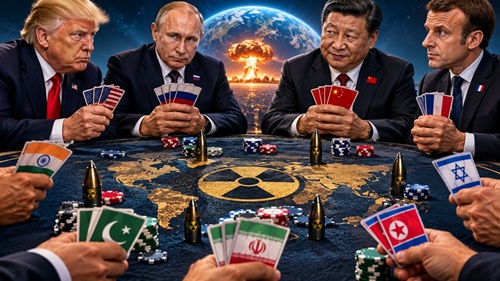
Introduction: Playing with a Planetary StakeThe nuclear age has produced one of the strangest paradoxes in human history. The most powerful weapons ever invented are widely understood to be too destructive to use, yet the states possessing them continue to invest enormous resources in maintaining, modernizing, expanding, and occasionally brandishing their nuclear arsenals. Nuclear weapons are simultaneously instruments of deterrence, symbols of national prestige, bargaining chips in international negotiations, and potential instruments of national suicide. The resulting geopolitical situation resembles a high-stakes game of cards. The players are the major nuclear powers: the United States, Russia, China, France, and the United Kingdom, joined by India, Pakistan, North Korea, and Israel. Each holds a different hand, operates according to different strategic calculations, and attempts to anticipate the moves of its opponents. Some players bluff, some raise the stakes, some conceal their intentions, and others attempt to change the rules of the game. But this is not an ordinary poker game. There is no casino, no referee, and no agreed-upon mechanism for stopping the game when things become dangerous. The ultimate stake is not money or territory but the survival of millions of people, the stability of civilization, and potentially the habitability of large parts of the planet. What makes this situation especially disturbing is that the players can lose even when nobody intends to lose. Miscalculation, technological failure, false warnings, domestic political pressures, or an uncontrolled escalation can turn a calculated strategy of deterrence into an irreversible catastrophe. 1. The Original Game: Mutually Assured DestructionThe strategic logic of the nuclear game emerged during the Cold War. Following the development of thermonuclear weapons and increasingly sophisticated delivery systems, the United States and the Soviet Union acquired the ability to destroy one another on an unprecedented scale. The doctrine that eventually became known as Mutually Assured Destruction (MAD) rested on a peculiar form of rationality. Neither superpower could launch a nuclear attack without risking devastating retaliation. Even if one side attempted a first strike, the other would retain sufficient weapons to respond. The paradox was that peace was maintained not through trust, cooperation, or reconciliation, but through the mutual capacity for annihilation. In this arrangement, nuclear weapons were not primarily war-fighting instruments. Their principal purpose was to prevent war by making its consequences intolerable. The credibility of deterrence depended on convincing the opponent that retaliation would follow an attack, even if carrying it out would be suicidal. This created an extraordinary strategic contradiction: leaders had to demonstrate that they were willing to do something that, if actually done, would destroy much of what they were supposedly protecting. The nuclear game therefore depends on a carefully managed performance of irrationality. A government must appear sufficiently determined, unpredictable, and dangerous to discourage an adversary from testing its resolve, while remaining sufficiently cautious to avoid an actual nuclear exchange. This is a precarious psychological and political arrangement, not a guarantee of safety. 2. Russia: Nuclear Weapons as Instruments of Political IntimidationRussia inherited the world's largest nuclear arsenal from the Soviet Union and continues to regard it as a central pillar of its international status. In conventional military terms, Russia has experienced serious limitations, most visibly in its invasion of Ukraine. Its nuclear capabilities, however, remain a major source of strategic leverage. Under Vladimir Putin, nuclear rhetoric has increasingly become part of Russia's repertoire of political intimidation. References to nuclear retaliation, changes in nuclear doctrine, exercises, weapons announcements, and warnings directed at Western governments have repeatedly accompanied developments in the war against Ukraine. The underlying message is that Western support for Ukraine must remain within limits established, or at least suggested, by Moscow. Russia cannot necessarily prevent NATO countries from supplying weapons, intelligence, or financial assistance, but it can attempt to raise the perceived cost of doing so. This is nuclear blackmail in a political sense: the threat of an exceptionally destructive escalation is used to influence the decisions of countries that are not themselves directly attacking Russia. There is a strategic logic behind this approach. Russia wants to exploit the asymmetry between its willingness to threaten escalation and the West's understandable reluctance to risk nuclear war. The Kremlin hopes that democratic governments, accountable to their populations, will be more sensitive to nuclear danger than an authoritarian leadership that can manipulate public information and suppress domestic opposition. Yet nuclear intimidation also has costs. Repeated threats can lose credibility through overuse. They can encourage adversaries to strengthen their military cooperation, increase NATO's readiness, and reinforce the conviction that Russia's nuclear posture is itself a security problem. The more Moscow relies on nuclear intimidation, the more it risks making the international environment it inhabits hostile and unstable. There is also a fundamental distinction between possessing a credible deterrent and using nuclear weapons as a political instrument of coercion. The former may discourage an existential attack; the latter attempts to restrict the legitimate foreign-policy choices of other states by holding catastrophic consequences over their heads. 3. The United States: The Guardian of Deterrence and Its ContradictionsThe United States occupies a distinctive position in the nuclear game. It maintains an enormous nuclear arsenal, extends nuclear protection to allies through its security commitments, and presents itself as the principal guarantor of the international order established after the Second World War. American nuclear strategy must therefore serve several purposes simultaneously: deter a Russian attack, discourage Chinese aggression, reassure European and Asian allies, prevent nuclear proliferation, and preserve American strategic superiority. This is an increasingly complicated assignment. Washington faces a difficult credibility problem. If the United States promises to defend an ally against nuclear coercion, will it actually risk its own cities to protect that ally? This is the central dilemma of extended deterrence. American allies want reassurance that Washington's nuclear umbrella is real, while adversaries have an incentive to question whether the United States would accept such enormous risks. The American response has included forward military deployments, nuclear-sharing arrangements, missile defenses, conventional precision weapons, and the modernization of its nuclear triad. But this modernization raises an important question: when does maintaining a credible deterrent become an arms race in its own right? The United States frequently describes its nuclear posture as defensive, but its adversaries interpret American military capabilities through their own security anxieties. The same weapons that Washington considers necessary for deterrence can appear threatening to Moscow and Beijing. This is one of the enduring problems of international security: defensive intentions cannot simply be assumed by one's opponents. American policy also contains an uncomfortable contradiction. Washington advocates nuclear nonproliferation while retaining a vast arsenal and investing in its modernization. It expects other states to accept limits on their nuclear ambitions while insisting that its own nuclear capabilities remain indispensable. There are legitimate historical and strategic reasons for distinguishing established nuclear powers from aspiring ones. Nevertheless, the credibility of nonproliferation suffers when nuclear disarmament appears to be a permanent obligation for everyone except those who already possess the weapons. 4. China: The Rising Player Changes the GameChina's nuclear expansion is arguably one of the most consequential developments in the contemporary nuclear balance. For decades, Beijing maintained a comparatively modest nuclear arsenal, officially emphasizing a policy of minimum deterrence and no first use. Its strategic position was different from that of the United States and Russia, both of which maintained much larger and more diversified nuclear forces. That situation is changing. China is expanding its nuclear capabilities, constructing additional missile facilities, developing more advanced delivery systems, and investing in a more sophisticated nuclear infrastructure. The precise intentions behind this expansion remain debated. Several explanations are plausible. Beijing may want to ensure that its retaliatory capabilities cannot be neutralized by an American first strike. It may seek greater bargaining power in future arms-control negotiations. It may also want to prevent Washington from believing that it can intervene militarily in a Taiwan crisis without risking nuclear escalation. The Taiwan question makes this particularly dangerous. A conventional military confrontation over the island could involve the United States and China directly. Both countries would then face the problem of managing escalation between two powers with increasingly sophisticated nuclear capabilities. China's rise also complicates the traditional bilateral arms-control framework. Agreements designed around American and Russian arsenals do not automatically accommodate a third major nuclear power. The game is no longer simply a two-player contest. It is becoming a triangular competition in which each participant must calculate its position relative to two others. This makes arms control more difficult, not less necessary. 5. The Smaller Nuclear Powers: Regional Games with Global ConsequencesThe nuclear game is not restricted to the three largest arsenals. India and Pakistan maintain nuclear weapons in a region marked by territorial disputes, historical antagonism, domestic political pressures, and periodic military crises. Their rivalry demonstrates that nuclear deterrence does not eliminate conventional conflict. Instead, it can create a dangerous environment in which each side believes the other's nuclear threshold will prevent a full-scale war. North Korea has developed nuclear weapons into a central instrument of regime survival and international bargaining. Its arsenal is not simply a military capability but a political insurance policy. The North Korean leadership sees nuclear weapons as protection against external intervention and as a means of ensuring that its government cannot easily be overthrown. Israel, although maintaining a policy of nuclear ambiguity, is widely understood to possess nuclear weapons. Its strategic circumstances are different from those of the other nuclear powers, reflecting the country's perception of existential threats in a hostile regional environment. These smaller arsenals complicate the global picture. A nuclear crisis does not need to begin between Washington and Moscow. It could emerge from a regional confrontation, a misinterpreted military exercise, an attack on critical infrastructure, or a domestic political crisis. And because nuclear weapons are ultimately connected to the international balance of power, a regional nuclear exchange could have consequences far beyond the countries directly involved. 6. The Bluffing Problem: How Much Irrationality Is Credible?Poker players bluff because they want opponents to make decisions based not only on the cards they hold but also on what they believe the player might do. Nuclear deterrence operates in a similar psychological environment. A government may deliberately cultivate uncertainty about the circumstances in which it would use nuclear weapons. It may refuse to specify its precise red lines, leaving opponents to consider the possibility that crossing a particular threshold could trigger an unpredictable response. Strategic ambiguity can be useful. It makes an adversary less confident that it can act without consequences. But ambiguity has a dangerous downside. If opponents cannot distinguish genuine intentions from political theater, they may misinterpret signals. A warning intended to deter can be understood as preparation for attack. A defensive measure can be interpreted as the beginning of an offensive operation. This is especially dangerous during a rapidly developing military crisis. Nuclear decisions are also made by human beings operating under enormous pressure. They may have incomplete information, distorted intelligence, ideological prejudices, domestic political incentives, or an exaggerated belief in their own ability to control events. The assumption that nuclear-armed governments always behave as perfectly rational actors is therefore questionable. History offers numerous examples of nuclear near-misses and false alarms. The world has survived not only because deterrence worked, but also because individual decision-makers sometimes exercised restraint, questioned available information, or refused to follow procedures mechanically. That is a profoundly uncomfortable foundation for planetary security. 7. The Technological Wild Cards: AI, Cyberwarfare, and Hypersonic WeaponsThe nuclear game is becoming more complicated through technological developments that can shorten decision-making times and undermine established assumptions. Artificial intelligence is one such development. Although nuclear decision-making remains a human responsibility in the major nuclear powers, AI systems may increasingly assist with intelligence analysis, surveillance, early warning, target identification, and military planning. These applications could improve situational awareness. They could also introduce new vulnerabilities. An algorithm may misclassify an event, amplify an intelligence error, or produce a misleading assessment that human decision-makers trust too readily. The danger is not necessarily that an AI system independently launches nuclear weapons. It is that automated information processing could accelerate a crisis in which humans have less time to evaluate what is happening. Cyberwarfare presents another problem. Nuclear command-and-control systems, communication networks, early-warning infrastructure, and supporting military systems may become targets of cyberattacks. Even an unsuccessful attack could generate uncertainty about whether an adversary is attempting to disable a country's retaliatory capability. Hypersonic weapons and other advanced delivery systems introduce further complications. Their speed, maneuverability, and sometimes uncertain mission profiles can make it more difficult to determine what is being launched and what its intended target might be. The broader issue is that nuclear stability depends on predictable communication and sufficient time for political decision-making. Technologies that undermine either condition may make the system more fragile. The nuclear game is thus being played with increasingly sophisticated cards, while the rules governing their use remain dangerously incomplete. 8. The Expiration of Arms Control: Playing Without Agreed RulesOne of the most troubling developments in nuclear politics has been the erosion of the arms-control framework developed during the Cold War and extended afterward. The United States and Russia have long recognized that nuclear competition requires some degree of mutual restraint. Treaties and verification arrangements helped limit particular categories of weapons, establish transparency, and reduce the possibility of misunderstandings. But arms control has progressively weakened. The Intermediate-Range Nuclear Forces Treaty collapsed in 2019. The United States withdrew from the Open Skies Treaty in 2020, and Russia followed in 2021. The New START treaty, the last remaining major bilateral agreement limiting American and Russian strategic nuclear arsenals, expired in February 2026. The expiration of New START is particularly significant because it removes the last major legally binding quantitative constraints on the two largest nuclear arsenals. This does not mean that an immediate arms race or a massive increase in deployed weapons is inevitable. Political choices remain possible. But the loss of agreed limits and verification mechanisms makes the strategic environment less transparent and less predictable. The danger is a familiar security dilemma. Each country interprets the other's military preparations as evidence of hostile intentions and responds with additional preparations of its own. What begins as an attempt to improve security can therefore produce greater insecurity for everyone. Without arms-control agreements, the nuclear players are increasingly relying on unilateral judgments about the intentions and capabilities of their opponents. That is an exceptionally risky way to manage weapons of such destructive power. 9. The Nuclear Poker Game Is Not a Fair GameThe poker analogy has another important limitation: the players are not the only people who stand to lose. Political leaders make nuclear decisions, military establishments formulate strategies, intelligence agencies assess threats, and defense industries profit from weapons development. But the people who would suffer the consequences have virtually no influence over the decisions that determine their fate. A president or head of government might initiate a nuclear confrontation, but the resulting destruction would extend across national borders and generations. Millions of people who never consented to participate in the game would become its victims. There is also a profound inequality between those who make nuclear policy and those who bear its risks. Nuclear weapons are frequently discussed in the abstract language of strategic stability, escalation management, second-strike capability, and deterrence credibility. Such terminology is useful for military analysis, but it can obscure the human reality of nuclear warfare. A nuclear explosion is not simply another military event. It destroys cities, hospitals, infrastructure, families, and entire communities. Radiation and environmental consequences do not respect national borders. A large-scale nuclear exchange could disrupt agricultural production and global food supplies, potentially producing famine far from the original battlefield. The people of the world are therefore involuntary participants in a game over which they have remarkably little democratic control. This raises a fundamental question: by what moral or political authority do a handful of national leaders claim the right to gamble with humanity's future? 10. The Nuclear Taboo and the Normalization of the UnthinkableSince 1945, nuclear weapons have acquired a peculiar moral status. Their use has generally been regarded as an exceptional act, something fundamentally different from conventional warfare. This informal prohibition is often called the nuclear taboo. It is not an absolute legal prohibition on every conceivable use of nuclear weapons. Rather, it is a powerful international norm that has made their employment politically and morally extraordinary. The taboo has helped prevent nuclear weapons from becoming ordinary instruments of military policy. But it is not invulnerable. One disturbing development is the increasing normalization of nuclear rhetoric. Politicians and military commentators discuss tactical nuclear weapons, limited nuclear exchanges, battlefield nuclear options, and graduated escalation as though these were manageable extensions of conventional military planning. The distinction between strategic and tactical nuclear weapons can be useful in military analysis, but it should not be confused with a meaningful distinction between harmless and catastrophic weapons. A so-called tactical nuclear weapon is still a nuclear weapon. Its use could produce unpredictable escalation, including retaliation against cities and military installations. The notion that nuclear warfare can be carefully limited is therefore one of the most dangerous assumptions in contemporary strategic thinking. The danger is not simply that somebody will deliberately launch a nuclear attack. It is that the political and intellectual barriers against contemplating such an attack may gradually weaken. Once nuclear weapons become normalized as usable military instruments, the taboo loses some of its deterrent power. 11. The Nonproliferation Paradox: Who Gets to Hold the Cards?The international nuclear order rests partly on the Treaty on the Non-Proliferation of Nuclear Weapons (NPT), which entered into force in 1970. Its basic bargain is that countries without nuclear weapons agree not to acquire them, while the recognized nuclear-weapon states undertake obligations concerning disarmament and the peaceful use of nuclear technology. This arrangement has helped prevent a much larger number of countries from acquiring nuclear arsenals. That is an important achievement. Yet the treaty also embodies an enduring contradiction. Five countries—the United States, Russia, China, France, and the United Kingdom—are recognized as nuclear-weapon states under the treaty, while the others are expected to remain non-nuclear. The treaty does not grant these five states an unlimited right to retain their arsenals. Article VI commits all parties to pursue negotiations in good faith on effective measures relating to nuclear disarmament. Nevertheless, the practical reality is that the established nuclear powers have been unwilling to eliminate their arsenals. This creates a legitimacy problem. Why should countries without nuclear weapons accept permanent restrictions when the most powerful states continue to regard their own nuclear capabilities as essential to national security? India, Pakistan, Israel, and North Korea demonstrate different ways in which the existing nuclear order has been challenged or circumvented. Their cases are not identical, and their political circumstances differ considerably. But collectively they illustrate the limitations of a system based on a hierarchy of nuclear privileges. The fundamental problem is that nuclear weapons remain attractive precisely because they confer strategic status and a measure of protection against external intervention. As long as possession is treated as a source of international power, nonproliferation will remain an incomplete project. 12. The Nuclear Business: Fear as an Economic ResourceThe nuclear game is not played exclusively by politicians and military strategists. It also involves powerful institutional and economic interests. Nuclear modernization requires enormous investments in missile systems, submarines, bombers, warheads, command networks, research facilities, and supporting infrastructure. Defense contractors, military establishments, research institutions, and political constituencies all have stakes in the continuation of these programs. This does not mean that every advocate of nuclear modernization is motivated by commercial interests. Genuine security concerns exist, and governments cannot simply disregard the military capabilities of their adversaries. But an important question deserves greater attention: who benefits economically and institutionally from the permanent maintenance of nuclear confrontation? The arms industry does not need a nuclear war to be profitable. It needs governments to believe that the threat of nuclear war remains sufficiently serious to justify continuous investment. A permanent state of geopolitical anxiety can therefore become an economic resource. The danger is that nuclear policy becomes embedded in institutional structures that have an interest in perpetuating the very insecurity they claim to manage. The result is a military-industrial environment in which disarmament is frequently treated as an unrealistic aspiration, while the indefinite modernization of nuclear arsenals is presented as sober realism. This is a questionable definition of realism. A policy that continuously increases the destructive capabilities of rival powers without creating a credible path toward reducing their dependence on those capabilities is not necessarily prudent. It may simply institutionalize the danger. 13. Can the Game Be Changed?It would be unrealistic to expect nuclear-armed states to abandon their arsenals overnight. The security dilemmas that produced nuclear deterrence have not disappeared, and unilateral disarmament could create new strategic vulnerabilities. But accepting the persistence of nuclear weapons does not require accepting an endless arms race. There are several practical ways to make the game less dangerous. First, the United States and Russia need a successor framework to New START. Even in the absence of comprehensive political agreement, restoring transparency, verification, and numerical restraint would be a major improvement. Second, China must become a participant in a broader arms-control dialogue. Its growing arsenal makes a purely bilateral approach increasingly inadequate. This does not mean that China should immediately accept the same numerical limits as Washington and Moscow, but it should engage in serious discussions about transparency, strategic stability, and the avoidance of miscalculation. Third, nuclear-armed governments should strengthen communication channels, military hotlines, crisis-management procedures, and mechanisms for clarifying ambiguous military activities. Fourth, nuclear weapons should be kept out of automated decision-making processes. Human responsibility, independent verification, and sufficient time for deliberation are essential safeguards against catastrophic mistakes. Fifth, governments should reaffirm the principle that nuclear war cannot be won and must never be fought. This should be more than ceremonial diplomatic language. It should inform military doctrines, public statements, and actual security policies. Finally, the international community should strengthen the nonproliferation regime while taking the disarmament obligations of established nuclear powers seriously. Nonproliferation cannot remain credible indefinitely if disarmament is treated as an obligation that belongs exclusively to others. The objective need not be immediate global nuclear abolition. It should be a gradual transition away from nuclear weapons as the central guarantee of international security. That requires a broader conception of security based on diplomacy, economic cooperation, regional conflict prevention, and the reduction of existential threats. 14. Iran: The Player Who Is Not Allowed to Hold the CardsIran's nuclear ambitions reveal the double standards, strategic anxieties, and unresolved contradictions of the international nuclear order. Tehran has long maintained that its nuclear programme is intended for peaceful purposes, particularly civilian energy production. However, its enrichment activities have gone far beyond what is ordinarily required for civilian nuclear power. Before the Israeli and American attacks on Iranian nuclear facilities in June 2025, Iran had accumulated substantial quantities of uranium enriched to 60 percent purity, relatively close to the approximately 90 percent generally associated with weapons-grade uranium. The distinction between possessing the technical capacity to produce nuclear material for a weapon and actually deciding to build one is crucial. American intelligence assessments had previously concluded that Iran was not actively constructing a nuclear weapon, although its technological progress gave it the option to do so. The situation has become considerably more opaque following the military attacks of 2025 and 2026. According to an October 2026 assessment, the IAEA has been unable to establish the current status of important nuclear facilities and materials because Iran has denied inspectors access to the bombed sites. The agency has consequently lost continuity of knowledge about significant portions of Iran's enriched uranium inventory. This uncertainty is itself a serious proliferation risk. The Israeli double standardOne of the most politically sensitive aspects of the Iranian nuclear question is Israel's position. Israel is widely understood to possess nuclear weapons, although it maintains a policy of nuclear ambiguity and has never officially acknowledged an arsenal. It is not a party to the Nuclear Non-Proliferation Treaty. Iran, by contrast, is an NPT signatory and therefore has legally binding nonproliferation and safeguards obligations. This produces an uncomfortable regional asymmetry. Israel possesses an undeclared nuclear deterrent, while Iran is subjected to extraordinary international scrutiny over its nuclear activities. There are legitimate reasons for concern about Iran's programme, including its enrichment activities, inadequate transparency, missile capabilities, and hostility toward Israel. But these concerns do not eliminate the larger question of why the international community tolerates one country's nuclear monopoly while treating another country's potential acquisition as an intolerable threat. The issue is not that Israel should necessarily surrender its nuclear deterrent unilaterally. It is that a sustainable Middle Eastern security arrangement cannot indefinitely rest on an unequal distribution of nuclear privileges. The American contribution to the crisisThe history of the Iranian nuclear dispute also deserves a more balanced assessment of American responsibility. The 2015 Joint Comprehensive Plan of Action (JCPOA), negotiated under the Obama administration, placed substantial restrictions on Iran's nuclear programme in exchange for sanctions relief and international monitoring. In 2018, Donald Trump withdrew the United States from the agreement, despite the fact that international inspectors had been verifying Iranian compliance with its principal nuclear restrictions. Iran subsequently began exceeding important enrichment limits and reducing international monitoring. This does not absolve Tehran of responsibility for its later decisions. But it demonstrates that diplomatic agreements can be undermined by the very powers that helped negotiate them. The lesson is particularly damaging for international diplomacy: why should a government accept difficult restrictions in exchange for promises that a subsequent administration in another country may simply abandon? The subsequent American and Israeli military strikes further complicated the situation. Destroying nuclear facilities is not equivalent to eliminating nuclear knowledge, technical expertise, or political motivation. Military attacks may delay a programme while simultaneously strengthening the domestic argument that only nuclear deterrence can protect Iran against future attacks. The strategic ironyIran's predicament illustrates a fundamental paradox of nuclear deterrence. A country that feels threatened by nuclear-armed adversaries may conclude that acquiring nuclear weapons is its best guarantee of national survival. North Korea provides an obvious example of this reasoning. Its nuclear arsenal makes military intervention against the regime considerably more dangerous. Iranian leaders can hardly ignore that lesson. Yet an Iranian nuclear arsenal would probably stimulate further proliferation in the Middle East, particularly among Saudi Arabia and potentially other regional powers. It could also produce a more dangerous confrontation with Israel and the United States. Iran therefore faces a strategic dilemma: pursuing nuclear weapons might strengthen its deterrent position while making its regional security environment considerably more dangerous. And the existing nuclear powers face their own dilemma: attempting to prevent proliferation through military coercion may reinforce precisely the motivations that make nuclear weapons attractive. Who is allowed to play?Iran should therefore be included in the nuclear poker analogy, but as a particularly interesting kind of player: one whose hand is incomplete, whose technical capabilities are substantial, and whose opponents are determined to prevent it from acquiring the final cards. The question is not whether Iran should be permitted to develop nuclear weapons. There are compelling reasons to prevent another country from joining the nuclear club. The deeper question is whether the existing nuclear powers are prepared to apply the principles of nonproliferation consistently, including to themselves and their allies. A credible international nuclear order cannot indefinitely demand restraint from aspiring nuclear powers while treating the arsenals of established powers as permanent necessities. Iran is not merely another problem in the nuclear game. It is a test of whether the rules of that game can ever become genuinely universal. Conclusion: The Last Card Should Never Be PlayedThe nuclear game of cards is one of the most disturbing features of contemporary geopolitics. The major powers continue to calculate their relative advantages, test one another's resolve, modernize their arsenals, issue threats, and interpret the military preparations of their rivals. Each claims to be acting defensively. Each insists that its nuclear capabilities are necessary because the others possess them. This produces a circular logic of insecurity: everybody arms because everybody else is arming, and nobody feels sufficiently secure to stop. The original Cold War model of mutually assured destruction at least rested on a recognizable strategic balance between two superpowers. The emerging nuclear environment is considerably more complicated. Three major powers now shape the central strategic competition, while several regional nuclear rivalries introduce additional opportunities for escalation. Meanwhile, technological change is accelerating, arms-control institutions are weakening, and political leaders increasingly invoke nuclear weapons in ordinary geopolitical disputes. The most alarming development is not simply that nuclear arsenals exist. It is that their possession and modernization are increasingly treated as normal, permanent features of international politics. There is something profoundly irrational about a system in which governments claim to protect their populations by maintaining the means to destroy those of their adversaries, while simultaneously accepting that retaliation could destroy their own societies. Nuclear deterrence may have contributed to the avoidance of direct great-power war since 1945. But its historical survival does not establish its permanent reliability. The absence of nuclear war is not proof that the system is safe. It may also reflect a combination of restraint, luck, and circumstances that cannot be guaranteed in the future. The metaphor of poker ultimately breaks down at precisely the point where it becomes most important. In poker, losing a hand means losing money. In the nuclear game, losing a hand could mean losing entire cities, countries, and perhaps the foundations of modern civilization. There is no final winner, no consolation prize, and no possibility of starting another game. The real measure of geopolitical leadership should therefore not be how convincingly a government can threaten its opponents with nuclear destruction. It should be how effectively it can reduce the need for such threats in the first place. Humanity has spent eight decades learning how to live with nuclear weapons. It is time to become considerably more serious about learning how to live without them. The last card must never be played.
Comment Form is loading comments...
|