|
TRANSLATE THIS ARTICLE
Integral World: Exploring Theories of Everything
An independent forum for a critical discussion of the integral philosophy of Ken Wilber
  Frank Visser, graduated as a psychologist of culture and religion, founded IntegralWorld in 1997. He worked as production manager for various publishing houses and as service manager for various internet companies and lives in Amsterdam. Books: Ken Wilber: Thought as Passion (SUNY, 2003), and The Corona Conspiracy: Combatting Disinformation about the Coronavirus (Kindle, 2020).
Check out my other conversations with ChatGPT
Unpopular questions about the Ukraine War:
Did Russia Have Any Valid Reasons to Invade Ukraine? From Regional War to World War III? Russia, Ukraine, and Europe in the Drama Triangle Three-Quarters of the World Condemned Russia? Was Putin's Invasion a Pre-emptive Strike That Backfired? Russia's Hybrid War Against Europe The Nuclear Game of Cards A New European Security Architecture Putin's Demand for a New European Security ArchitectureBetween Legitimate Security Concerns, Spheres of Influence, and the Right of Nations to ChooseFrank Visser / ChatGPT
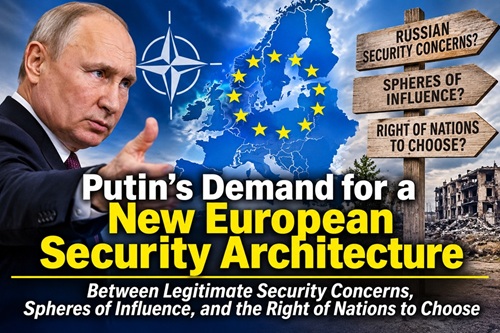 Introduction: Who Gets to Design Europe's Security?Vladimir Putin has repeatedly called for a new European security architecture, arguing that the existing post-Cold War security arrangements have failed and that Russia's legitimate security interests have been disregarded. The demand is not new. It has been a recurring feature of Russian foreign policy, reaching a particularly consequential moment in December 2021, when Moscow presented the United States and NATO with draft agreements intended to reshape the European security order. At first glance, the proposal touches upon a legitimate question: can European security remain stable when one of its largest military powers feels excluded from the arrangements governing the continent? Shouldn't Russia, like every other European state, have its security concerns taken seriously? But there is a second, more difficult question: what exactly does Putin mean by a new security architecture? Does he envisage a genuinely cooperative system in which all European nations enjoy equal sovereignty and security guarantees? Or does he seek an arrangement in which Russia acquires a privileged position, including a de facto veto over the foreign and security policies of its neighbours? These questions cannot be answered simply by invoking NATO expansion or Russian aggression. They require an examination of the historical record, the competing interpretations of European security, and the fundamental contradiction between national sovereignty and great-power privilege. 1. The Post-Cold War Settlement: A Missed Opportunity?The collapse of the Soviet Union in 1991 created an extraordinary opportunity to establish a new European security order. The ideological confrontation between East and West had ended, the Warsaw Pact was dissolved, and the Soviet Union itself ceased to exist. There were expectations that Europe could gradually move beyond the military confrontation that had characterized the Cold War. Russia was initially included in several European institutions and cooperative arrangements. It joined the Council of Europe in 1996 and became a member of the G8 in 1998. NATO established a Permanent Joint Council with Russia in 1997 and subsequently created the NATO-Russia Council in 2002. Yet the emerging order remained asymmetrical. NATO survived the dissolution of its original adversary, while Russia experienced a dramatic decline in international influence. Former Warsaw Pact countries and Soviet republics increasingly sought integration with Western institutions. From Moscow's perspective, this process represented a gradual encroachment of Western political and military influence into what Russia considered its traditional security environment. There is a historical basis for discussing Western responsibility in this process. American and European policymakers did not always appreciate how NATO enlargement would be perceived in Moscow. The debate over assurances allegedly given to Soviet leader Mikhail Gorbachev in 1990 remains controversial. While discussions about NATO's future eastward reach did take place, no legally binding agreement prohibited subsequent enlargement beyond Germany. More importantly, the political choices of Central and Eastern European countries cannot be reduced to Western expansionism. Poland, Hungary, the Baltic states and others had their own historical reasons for seeking NATO membership. Their experience of Soviet domination made Western security guarantees attractive. The post-Cold War settlement therefore contained two competing aspirations: Russia's desire to retain strategic influence and the desire of formerly communist countries to secure their independence from Russian domination. Any new European security architecture would have to accommodate both concerns without sacrificing the sovereignty of either side. 2. The Principle of Indivisible SecurityOne of the central concepts in Putin's argument is indivisible security. It sounds reasonable: no country should be allowed to increase its security at the expense of another country's security. Indeed, this principle is explicitly recognized in the 1999 OSCE Charter for European Security, adopted in Istanbul with Russia's participation. But the same document contains an equally important qualification: every participating state has the right to choose or change its security arrangements, including membership in military alliances. Furthermore, no state may consider any part of the OSCE area its sphere of influence. This creates an interesting problem for Putin's argument. If Russia's security interests deserve recognition, so do those of Poland, Estonia, Latvia, Lithuania, Finland and Ukraine. If Russia is entitled to reject military arrangements it considers threatening, why should Ukraine not be entitled to seek protection against a Russia it considers threatening? Indivisible security cannot mean that the largest military power gets to determine what constitutes security for its smaller neighbours. There are two possible interpretations of the principle. In the first, security is genuinely reciprocal: states negotiate limitations on military deployments, missile systems, exercises and other potentially destabilizing activities. In the second, one state defines the security requirements of another and expects its neighbours to comply. The first interpretation is compatible with cooperative international security. The second risks turning the principle into an instrument of geopolitical hierarchy. 3. The December 2021 UltimatumPutin's demand for a new security architecture became particularly concrete in December 2021, when Russia published two draft agreements, one addressed to the United States and another to NATO. These documents were not modest proposals for improving military transparency or restoring diplomatic communication. They demanded a fundamental revision of the European security order. Among other things, Russia demanded that NATO:
The American proposal also included restrictions on military activities and nuclear weapons deployments. In effect, Moscow was demanding a rollback of NATO's military presence towards its pre-1997 configuration, while seeking to restrict the independent security choices of countries that had subsequently joined the alliance. This raises an important question: why should the security arrangements of Poland or the Baltic states be subject to negotiations between Washington and Moscow? These countries were not passive objects in the Cold War's geopolitical chess game. They had their own historical experiences, political preferences and security concerns. Their accession to NATO was the result of sovereign political decisions. A security architecture negotiated over their heads would reproduce precisely the great-power politics that the post-Cold War settlement was supposed to overcome. There was also a striking contradiction in Russia's negotiating position. Moscow demanded guarantees against military threats while concentrating an enormous military force around Ukraine's borders. The timing made it difficult to interpret the proposals as an ordinary diplomatic initiative detached from coercive pressure. The United States and NATO did not reject dialogue altogether. They indicated a willingness to discuss arms control, military transparency, missile deployments and risk reduction. But they refused to negotiate away the fundamental right of sovereign states to determine their own alliances. On February 24, 2022, Russia launched its full-scale invasion of Ukraine. Whatever legitimate grievances Moscow may have had concerning the European security order, the invasion fundamentally changed the context in which its proposals would be received. 4. Ukraine: The Missing Subject of Russian Security ThinkingPerhaps the most revealing aspect of Putin's proposed architecture is its treatment of Ukraine. In the Kremlin's geopolitical worldview, Ukraine occupies a special position. It is not regarded merely as a neighbouring sovereign state but as a country whose historical, cultural and strategic orientation is intimately connected to Russia. Putin's 2021 historical essay, On the Historical Unity of Russians and Ukrainians, illustrated this approach. It questioned the historical foundations of a separate Ukrainian national identity and portrayed the division between Russians and Ukrainians as an artificial consequence of historical and political developments. This historical narrative has direct geopolitical consequences. If Ukraine is regarded as an essentially inseparable part of the Russian historical world, its decision to orient itself towards the European Union and NATO becomes more than an ordinary foreign-policy choice. It becomes, in the Kremlin's interpretation, a strategic and civilizational loss. But historical connections do not establish contemporary political ownership. Many European countries share complicated histories of empire, occupation, cultural exchange and territorial change. These histories cannot provide an enduring justification for denying present-day populations the right to determine their political future. Ukraine's aspirations towards Western institutions may be disputed, and its potential NATO membership can legitimately be discussed in the context of wider European security. But such discussions cannot simply exclude Ukraine itself. A settlement about Ukraine's security that is negotiated exclusively between Russia and Western powers would be fundamentally incomplete. The country whose security is supposedly being discussed must be a participant in the negotiations, not their object. This is also why the distinction between Russian security concerns and Russian demands for strategic control is so important. Preventing an accidental military confrontation is a legitimate objective. Preventing a neighbouring country from choosing its political and economic orientation is something quite different. 5. Putin's 2024 Proposal: From European to Eurasian SecurityIn June 2024, Putin expanded his vision beyond the traditional European security framework. Addressing the Russian Foreign Ministry, he argued that the existing Euro-Atlantic security system was effectively finished and proposed developing a new Eurasian security architecture. This proposal was presented as an inclusive framework, potentially involving all Eurasian countries, including European and NATO members. Putin emphasized bilateral and multilateral security guarantees, greater cooperation among Eurasian states and, in the longer term, the gradual removal of military forces belonging to powers from outside the region. He also connected the proposal to Russia's broader vision of a multipolar international order and to cooperation with China. There is an interesting conceptual shift here. Whereas the 2021 proposals focused heavily on limiting NATO's geographical and military reach, the 2024 initiative presents itself as a much broader alternative to the Western-led international security system. The vocabulary is familiar: multipolarity, equality, indivisible security, mutual respect and cooperation. These are not inherently objectionable principles. Indeed, a genuinely multipolar international order could provide opportunities for greater diplomatic participation by countries that have traditionally had limited influence in Western-led institutions. But the crucial question remains: how would such a system work in practice? Would European countries be free to maintain their American security partnerships? Would Ukraine be free to choose its own international orientation? Would Russia accept military cooperation between neighbouring countries without treating it as an encroachment on its sphere of influence? Would China be expected to observe the same principles of non-interference in its own neighbourhood? Without satisfactory answers to these questions, multipolarity risks becoming little more than a redistribution of geopolitical influence among competing great powers. A world in which Washington, Moscow and Beijing each exercise privileged control over their respective neighbourhoods is not necessarily a more peaceful or democratic world. It may simply replace one hierarchy with several others. 6. The NATO Question: Was Western Policy Entirely Innocent?A critical examination of Putin's position should not become an exercise in Western self-exoneration. NATO enlargement was not a politically neutral process. It changed the strategic geography of Europe and inevitably affected Russian perceptions of security. Western policymakers sometimes underestimated the political consequences of treating Russia as a defeated power rather than as a country that would remain a major participant in European affairs. The diplomatic failures of the post-Cold War period deserve serious examination. The deterioration of the NATO-Russia relationship was not inevitable from the beginning. The 1997 NATO-Russia Founding Act actually envisioned an inclusive European security order. Both sides committed themselves to building a stable and peaceful Europe without dividing lines or spheres of influence. It also affirmed the sovereignty of states and their right to choose their own security arrangements. The agreement was an important attempt to reconcile two concerns: Russia's desire for a cooperative relationship with NATO and the independence of other European countries. But it did not provide Russia with a veto over NATO decisions, nor did it restrict the independent choices of other states. The West can be criticized for failing to develop this cooperative framework sufficiently. It can also be questioned whether NATO enlargement was always handled with adequate strategic sensitivity. Yet acknowledging these shortcomings does not establish that Russia was entitled to demand a rollback of other countries' membership or to use military force to influence their political orientation. There is a fundamental difference between recognizing that a policy may have contributed to insecurity and accepting that another state has the right to correct that policy through coercion. The West's mistakes do not erase Russia's responsibility for its own decisions. 7. The Security Dilemma: A Problem Without an Easy SolutionThe underlying issue is a classic international-relations problem known as the security dilemma. One country increases its military capabilities because it feels threatened. Its neighbours interpret those measures as potentially offensive and respond by strengthening their own defences. The original country then regards these defensive measures as confirmation of its fears. The process can become self-reinforcing. Russia views NATO's military presence near its borders as threatening. NATO members, particularly those in Eastern Europe, view Russian military activities and territorial ambitions as threatening. Both sides can point to developments that appear to confirm their respective interpretations. But the security dilemma should not become an excuse for overlooking differences in behaviour. Military exercises, defensive deployments and alliance membership are not equivalent to invading another country and attempting to alter its borders by force. The distinction matters. A workable European security arrangement would have to address the security dilemma through reciprocal measures rather than unilateral demands. It would require military transparency, reliable communication channels, arms-control agreements, limits on destabilizing deployments and effective mechanisms for investigating violations. It would also require something more difficult: a willingness by all parties to accept that their neighbours possess legitimate security interests of their own. That includes Russia, but it equally includes the countries situated between Russia and Western Europe. 8. What Would a Genuine European Security Architecture Look Like?If the objective is genuinely to create a more stable European security order, the discussion should begin with principles that apply equally to every participating country. First, no country should be permitted to dictate the foreign-policy orientation of another. This principle must apply to Russia, but also to the United States and other major powers. Second, military security must be reciprocal. Russia's concerns about NATO deployments should be taken seriously, but the concerns of Poland, the Baltic states, Finland and Ukraine about Russian military capabilities must receive equal consideration. Third, arms control must return to the centre of European diplomacy. The erosion of agreements governing conventional forces, intermediate-range missiles and nuclear weapons has created an increasingly dangerous environment. New arrangements should include verification, transparency and meaningful compliance mechanisms. Fourth, Europe needs stronger diplomatic institutions. The OSCE remains a potentially valuable framework because it includes Russia, Ukraine, the United States, Canada and all European countries. Its principles provide a foundation for negotiations that do not reduce European security to a bilateral conversation between Washington and Moscow. Finally, any settlement concerning Ukraine must involve Ukraine. A ceasefire or peace agreement imposed over its head would not constitute a durable European security settlement. These principles are not particularly revolutionary. In fact, much of the institutional groundwork already exists in the Helsinki Final Act, the OSCE Charter and the NATO-Russia Founding Act. The problem is less an absence of principles than the willingness of governments to respect them when they conflict with perceived national interests. 9. The European Dilemma: Strategic Autonomy or Continued Dependence?Putin's proposals also expose an unresolved dilemma within Europe itself. For decades, European security has depended heavily on American military power. NATO provided a framework for collective defence, while the United States supplied much of the alliance's military infrastructure and strategic leadership. This arrangement has offered substantial protection, but it has also limited Europe's ability to formulate an independent security policy. The question of European strategic autonomy therefore deserves serious consideration, independently of whether Putin's proposals are accepted. Europe needs the capacity to defend itself, protect its eastern members, maintain credible deterrence and negotiate with Russia from a position of political and military coherence. But strategic autonomy should not be confused with geopolitical neutrality or accommodation with Moscow. Nor should it mean replacing American dependence with dependence on another great power. A genuinely independent European security policy would require stronger European defence cooperation, greater military capabilities, a coherent diplomatic strategy and democratic accountability. It would also require recognizing that the security interests of Eastern European countries cannot simply be sacrificed in pursuit of a diplomatic rapprochement with Russia. There is a danger that the language of a new European security architecture could become an invitation to return to an older European tradition: great powers negotiating the fate of smaller countries among themselves. That is precisely the tradition that European integration was intended to overcome. Conclusion: Security Without Spheres of InfluencePutin's demand for a new European security architecture raises an important question that cannot simply be dismissed: how can lasting peace be established on a continent where major military powers perceive one another as strategic threats? The post-Cold War security order did not resolve this problem satisfactorily. NATO expansion, Russian resentment, failed diplomatic initiatives and the gradual collapse of arms-control arrangements all contributed to a deteriorating relationship. Western governments should examine their own role in this history rather than treating every Russian security concern as inherently illegitimate. But the central weakness of Putin's proposals lies in the apparent tension between his language of indivisible security and his insistence on limiting the strategic choices of neighbouring countries. A European security architecture cannot be genuinely cooperative if it grants Russia a privileged right to determine the security arrangements of Ukraine, Georgia or other states in its neighbourhood. Nor can it be stable if it ignores Russia's legitimate interests or assumes that military containment alone will provide a permanent solution. The challenge is to move beyond both NATO triumphalism and Russian imperial nostalgia. Europe needs a security order based on reciprocal guarantees, negotiated military limitations, respect for international law and the political independence of all participating states. Such an order would not require Russia to become a Western ally, nor would it require European countries to abandon NATO. It would require all parties to accept that security cannot be achieved by depriving others of their sovereignty. There is an important distinction between a Europe in which Russia feels secure and a Europe in which Russia feels entitled to control its neighbours. The former is a legitimate diplomatic objective. The latter is a return to nineteenth-century great-power politics. The real test of Putin's proposed security architecture is therefore not whether it offers Russia greater security, but whether it offers every European country the same right to security, independence and political choice. A new European security order will only become possible when that question has been answered convincingly. Editorial note: The historical and institutional background discussed here draws on the OSCE Charter for European Security (1999), the NATO-Russia Founding Act (1997), the Russian draft agreements of December 2021 and Putin's June 2024 address on Eurasian security.
Comment Form is loading comments...
|