|
TRANSLATE THIS ARTICLE
Integral World: Exploring Theories of Everything
An independent forum for a critical discussion of the integral philosophy of Ken Wilber
  Frank Visser, graduated as a psychologist of culture and religion, founded IntegralWorld in 1997. He worked as production manager for various publishing houses and as service manager for various internet companies and lives in Amsterdam. Books: Ken Wilber: Thought as Passion (SUNY, 2003), and The Corona Conspiracy: Combatting Disinformation about the Coronavirus (Kindle, 2020).
Check out my other conversations with ChatGPT
Unpopular questions about the Ukraine War:
Did Russia Have Any Valid Reasons to Invade Ukraine? From Regional War to World War III? Russia, Ukraine, and Europe in the Drama Triangle Three-Quarters of the World Condemned Russia? Was Putin's Invasion a Pre-emptive Strike That Backfired? Russia's Hybrid War Against Europe Russia's Hybrid War Against EuropeSabotage, Disinformation, Political Subversion, and the New Frontline of European SecurityFrank Visser / ChatGPT
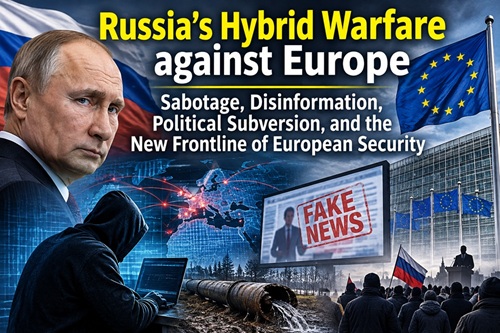 Russia's confrontation with Europe is no longer confined to the conventional military battlefield in Ukraine. It has expanded into a much less clearly defined domain in which sabotage, cyberattacks, disinformation, political interference, economic pressure, espionage, and psychological intimidation are deployed as instruments of state power. This is commonly described as hybrid warfare. The significance of this development is that Europe is already experiencing a form of confrontation that falls short of conventional war but cannot reasonably be described as peace. Its infrastructure, political institutions, information systems, and social cohesion have become potential targets. The challenge for European governments is not simply to defend their territories against military invasion, but to protect the institutional and psychological foundations of democratic societies. Russia's strategy is particularly unsettling because it exploits precisely those freedoms and vulnerabilities that distinguish open societies from authoritarian ones. Freedom of expression, political pluralism, independent media, international economic connections, and democratic disagreement are all potential channels through which hostile influence can operate. Yet a critical examination must avoid two opposite mistakes: dismissing Russian hybrid operations as Western paranoia, and interpreting every European disruption or political disagreement as evidence of a Kremlin-directed conspiracy. The first underestimates a genuine security threat; the second risks turning legitimate political criticism into an object of suspicion. 1. The anatomy of hybrid warfareThere is no universally accepted definition of hybrid warfare. The term generally refers to the coordinated use of military and non-military instruments to weaken an adversary without necessarily triggering a conventional military response. The distinguishing feature is not any particular weapon or technique, but the combination of different methods and the deliberate exploitation of uncertainty about who is responsible. In the Russian case, several instruments deserve particular attention. Sabotage and attacks on critical infrastructure. European countries have experienced suspicious damage to undersea communication cables, energy infrastructure, railway systems, military installations, and logistics networks. The Baltic Sea has become a particularly sensitive area because of its strategic importance for European communications and energy security. Some incidents have been attributed to Russian-linked operations, although individual cases differ considerably in the strength of the available evidence. The International Institute for Strategic Studies has documented the growing significance of infrastructure sabotage in Russia's confrontation with Europe. Cyberwarfare and espionage. Russian intelligence-linked groups have repeatedly targeted government institutions, military organizations, businesses, and critical infrastructure. Cyberattacks can disrupt services, steal confidential information, compromise communications, and create uncertainty about the security of essential systems. They also offer an attractive instrument of coercion because responsibility can be difficult to establish and the perpetrators can operate across international borders. Disinformation and political interference. Russia has invested heavily in information operations designed to influence public perceptions of the war in Ukraine, undermine confidence in European institutions, and deepen existing political divisions. These campaigns can involve state-controlled media, fabricated news websites, manipulated social media accounts, and networks of apparently independent commentators. The objective is not necessarily to persuade Europeans to become supporters of Vladimir Putin. It may be sufficient to make them distrust their own governments, question the reliability of established media, and regard support for Ukraine as an unnecessary or dangerous commitment. A population divided over the legitimacy of its foreign policy is less capable of sustaining a coherent response to external aggression. Proxy operations and disposable agents. One particularly disturbing development is the recruitment of individuals through social media and criminal networks to perform acts of vandalism, arson, surveillance, or sabotage. Some recruits may have little understanding of the larger geopolitical purpose of their assignments. Others may be motivated primarily by money. This arrangement provides Russian intelligence with a degree of operational distance. The person carrying out an attack may be a criminal or an otherwise unremarkable individual rather than a trained intelligence officer. Investigators then face the difficult task of establishing the connection between the immediate perpetrators and the state actors who may have commissioned the operation. Research by the International Centre for Counter-Terrorism and GLOBSEC identified 151 known cases of sabotage, arson, and related operations linked to Russia between February 2022 and February 2026. The figure illustrates the scale of the problem, although the cases differ in their evidentiary status and severity. Political and economic coercion. Russia has also attempted to exploit European vulnerabilities through energy dependence, economic pressure, migration-related tensions, and threats of military escalation. The weaponisation of migration along the borders of Finland and Poland, involving Belarus as a Russian ally, illustrates how humanitarian and border-management problems can be incorporated into a wider strategy of political pressure. These instruments are not independent. Their effectiveness increases when they reinforce one another. A cyberattack can be accompanied by disinformation about government incompetence. Sabotage can be followed by conflicting explanations that undermine public confidence. Military intimidation can be combined with political messaging designed to discourage European governments from supporting Ukraine. The resulting effect is cumulative: a persistent atmosphere of insecurity, uncertainty, and distrust. 2. Why Russia pursues hybrid warfareThe obvious question is why Russia would invest in such operations rather than concentrate exclusively on conventional military power. One answer is that hybrid warfare offers a relatively inexpensive way of imposing costs on a much wealthier and technologically advanced adversary. Russia cannot compete with NATO in every conventional military dimension. The combined economic and technological resources of the alliance are vastly greater. But military superiority does not automatically translate into political effectiveness. An adversary does not need to defeat NATO militarily if it can weaken the political cohesion that makes NATO effective. This is particularly relevant in relation to Ukraine. European military and financial assistance has been essential to Ukraine's ability to resist the Russian invasion. Moscow therefore has an incentive to undermine the political foundations of that assistance. If European voters become increasingly convinced that supporting Ukraine is too expensive, too dangerous, or ultimately futile, governments may gradually reduce their commitments. Hybrid warfare is thus partly an extension of the war in Ukraine. It seeks to influence the political environment in which that war is being fought. There is also a broader strategic objective. The Kremlin has repeatedly portrayed the European Union and NATO as instruments of Western domination, while presenting Russia as the defender of national sovereignty and a supposedly multipolar international order. This narrative serves several purposes. It legitimizes Russian hostility towards Western institutions, appeals to existing anti-American and anti-European sentiments, and provides ideological justification for Russian interference in the affairs of other countries. Yet there is an obvious contradiction here. A government that insists on the absolute sovereignty of Russia is simultaneously accused of violating the sovereignty of its neighbours through military aggression, covert operations, political interference, and intimidation. The contradiction is not accidental. Sovereignty, in this political worldview, appears to mean freedom from external interference for Russia, but not necessarily for countries that Moscow regards as belonging to its historical sphere of influence. 3. Europe's vulnerabilities: the open society problemRussia's hybrid strategy works partly because European democracies are open societies. Their political systems depend on freedom of expression, independent journalism, public debate, and the peaceful competition of political ideas. These are strengths, but they also create opportunities for hostile actors. An authoritarian state can restrict information, suppress dissent, and mobilize society through centralized propaganda. A democracy cannot legitimately respond to foreign disinformation by imposing comprehensive state control over public communication without undermining its own foundations. This creates an asymmetry. Russian propaganda can operate through tightly controlled state media and opaque networks, while European governments must respect constitutional protections, independent journalism, and political pluralism. The problem becomes particularly acute when disinformation attaches itself to genuine grievances. Economic insecurity, immigration controversies, distrust of political elites, dissatisfaction with the European Union, and fears of military escalation are not Russian inventions. They are real subjects of democratic debate. Moscow's opportunity lies in exploiting these disagreements, amplifying extreme positions, and encouraging the belief that democratic institutions are fundamentally corrupt or incapable of protecting their populations. It is important to distinguish between the existence of a political opinion and its possible manipulation by a foreign power. Opposition to European military assistance for Ukraine, for example, is not in itself evidence of Russian influence. Nor is criticism of NATO, the European Union, or American foreign policy. Democratic disagreement must remain legitimate, even when it concerns questions of national security. The danger arises when covert financing, fabricated information, concealed coordination, or foreign-directed political operations distort the conditions under which public debate takes place. Europe must therefore defend its information environment without turning political dissent into a security offence. 4. The Dutch and wider European dimensionThe Netherlands is particularly exposed to several aspects of this confrontation. It is a NATO founding member, a major European logistics and transport hub, and an important participant in the international support for Ukraine. The Port of Rotterdam, Dutch energy infrastructure, digital networks, and international communications systems all have strategic significance. The Netherlands is also an important centre for international institutions and diplomatic activity. Its geographical position and economic connections make the country relevant to both conventional military planning and less visible forms of intelligence gathering. The wider European picture is equally concerning. Poland, Germany, France, the Baltic states, Finland, and the United Kingdom have all faced various forms of suspected Russian-linked hostile activity. These include sabotage, espionage, cyber operations, airspace violations, and political interference. An investigation coordinated by the European Broadcasting Union in 2026 documented hundreds of reported incidents across 17 European countries during a period of just over six months. Its methodology distinguished between different degrees of attribution rather than treating every incident as conclusively Russian-directed. spotlight.ebu.ch+1 This geographical distribution is significant. Russia does not need to attack every European country equally. It can concentrate pressure on states that provide military assistance to Ukraine, countries near Russian territory, and strategically important infrastructure. At the same time, incidents in Western European countries can serve as demonstrations that geographical distance offers no complete protection. The Netherlands should consequently regard hybrid warfare not as a distant Eastern European problem but as a European security challenge with direct national implications. 5. The danger of escalation and miscalculationOne of the most troubling characteristics of hybrid warfare is that it deliberately occupies the space between peace and war. A conventional military attack is relatively easy to recognize. An explosion at a railway installation, damage to an undersea cable, a cyberattack on a government department, or the appearance of unidentified drones near sensitive infrastructure is much more difficult to interpret. Was it an accident? An act of ordinary criminality? An independent provocation? Or an operation commissioned by a foreign intelligence service? This ambiguity is strategically useful to the perpetrator. It complicates the victim's response and creates uncertainty about how far retaliation should go. The danger is that such operations can gradually normalize hostile behaviour. If every individual incident is treated as too minor to justify a serious response, the cumulative campaign may become increasingly damaging. But the opposite danger is equally real. If European governments automatically attribute every suspicious incident to Moscow, they risk making mistakes that could provoke unnecessary escalation. NATO's Article 5 collective-defence commitment is particularly relevant here. The alliance has recognized that cyberattacks and other hybrid operations can potentially reach the threshold of an armed attack. However, there is no automatic rule that every hybrid incident triggers collective military action. This ambiguity is partly intentional. It preserves political flexibility, but it also creates uncertainty about the credibility of deterrence. Russia may therefore be testing not only European infrastructure but also European political resolve. How much disruption will European governments tolerate? At what point will they retaliate? Can the alliance agree on a common response when the evidence is incomplete? These are not merely technical questions. They concern the credibility of European security arrangements. 6. The propaganda dimension: Russia's narrative and Europe's responseHybrid warfare is also a struggle over the interpretation of reality. The Kremlin presents Russia as a country surrounded by hostile Western powers, forced to defend its legitimate security interests against NATO expansion and American interference. In this narrative, the invasion of Ukraine becomes a defensive response to Western provocation, while European support for Ukraine is portrayed as an aggressive continuation of American geopolitical ambitions. This interpretation is repeatedly reinforced through Russian state media and sympathetic political networks abroad. There is, of course, a legitimate historical and geopolitical discussion to be had about NATO enlargement, American foreign policy, European strategic dependence, and the security dilemmas created by competing military alliances. But acknowledging that discussion does not require accepting the Kremlin's conclusions. A distinction must be maintained between explaining Russian strategic perceptions and legitimizing Russian actions. The fact that Russian leaders regard NATO as a threat does not establish that invading Ukraine was necessary, legally justified, or strategically inevitable. Equally, European governments should not use the existence of Russian propaganda as an excuse to avoid examining their own mistakes. Western political communication is not always honest or consistent. Governments have sometimes exaggerated threats, simplified complex geopolitical situations, or presented controversial policies as morally self-evident. The history of Western military interventions provides ample reason for independent scrutiny. If European leaders expect citizens to distinguish between Russian disinformation and reliable information, they must themselves maintain high standards of transparency. Otherwise, the fight against disinformation risks becoming a competition between competing official narratives rather than a defence of public reasoning. This is especially important in the context of Ukraine. European governments should explain not only why they support Ukraine, but also the costs, risks, limitations, and possible consequences of their policies. A democracy cannot sustain a long-term security strategy on the assumption that citizens will simply accept official explanations. 7. How should Europe respond?An effective European response requires more than increased military expenditure and occasional diplomatic protests. It requires a comprehensive strategy combining deterrence, intelligence cooperation, infrastructure protection, political transparency, and democratic resilience. First, European countries must improve the physical security of critical infrastructure. Undersea cables, energy networks, ports, railway systems, telecommunications, and data centres require better monitoring, redundancy, and emergency repair capabilities. Second, intelligence cooperation must become more effective. Russian operations frequently exploit the fact that European security agencies operate within national jurisdictions. Information about suspicious activities should be shared more rapidly, while investigators need the resources to trace the financial and organizational networks behind proxy operations. Third, governments must develop credible consequences for state-sponsored sabotage. These could include coordinated sanctions, diplomatic expulsions, restrictions on intelligence operations, financial measures against intermediary networks, and other proportionate responses. Deterrence requires more than announcing that hostile behaviour is unacceptable. Potential perpetrators must have reason to believe that such behaviour will carry costs. Fourth, Europe must strengthen its capacity to identify and expose foreign information manipulation. Independent fact-checking, investigative journalism, media literacy, and transparent political financing are more sustainable defences than centralized government control over public discourse. Fifth, European governments must protect democratic institutions against covert interference without criminalizing legitimate opposition. This requires clear legal definitions, independent oversight, judicial review, and public accountability. Finally, European security policy must become less dependent on the assumption that the United States will always provide the ultimate guarantee of European defence. NATO remains indispensable, but Europe needs greater independent capabilities in intelligence, surveillance, cyber defence, logistics, ammunition production, and infrastructure protection. The European Union's March 2026 framework for countering hybrid threats recognizes the need for a coordinated response across these different domains. The challenge is turning institutional commitments into operational capabilities. 8. The paradox of defending democracyThere is a deeper political problem here that deserves attention. Hybrid warfare attacks not simply territory or infrastructure but the social conditions that make democratic government possible. It seeks to weaken trust, encourage cynicism, and convince citizens that their institutions cannot be relied upon. This strategy can succeed without producing a single decisive military victory. But Europe's response could inadvertently reproduce some of the tendencies it seeks to resist. In the name of national security, governments may be tempted to expand surveillance, restrict information, suppress inconvenient opinions, and classify legitimate political opposition as a security threat. Such measures might provide short-term advantages to security agencies, but they could damage the democratic culture that Europe is supposed to defend. The central paradox is that democracies must become more resilient against authoritarian interference without becoming more authoritarian themselves. This requires a distinction between protecting democracy and protecting governments from criticism. These are not the same thing. Governments come and go. Their policies must remain open to criticism, including criticism of NATO, Ukraine policy, sanctions, military expenditure, and relations with Russia. A healthy democracy does not require citizens to agree with its foreign policy. It requires that political decisions emerge from an open and reasonably well-informed public debate, free from covert manipulation and intimidation. That is a much more demanding objective than simply countering Russian propaganda. 9. Beyond the Cold War mentalityThere is also a risk that Europe's confrontation with Russia will revive an excessively simplified Cold War worldview. Russia is not a monolithic entity, and Russian society cannot be equated with the policies of the Kremlin. The distinction between the Russian state, its security apparatus, its political leadership, and its population remains important. Furthermore, hybrid warfare is not an exclusively Russian invention. Western governments have also employed covert influence operations, cyber capabilities, propaganda, and political interference in international affairs. Other authoritarian states, particularly China and Iran, have developed their own forms of hybrid pressure. Recognizing these broader realities does not diminish the seriousness of Russia's activities. It places them within a more general transformation of international conflict. The contemporary geopolitical environment is characterized by competition in which economic, technological, informational, political, and military instruments increasingly overlap. The boundaries between domestic and international security are becoming less clear. A social media campaign, a cyberattack, a suspicious financial transaction, and a physical act of sabotage may all become elements of a single geopolitical strategy. This is why the traditional distinction between war and peace is becoming increasingly inadequate. But the answer should not be to declare everything a form of war. Such an approach would make the concept meaningless and encourage permanent emergency politics. Europe needs a more discriminating vocabulary and a more sophisticated understanding of the different levels of hostile activity. Conclusion: A war of attrition against European confidenceRussia's hybrid campaign against Europe represents a serious challenge to the security of democratic societies. Its effectiveness lies partly in its relative cheapness, its operational flexibility, and its ability to exploit the openness of European political systems. The objective is not necessarily to conquer European territory. It is to weaken the political cohesion, institutional confidence, and strategic determination that enable European countries to act collectively. In that sense, hybrid warfare is a war of attrition against European confidence. The invasion of Ukraine remains its most visible military expression, but the confrontation extends far beyond the Ukrainian battlefield. Sabotage, cyberattacks, espionage, disinformation, and political subversion form part of a wider attempt to reshape Europe's strategic environment. Yet Europe should resist the temptation to respond with indiscriminate suspicion or an increasingly militarized political culture. Not every infrastructure accident is sabotage, not every populist movement is Kremlin-directed, and not every critic of Western policy is a Russian sympathizer. The distinction between genuine political disagreement and covert foreign interference must remain clear. Ultimately, Europe's strongest defence is not simply a larger military establishment or a more sophisticated intelligence apparatus. It is a combination of credible deterrence, protected infrastructure, political transparency, independent journalism, and public confidence in democratic institutions. There is an irony in the situation. Russia's leadership frequently portrays Western liberal democracy as weak, decadent, divided, and incapable of defending itself. Hybrid warfare attempts to turn these accusations into a self-fulfilling prophecy. Europe's task is to demonstrate that openness need not mean vulnerability, that pluralism need not mean paralysis, and that democratic disagreement need not lead to political disintegration. The real test of European resilience is not whether it can eliminate every hostile influence, but whether it can resist those influences without sacrificing the democratic principles that make Europe worth defending.
Comment Form is loading comments...
|