|
TRANSLATE THIS ARTICLE
Integral World: Exploring Theories of Everything
An independent forum for a critical discussion of the integral philosophy of Ken Wilber
  Frank Visser, graduated as a psychologist of culture and religion, founded IntegralWorld in 1997. He worked as production manager for various publishing houses and as service manager for various internet companies and lives in Amsterdam. Books: Ken Wilber: Thought as Passion (SUNY, 2003), and The Corona Conspiracy: Combatting Disinformation about the Coronavirus (Kindle, 2020). Frank Visser, graduated as a psychologist of culture and religion, founded IntegralWorld in 1997. He worked as production manager for various publishing houses and as service manager for various internet companies and lives in Amsterdam. Books: Ken Wilber: Thought as Passion (SUNY, 2003), and The Corona Conspiracy: Combatting Disinformation about the Coronavirus (Kindle, 2020).
Check out my other conversations with ChatGPT
Deep Dive Wilber Books: The Four Faces of Truth Integral Semiotics Revolutionary Social Transformation Integral Politics The Many Ways We Touch An Integral Age at the Leading Edge The Deconstruction of the World Trade Center Who Ate Captain Cook? Toward a Comprehensive Theory of Subtle Energies Ken Wilber's Subtle EnergiesAn Integral Theory in Search of a ScienceFrank Visser / ChatGPT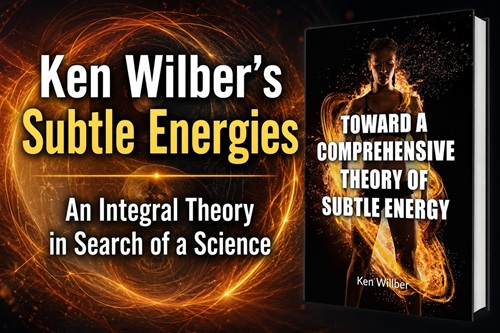 Ken Wilber's “Toward a Comprehensive Theory of Subtle Energies” is one of the more ambitious documents in his integral corpus. It attempts to do something that has long been central to Wilber's project: reconcile the contemplative traditions of the premodern world with modern science and postmodern cultural criticism, while preserving a substantial spiritual ontology. In this case the subject is especially difficult. Wilber is trying to construct a theoretical bridge between gross physical energy, subtle energies, consciousness, the chakra systems of Indian traditions, reincarnation, quantum physics, and the AQAL framework. The result is intellectually imaginative but ultimately unstable. The booklet is strongest when Wilber is doing conceptual housekeeping—distinguishing consciousness from its bodily correlates, warning against simplistic “quantum mysticism,” and insisting that premodern spiritual experiences should not automatically be identified with the metaphysical interpretations traditionally attached to them. It is weakest when, after criticizing metaphysics, he quietly reintroduces an elaborate metaphysical ontology of etheric, astral, psychic and causal energies, and then labels these hypothetical entities “scientific” or potentially measurable. The central problem is therefore not that Wilber believes in subtle energies. It is that he repeatedly moves from a useful phenomenological distinction to an ontological assertion without providing the empirical bridge that would justify the move. The booklet itself is explicitly presented as an excerpt from an early draft of the second volume of Wilber's proposed Kosmos trilogy, tentatively titled Kosmic Karma. Wilber says that it is intended to offer a “coherent and comprehensive theory” of subtle energies, beginning with the Great Chain of Being, proceeding through modernity and postmodernity, and ending with an AQAL reinterpretation of subtle-energy traditions. Its structure reflects this ambition: the first part moves from premodern metaphysics to postmodernism; the second constructs the theory of subtle energies; and the final part applies the theory to taxonomy, reincarnation, and the chakras. The central maneuver: naturalizing the Great ChainWilber begins with the traditional Great Chain or Great Nest of Being: matter, body, mind, soul and spirit. He interprets this not merely as a hierarchy but as a holarchy, in which each higher level transcends and includes its predecessors. Evolution consequently becomes an unfolding of dimensions that were already implicit in Spirit through involution. Matter is therefore not ultimately the source of life and consciousness; it is the lowest expression of a reality whose higher dimensions have been folded into it in advance. This is already the crucial metaphysical commitment. Wilber's subsequent argument depends upon it. Evolution, on this account, does not simply generate genuinely novel properties through natural processes. Rather, evolution gradually reveals dimensions that were present in potential from the beginning. Wilber explicitly describes matter as having been produced by successive “sedimentation” of Spirit, with life, mind and higher consciousness subsequently “remembering” what had been lost during involution. Yet Wilber is sufficiently aware of the difficulties of traditional metaphysics to propose a substantial revision. The Great Chain, he argues, was an interpretation of spiritual experience rather than an infallible ontological map. Modern science has revealed facts unavailable to ancient contemplatives, while postmodernism has shown how deeply our interpretations are conditioned by language, culture and social structures. This is one of the booklet's genuinely valuable insights. Wilber correctly recognizes that there is a distinction between an experience and an interpretation of that experience. A contemplative may have a profound experience of unity, emptiness, luminosity or transcendence without thereby acquiring privileged knowledge of neurophysiology, cosmology or ontology. Wilber himself makes this distinction quite forcefully. Unfortunately, he does not consistently apply his own methodological caution to the subtle-energy claims that follow. From metaphysics to “intra-physics”Wilber's first major revision is to reject the traditional idea that matter constitutes the bottom of reality while consciousness occupies progressively higher metaphysical realms. Instead, matter becomes the exterior of every level. Consciousness is the interior, while matter-energy constitutes the exterior correlate. This is the AQAL move: what appears in the Upper-Left quadrant as interior consciousness has a corresponding Upper-Right exterior form. The evolution of physical complexity is therefore correlated with the emergence of increasingly complex forms of consciousness. Atoms have “prehension,” neuronal organisms have sensations, more complex nervous systems have perception and emotion, and human brains support sophisticated cognitive capacities. As a philosophical framework this is attractive. It avoids a crude Cartesian dualism and emphasizes the fact that conscious organisms are simultaneously biological systems and experiencing subjects. It also permits Wilber to reinterpret traditional spiritual phenomena without automatically placing them in a supernatural realm. Premodern “metaphysical” realities can become, in his terminology, “intra-physical”: not above nature but interior to it. But the argument contains a subtle equivocation. That consciousness has a physical correlate does not establish that every claimed level of consciousness possesses a corresponding new form of energy. The correlation between neural complexity and behavioral or cognitive complexity is an empirical research program. The assertion that increasingly complex organisms generate increasingly subtle etheric, astral and psychic energy fields is an entirely different claim. Wilber treats these two claims as if they naturally lead into each other. The crucial “connecting hypothesis”The conceptual heart of the booklet is therefore hypothesis #3: increasing complexity of gross form is correlated with increasingly subtle energies. Wilber proposes a threefold progression: greater complexity of physical form, greater consciousness, and increasingly subtle corresponding energy patterns. This is the point at which the argument changes character. The first relationship—complexity and biological organization—is part of ordinary evolutionary science. The second—complexity and consciousness—is a legitimate but extremely difficult scientific and philosophical question. The third is an additional hypothesis about the existence of new forms of energy. Wilber himself describes the subtle-energy spectrum as running from gross physical energy through etheric, astral, psychic and causal energy. But at the outset he says, remarkably, “Without, at this point, arguing the details, let's simply accept that as a type of subtle-energy spectrum that might exist.” That sentence exposes the fundamental methodological problem. A theory cannot become empirical merely by assigning hypothetical entities a place in a multidimensional diagram. Before a spectrum of energies can be integrated into physics, one needs operational definitions, measurable quantities, reproducible effects, specified mechanisms, predictions and independent confirmation. Wilber instead begins with traditional categories and asks how they might be fitted into AQAL. The procedure is largely abductive and taxonomic rather than empirical. The theory is designed to accommodate the phenomena rather than to expose itself to serious risk of falsification. The problem becomes especially clear in his treatment of “etheric” energy. Wilber proposes that when life emerges, an etheric or L-field appears; when increasingly sophisticated nervous systems evolve, astral energy appears; and with the emergence of the human brain, psychic energy appears. This is presented as a “natural history” of subtle energies. But it is not a natural history in the scientific sense. No evolutionary evidence is offered showing that such fields emerged at these historical transitions. The sequence is inferred from the traditional hierarchy itself. The evolutionary history of organisms is known independently; the proposed energy hierarchy is then mapped onto it. In effect, Wilber takes the evolutionary tree and decorates its branches with traditional metaphysical entities. The language of science without the methodology of scienceThis is perhaps the booklet's greatest weakness. Wilber repeatedly uses scientific terminology—energy, fields, frequency, mass-energy, wave/particle events, quantum potential, signatures, measurable fields—while retaining concepts whose definitions remain fundamentally non-scientific. At one point he proposes a taxonomy in which gross energy includes gravitational, electromagnetic, strong and weak nuclear forces; subtle energy includes etheric, astral and psychic genera; and causal energy includes a C-field. Even developmental stages such as “red,” “blue,” “orange,” “green,” “yellow” and “turquoise” are assigned hypothetical corresponding energy signatures. The taxonomy is ingenious. It is also almost entirely speculative. Wilber admits that much of the classification is conventional and semantic and that the precise number of levels is arbitrary. But he then argues that the various levels of consciousness must have corresponding levels of matter-energy because they are the interiors and exteriors of the same event. Here AQAL functions less as an empirical theory than as a consistency-generating machine. Once one accepts the axiom that every interior has a corresponding exterior, it becomes possible to infer that every developmental stage must have a corresponding energetic signature. But this is not an empirical discovery. It is a consequence of the framework's architecture. A genuinely scientific version of Wilber's proposal would have to specify what, for example, a “green energy signature” is, how it differs from an “orange energy signature,” which instruments can detect it, under what conditions, what statistical effect should be observed, and what result would count as evidence against the hypothesis. The booklet does not get close to this level of specificity. The Burr problemWilber's discussion of Harold Saxon Burr is revealing. Burr's research on electrical fields in organisms is used to illustrate the possibility of experimentally detected energy fields, after which Wilber introduces L-fields and T-fields and interprets them as part of his holarchical energetic hierarchy. But the existence of ordinary bioelectrical fields does not establish the existence of etheric or astral fields. Living organisms necessarily generate measurable electrical and electromagnetic activity because of ionic currents, membrane potentials, nervous activity and other well-understood physiological processes. Moving from these established phenomena to a hierarchy of subtle energies requires additional evidence. Wilber's formulation tends to blur this distinction. He says that subtle fields can be physically detected by instruments and refers to Burr, Motoyama and Tiller, while also invoking psychic perception of energy shells. But these sources do not automatically form a cumulative scientific evidence base. A scientific theory requires independent replication and convergence of measurement, not simply the accumulation of authors who interpret unusual phenomena in similar ways. The quantum detourThe most interesting part of the booklet is paradoxically the section in which Wilber attacks quantum mysticism. Here he is substantially more disciplined. He strongly rejects the popular tendency to identify the quantum vacuum, the implicate order, quantum potential or subatomic physics with Spirit, Tao, Brahman or Buddhist emptiness. His argument is that quantum realities possess describable properties, dimensions and relations, whereas the absolute, by definition, is beyond finite characterization. This criticism is philosophically sound. Quantum mechanics does not become mystical simply because its formalism is counterintuitive. Nor does “vacuum” mean metaphysical Nothingness, and quantum indeterminacy does not imply consciousness. Wilber is right to object to the widespread habit of turning difficult physics into spiritual metaphor. His formulation of the “two truths” distinction is also potentially useful: scientific propositions concern finite, conventional realities, whereas claims about ultimate reality belong to a different philosophical or contemplative register. But then Wilber immediately commits the kind of category-crossing that he has just criticized. He declares that the quantum vacuum is not Spirit but “prana,” and that quantum material energy emerges from prana rather than directly from Spirit. Quantum physics, he suggests, is catching a glimpse of etheric-astral energy, with gross matter constituting the surface manifestation of deeper subtle fields. This is a remarkable reversal. The quantum vacuum cannot legitimately be identified with Spirit because it is a scientifically describable physical entity. Fair enough. But why does that make it prana? The answer is not supplied by physics. It comes from Wilber's metaphysical reconstruction of the Great Chain. The quantum vacuum is therefore prevented from becoming “Spirit” by one conceptual distinction and transformed into “prana” by another conceptual distinction. The first move is an epistemological caution; the second is an ontological assertion. Wilber has escaped quantum mysticism only to arrive at quantum vitalism. The reincarnation problemThe section on reincarnation reveals another structural weakness. Wilber acknowledges that his theory faces a serious difficulty: if subtle energies are correlated with complex physical forms, what happens to those energies when the physical body dies? He introduces hypothesis #4 to solve the problem: higher consciousness and subtler energies are not ontologically dependent upon gross matter, although they require sufficiently complex matter to manifest through it. This is clever as a piece of system-building. It preserves both embodiment and reincarnation. A subtle body can survive the dissolution of the gross body and subsequently become associated with another gross body. Wilber explicitly acknowledges that this introduces additional metaphysical baggage. But the solution illustrates rather than resolves the underlying problem. Hypothesis #4 is introduced because reincarnation requires it. That makes the theory increasingly flexible: whenever an empirical difficulty arises, another ontological level can be introduced to preserve the system. Such flexibility is attractive philosophically but dangerous scientifically. Wilber says that the subtle energies are “real, concrete, detectable, often measurable,” and therefore argues that reincarnation need not disappear into pure metaphysics. Yet the logical structure is reversed. The existence of measurable physiological or electromagnetic phenomena does not establish that a person's identity, consciousness or karmic trajectory survives bodily death. The crucial question is not whether subtle energy could theoretically survive death. It is whether there is evidence that something corresponding to personal consciousness actually does survive. Wilber largely brackets that question and concentrates on constructing a mechanism that would make reincarnation conceptually possible. Possibility is not evidence. Dreams, altered states and the subtle bodyWilber's use of dreams and meditation is similarly revealing. He argues that waking, dreaming and deep sleep correspond respectively to gross, subtle and causal body-energy systems. There is a legitimate phenomenological observation here: consciousness changes dramatically between waking, dreaming and deep sleep. Traditional contemplative systems developed sophisticated conceptual maps of these states. AQAL can certainly be used as a comparative framework for studying them. But the phenomenological fact that dreams feel different from waking perception does not entail the existence of a subtle body. Nor does dreamless sleep establish a causal body-energy. Wilber repeatedly turns distinctions in subjective experience into hypotheses about corresponding ontological structures. This is the recurring pattern of the booklet: phenomenology supplies the data, traditional metaphysics supplies the categories, and AQAL supplies the architecture that connects them. What is missing is the independent empirical evidence that would establish the ontological reality of the categories. The chakra system as “real test case”Wilber eventually declares that the “real test case” for any theory of subtle energies is whether it can adequately explain the chakras. His resulting synthesis is elaborate. Each of seven chakras is said to contain gross, subtle and causal energies; each is associated with waking, dreaming and sleeping; and each also represents a developmental stage. The chakras thus become intersections of states, stages and energy systems. As an exercise in theoretical integration, this is perhaps the most impressive part of the booklet. Wilber succeeds in making several previously separate schemes mutually compatible. The chakra system becomes a seven-level developmental model; each level operates across gross, subtle and causal dimensions; and the three major states of consciousness are integrated into every stage. But this is also where the distinction between interpretation and evidence becomes indispensable. Wilber has not demonstrated that chakras are energetic structures. He has constructed an AQAL interpretation of a traditional chakra system. These are not the same achievement. Indeed, the multiplicity of historical chakra systems should itself encourage caution. Wilber acknowledges that there are “dozens, perhaps hundreds” of variations on the chakra system. Such diversity can be interpreted as evidence of a common underlying experiential structure, but it can equally suggest that chakra maps are culturally elaborated interpretive systems rather than reports of a single objective energetic anatomy. Wilber chooses the first interpretation without adequately confronting the second. The deeper philosophical problem: ontology disguised as correlationThe central conceptual problem of the booklet can be stated simply: Wilber repeatedly confuses correlation with ontological identity or causal dependence. Suppose complex nervous systems correlate with increasingly sophisticated forms of consciousness. That is compatible with a great deal of contemporary science. Suppose subjective experiences have measurable neural correlates. That is also well established. But neither proposition implies the existence of a second hierarchy of etheric, astral, psychic and causal energies. Wilber's argument effectively runs: physical complexity → consciousness complexity → subtle-energy complexity. The first arrow is an empirical evolutionary claim. The second is partly empirical and partly philosophical. The third is a speculative metaphysical hypothesis. Yet the three are presented as parts of a single continuous theoretical sequence. This gives the theory an appearance of scientific continuity that it has not earned. Wilber is especially vulnerable here because he is trying to escape both material reductionism and supernatural dualism. He does not want consciousness reduced to matter, but neither does he want consciousness to float free of embodiment. His solution is to posit increasingly subtle forms of matter-energy that correspond to increasingly subtle forms of consciousness. This is philosophically understandable. But it risks creating an explanatory middle kingdom that solves the mind-body problem only by renaming it. Instead of asking how consciousness relates to the brain, we are invited to posit subtle body-energy systems. But then we must ask how subtle energy relates to the brain, how psychic energy relates to subtle energy, and how causal energy relates to psychic energy. The explanatory problem has not disappeared. It has been recursively relocated. The irony of “post-metaphysics”The booklet repeatedly describes itself as part of the transition from metaphysics to “integral post-metaphysics.” Wilber wants to retain the enduring insights of spiritual traditions while removing their obsolete metaphysical interpretations. This is an admirable project. But the subtle-energy theory demonstrates how difficult it is to accomplish. Wilber's “post-metaphysics” still contains Spirit, involution, causal dimensions, subtle bodies, astral energies, reincarnation, karmic transmission and nondual realization. The vocabulary has changed, and AQAL has been added, but the ontological commitments remain substantial. The theory therefore looks less like the abolition of metaphysics than its modernization. This is not necessarily a fatal objection. A philosopher is perfectly entitled to defend metaphysical propositions. The problem is rhetorical and methodological. If the theory is metaphysical, it should be evaluated as metaphysics. If it is empirical, it needs empirical evidence. If it is phenomenological, its claims should be restricted to experience. Wilber tries to occupy all three territories simultaneously. That produces conceptual slippage. What Wilber gets rightA critical assessment should not obscure the booklet's real strengths. First, Wilber is right to insist that subjective experience cannot simply be reduced to third-person descriptions. His distinction between first-person consciousness and third-person physical correlates is philosophically important. He explicitly warns against both gross materialism and what he calls “subtle materialism,” the reduction of consciousness to subtle energies. Second, his critique of crude quantum mysticism is one of the strongest sections of the work. The quantum vacuum is not Brahman merely because it is mysterious, and Wilber is correct that scientific models and mystical realization should not be conflated. Third, the distinction between states and stages is genuinely useful. Wilber's observation that temporary altered states do not necessarily constitute permanent developmental achievements provides a sophisticated framework for thinking about meditation and spiritual experience. His discussion of infants, dreams and developmental stages illustrates the distinction effectively. Fourth, AQAL provides a useful reminder that individual consciousness does not exist in isolation from biology, culture and social systems. Wilber's insistence that spiritual phenomena should be considered from multiple perspectives is methodologically healthier than attempting to explain everything from one privileged domain. Finally, the booklet is intellectually courageous. Wilber does not hide the difficult questions. He explicitly identifies reincarnation as a problem for his own theory and adds hypothesis #4 to address it. He also admits that the taxonomy is partly conventional and that much more research would be required. The trouble is that acknowledging the need for research is not the same as conducting it. A theory waiting for its evidenceThe most charitable interpretation of “Toward a Comprehensive Theory of Subtle Energies” is that Wilber is proposing a research program rather than presenting a completed scientific theory. The title itself says “Toward,” and Wilber repeatedly describes his taxonomies as suggestions. On this interpretation, the booklet asks a legitimate question: could the phenomenology of contemplative traditions eventually be correlated with a richer account of embodied states than conventional neuroscience currently provides? Certainly that question is worth investigating. But if this is the project, Wilber should have stopped much earlier in the ontological chain. A rigorous research program could investigate meditation, altered states, interoception, autonomic regulation, neural dynamics, subjective reports and physiological signatures. It could compare contemplative maps cross-culturally. It could investigate unusual experiences without prematurely deciding what they mean ontologically. Instead, Wilber builds the answer into the question. He begins with traditional subtle-energy categories and then seeks their AQAL location. That makes the framework extraordinarily accommodating—and therefore difficult to falsify. Conclusion: a brilliant map, but not yet a theory of nature“Toward a Comprehensive Theory of Subtle Energies” is best read not as a scientific theory of subtle energy but as a sophisticated piece of integral metaphysics presented in the language of a prospective scientific research program. Its most valuable contribution is negative: Wilber demonstrates why neither traditional metaphysics nor fashionable quantum mysticism provides an adequate account of the relationship between consciousness, matter and spirituality. His rejection of the equation “quantum = Spirit” is particularly important. His distinction between absolute and relative truth, however imperfectly formulated, also offers a useful warning against category mistakes. His positive theory is much less convincing. The proposed hierarchy from gross to etheric to astral to psychic to causal energy is not empirically demonstrated. The assignment of developmental stages to energetic signatures is a theoretical extrapolation. The appeal to Burr, Motoyama, Tiller and similar investigators does not establish the existence of the proposed hierarchy. Reincarnation is accommodated through an additional metaphysical hypothesis rather than demonstrated by it. And the chakra model is made internally coherent by AQAL without thereby becoming empirically validated. The deepest irony is that Wilber's own methodological principles point toward a more modest conclusion than the one he draws. If premodern spiritual maps are interpretations of authentic experiences rather than infallible ontologies, then the same caution should be applied to Wilber's own integral reinterpretation. AQAL can organize reports of subtle energies; it cannot by itself establish that the entities being organized actually exist. In that sense, the booklet is most successful when it is understood as a mapmaking exercise. Wilber constructs an extraordinarily elaborate map linking consciousness, developmental stages, bodily states, traditional subtle-energy systems, chakras and reincarnation. The map is ingenious and sometimes illuminating. But the existence of a beautifully organized map does not demonstrate the existence of the territory. And that is ultimately the problem with Wilber's “comprehensive theory.” It is comprehensive largely because AQAL has enough conceptual room to accommodate almost anything. What it lacks is the one thing that would transform the architecture from an integral metaphysical synthesis into a scientific theory: a body of independently reproducible evidence capable of showing that the proposed subtle energies are more than names for experiences, correlations, physiological processes, or traditional interpretations. Until that evidence exists, Wilber's subtle energies remain, at best, hypotheses—and at worst, metaphysical entities wearing scientific clothing.
Widget is loading comments...
|