|
TRANSLATE THIS ARTICLE
Integral World: Exploring Theories of Everything
An independent forum for a critical discussion of the integral philosophy of Ken Wilber
  Frank Visser, graduated as a psychologist of culture and religion, founded IntegralWorld in 1997. He worked as production manager for various publishing houses and as service manager for various internet companies and lives in Amsterdam. Books: Ken Wilber: Thought as Passion (SUNY, 2003), and The Corona Conspiracy: Combatting Disinformation about the Coronavirus (Kindle, 2020). Frank Visser, graduated as a psychologist of culture and religion, founded IntegralWorld in 1997. He worked as production manager for various publishing houses and as service manager for various internet companies and lives in Amsterdam. Books: Ken Wilber: Thought as Passion (SUNY, 2003), and The Corona Conspiracy: Combatting Disinformation about the Coronavirus (Kindle, 2020).
Check out my other conversations with ChatGPT
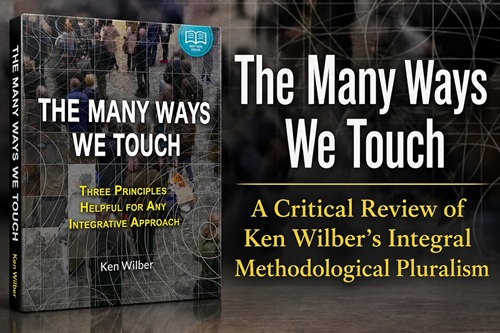
Deep Dive Wilber Books: The Four Faces of Truth Integral Semiotics Revolutionary Social Transformation Integral Politics The Many Ways We Touch An Integral Age at the Leading Edge The Deconstruction of the World Trade Center Who Ate Captain Cook? Toward a Comprehensive Theory of Subtle Energies The Many Ways We TouchA Critical Review of Ken Wilber's Integral Methodological PluralismFrank Visser / ChatGPT
Ken Wilber's The Many Ways We Touch is one of those short texts that attempts to carry an extraordinary amount of theoretical baggage in a relatively small suitcase. The booklet is only 69 pages long, but it revisits virtually the entire architecture of Wilber's mature Integral Theory: AQAL, developmental stages, states of consciousness, quadrants, enactment, “true but partial” truths, transcend-and-include, Integral Methodological Pluralism, and the claim that different knowledge systems can be integrated without reducing one to another. Its organizing slogan is deceptively simple: “Everybody is right.” Its deeper ambition is much more radical. Wilber wants to establish a meta-framework in which science, phenomenology, hermeneutics, systems theory, developmental psychology, meditation, spirituality and other forms of inquiry can all retain their legitimacy while being situated within a larger integral whole. The result is intellectually ambitious and, in places, genuinely illuminating. Wilber has identified a real problem: modern knowledge is divided among specialized disciplines whose methods often cannot easily communicate with one another. His attempt to distinguish a theory from the practice that generates its data is useful, as is his insistence that different questions may require different methods. His three principles—nonexclusion, unfoldment and enactment—form an elegant conceptual triad. Yet the same move that gives the booklet its philosophical power also creates its central weakness. Wilber repeatedly presents conclusions that are controversial philosophical interpretations as though they follow almost automatically from the existence of methodological pluralism. The transition from “different methods disclose different aspects of reality” to “different methods enact different worlds,” and from there to AQAL as the appropriate meta-framework, is much less secure than Wilber suggests. The booklet therefore works best not as a demonstration that Integral Theory has solved the problem of pluralism, but as an unusually clear demonstration of both the attraction and the danger of Wilber's approach: he is exceptionally good at constructing a framework capable of accommodating almost everything, but considerably less successful at demonstrating that his framework is actually true. From theories to practicesWilber begins with a distinction that deserves serious attention. An integral paradigm, he argues, should not merely be another theory about reality. It should consist of practices that generate or disclose phenomena. The scientific revolution provides his principal analogy. New experiments and experimental practices produce novel observations; theories subsequently arise to explain those observations. A paradigm, in this sense, is not simply a worldview but a practice or “injunction” that brings a particular domain of phenomena into view. This is one of the stronger aspects of the argument. Knowledge is indeed inseparable from method. What scientists can observe depends partly upon instruments, experimental procedures, operational definitions and established conceptual frameworks. Historians, anthropologists, psychologists and phenomenologists likewise have different objects of inquiry partly because they ask different questions and employ different procedures. Wilber formulates this as three “strands” of valid knowing: an injunction or practice (“if you want to know this, do this”), the resulting experience or data, and confirmation or rejection by an appropriate knowledge community. The formulation is useful because it reminds us that knowledge is not simply passively received. One has to do something to investigate a phenomenon. But there is already an important ambiguity here. Wilber slides rather easily between the claim that methods reveal different aspects of an independently existing reality and the stronger claim that methods bring those realities into existence. The first claim is almost uncontroversial. The second is an ontological thesis. The distinction matters enormously. A microscope does not merely give us a different description of a cell; it makes cellular structures observable to us. But this does not entail that the microscope literally creates the cell or its molecular structure. Wilber himself occasionally recognizes this distinction, saying that phenomena are “partially enacted.” Yet the booklet repeatedly moves toward the much stronger thesis that changing the knower or the method changes the ontology of the object itself. That is a philosophical position, not an empirical consequence of methodological pluralism. “Everybody is right”Wilber's most memorable formula is “Everybody is right.” He means this carefully—or at least he tries to. He does not claim that every proposition made by every person is true. Rather, legitimately practiced paradigms disclose genuine but partial domains of experience and knowledge. The sciences, phenomenology, hermeneutics, meditation and other disciplines therefore each possess some legitimate contribution. There is considerable wisdom in this formulation. Scientific reductionism can indeed become imperialistic when it assumes that everything meaningful must ultimately be translated into the vocabulary of physics. Conversely, spiritual or phenomenological traditions can become imperialistic when they assume that their experiential categories invalidate empirical inquiry. Wilber's injunction to “free a paradigm by limiting it” is particularly attractive: let each discipline do what it does well without allowing it to claim jurisdiction over domains for which its methods were never designed. The problem begins when Wilber turns this modest methodological pluralism into an ontological pluralism. Consider the booklet's comparison between physics and meditation. A physicist investigates quarks, leptons and other physical phenomena; a meditator investigates states of consciousness. Wilber argues that these need not be mutually exclusive because different practices enact different phenomenological domains. A person competent in both paradigms could, in principle, compare them. So far, so good. But Wilber then says that practitioners who master both domains “almost always” conclude that both are real and that the ground of nirvana is more encompassing than a quark. That conclusion does not follow from the premises. It is already a metaphysical interpretation. A physicist who meditates does not thereby acquire a privileged epistemic position concerning the ontological status of nirvana. Nor does meditative experience automatically establish that consciousness is metaphysically prior to matter. One can consistently accept meditation as a powerful first-person methodology while remaining agnostic about whether its deepest experiences reveal ultimate reality, altered brain states, a culturally shaped phenomenology, or some combination of these. Wilber's argument therefore risks committing precisely the kind of category error that his pluralism was designed to prevent: the phenomenological authority of one methodology is quietly converted into an ontological conclusion about reality as a whole. The problem with “true but partial”Wilber's second principle, unfoldment, is designed to solve the problem that “everybody is right” cannot mean that all views are equally adequate. His answer is the familiar Integral formula: every stage is true, but later stages are “more true” because they transcend and include earlier ones. His analogy with atoms, molecules, cells and organisms is rhetorically effective. Molecules do not make atoms false; they incorporate atoms into a larger organization. Likewise, he argues, later stages of consciousness incorporate the enduring truths of earlier stages. But the biological analogy conceals a crucial difference. Atoms, molecules, cells and organisms form a demonstrable compositional hierarchy. Developmental stages of consciousness do not automatically form an equivalent ontological hierarchy. The fact that organisms depend upon cells does not demonstrate that “green” depends upon “orange,” or that “turquoise” incorporates “green” in an analogous sense. Wilber tries to strengthen the argument by proposing a supposedly factual criterion for hierarchy: if destroying a lower level destroys the higher level, but destroying the higher level does not destroy the lower, then the lower is genuinely lower. This works reasonably well for biological levels of organization. It does not establish the same ordering for cultural worldviews or stages of consciousness. The crucial issue is that Wilber imports the structure of developmental biology into developmental psychology and then into cultural history. The metaphor of holarchy does much of the work that empirical evidence would have to perform. The Ptolemy problemWilber's treatment of scientific history illustrates both the strength and weakness of his argument. Ptolemaic astronomy, he says, was not simply false. From the terrestrial observational standpoint, its descriptions of planetary movements were phenomenologically accurate. Copernicus and Kepler subsequently provided more encompassing accounts, and Einstein transcended and included the earlier perspectives. There is a legitimate philosophical point here. Scientific theories are rarely discarded in their entirety. Older models often remain useful within restricted domains. Newtonian mechanics remains extraordinarily successful at ordinary scales despite being superseded as a fundamental theory by relativity and quantum mechanics. But “true but partial” should not be confused with “equally true in its own worldspace.” Ptolemy's epicycles were not rendered ontologically correct merely because they could reproduce observations. Scientific theories can be progressively improved precisely because empirical reality imposes constraints upon them. The history of science is therefore not simply a sequence in which every paradigm discloses its own valid world. It is also a history of error correction, empirical constraint and theory replacement. Wilber's formulation tends to soften this crucial distinction. His statement that “no paradigm is ever simply wrong” sounds conciliatory, but it becomes misleading if it implies that all established paradigms contain some ontological truth merely because intelligent people practiced them. He explicitly grounds nonexclusion partly in the assertion that “no human mind can produce 100% error.” That is true but trivial. A person can be wrong about a great many things while being right about others. From that banal observation one cannot infer that every intellectual tradition contains a distinctive metaphysical truth that deserves inclusion in an integral ontology. Enactment and the “many worlds” problemThe most philosophically ambitious part of the booklet concerns enactment. Wilber argues that subjects do not simply perceive a single pregiven world. Rather, different subjects, developmental levels and methodologies disclose different worlds. This is closely related to important developments in twentieth-century philosophy. Phenomenology, hermeneutics, pragmatism and constructivist traditions have all shown that perception and knowledge are mediated by embodied capacities, conceptual schemes, linguistic practices and cultural contexts. But Wilber pushes this insight much further. He proposes that an atom “subsists” before it “ex-ists”: the atom was physically present long before human beings could conceptualize it, but it only became an explicitly existing phenomenon within a sufficiently developed cognitive worldspace. The terminology is clever, but the distinction can obscure rather than clarify the issue. There is a perfectly intelligible difference between an entity existing independently of human awareness and becoming an object of human knowledge. We do not need to say that the atom literally came into existence only when human consciousness reached the appropriate developmental level. The problem becomes sharper when Wilber says that different levels of consciousness bring forth different ontologies. His discussion of physics imagines successive developmental levels producing increasingly sophisticated conceptions of atomic reality, culminating in string theory and multiverse speculation. Here Wilber's developmental vocabulary begins to distort the history of science. Scientific theories do not map neatly onto psychological stages. String theory is not a “turquoise” ontology simply because it is mathematically sophisticated. Nor is the historical progression from classical physics to quantum physics adequately described as the unfolding of human consciousness through AQAL levels. The danger is a subtle form of intellectual stageism: whatever comes later in the history of ideas can be interpreted as evidence that consciousness itself has evolved to a higher altitude. The curious case of Santa ClausPerhaps the most revealing example in the booklet is Wilber's claim that Santa Claus has a “Kosmic Address”: the mythic level, the Upper-Left quadrant, and the subtle or dream state. This is an ingenious illustration of his framework. It shows how AQAL can classify phenomena that would otherwise be dismissed as simply nonexistent. But classification is not validation. To give Santa Claus a location in an AQAL matrix does not establish that Santa Claus exists in the same sense that a dog, a mathematical object or a physical particle exists. The framework risks transforming ontological questions into taxonomic ones. Once something has been assigned a quadrant, level and state, it can acquire an aura of legitimacy merely by having received an “address.” This is one of the deeper problems with AQAL. Its classificatory power is impressive precisely because it can place almost anything somewhere. But a map that has a location for everything is not necessarily a map that tells us what actually exists. Integral Methodological Pluralism: the genuinely useful idea The most practically promising concept in the booklet is Integral Methodological Pluralism, or IMP. Wilber proposes that an integral approach should not simply accumulate all available information. It should recognize the legitimacy of multiple established methodologies and then develop meta-practices that allow them to interact. His example of “simultracking” is particularly interesting: researchers might combine collaborative inquiry with objective measures such as EEG recordings rather than forcing one method to eliminate the other. This is much more defensible than some of Wilber's metaphysical claims. Contemporary science already operates through methodological pluralism. Complex phenomena often require multiple levels of explanation. Climate science, neuroscience, evolutionary biology, medicine and social science routinely combine observational, experimental, computational, statistical and qualitative methods. The problem is that Wilber sometimes presents this ordinary interdisciplinary virtue as though AQAL were uniquely required to discover it. There is no obvious reason why one needs the entire AQAL architecture to recognize that brain activity, subjective experience, social context and institutional structures can all matter to a problem. Multidisciplinary and interdisciplinary research have been doing precisely this for decades. Wilber's contribution is to provide a philosophical vocabulary for such integration, not to establish the practice itself. This distinction is important. The value of AQAL may lie in its heuristic usefulness rather than in its status as a discovered structure of reality. The “Integral Operating System”Wilber subsequently recasts AQAL as an “Integral Operating System.” Like an operating system, it scans an intellectual problem to determine whether important dimensions have been omitted: the four quadrants, developmental waves, lines, states and types. As a practical checklist, this is sensible. Before making a sweeping claim about a complex human phenomenon, ask whether subjective experience, interpersonal relations, behavioral evidence and systemic conditions have all been considered. Ask whether developmental differences matter. Ask whether temporary states have been confused with stable traits. The analogy becomes problematic only when the operating system metaphor suggests that AQAL is a neutral architecture rather than a theoretical model with substantive assumptions built into it. An operating system is not neutral if its categories determine what counts as relevant information. AQAL itself privileges particular ontological distinctions: quadrants, levels, lines, states and types. It therefore cannot simply function as an impartial scanner of reality. The scanner has already been programmed. Wilber himself admits that AQAL is only a “pale and abstract map” and a third-person system of signifiers, not ultimate reality. This is an important qualification. But it raises the question he does not adequately answer: why should we believe that the particular categories programmed into this operating system are the most comprehensive ones available? Holonic conferencing and the Kosmic AddressThe final major application is “holonic conferencing,” built around the idea of the “Kosmic Address.” Each phenomenon is supposedly locatable according to quadrant, level, line, state and type. There is a useful idea here. Intellectual disagreements often become less confusing when we specify what kind of claim is being made, from what perspective, using what method and at what level of analysis. A physicist and a phenomenologist may indeed be answering different questions. But Wilber's “Kosmic Address” can become an elaborate system of relabelling. Instead of resolving an epistemological disagreement, AQAL can simply assign each position to a different quadrant or altitude. This makes conflict disappear conceptually without necessarily resolving it empirically. The distinction between “different perspectives” and “different realities” is therefore crucial. If two researchers describe the same climate system using different models, their descriptions may differ while their object remains one physical system. Wilber's stronger enactment thesis allows the object itself to multiply. The resulting pluralism is philosophically fascinating but empirically difficult to adjudicate. The problem of spiritual privilegeThe booklet becomes most vulnerable when it moves from methodological pluralism toward Wilber's own spiritual metaphysics. The final pages abandon much of the restrained language of methodological integration and return to the familiar vocabulary of Spirit, nirvana, the Original Face and nondual awareness. Wilber concludes that samsara and nirvana are ultimately the same, that the manifest world is the Divine, and that there are ultimately no separate beings because there is only “This.” This is beautiful writing, but it is not established by the preceding argument. Indeed, there is an unresolved tension in the booklet. Wilber repeatedly insists that one paradigm cannot prove or disprove another. Yet he himself uses contemplative realization to make claims about ultimate reality. He says that Spirit is the ultimate nondual Reality and that it can be found only in a nondual state of consciousness. If physics cannot invalidate meditation because it operates within another methodological domain, then meditation cannot simply establish metaphysical claims about the whole universe either. Wilber might answer that the relevant claims are disclosed through first-person enactment rather than third-person inference. That is a coherent philosophical position. But it does not make those claims universally compelling. A phenomenology of nondual consciousness can be taken seriously without accepting its traditional metaphysical interpretation. This is precisely where the booklet's methodological pluralism threatens to collapse into metaphysical integralism. Integralism as the exception to its own pluralismThere is a further structural problem. Wilber repeatedly emphasizes that no paradigm should exclude other paradigms. Yet AQAL itself is presented as the meta-framework capable of containing them all. He anticipates the obvious objection: isn't AQAL itself claiming superiority? His answer is that AQAL is “better” because it allows more theories to be right. Other integral meta-theories can compete with AQAL, but only within the same general Integral paradigm. This is clever, but it does not completely solve the problem. The framework effectively defines the criteria of successful integration and then demonstrates its superiority according to those criteria. The circularity is subtle: AQAL says that an adequate theory should be inclusive. AQAL is exceptionally inclusive. Therefore AQAL is exceptionally adequate. But why should inclusiveness be the primary criterion of adequacy? Sometimes exclusion is epistemically necessary. A good theory excludes irrelevant variables. A good scientific model simplifies. A good explanation identifies causal structure rather than accommodating every conceivable perspective. More is not necessarily better. Comprehensiveness can produce explanatory inflation. The critique of postmodernismWilber's discussion of postmodernism is among the booklet's most polemical passages. He argues that healthy pluralism eventually degenerates into deconstruction, political correctness, nihilism and narcissism. There is a legitimate criticism buried here. Radical relativism can undermine the possibility of criticism, and a pluralism incapable of making distinctions can become intellectually sterile. But Wilber caricatures a very diverse intellectual tradition by compressing postmodernism into a single developmental “green” worldview. The irony is striking. Wilber criticizes postmodernism for reducing intellectual diversity to a single privileged perspective while performing a similar reduction himself. Derrida, Foucault, Lyotard, Rorty, Butler and the many traditions loosely grouped under “postmodernism” do not constitute a single stage of consciousness with a single epistemology. AQAL's developmental taxonomy is therefore vulnerable to the same flattening it accuses its opponents of practicing. The calculus of uncomfortThe “calculus of uncomfort” is perhaps the booklet's most unusual contribution. Wilber recognizes that once we admit that some positions are better than others, ranking becomes unavoidable. The question then becomes how to make necessary judgments while minimizing suffering. This is a humane idea. It moves the discussion from abstract hierarchy toward consequences. Wilber compares competing accounts of human development and argues that an evolutionary/enfolding interpretation produces less suffering than a romanticized devolutionary interpretation that condemns modernity as diseased. Yet the “calculus” is never actually a calculus. There is no operational metric for calculating the “span x depth” of suffering, and no clear procedure for determining when one developmental interpretation genuinely produces less harm. The mathematical language lends an impression of precision to what remains a moral intuition. That does not make the intuition worthless. It means it should be called what it is: a normative heuristic. What remains valuableDespite these criticisms, The Many Ways We Touch should not be dismissed. Its best contribution is not its claim to have discovered the architecture of the Kosmos. It is the proposal that intellectual life benefits from disciplined methodological pluralism. Wilber is right that a phenomenologist should not be expected to answer every question using laboratory methods, just as a physicist should not be expected to settle questions of meaning through particle physics. He is right that subjective, intersubjective, behavioral and systemic dimensions can all matter. He is right that contemplative practices constitute genuine forms of experience that deserve serious psychological investigation. He is right that specialists often mistake the success of their own method for universal jurisdiction. His insistence that AQAL itself cannot replace actual practices is particularly important. Wilber explicitly says that the Integral Operating System is merely a map and that it can never substitute for the concrete practices that generate experience. That is a salutary warning, especially for Integral Theory itself. But the warning should be applied more rigorously than Wilber applies it. AQAL is itself a practice-independent theoretical construction to a considerable degree. Its categories do not become empirically established merely because they remind us to look at multiple dimensions. The framework can function as a useful heuristic without thereby becoming an ontology. Conclusion: a powerful framework with an unearned metaphysicsThe Many Ways We Touch presents one of Wilber's most attractive formulations of Integral Theory. It moves beyond the simplistic idea that an integral worldview is merely a bigger worldview and proposes instead an Integral Methodological Pluralism: many methods, many domains of experience, and a meta-practice for bringing them into conversation. The three principles of nonexclusion, unfoldment and enactment provide a memorable conceptual structure. But the argument is ultimately undermined by the very comprehensiveness that makes it attractive. Wilber begins by warning against paradigmatic imperialism. He ends by granting his own Integral framework an extraordinary degree of jurisdiction. He begins by saying that no paradigm should be allowed to speak beyond its competence. He then moves from developmental psychology, phenomenology and contemplative practice toward claims about ontology, evolution and Spirit. He begins by insisting that AQAL is merely a map. Yet the map repeatedly functions as though it were a discovery about the structure of reality itself. The central weakness, therefore, is not that Wilber is insufficiently pluralistic. It is that his pluralism is selectively asymmetrical. Other paradigms are “true but partial”; AQAL is the framework that determines how their partial truths fit together. Other disciplines are limited to their own worldspaces; Integral Theory acquires the privilege of surveying all worldspaces. Other paradigms must respect the limits of their methods; Wilber's meta-paradigm is permitted to draw ontological conclusions from the relations among those methods. That is the unresolved paradox at the heart of The Many Ways We Touch. Wilber has constructed an impressive intellectual diplomacy: everyone gets a seat at the table, every methodology is granted some territory, and no legitimate contribution is simply discarded. But the person who designed the table also decides where every guest sits, which guests occupy higher floors, and what the building as a whole ultimately means. As a philosophy of intellectual hospitality, this is often admirable. As a demonstration of the metaphysical truth of Integral Theory, it falls considerably short. The most defensible version of Wilber's thesis is therefore also the most modest one: reality is complex; human inquiry is methodologically plural; different perspectives can reveal different aspects of phenomena; and intellectual progress often requires learning how to combine perspectives without prematurely reducing one to another. That is already a valuable lesson. We do not need to accept the entire AQAL Kosmos to learn it.
Widget is loading comments...
|