|
TRANSLATE THIS ARTICLE
Integral World: Exploring Theories of Everything
An independent forum for a critical discussion of the integral philosophy of Ken Wilber
  Frank Visser, graduated as a psychologist of culture and religion, founded IntegralWorld in 1997. He worked as production manager for various publishing houses and as service manager for various internet companies and lives in Amsterdam. Books: Ken Wilber: Thought as Passion (SUNY, 2003), and The Corona Conspiracy: Combatting Disinformation about the Coronavirus (Kindle, 2020). Frank Visser, graduated as a psychologist of culture and religion, founded IntegralWorld in 1997. He worked as production manager for various publishing houses and as service manager for various internet companies and lives in Amsterdam. Books: Ken Wilber: Thought as Passion (SUNY, 2003), and The Corona Conspiracy: Combatting Disinformation about the Coronavirus (Kindle, 2020).
Check out my other conversations with ChatGPT
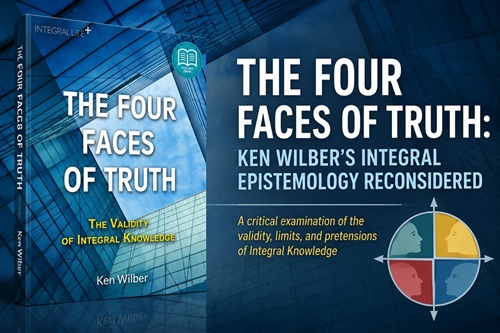
Deep Dive Wilber Books: The Four Faces of Truth Integral Semiotics Revolutionary Social Transformation Integral Politics The Many Ways We Touch An Integral Age at the Leading Edge The Deconstruction of the World Trade Center Who Ate Captain Cook? Toward a Comprehensive Theory of Subtle Energies The Four Faces of TruthKen Wilber's Integral Epistemology ReconsideredFrank Visser / ChatGPT
Ken Wilber's “The Four Faces of Truth,” originally published as part of The Eye of Spirit in 1997 and now re-issued by Integral Life (members-only) as a standalone excerpt, occupies an unusually important place in the development of Integral Theory. It is not merely an exposition of the famous four-quadrant model. It is an epistemological manifesto: an attempt to explain why modern knowledge becomes distorted whenever one legitimate mode of knowing claims jurisdiction over all the others. The central idea is attractive and, at its best, genuinely illuminating. Human phenomena can be approached from four irreducible perspectives: the interior of the individual, the exterior of the individual, the interior of the collective, and the exterior of the collective. These correspond respectively to subjective experience, observable behavior and physiology, shared culture and meaning, and social or systemic structures. Wilber then associates each domain with a distinctive validity claim: truthfulness, propositional truth, justness, and functional fit. This is an elegant intellectual architecture. But it is also where the difficulties begin. Wilber repeatedly moves from the defensible claim that different perspectives are useful to the much stronger claim that the four quadrants represent fundamentally distinct domains of reality, each possessing its own kind of truth. He then adds a further claim: that attempts to deny any quadrant necessarily generate a performative contradiction. Finally, the whole framework is embedded in a much more ambitious developmental and spiritual metaphysics, culminating in a spectrum of consciousness and the Great Chain of Being. The result is simultaneously one of Wilber's most useful conceptual contributions and one of his clearest examples of a recurring problem in his work: a modest methodological insight is transformed into an ontological system and then presented with considerably greater certainty than the argument warrants. 1. From two worlds to four quadrantsWilber begins with a familiar philosophical opposition: interior versus exterior, subjective versus objective, mind versus brain, idealism versus materialism. He argues that neither side is sufficient. The subjective world of intentions, thoughts, feelings and meanings cannot simply be identified with its physiological correlates; conversely, subjective experience cannot replace the empirical investigation of brains and behavior. The important move comes when Wilber adds a second distinction: individual versus collective. The result is his four-quadrant framework: • Upper Left: individual interior — intentions, feelings, consciousness, meaning. • Upper Right: individual exterior — behavior, brain, physiology. • Lower Left: collective interior — culture, shared meanings, values, worldviews. • Lower Right: collective exterior — institutions, social structures, technology and systems. Wilber illustrates the scheme with the apparently trivial example of thinking about going to the grocery store. The thought is experienced subjectively; it has neural correlates; it depends upon a cultural and linguistic background; and that culture is embedded within concrete social structures. Wilber concludes that the supposedly individual thought therefore possesses four intrinsic aspects: intentional, behavioral, cultural and social. This is a powerful corrective to simplistic reductionism. A thought is not adequately understood merely by recording neural activity. Nor is it adequately understood merely by interpreting what the person says. Nor can its cultural significance be separated entirely from the institutions and material conditions in which the person lives. But Wilber's formulation also contains a subtle logical slide. There is an important difference between saying that an event can be described from four perspectives and saying that the event therefore has four ontologically distinct aspects. The former is almost indisputable. The latter requires argument. Wilber largely assumes rather than demonstrates the transition. He says that the persistent existence of four major knowledge traditions is evidence that the four aspects themselves are “very real.” But the existence of different academic disciplines does not by itself demonstrate the existence of four fundamental ontological domains. Chemistry, biology and geology are distinct disciplines too; that does not mean that nature consists of three metaphysically separate kinds of stuff. The quadrants may therefore be better understood as a pluralistic methodological matrix than as a map of the furniture of reality. That distinction matters enormously. 2. The genuinely valuable idea: different questions require different methodsThe strongest part of “The Four Faces of Truth” is Wilber's insistence that different questions require different standards of evidence. For the Upper Right, Wilber calls the relevant validity claim propositional or correspondence truth. A statement is true when it corresponds to an observable state of affairs. “It is raining” is true if it is in fact raining. For the Upper Left, the relevant criterion is truthfulness: sincerity, authenticity and accurate access to one's own interior experience. Here Wilber emphasizes dialogue and interpretation rather than external observation. For the Lower Right, the relevant criterion is functional fit: whether elements function appropriately within an objective system. For the Lower Left, the criterion is justness or mutual recognition: whether subjects can inhabit a shared intersubjective world of meaning, morality and respect. This fourfold distinction is genuinely useful. A brain scan cannot tell us by itself what a person experiences. A person's introspective report cannot establish the concentration of dopamine in a synapse. A description of a social institution does not automatically tell us whether the institution is just. And a moral judgment cannot substitute for empirical evidence about how a social system actually operates. Wilber's basic warning is therefore sound: do not confuse different kinds of questions merely because they concern the same phenomenon. This is perhaps the most durable contribution of the essay. 3. But are these really four kinds of “truth”?Here the argument becomes considerably less secure. Wilber calls the four validity claims “types of truth.” Yet “truth,” “truthfulness,” “justness,” and “functional fit” are not obviously four varieties of the same epistemological category. Correspondence truth is a semantic or epistemic relation between a proposition and a state of affairs. Truthfulness is a property of a speaker or report. Justness is a normative property of relationships, institutions or social arrangements. Functional fit concerns systemic organization and causal or functional relations. These are not simply four versions of the same thing. They operate at different logical levels. Consider the distinction between truth and truthfulness. A person can sincerely believe something that is false. Conversely, someone can knowingly utter a true statement while lying about why they are saying it. Truthfulness therefore cannot simply be treated as another kind of truth equivalent to correspondence. The same problem is even more pronounced with justness. A society may sincerely agree on a norm that is unjust. Mutual recognition is undoubtedly important, but consensus does not by itself establish moral correctness. Wilber's language sometimes obscures these distinctions by putting all four under the single heading of “truth.” The framework would be stronger if it said: human inquiry involves different kinds of validity, evidence, interpretation and normative evaluation. That formulation would preserve almost everything useful while avoiding the unnecessary metaphysical burden. 4. The best epistemological move: fallibilismThe most interesting section of the essay is perhaps “The Validity of Integral Knowledge.” Wilber argues that each quadrant has its own evidence and that claims within each domain are therefore capable of being confirmed, rejected or revised. He explicitly invokes fallibilism. Knowledge develops because mistakes can be displaced by better evidence. This is an important qualification because it prevents the quadrant model from degenerating into “anything goes.” Wilber gives the example of interpreting Hamlet. An interpretation such as “Hamlet is about the joys of war” can be challenged by examining the play, gathering interpretive evidence and comparing one's interpretation with those of other competent readers. He identifies three components of valid inquiry: injunction, data and confirmation. This is a productive idea. Hermeneutical inquiry is not necessarily arbitrary simply because it is not experimental physics. Interpretations can be better or worse. They can be supported by textual evidence, contextual knowledge, comparison with alternative interpretations and critical discussion. But Wilber risks making the analogy between the quadrants too strong. Reading Hamlet is not literally an experiment in the same sense as measuring the acceleration of a falling body. The term “injunction” can be useful metaphorically — perform the relevant practice and observe what becomes available — but the epistemic structures are not identical. Nor does intersubjective agreement automatically guarantee truth. Scientific consensus can be wrong; interpretive communities can converge on bad interpretations; entire cultures can normalize false beliefs. Consensus is an important mechanism for error correction, but it is not itself a truth-producing machine. Wilber occasionally comes close to treating the methodological structures of the four domains as formally equivalent when they are only analogous. That is an important weakness. 5. The “I, We and It” formulation is elegant but reductiveWilber subsequently compresses the four quadrants into three domains: “I,” “we” and “it.” The Upper Left becomes “I,” the Lower Left becomes “we,” and both right-hand quadrants become “it.” This is rhetorically brilliant. It makes a complicated model memorable. It also connects the model with Plato's True, Good and Beautiful, Popper's three worlds, Habermas's validity claims, Kant's three Critiques and the Buddhist Three Jewels. But this is precisely where Wilber's tendency toward grand synthesis becomes problematic. The fact that several philosophical traditions contain threefold distinctions does not establish that they are “essentially” describing the same three domains. The similarities can be illuminating without proving structural identity. Wilber frequently employs what might be called retrospective convergence: he takes a distinction from his own system and then searches intellectual history for apparently corresponding distinctions. The result creates an impressive web of intellectual parallels, but the parallels sometimes function rhetorically rather than demonstratively. Kant's three Critiques, Habermas's validity claims, Popper's three worlds and the Buddhist Three Jewels emerged from very different intellectual projects. To say that they “correspond” can be heuristically interesting. To say that they reveal the same underlying structure requires considerably more argument than Wilber supplies. 6. “Flatland”: the critique of scientismWilber's attack on scientism is one of the most forceful parts of the essay. He distinguishes science from scientism. Science, in his account, legitimately investigates exteriors. Scientism goes further and claims that everything can ultimately be explained in “it-language.” Wilber calls the resulting reductionism “Flatland”: the reduction of subjective and intersubjective realities to objective processes. This distinction remains important. There is a difference between saying that consciousness has neural correlates and saying that consciousness is nothing but neural activity. There is a difference between studying social institutions as systems and claiming that moral meaning is nothing more than systemic functionality. Wilber is right to insist that explanatory reduction is not automatically ontological explanation. However, his characterization of modern science is frequently overstated. He presents “modern science,” “scientific materialism,” positivism, behaviorism, empiricism and objectivism as if they formed a relatively unified historical bloc bent upon colonizing the subjective and intersubjective worlds. That is a caricature. Modern science contains many traditions that explicitly study subjective experience, social meaning, language, interpretation, cognition, culture and values. Psychology, neuroscience, anthropology, sociology and cognitive science cannot simply be placed on one side of a materialist-versus-integral divide. More importantly, explaining a subjective phenomenon through neuroscience does not necessarily mean denying its phenomenology. A scientific account of pain as a neural process does not imply that the experience of pain is unreal. A functional account of language does not make meaning disappear. Wilber is strongest when he says that third-person description does not exhaust first-person experience. He becomes weaker when he portrays scientific explanation itself as inherently reductionistic. 7. The mind-brain argument is less decisive than Wilber thinksThe essay repeatedly emphasizes the difference between experiencing a thought and observing its neural correlate. This is obviously correct phenomenologically. When I think about groceries, I experience meaning; I do not experience dopamine concentrations. Wilber uses this to argue that the brain and the mind cannot be reduced to one another “without remainder.” But this establishes a difference in description, not necessarily a difference in ontology. A phenomenon can possess multiple descriptions without possessing multiple substances or ontological realms. Water can be described as a liquid, H2O, a solvent, a habitat, a source of hydration and a cultural symbol. These descriptions are not interchangeable. But their irreducibility at the level of vocabulary does not demonstrate that water consists of several ontologically independent realities. The same caution applies to mind and brain. Wilber's quadrant framework is therefore much more convincing as an argument for explanatory pluralism than as an argument against physicalism. The claim that first-person and third-person descriptions are indispensable is strong. The claim that this indispensability demonstrates irreducible ontological duality is much weaker. 8. The attack on constructivism contains a genuine point — and a straw manWilber then turns against what he calls extreme cultural constructivism. He argues that if all truth is culturally constructed, the claim that all truth is culturally constructed must itself either be culturally constructed or exempt itself from its own theory. This is a familiar and legitimate criticism of radical relativism. If someone claims, without qualification, “There are no truths independent of cultural construction,” it is reasonable to ask whether that statement itself is intended as culturally relative or universally valid. But Wilber too often targets the strongest and least defensible version of constructivism and then treats it as representative of postmodern thought. The actual intellectual landscape is much more nuanced. One can distinguish between claims that are culturally constituted and claims about physical reality. One can argue that categories such as race, gender, money, citizenship or political legitimacy have historically constructed dimensions without claiming that gravity is socially constructed. Indeed, Wilber himself acknowledges this complexity when he says that some cultural features are constructed and historically relative while other features of human embodiment are shared across cultures. That moderate position is far more defensible than his polemical presentation suggests. The irony is that Wilber's own four-quadrant model requires precisely this kind of nuanced interaction between construction and constraint. 9. His critique of systems theory is similarly too sweepingWilber identifies systems theory as the Lower Right's characteristic reductionism. Because systems theory describes relations among observable entities, he argues, it can become another form of “it-ism,” reducing the I and We to an interlocking network of Its. Again, the underlying warning is valuable. A systems description of a society does not automatically tell us whether its institutions are legitimate or how those institutions are experienced by their members. But Wilber's attack on systems theory is far too categorical. Systems theory need not claim that subjective experience is unreal. Nor does describing a social system necessarily imply that individuals are merely functional components within it. Wilber himself acknowledges that systems approaches can provide important knowledge of exteriors and functional relationships. The real issue is therefore not systems theory versus integral theory. It is whether a systems model is being used as one explanatory level or as an exhaustive theory of human reality. That distinction should have been central to Wilber's critique. 10. The performative-contradiction argument is overusedOne of the essay's recurring rhetorical devices is the claim that every reductionistic position eventually “smuggles” the denied quadrant back into itself. Scientism allegedly requires intersubjective language and therefore presupposes the Lower Left. Radical constructivism requires objective truth and therefore presupposes the Upper Right. Systems theory allegedly requires normative judgments and therefore presupposes the Left Hand. Extreme aestheticism uses truth and moral judgment while claiming that taste alone is sufficient. There is a genuine philosophical insight here. Some forms of epistemological absolutism can indeed be self-undermining. But Wilber turns this into something close to a universal solvent. The problem is that the argument often depends upon shifting between different senses of “truth,” “reality” and “validity.” A scientist does not necessarily contradict herself by using language, culture and social institutions while investigating objective reality. Rather, she is a socially situated investigator studying an objective domain. That is entirely compatible with scientific realism. Likewise, a systems theorist can use normative concepts without pretending that norms are reducible to system functionality. The theorist may simply be combining descriptive systems theory with an independent ethical framework. In other words, the alleged contradiction often disappears once the positions are formulated less absolutely than Wilber formulates them. The “pain of denial” is therefore more convincing as a warning against intellectual monoculture than as a general proof of the integral framework. 11. Cultural relativism and Wilber's “universal pluralism”Wilber's treatment of cultural relativism is one of the more interesting sections because he tries to steer between universalism and relativism. He argues that cultures differ enormously in their surface manifestations while sharing deep biological and psychological commonalities. His memorable example is that human beings share the same basic bodily architecture, but different cultures make radically different uses of it. He calls the resulting position “commonality-in-difference.” This is a sensible position. Human universals and cultural variation are not mutually exclusive. The weakness lies in Wilber's tendency to infer more developmental structure than the evidence presented warrants. Establishing cross-cultural commonalities does not automatically establish a universal sequence of psychological or spiritual stages. This becomes especially important when the essay moves from quadrants to levels. 12. The hidden pivot: from epistemology to developmental metaphysics“The Four Faces of Truth” initially presents itself as an epistemological framework. But by its second half, the argument has quietly expanded into a theory of consciousness. Wilber introduces what he calls the “Human Consciousness Project,” supposedly revealing an emerging master template of consciousness ranging from instinctual to egoic to spiritual, from prepersonal to personal to transpersonal, and from body to mind to spirit. This is a crucial transition. The quadrant model does not logically entail a developmental spectrum of consciousness. One could accept all four quadrants and reject Wilber's particular hierarchy of consciousness. One could believe that first-person experience, brain processes, culture and social systems must all be studied without believing that consciousness develops through a universal sequence culminating in transpersonal or spiritual states. Wilber treats these ideas as parts of a single integral architecture, but the connection between them is not demonstrated in the essay itself. The same problem appears when he invokes the Great Chain of Being. 13. The Great Chain: where the epistemology becomes metaphysicsWilber invokes the traditional “Great Chain of Being,” interpreting it as a developmental holarchy in which higher levels transcend and include lower ones. He rejects the criticism that hierarchy is necessarily oppressive by distinguishing developmental or actualization hierarchies from pathological dominator hierarchies. There is a legitimate point here. Not every hierarchy is a hierarchy of domination. A mature organism can contain nested levels of organization without implying political oppression. But Wilber's defense does not resolve the central empirical question: do human beings actually develop through a universal hierarchy of consciousness of the sort he proposes? That requires evidence quite different from the evidence needed to establish that subjective and objective perspectives are both useful. The danger is that “all quadrants” can become a vehicle for smuggling “all levels” into the same argument. Because the four perspectives are plausible, the developmental hierarchy begins to inherit their legitimacy by association. But the two claims must be evaluated separately. 14. The essay's most problematic scientific predictionWilber's confidence is especially striking when he describes the supposed “Human Consciousness Project” as already providing evidence so significant that the existence of a spectrum of consciousness is “largely beyond serious dispute.” This is much too strong. There is abundant evidence for developmental changes in cognition, emotion, identity, moral reasoning and self-understanding. There is also substantial evidence for diverse altered states of consciousness. But that is not equivalent to establishing a single, culturally universal, hierarchically ordered spectrum from body through ego to transpersonal spirit. The existence of multiple developmental trajectories is not the same as the existence of one master hierarchy. Indeed, Wilber himself later speaks of multiple developmental lines — cognition, affect, moral sense, object relations, identity, motivation and so forth. That move creates a more sophisticated model than a simple ladder, but it also exposes a tension in the earlier rhetoric of a single “master template.” The more pluralistic the developmental evidence becomes, the less plausible a single universal spectrum appears. 15. Wilber's strongest insight is actually more modest than Integral TheoryThere is a striking possibility here. The most defensible version of “The Four Faces of Truth” does not require Wilber's metaphysics at all. We can retain the following propositions: • Human phenomena have multiple legitimate dimensions of analysis. • First-person experience cannot simply be replaced by third-person measurement. • Third-person measurement cannot simply be replaced by introspection. • Individual psychology is embedded in culture. • Culture is embedded in institutions and material systems. • Empirical claims require empirical evidence. • Interpretive claims require interpretive justification. • Normative claims require ethical argument. • Systemic claims require analysis of functional relations. • No single methodology should automatically monopolize every legitimate question. That is already a powerful intellectual program. But none of these propositions requires the existence of Spirit, a Kosmos, a Great Chain of Being, transpersonal levels or a universal evolutionary spectrum of consciousness. Wilber's framework therefore contains an important methodological core surrounded by a much more speculative metaphysical superstructure. That distinction is essential for evaluating it fairly. 16. The problem of symmetryAnother difficulty is the apparent symmetry of the four quadrants. The diagram makes the quadrants look beautifully balanced. But real epistemology is not necessarily symmetrical. Different claims have different evidential burdens. An empirical claim about the brain can often be tested through controlled observation. A claim about subjective experience can be investigated through phenomenological reports, behavioral measures and increasingly sophisticated neuroscientific methods. A claim about cultural meaning requires historical, ethnographic and hermeneutic evidence. A moral claim requires normative reasoning and cannot simply be validated in the same way as an empirical hypothesis. The quadrants are therefore not four parallel epistemological universes. Their methods overlap, interact and sometimes constrain one another. A person's report that she experienced enlightenment is evidence that she reports such an experience. It is not automatically evidence that an objectively existing spiritual realm was encountered. This distinction is absolutely central to any serious integral epistemology. Wilber occasionally comes close to conflating phenomenological validity with metaphysical validity. 17. The danger of epistemic inflationThis is perhaps the deepest criticism that can be made of the essay. Wilber's framework begins by making a very reasonable distinction: “Different perspectives disclose different aspects of a phenomenon.” It then becomes: “Different perspectives have different validity claims.” Then: “Those validity claims are equally legitimate.” Then: “The corresponding domains are irreducible.” Then: “The domains are ontologically real.” Then: “Each domain participates in developmental levels.” And finally: “Those levels culminate in a spiritual spectrum.” Each transition adds philosophical weight. The danger is epistemic inflation: a modest methodological observation is progressively upgraded into an ontology, a developmental psychology and eventually a spiritual cosmology. The first claim is considerably easier to defend than the last. This does not invalidate the framework. It means that the various layers must be evaluated independently. 18. What remains genuinely original and valuable?Despite these criticisms, it would be a mistake to dismiss “The Four Faces of Truth.” Wilber's ability to place phenomenology, behavioral science, hermeneutics and systems theory into one visual framework remains genuinely useful. His insistence that “holism” itself can become one-sided is also important. A system can be holistic in its treatment of external relations while remaining blind to meaning, subjectivity and values. Wilber makes this point forcefully. His distinction between gross and subtle reductionism is also rhetorically effective. Gross reductionism reduces complex phenomena to simpler physical components; subtle reductionism allows sophisticated systems language while still treating everything as an objective process. Most importantly, the framework encourages methodological humility. A neuroscientist should not assume that neural correlates exhaust phenomenology. A phenomenologist should not assume that subjective experience makes neuroscience irrelevant. A cultural theorist should not assume that reality is infinitely malleable. A systems theorist should not assume that functionality exhausts value. And an integral theorist should not assume that recognizing these limitations automatically validates his own metaphysical conclusions. That last qualification is the one Wilber himself most needs. 19. A critical reconstructionA more defensible version of the model would therefore make several changes. • First, replace “four kinds of truth” with “four domains of inquiry and validity.” This avoids suggesting that correspondence, sincerity, justice and functionality are interchangeable epistemic categories. • Second, treat the quadrants primarily as perspectives rather than ontologically independent realms. • Third, recognize that the quadrants are deeply interconnected without assuming that interconnection proves mutual causation in every direction. • Fourth, distinguish phenomenological reports from metaphysical interpretations of those reports. • Fifth, abandon the claim that every rival position is necessarily self-contradictory. Many scientific, constructivist and systems approaches can be formulated in ways that acknowledge the dimensions Wilber wants to protect. • Sixth, separate the quadrant model from the developmental spectrum. The former can stand even if particular stage theories are rejected. • Seventh, treat spiritual experiences as legitimate objects of first-person inquiry without prematurely treating their metaphysical interpretations as established facts. This reconstruction would actually make the integral project more resilient. 20. The historical significance of the essaySeen historically, “The Four Faces of Truth” represents an important moment in Wilber's intellectual development. The essay explicitly situates his model as a refinement of earlier integral approaches associated with Sri Aurobindo and Haridas Chaudhuri. Wilber says that his earlier “Aurobindo/wilber-2” model was subsequently developed into “wilber-3” and “wilber-4,” with the four-quadrant framework becoming central to the latter. This makes the essay more than a philosophical essay about epistemology. It is a declaration of what Integral Theory was becoming in the late 1990s. The earlier emphasis on spiritual development was being supplemented by an ambitious attempt to integrate psychology, social science, culture, systems theory and spirituality. That ambition deserves recognition. The problem is not that Wilber attempts synthesis. The problem is that synthesis can create an illusion of demonstrated unity. The fact that many theories can be placed into one diagram does not mean that they share one underlying ontology. The map can be integrative without the territory necessarily possessing the same architecture. 21. Final assessment“The Four Faces of Truth” is one of the more intellectually substantial statements of Wilber's Integral Theory. Its central methodological insight remains valuable: human reality cannot be adequately understood through a single explanatory lens. Its best contribution is therefore pluralism with discipline rather than pluralism without standards. Wilber does not merely say that everybody has their own truth. He insists that different domains have different procedures for generating and correcting knowledge. That is a serious and worthwhile epistemological proposal. But the essay repeatedly overreaches. The four quadrants are presented not merely as useful perspectives but as fundamental aspects of reality. The four validity claims are treated as parallel kinds of truth despite their considerable logical differences. The performative-contradiction argument is applied too broadly. “Scientism,” constructivism and systems theory are frequently presented in their most extreme forms. And the discussion of the spectrum of consciousness and the Great Chain moves from a useful pluralistic epistemology into developmental and spiritual claims that require independent evidence. The deepest irony is that Wilber's own integral principle should be applied to Wilber. His theory should itself be subjected to all four faces of truth. Its propositions should be tested against empirical evidence. Its first-person claims should be examined phenomenologically. Its cultural assumptions should be subjected to historical and hermeneutic analysis. Its institutional and systemic implications should be investigated sociologically. And its spiritual claims should not be granted immunity simply because they arise from the contemplative quadrant. That would be a genuinely integral epistemology: not four quadrants arranged around Wilber's conclusions, but four modes of inquiry capable of correcting Wilber himself. In that sense, the enduring value of “The Four Faces of Truth” may lie precisely in a principle that Wilber states but does not always apply consistently: no single perspective should be allowed to monopolize reality. That principle is stronger than the metaphysics he builds upon it. And it is probably the part of the essay most worth preserving.
Widget is loading comments...
|