|
TRANSLATE THIS ARTICLE
Integral World: Exploring Theories of Everything
An independent forum for a critical discussion of the integral philosophy of Ken Wilber
  Frank Visser, graduated as a psychologist of culture and religion, founded IntegralWorld in 1997. He worked as production manager for various publishing houses and as service manager for various internet companies and lives in Amsterdam. Books: Ken Wilber: Thought as Passion (SUNY, 2003), and The Corona Conspiracy: Combatting Disinformation about the Coronavirus (Kindle, 2020). Frank Visser, graduated as a psychologist of culture and religion, founded IntegralWorld in 1997. He worked as production manager for various publishing houses and as service manager for various internet companies and lives in Amsterdam. Books: Ken Wilber: Thought as Passion (SUNY, 2003), and The Corona Conspiracy: Combatting Disinformation about the Coronavirus (Kindle, 2020).
Check out my other conversations with ChatGPT
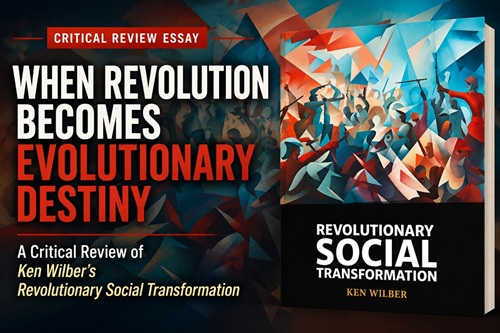
Deep Dive Wilber Books: The Four Faces of Truth Integral Semiotics Revolutionary Social Transformation Integral Politics The Many Ways We Touch An Integral Age at the Leading Edge The Deconstruction of the World Trade Center Who Ate Captain Cook? Toward a Comprehensive Theory of Subtle Energies When Revolution Becomes Evolutionary DestinyA Critical Review of Ken Wilber's Revolutionary Social TransformationFrank Visser / ChatGPT
Ken Wilber's Revolutionary Social Transformation (2023) is an ambitious attempt to explain social change through the machinery of Integral Theory. Its point of departure is deceptively simple: what do we actually mean when we call something “revolutionary”? Wilber observes that the word has become so inflated that almost every new idea, technology, management technique, or lifestyle product is marketed as revolutionary. He therefore proposes to distinguish genuine social transformation from superficial change. The booklet, running to some fifty pages of argument followed by extensive notes, develops this distinction through Marx, Kuhn, Max Weber, Jack Goldstone, Jean Gebser and, above all, Wilber's own AQAL framework. There is much here that is genuinely interesting. Wilber is at his best when he insists that social transformation cannot be reduced either to changes in consciousness or to changes in material structures. A revolution that merely changes political rhetoric while leaving economic organization untouched is incomplete; but so is a supposed spiritual transformation that has no institutional or technological expression. His adaptation of Marx's distinction between “base” and “superstructure” into an AQAL account of mutually interacting dimensions is an intellectually useful move. Wilber argues that technological and economic developments influence culture and consciousness, while consciousness and cognition also contribute to the creation of new technologies and institutions. The resulting process is what he calls “tetra-evolution” or “tetra-meshing.” This is probably the booklet's strongest idea. Wilber recognizes something that both materialist and idealist theories of history tend to obscure: human beings live simultaneously in material systems, behavioral systems, cultural worlds and subjective worlds. A technological innovation can spread rapidly because people can adopt a new artifact without undergoing a corresponding transformation of consciousness. Cultural adaptation is slower. The resulting mismatch between technological realities and inherited meanings can generate social conflict. Wilber describes this as a disjunction between the Lower-Right and Lower-Left quadrants. That is a productive way of thinking about cultural lag. One does not have to accept the entire AQAL system to see the value of the observation. Industrialization, for example, did not automatically produce the moral, political and psychological habits required to live well within an industrial society. Nor does the digital transformation automatically produce institutions capable of dealing with its consequences. The basic insight that technologies can outrun the cultures that create and use them is both plausible and important. Wilber also makes a useful distinction between revolution as political upheaval and revolution as genuine structural transformation. Historically, he notes, “revolution” originally carried the meaning of revolving or cycling rather than progressing upward. Political regimes could change hands while reproducing essentially the same underlying structures. Wilber therefore distinguishes what he calls horizontal revolutions from vertical transformations. A horizontal revolution changes the occupants or surface structures of a system; a vertical transformation changes its developmental depth. This distinction is valuable because it prevents the romanticization of revolution. Wilber is emphatic that most revolutions are not progressive. He invokes Jack Goldstone's four conditions associated with revolutionary outbreaks—governmental weakness, elite conflict, population pressure and international intervention—and observes that these factors can generate political upheaval without producing any corresponding increase in human development. The booklet is therefore much less revolutionary in the conventional political sense than its title might suggest. Indeed, its message is almost anti-revolutionary: violent upheaval is usually a bad bet, whereas genuine transformation may just as well occur through gradual reform. This is one of the more sensible conclusions of the essay. Wilber's comparison of the American, French, Russian and Chinese revolutions with the quieter reforms in Prussia and England leads him to argue that profound transformation need not involve insurrection at all. The decisive question is whether a society actually moves to a new structural level rather than merely replacing one governing faction with another. But at precisely this point the strengths of Wilber's argument begin to turn into its weaknesses. From historical analysis to developmental metaphysicsThe central problem is that Wilber repeatedly converts a useful interpretive distinction into a grand theory of historical necessity. The vocabulary changes from ordinary historical explanation to evolutionary metaphysics: “depth,” “Eros,” “authenticity,” “probability waves,” “morphogenetic gradients,” and “AQAL selection pressures.” A descriptive observation—that some forms of social organization are more complex than others—is transformed into the much stronger claim that history possesses an intrinsic directional tendency toward greater complexity, consciousness, inclusiveness and wholeness. Wilber calls this tendency Eros. In his account, evolution does not merely happen; it has a directional pull. The universe is supposedly “winding up,” moving from quarks to atoms to molecules to cells to organisms and eventually toward higher forms of consciousness and culture. Social transformation is therefore embedded within a much larger cosmic evolutionary process. This is the point where a potentially fruitful sociology becomes a metaphysics of history. There is nothing wrong with proposing a metaphysical interpretation of evolution. The problem is that Wilber frequently presents the metaphysical interpretation as though it were the explanation of the historical evidence. The fact that biological evolution has produced increasingly complex forms does not by itself demonstrate that social history possesses an intrinsic tendency toward moral progress. Nor does the existence of developmental sequences in human psychology establish that political history must move toward higher developmental levels. The argument becomes circular. Wilber identifies certain historical developments as higher because they embody more differentiation, integration, inclusiveness and complexity. He then points to their historical emergence as evidence that evolution moves toward greater differentiation, integration, inclusiveness and complexity. The conclusion is effectively built into the definition of the evolutionary process. That circularity becomes especially visible in the concept of “authenticity.” Wilber defines legitimacy as adequate functioning at a given level and authenticity as vertical development to a higher level. A legitimation crisis is therefore ultimately resolved by “an increase in authenticity.” But how do we independently determine that a particular historical change represents an increase in authenticity? The answer is essentially: it represents a higher developmental level. And how do we know that the level is higher? Because it represents greater developmental depth. The framework therefore risks becoming self-validating. AQAL identifies the developmental hierarchy; the hierarchy tells us which historical developments are more authentic; and those developments then confirm the developmental trajectory. The problem of the developmental ladderThis is particularly problematic when Wilber moves from technological complexity to human maturity. His correlations between techno-economic modes and developmental stages are suggestive but far stronger than the evidence presented warrants. Foraging is associated with magic, horticulture with mythic consciousness, industrial society with rationality, and informational society with pluralism. Wilber repeatedly emphasizes that these are not crude one-to-one causal relationships, but the correlations remain sufficiently strong in his narrative that they function as precisely that kind of historical map. The danger is a familiar one in grand theories of history: contemporary Western development becomes the implicit standard by which earlier and non-Western societies are ranked. Wilber's sequence moves from archaic through magic, mythic, rational and pluralistic consciousness toward Integral consciousness. The historical trajectory therefore looks suspiciously like a refined version of the familiar Western story of progress, even though Wilber explicitly criticizes Enlightenment and liberal theories for their simplistic linearity. His “layer cake” metaphor is intended to solve this problem. A modern society is not homogeneous: it contains people and subcultures operating at different developmental levels. A technologically advanced society can contain mythic, magical and even archaic forms of consciousness. This is an important corrective to crude modernization theory. Yet the hierarchy remains. The layers may coexist, but they are still ranked. Orange is more developed than amber; green is more developed than orange; Integral is more developed than green. Wilber's argument therefore escapes simplistic linearism only by replacing a single historical ladder with a layered developmental ladder. That may be perfectly legitimate as a psychological model. It becomes much more questionable when it is used as a comprehensive theory of civilization. The remarkable 10-percent thesisThe weakest empirical claim in the booklet is probably Wilber's “tipping point” argument. He suggests that when approximately 10 percent of a population reaches a new developmental wave, the values of that leading edge can permeate the wider society. He uses this to interpret the rise of orange rationality and green pluralism, and ends by expressing anticipation of the moment when second-tier consciousness reaches its own 10-percent threshold. This is an enormous claim resting on remarkably little evidence. Wilber himself calls the underlying survey preliminary. Yet the 10-percent figure is then used to explain some of the most consequential transformations of modern history: the American and French revolutions, constitutional government, abolitionism, the rise of science, civil rights, environmentalism, feminism and multiculturalism. The danger here is obvious. Once a sufficiently flexible developmental scheme is combined with a post hoc 10-percent threshold, almost any historical transformation can be reconstructed as evidence for the theory. One identifies the new value system, estimates when approximately ten percent of the population supposedly possessed it, and then observes that broader cultural change followed. But that does not establish causation. Nor does it demonstrate that ten percent is a genuine threshold rather than an arbitrary retrospective marker. Social diffusion certainly exists. Ideas can spread rapidly after reaching a critical mass. But the mechanism may involve institutions, media, political organization, economic interests, charismatic leadership, social networks, demographic changes, technological changes, war, elite bargaining or contingent historical events. Wilber's developmental interpretation does not eliminate these mechanisms, but it tends to subordinate them to the AQAL narrative. The 10-percent thesis is therefore precisely the sort of claim that would require systematic comparative evidence rather than illustrative historical anecdotes. The “leading edge” and the return of the enlightened eliteAn even more troubling feature is Wilber's treatment of elites. Genuine vertical transformation, he argues, must be “inaugurated and channeled by an elite,” and in successful transformations the relevant elite is itself operating at the emerging developmental level. This introduces a paradox at the heart of the supposedly inclusive Integral revolution. Wilber repeatedly celebrates Integral consciousness as uniquely capable of transcending domination, marginalization and exclusion. He claims that there has never previously been a culture whose dominant nexus-agency was genuinely all-inclusive and non-oppressive, and presents Integral emergence as an unprecedented historical breakthrough. Yet the mechanism by which this supposedly egalitarian society comes into being is distinctly elitist: a sufficiently developed minority must reach the leading edge, influence the elites, trigger a tipping point, and eventually permeate society. This is not necessarily sinister. Every major social transformation obviously requires innovators, organizers, intellectuals and political leaders. But Wilber's developmental language can easily turn ordinary leadership into a hierarchy of consciousness. Those who disagree with the “leading edge” can be interpreted not simply as political opponents with different interests or moral priorities, but as people operating from lower developmental stages. That creates a built-in epistemic asymmetry. The Integral theorist can regard himself as occupying a higher level from which the positions of others are explained. The others, meanwhile, can be classified as amber traditionalists, orange modernists, green pluralists, red reactionaries, or victims of “mean green.” Disagreement thereby becomes developmental diagnosis. This is one of the recurring dangers of Integral Theory: the hierarchy that it claims to transcend can reappear as a hierarchy of people who supposedly possess more evolved consciousness. The familiar villain: “mean green”The booklet also reveals how heavily Wilber's political sociology remains shaped by his long-standing critique of postmodernism. He treats contemporary Western society as caught between traditionalist amber, modernist orange and postmodern green, while arguing that malformed green—“flatland pluralism”—has erased genuine developmental depth. The final pages make this even more explicit. “Boomeritis,” in Wilber's terminology, combines postmodern pluralism with preconventional narcissism. Deconstruction has supposedly destroyed inherited systems without constructing adequate replacements, leaving nihilism, irony and narcissism behind. Wilber then calls for the return of “Big Pictures,” value, universals and comprehensive worldviews. There is a legitimate criticism buried here. A culture that can endlessly deconstruct inherited institutions without explaining what should replace them can indeed become politically and intellectually sterile. Wilber is also right that pluralism can become self-defeating if it refuses to make any judgments whatsoever. But his critique is too sweeping. “Postmodernism” is treated less as a diverse intellectual field than as a developmental pathology. Its internal distinctions disappear. Constructive pluralism, radical skepticism, poststructuralism, identity politics, literary theory and academic deconstruction are folded together into a single green problem. The argument then becomes almost impossible to falsify: if pluralism criticizes Integral Theory, it is evidence of green resistance to second-tier development; if it embraces Integral ideas, that is evidence of the emergence of Integral consciousness. This is not critical engagement with an intellectual opponent so much as developmental domestication. Marx and Kuhn: useful appropriations, questionable correctionsWilber's use of Marx is considerably more interesting. He correctly appreciates the enduring importance of material conditions and refuses the common spiritualizing temptation to explain social change entirely in terms of ideas. Every genuine transformation, he insists, needs a Lower-Right component. Yet Wilber's treatment of Marx is also revealingly asymmetrical. Marx's insights are praised as profound, while Marx's “reductionism” is dismissed and his “details” are said to be virtually all wrong. Wilber then absorbs what he likes into AQAL. The result is less a dialogue with Marx than an annexation of Marx. Something similar happens with Thomas Kuhn. Wilber makes an interesting point that Kuhn's “paradigm” referred much more specifically to scientific practices and exemplars than the popular New Age use of “new paradigm” would suggest. He rightly objects to the casual identification of any new worldview with a Kuhnian paradigm. But again, Kuhn is recruited into a much larger evolutionary scheme that Kuhn himself did not establish. Scientific revolutions become a subset of AQAL transformation; paradigm change becomes evidence of increasing depth; and scientific progress becomes another manifestation of Eros. The historical complexity of scientific development is thus subordinated to Wilber's overarching developmental story. Progress without naivety?One of the booklet's more sophisticated sections concerns the problem of progress. Wilber does not simply say that history gets better. He recognizes what he calls the “good news, bad news” character of development. Greater complexity creates new possibilities but also new pathologies. A technologically advanced civilization can generate horrors that simpler societies could never have produced. This is an important insight. Wilber's notion of “levels and lines” helps explain how cognitive, technological, moral and emotional development can become decoupled. A society can possess extraordinary technological capacities while remaining morally immature. High intelligence does not guarantee compassion; scientific sophistication does not guarantee political wisdom. This is arguably the most defensible interpretation of Wilber's developmental framework: not as a law of history, but as a warning against equating technological advancement with human maturity. Unfortunately, Wilber repeatedly pushes beyond this modest conclusion. The moment he invokes Eros as an intrinsic cosmic tendency, developmental progress becomes more than a possibility or evaluative framework. It becomes the underlying direction of reality itself. The dialectic of progress then becomes a dialectic whose eventual direction is already known. That is where his analysis begins to resemble the grand evolutionary philosophies of the nineteenth century that he otherwise seeks to overcome. The Integral revolutionThe ultimate purpose of the booklet is not merely to reinterpret previous revolutions. It is to prepare the conceptual ground for the next one: the Integral transformation. Wilber believes that humanity is approaching a historically unprecedented developmental transition. Previous societies had dominant developmental levels that inevitably marginalized lower levels. Integral consciousness, by contrast, would include the previous stages without privileging or excluding them. This would supposedly make the Integral transformation radically different from everything that came before. This is the booklet's grand promise—and its greatest vulnerability. The claim that Integral consciousness will be uniquely inclusive is not demonstrated historically. It is derived from the definition of Integral consciousness itself. If Integral is defined as the stage that transcends and includes previous stages, then naturally an Integral society will appear uniquely inclusive. But the crucial historical question is whether people who describe themselves as Integral actually behave in ways that justify this description. That is precisely what the booklet does not establish. Nor does Wilber offer a sufficiently concrete account of what an Integral political economy, constitutional system, educational system or democratic institution would actually look like. The reader is told that all four quadrants must tetra-mesh, that consciousness must rise alongside institutions, and that a new Integral governance system will eventually emerge. But the practical institutional content remains vague. The revolutionary future is therefore considerably more detailed as a developmental metaphysics than as a political program. A theory that explains too muchThe deepest problem with Revolutionary Social Transformation is ultimately methodological. AQAL is so comprehensive that it can accommodate almost any historical outcome. A revolution can be interpreted as horizontal or vertical. A failure can be explained by insufficient developmental consciousness. A success can be explained by the presence of a leading-edge elite. Cultural conflict can be attributed to different levels occupying the same layer cake. Technological progress can be understood as an increase in depth. Resistance to Integral ideas can be classified as lower-level consciousness or malformed green. And the eventual emergence of Integral society can be predicted as the next step in Eros. A theory capable of explaining everything after the fact has a serious problem: what would count as evidence against it? Suppose the Integral revolution never occurs. AQAL can explain the failure by pointing to insufficient cultural development. Suppose it occurs. AQAL predicted it. Suppose societies become more authoritarian. That can be interpreted as regression. Suppose they become more democratic. That can be interpreted as vertical transformation. Suppose pluralism survives. It represents a layer-cake persistence of earlier stages. Suppose pluralism declines. Integral consciousness is replacing it. The framework therefore has extraordinary interpretive flexibility but limited predictive discipline. That does not make it worthless. Maps can be useful without being scientific laws. But Wilber often writes as though he has provided a scientific account of historical evolution when he has really provided a highly elaborate philosophical interpretation of it. What remains valuableDespite these criticisms, Revolutionary Social Transformation should not be dismissed. It contains several genuinely useful conceptual distinctions. Its insistence on combining material structures with cultural meanings and individual consciousness is valuable. Its distinction between horizontal political upheaval and vertical social transformation is illuminating. Its warning that institutional reforms cannot automatically manufacture the psychological capacities required to sustain them deserves serious attention. Its distinction between technological capability and moral development is also important. And its recognition that advanced societies remain internally heterogeneous—the “layer cake” of different developmental levels—is a useful corrective to simplistic theories of modernization. The problem is not that Wilber sees too much complexity. It is that he eventually organizes that complexity around one master narrative: development has direction, direction has depth, depth generates Eros, Eros produces higher stages, and Integral consciousness represents the next great historical threshold. Once that narrative is installed, history begins to look less like an open-ended field of contingency and more like a cosmic curriculum. And that is precisely where the title Revolutionary Social Transformation becomes ironic. Wilber wants to liberate the concept of revolution from the simplistic idea that political upheaval automatically produces progress. He succeeds. But he then risks replacing revolutionary romanticism with evolutionary romanticism: the belief that history itself is secretly moving toward the worldview he happens to occupy. The most interesting Wilber is therefore not the prophet of the coming Integral revolution. It is the Wilber who tells us to look simultaneously at technology, institutions, culture, consciousness, developmental differences and unintended consequences. That Wilber offers a genuinely multidimensional sociology. The moment he tells us that these dimensions are ultimately being driven by an intrinsic cosmic Eros toward Integral consciousness, however, the sociologist gives way to the metaphysician—and the historical argument becomes much harder to defend. Revolutionary Social Transformation is consequently best read not as a demonstrated theory of social evolution but as a fascinating specimen of Integral historiography: an attempt to reinterpret Marx, Kuhn, Weber, Goldstone and developmental psychology through a single comprehensive map. Its great strength is the breadth of that map. Its great weakness is the confidence with which the map is mistaken for the territory. And perhaps that is the most important critical lesson the booklet itself inadvertently offers. A map of social transformation can become revolutionary in its own right—but only if we remain willing to ask where the map ends and reality begins.
Widget is loading comments...
|