|
TRANSLATE THIS ARTICLE
Integral World: Exploring Theories of Everything
An independent forum for a critical discussion of the integral philosophy of Ken Wilber
  Frank Visser, graduated as a psychologist of culture and religion, founded IntegralWorld in 1997. He worked as production manager for various publishing houses and as service manager for various internet companies and lives in Amsterdam. Books: Ken Wilber: Thought as Passion (SUNY, 2003), and The Corona Conspiracy: Combatting Disinformation about the Coronavirus (Kindle, 2020). Frank Visser, graduated as a psychologist of culture and religion, founded IntegralWorld in 1997. He worked as production manager for various publishing houses and as service manager for various internet companies and lives in Amsterdam. Books: Ken Wilber: Thought as Passion (SUNY, 2003), and The Corona Conspiracy: Combatting Disinformation about the Coronavirus (Kindle, 2020).
Check out my other conversations with ChatGPT
Deep Dive Wilber Books: The Four Faces of Truth Integral Semiotics Revolutionary Social Transformation Integral Politics The Many Ways We Touch An Integral Age at the Leading Edge The Deconstruction of the World Trade Center Who Ate Captain Cook? Toward a Comprehensive Theory of Subtle Energies Who Ate Captain Cook?Ken Wilber's Integral Historiography and the Problem of 'Going Beyond' PostmodernismFrank Visser / ChatGPT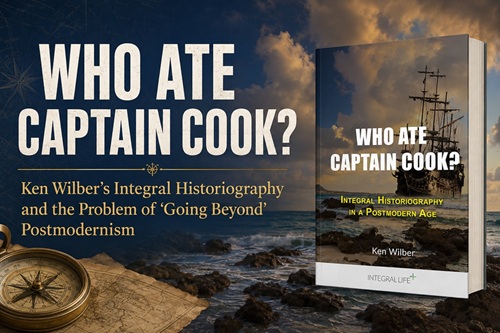 Ken Wilber's “Who Ate Captain Cook?” is an unusually revealing text. It is ostensibly an essay about the famous dispute between the anthropologists Marshall Sahlins and Gananath Obeyesekere over the death of Captain James Cook in Hawaii. But the historical episode is really a vehicle for a much larger argument: Wilber wants to demonstrate what an “integral historiography” would look like and, at the same time, to present Integral Theory as the intellectual framework capable of overcoming the sterile opposition between scientific objectivity and postmodern interpretation. The essay is also characteristic of Wilber at a particular stage of his development. Originally written as an extended sidebar to his novel Boomeritis, it retains the novel's fictional characters and deliberately comic, irreverent style. The narrator even tells us that the characters are fictional and that the discussion takes place as a seminar within the novel. That device gives Wilber considerable freedom to be provocative. It also creates one of the central weaknesses of the piece: serious historical, anthropological and philosophical arguments are repeatedly compressed into a developmental drama in which “orange,” “green,” and “second tier” become remarkably convenient labels for intellectual positions. At its best, however, “Who Ate Captain Cook?” contains a genuinely useful methodological intuition. Historians should not choose between facts and meanings. They should investigate both. The difficulty is that Wilber's proposed solution ultimately turns this sensible methodological pluralism into a justification for his own developmental hierarchy of consciousness. The central insight: history is both fact and interpretationWilber begins with the four quadrants. Any event, he argues, can be examined from the perspective of the individual or collective, and from the interior or exterior. Thus we have the Upper Left, Upper Right, Lower Left and Lower Right quadrants. An adequate historiography should therefore investigate observable behavior and material conditions, but also intentions, meanings, values, cultural contexts and systems. This is the strongest part of the argument. There is nothing inherently controversial about saying that historical explanation requires multiple levels of description. A historian investigating the French Revolution, for example, might examine economic conditions, political institutions, demographic changes, individual motivations, ideological commitments, religious beliefs, collective identities and changing interpretations of events. None of these necessarily cancels the others. Wilber makes the point especially clearly in his distinction between “what does it do?” and “what does it mean?” Observable behavior belongs primarily to the exterior perspective, while understanding meaning requires interpretive and hermeneutic approaches. This is a useful corrective to simplistic scientism. Historical facts do not come with their own interpretation attached. The fact that Columbus sailed across the Atlantic in 1492 does not by itself determine whether his voyage should be described as exploration, conquest, imperial expansion, cultural encounter, catastrophe, or some combination of these. Wilber is equally right that interpretation does not make factual investigation irrelevant. His repeated insistence that empirical evidence constrains interpretation is entirely reasonable. An interpretation that contradicts overwhelming evidence cannot simply be rescued by saying that “everything is interpretation.” In this respect, Wilber's argument can be reduced to a proposition that is considerably more modest than Integral Theory: Good history requires both evidence and interpretation. That is hardly a revolutionary proposition, but it remains a sound one. The problem with Wilber's caricature of scienceWilber's argument becomes considerably less convincing when he describes the two opposing camps. “Orange” supposedly represents the scientific-modernist position: objective facts, empirical verification, universal truth and the attempt to describe history as it really happened. “Green,” by contrast, represents postmodern pluralism, interpretation, cultural relativism and the claim that there are “no facts, only interpretations.” The problem is that this opposition is largely constructed by Wilber himself. Serious historians and philosophers of history do not generally divide into people who believe exclusively in facts and people who believe exclusively in interpretations. Historians have long understood that evidence requires interpretation. Scientific historians do not simply collect uninterpreted “facts”; they formulate hypotheses, assess sources, evaluate causal explanations and debate competing interpretations. Consequently, Wilber scores an easy victory by defining “orange science” as naïve positivism and “green postmodernism” as extreme relativism, then announcing that Integral Theory transcends both. The actual intellectual landscape is considerably messier. Even more problematic is Wilber's claim that science itself “denied” interiors because empirical methods could not reach them. He says that science effectively moved from “our methods cannot reach those domains” to “those domains do not exist.” That criticism applies to certain forms of scientism or reductionism. It does not adequately describe science as a whole. Psychology, neuroscience, cognitive science, psychiatry, linguistics and the social sciences have spent enormous effort investigating precisely those phenomena Wilber calls “interiors.” The distinction Wilber wants to establish between empirical science and interpretive understanding is therefore useful, but his historical narrative about science is much too sweeping. The Captain Cook controversyThe historical centerpiece is the dispute between Marshall Sahlins and Gananath Obeyesekere concerning the Hawaiian reception and subsequent killing of Cook. Wilber summarizes the empirical sequence: Cook arrived at Kealakekua Bay in January 1779, was received with extraordinary ceremonial respect, departed, returned after damage to his ship, and was subsequently killed, dismembered and eaten. The question is how these apparently contradictory events should be understood. Sahlins, in Wilber's presentation, offers a culturally embedded interpretation. Cook's reception can be understood through Hawaiian mythological structures, particularly the association with Lono and the ceremonial calendar. Obeyesekere challenges this account, arguing that Sahlins has imposed a European myth about supposedly primitive natives who mistook Cook for a god. Wilber's most interesting conclusion is that both scholars possess part of the truth. Sahlins is right to insist that historical actors inhabit culturally specific systems of meaning. Obeyesekere is right to insist that historians must remain accountable to empirical evidence and ordinary human motivations. Wilber therefore regards the controversy as a miniature demonstration of his integral method. This is persuasive up to a point. But there is a significant problem: Wilber does not merely integrate the two interpretations. He reclassifies them within his own developmental vocabulary. The irresistible temptation of “red,” “orange” and “green”Wilber suggests that Sahlins's interpretation would make more sense if the Hawaiian actors were understood through the “red” stage of Spiral Dynamics. He proposes that the Hawaiians' actions could be understood as manifestations of a mythic worldview in which Cook was interpreted as Lono and subsequently as subject to a different ritual and political configuration associated with Ku. This is where the argument becomes much more speculative. Wilber acknowledges that he is making a loose heuristic generalization, but the looseness of the proposal is precisely the problem. What independent evidence establishes that the relevant Hawaiian worldview should be classified as “red”? What empirical procedure determines whether a historical culture is red, blue, orange or green? How do we distinguish an actual developmental structure from a retrospective classification imposed by the theorist? Wilber recognizes the danger of imposing developmental schemes. He explicitly condemns earlier social evolutionists who used their own culture as the supposedly highest point of a universal scale and then judged other cultures according to their distance from it. Yet his own procedure risks reproducing a subtler version of the same problem. The terminology has changed. Instead of “primitive” and “civilized,” we have “red,” “blue,” “orange,” “green,” and “second tier.” But the historian still possesses a master map against which cultures can be interpreted. That does not automatically invalidate developmental models. It does mean, however, that Wilber's repeated assurance that the maps are merely “held lightly” is not sufficient. A developmental classification must be independently justified in the particular historical case under investigation. Wilber's clever solution: genealogyThe most intellectually ambitious section of the essay concerns genealogy. Wilber distinguishes between pluralistic relativism and developmental genealogy. Pluralism recognizes multiple worldviews and tries to understand them on their own terms. Genealogy adds a temporal dimension: it asks whether worldviews themselves develop and whether patterns can be detected in their historical unfolding. This is a much more sophisticated proposal than the simplistic caricature of “postmodernism” found elsewhere in the essay. Wilber is especially concerned to avoid the old evolutionary mistake of ranking entire societies on a single ladder. Instead, he emphasizes multiple developmental lines. A person or culture can be highly developed in one capacity and poorly developed in another. That qualification is important. It anticipates one of the strongest features of later Integral Theory: development is multidimensional rather than reducible to a single scale. But Wilber nevertheless wants development to provide what pluralism allegedly cannot: a “scale of depth.” And here the deeper philosophical issue returns. Who determines what counts as development? The Gilligan exampleWilber uses Carol Gilligan's work on moral development as an illustration of what he calls “good genealogy.” He describes a movement from selfishness, to care for close others, to universal care. Because later stages supposedly include the capacities of earlier ones while adding something new, Wilber considers them genuinely higher. This is an elegant example, but Wilber asks more of it than the evidence necessarily warrants. The fact that a developmental sequence can be identified in a particular research population does not automatically establish a universal hierarchy of consciousness. Nor does the fact that a later stage incorporates certain capacities of an earlier stage establish that the later stage is universally “higher” in every relevant sense. Wilber does acknowledge this problem and repeatedly calls for further research. He recommends using highly generalized developmental categories when making broad historical claims and explicitly warns that universal claims require exceptionally strong evidence. That caution is welcome. But the architecture of the argument remains asymmetrical. Whenever evidence appears compatible with development, it is incorporated into the Integral framework; when evidence is insufficient, Wilber advises holding the model lightly. The theory is therefore remarkably difficult to falsify. The hierarchy that pretends not to be a hierarchyThis is perhaps the most important criticism of the essay. Wilber spends considerable effort distinguishing legitimate developmental hierarchy from crude ranking. He insists that development is multilinear, that earlier stages are retained, that no culture can be reduced to a single level, and that different developmental capacities can coexist. Yet his vocabulary remains fundamentally hierarchical. “Higher” means more encompassing, more inclusive, more caring and more conscious. The second-tier position supposedly transcends and includes the green achievement of pluralism while overcoming its limitations. This creates a structural problem. Integral Theory has already determined that the pluralistic position is a lower developmental stage and that Integral Theory represents its more adequate successor. Consequently, when a postmodern thinker resists Wilber's developmental hierarchy, that resistance can itself be interpreted as evidence of insufficient development—“green resistance to levels.” That is an extraordinarily convenient theoretical arrangement. The critic is effectively diagnosed by the theory being criticized. Wilber does not necessarily commit this fallacy in every individual case, but the architecture of his system makes it difficult to avoid. “Follow the evidence!”—but which evidence?One of the essay's most attractive slogans is “Follow the Evidence!” Wilber explicitly says that developmental models should be accepted or rejected according to research and that specific claims should remain provisional. This is exactly the right methodological principle. The difficulty is that the evidence base for the larger Spiral Dynamics and integral developmental narrative is much less secure than the confident architecture of the theory suggests. Wilber himself admits that some scholars believe the eight Graves levels do not yet have sufficient evidence to justify their use as a universal hermeneutic. He is willing to fall back on simpler schemes such as Gebser's archaic-magic-mythic-rational-integral sequence or the very general preconventional-conventional-postconventional sequence. This flexibility is both a strength and a weakness. It is a strength because Integral Theory does not depend entirely on one particular stage model. It is a weakness because the more general the developmental categories become, the harder it becomes to demonstrate that they actually explain historical events rather than merely redescribe them. “Preconventional,” “conventional,” and “postconventional” are useful psychological distinctions. But applying them to entire historical cultures or civilizations requires considerably more evidence than Wilber provides in this essay. The four quadrants: genuinely useful, theoretically overloadedThe four quadrants themselves are perhaps the most durable contribution of the essay. As a methodological checklist, they are valuable. When examining a historical phenomenon, ask about individual subjective experience, observable individual behavior, shared cultural meaning and objective social systems. This prevents investigators from becoming reductionistic. Wilber explicitly recommends beginning with the quadrants before adding levels, lines, states and types. That is sensible advice. The problem arises when the quadrants cease to function as a heuristic and become claims about the ontology of reality itself. Wilber states that the four quadrants are not merely four perspectives but four irreducible dimensions of every occasion. He even extends the logic to atoms, which supposedly participate in processes of mutual interpretation. Here the modest methodological insight is transformed into metaphysics. There is a major difference between saying: “An event can profitably be examined from four perspectives.” and saying: “Every event possesses four ontologically irreducible dimensions.” The first is a useful methodological proposal. The second requires a substantial philosophical argument. “Who Ate Captain Cook?” largely assumes rather than demonstrates the latter. The strange case of atoms that “interpret”The most revealing example is Wilber's claim that even atoms have four quadrants and that atoms are therefore involved in processes of “co-creating and interpreting each other.” This is a dramatic escalation. Human beings clearly interpret symbols, intentions and meanings. Whether elementary physical entities should be described as “interpreting” one another is an entirely different proposition. It begins to resemble a form of panpsychism or cosmopsychism, although Wilber does not develop the argument here. The terminology creates an impression of continuity between physics, biology, psychology and culture, but linguistic continuity is not the same as explanatory continuity. A stone does not obviously “interpret” gravity in the same sense that a human interprets a historical document. Wilber's four-quadrant model therefore risks committing precisely the category mistake it elsewhere warns against: treating different domains as though the same conceptual vocabulary can simply be applied at every level. The AI digressionThe opening discussion of artificial intelligence is particularly interesting today because it has aged in a revealing way. Wilber's fictional narrator argues that AI can represent external objects but cannot genuinely grasp interiors, cultural meanings or social systems. A truly functioning AI would therefore require not merely sophisticated hardware and software but the emergence of self-consciousness, its own developmental trajectory, a community of similarly developed beings and a supporting social system. The argument is intriguing because it anticipates an important question: is intelligence reducible to computation? But Wilber moves very quickly from “current AI systems lack certain characteristics” to the much stronger claim that genuine intelligence requires the four-quadrant architecture he proposes. That conclusion is not demonstrated. Indeed, the AI material exposes a recurring problem in the essay. Wilber frequently takes a useful distinction and turns it into a necessary ontological condition. The four quadrants begin as perspectives that may enrich interpretation. They end as prerequisites for intelligence itself. That leap requires considerably more argument than the essay supplies. Wilber and postmodernism: critique or culture-war polemic?There is another weakness that is impossible to ignore: Wilber's rhetoric. The text is deliberately comic. Fuentes mocks “green” thinkers as humorless, repeatedly uses deliberately outrageous language, and describes Sahlins and Obeyesekere at one point as engaged in a “clash of midgets.” This is part of the Boomeritis aesthetic. The problem is not that Wilber is funny. The problem is that humor frequently substitutes for argument. The repeated references to “green,” “mean green,” “PMS,” “boomeritis” and “first-tier” create a rhetorical atmosphere in which postmodern thinkers are not merely criticized but pathologized. The result is ironic. Wilber criticizes postmodernism for reducing intellectual opponents to ideological categories, while repeatedly reducing postmodernism to precisely such a category. The real diversity of postmodern thought disappears. Derrida, Foucault, Lyotard, Said, Rorty, Fish and others become representatives of a single “green” formation. Yet these thinkers differ profoundly in method, philosophical commitments and conceptions of truth. An integral historiography should presumably be more careful than this. The unresolved tension between understanding and judgingWilber's strongest philosophical question is also his most difficult one: how can we understand another culture without either imposing our own categories upon it or declaring all interpretations equally valid? This is a genuine problem. Pure relativism can make criticism difficult. But universalism can become ethnocentric. Wilber wants a position between the two: understand the Other on its own terms, but then situate that worldview within a broader developmental genealogy. The trouble is that the developmental genealogy inevitably reintroduces an external framework. Wilber tries to solve this by arguing that legitimate developmental judgments emerge “from within” the developmental sequence itself. His discussion of Gilligan is designed to show that later stages can legitimately recognize themselves as containing earlier stages, while earlier stages cannot fully comprehend later ones. But this is not a neutral solution. The claim that later stages genuinely possess greater depth is itself a philosophical commitment. It cannot simply be derived from hermeneutics. Hermeneutic understanding may establish that people at one stage describe their experience in certain ways. It does not automatically establish that those experiences occupy objectively superior positions in a universal developmental hierarchy. That additional conclusion requires independent evidence. What remains valuableDespite these criticisms, “Who Ate Captain Cook?” should not be dismissed. Its central methodological impulse is sound: historians should resist reductionism. Material conditions matter. Observable events matter. Individual intentions matter. Cultural meanings matter. Social structures matter. Development may matter. Altered states and symbolic systems may sometimes matter. Different forms of evidence require different investigative methods. Wilber is also right that historians should not confuse respect for cultural difference with the suspension of all judgment. A mature comparative inquiry must be capable of saying both “this worldview is different from ours” and “some practices or beliefs may nevertheless be more defensible than others.” His discussion of multilinear development is also an important improvement over simplistic evolutionary ladders. He explicitly rejects the idea that later cultures are automatically superior in every respect and emphasizes that developmental lines can diverge dramatically. And the essay's final formulation—“all quadrants, all levels, all lines, all states, all types”—provides an ambitious checklist for multidimensional historical interpretation. As a heuristic, that is useful. As a demonstrated scientific theory of historiography, it remains much less convincing. The deeper problem: Integral Theory becomes the judge of the judgesUltimately, “Who Ate Captain Cook?” illustrates both the attraction and the limitation of Wilber's Integral Theory. The attraction is obvious. Wilber sees intellectual conflicts as partial truths confronting other partial truths. Science has something postmodernism lacks; postmodernism has something scientism lacks; developmental theory adds something pluralism lacks. Integral Theory promises to preserve each insight while locating it within a larger framework. This is intellectually attractive because it makes Integral Theory look like the natural culmination of previous intellectual movements. But that is precisely the problem. Wilber's theory is not merely integrating the competing positions. It is deciding in advance what each position represents, what it gets right, what it gets wrong, and what developmental level it occupies. “Orange” is partial. “Green” is partial. “Second tier” integrates them. And Integral Theory is the framework that tells us why. The danger is circularity. The theory validates itself by defining its predecessors as incomplete versions of itself. This is particularly visible in the treatment of postmodernism. Wilber accepts pluralism as an achievement, but then argues that pluralism must be transcended by developmental genealogy. Thus postmodernism becomes simultaneously an important evolutionary achievement and an immature stage that requires Integral Theory to complete it. That is a clever philosophical construction. It is not yet an empirical demonstration. Conclusion: a useful manifesto, not yet an integral historiography“Who Ate Captain Cook?” is best read as a manifesto for methodological pluralism rather than as a completed theory of historiography. Its most defensible proposition is that history consists neither of uninterpreted facts nor of arbitrary interpretations. Facts constrain interpretation, while interpretation gives historical facts meaning. The four-quadrant framework offers a useful reminder that historical explanation can involve subjective experience, observable behavior, cultural meaning and social-material systems simultaneously. The problems begin when Wilber moves from this modest methodological pluralism to ontological claims about the four quadrants, developmental claims about cultures, and especially the assertion that Integral Theory represents a second-tier resolution of the orange-green conflict. His treatment of Sahlins and Obeyesekere is consequently double-edged. Wilber correctly sees that both empirical evidence and cultural interpretation are necessary. But instead of allowing the historical evidence to determine how much of each is required, he uses the Cook controversy to demonstrate the prior truth of his own Integral framework. That is the fundamental irony of the essay. Wilber criticizes earlier historians for imposing their conceptual frameworks on the Other. Yet he proposes that the ultimate way to understand the Other is to classify its worldview within a developmental spectrum of consciousness. He criticizes simplistic evolutionary hierarchies, yet retains a more sophisticated hierarchy. He criticizes postmodernists for reducing reality to interpretation, yet risks reducing intellectual disagreement to stages of consciousness. And he urges historians to “follow the evidence,” while offering developmental categories whose application to historical cultures remains substantially underdetermined by the evidence presented. The title question—Who ate Captain Cook?—therefore turns out to have a larger significance. The real question is: who gets to decide what Captain Cook's death means? Sahlins and Obeyesekere offer competing answers. Wilber offers a third: the answer should integrate their perspectives through a developmental, quadrant-based framework. That third answer is intellectually suggestive. But it should itself be treated as an interpretation rather than as the final court of appeal. And that may be the most important lesson to take from Wilber's own essay: an integral approach should not merely integrate other people's perspectives. It should also turn its integrative machinery upon itself.
Widget is loading comments...
|