|
TRANSLATE THIS ARTICLE
Integral World: Exploring Theories of Everything
An independent forum for a critical discussion of the integral philosophy of Ken Wilber
  Frank Visser, graduated as a psychologist of culture and religion, founded IntegralWorld in 1997. He worked as production manager for various publishing houses and as service manager for various internet companies and lives in Amsterdam. Books: Ken Wilber: Thought as Passion (SUNY, 2003), and The Corona Conspiracy: Combatting Disinformation about the Coronavirus (Kindle, 2020). Frank Visser, graduated as a psychologist of culture and religion, founded IntegralWorld in 1997. He worked as production manager for various publishing houses and as service manager for various internet companies and lives in Amsterdam. Books: Ken Wilber: Thought as Passion (SUNY, 2003), and The Corona Conspiracy: Combatting Disinformation about the Coronavirus (Kindle, 2020).
Check out my other conversations with ChatGPT
Deep Dive Wilber Books: The Four Faces of Truth Integral Semiotics Revolutionary Social Transformation Integral Politics The Many Ways We Touch An Integral Age at the Leading Edge The Deconstruction of the World Trade Center Who Ate Captain Cook? Toward a Comprehensive Theory of Subtle Energies The Integral Emperor's Political MapA Critical Review of Ken Wilber's Integral PoliticsFrank Visser / ChatGPT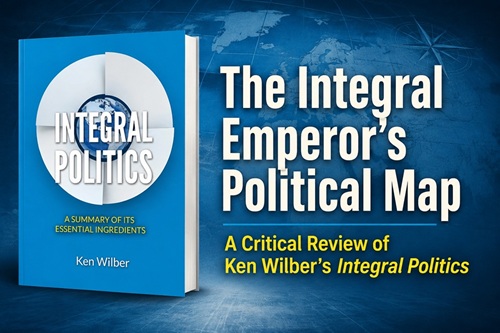 Ken Wilber's Integral Politics: Its Essential Ingredients is an ambitious attempt to do for politics what Integral Theory has attempted to do for psychology, spirituality, and the human sciences: provide a comprehensive map capable of accommodating apparently opposed perspectives within a larger whole. The booklet proposes that the familiar Left-Right conflict is not merely a disagreement about policies but the expression of different dimensions and developmental levels of human consciousness. Liberalism, conservatism, socialism, libertarianism, communitarianism and other political orientations each grasp something real, Wilber argues, but mistake their partial perspective for the whole. The solution is an “Integral Politics” based on his AQAL framework—“all quadrants, all levels, all lines, all states, all types.” There is a genuinely interesting intuition here. Politics really does involve conflicts between individual and collective interests, institutions and psychology, cultural values and material conditions, continuity and change. A political theory that recognizes only one of these dimensions will inevitably be incomplete. Wilber is therefore onto something important when he insists that political disagreements cannot be reduced to a single axis. But Integral Politics also illustrates one of the central problems of Integral Theory itself. Wilber begins with a useful pluralism and ends with a hierarchical system in which his own map becomes the privileged standpoint from which all other political positions can supposedly be diagnosed. What starts as “include everything” gradually becomes “classify everything according to my developmental scheme.” The result is intellectually stimulating, often perceptive, occasionally funny, but much less politically convincing than Wilber believes. A map of the political battlefieldThe booklet is actually presented as an excerpt from a much larger work-in-progress, The Many Faces of Terrorism, written around 2004 and subsequently incorporated into what Wilber calls the “Terrorism Trilogy.” Wilber himself warns that the material is a “crude, rough outline,” that it is repetitive, and that he has continued to refine its ideas. This is important because Integral Politics reads less like a finished political theory than like an extended conceptual sketch. Its basic proposal is straightforward. Political movements can be mapped along several dimensions. First there is the interior/exterior axis: does a movement explain suffering primarily in terms of individual psychology and responsibility or in terms of social, economic and institutional conditions? Second comes the individual/collective axis: does political sovereignty lie primarily with the individual or the community? Third is the transformation/translation axis: does a movement seek progressive transformation or conservative preservation? Finally there is developmental altitude: from which level of consciousness does a political movement arise, and toward which level does it point? Wilber adds further variables involving lines, states, agency and communion, progression and regression, stages and stations, and the regulatory role of government. As an organizing device this is useful. Indeed, it is arguably the strongest contribution of the booklet. Political arguments often become confused because people are disagreeing simultaneously about several different questions. One person may emphasize personal responsibility while another emphasizes structural inequality. One may defend individual liberty while another emphasizes social solidarity. One may seek radical transformation while another worries about unintended consequences and institutional stability. Wilber is right that these disagreements can be clarified by separating the dimensions. His observation that “nature/nurture” cannot be resolved by simply choosing one side is particularly sensible. In his terminology, interior and exterior factors are complementary rather than mutually exclusive. A serious political analysis should indeed ask simultaneously about psychology, culture, institutions, economics, biology, technology and historical circumstances. The trouble begins when this modest insight is transformed into a grand metaphysical claim: AQAL is not merely one useful framework among others but supposedly the architecture of reality itself. From useful distinctions to universal architectureWilber repeatedly tells us that AQAL is “the very structure of human existence.” Political movements that fail to take all its dimensions into account are therefore not merely incomplete theories but “fragmented, broken, partial, tortured” forms of political chaos. Elsewhere he claims that AQAL can classify every major political movement in history and that an Integral Politics would constitute something genuinely unprecedented. This is where the argument becomes much more questionable. A framework can be comprehensive without being true. A sufficiently flexible taxonomy can classify almost anything. The fact that political phenomena can be redescribed in terms of interiors and exteriors, individuals and collectives, levels and lines does not demonstrate that these categories constitute the fundamental architecture of politics—or reality. Wilber frequently slides from “this is a useful way of looking at political phenomena” to “this is how political phenomena actually are.” The difference matters enormously. A map that divides political arguments into four quadrants may be useful. But the usefulness of the map does not establish the ontological reality of the quadrants. Likewise, describing a political movement as “orange-green” or “amber” may offer an interpretive shorthand, but it does not demonstrate that its members actually inhabit a particular objectively measurable stage of consciousness. Wilber's rhetoric tends to obscure this distinction. He repeatedly speaks of locating the “Kosmic address” of a political movement, as though political ideologies came with developmental coordinates waiting to be discovered. The language is evocative, but it gives a speculative developmental typology the appearance of scientific measurement. The seductive simplicity of Left and RightWilber's treatment of Left and Right is simultaneously one of the booklet's most entertaining and weakest sections. His central proposition is that the Right tends to locate the causes of suffering “within” the individual, while the Left tends to locate them “outside” the individual—in society, economics and institutions. Republicans therefore emphasize character, responsibility, family and work ethic, whereas Democrats emphasize poverty, inequality and social structures. There is certainly something recognizable in this contrast. Political psychology has long identified differences in attitudes toward individual responsibility, social causation, hierarchy, equality and government intervention. Wilber's interior/exterior distinction can illuminate some of these differences. But he turns a tendency into an organizing definition. His own text acknowledges exceptions and mixtures, yet the exceptions are treated as secondary to the model. This produces a familiar problem with grand typologies: the more heterogeneous the political world becomes, the more the analyst has to force it into the categories supplied by the theory. The American Democratic and Republican parties, moreover, are historically contingent coalitions rather than manifestations of two stable psychological principles. Their positions have changed dramatically over time. Wilber is aware of this, and his developmental model is partly designed to explain those transformations. Yet there is a circularity here: political changes are interpreted as evidence for the developmental model that is then used to explain the political changes. The developmental hierarchy enters politicsThe most consequential—and controversial—element of Integral Politics is the elevation of Spiral Dynamics-style developmental stages into the principal explanatory framework for political ideology. Wilber distinguishes “red,” “amber,” “orange,” “green” and higher stages. Traditional conservatism is associated primarily with amber; Enlightenment liberalism with orange; and postmodern progressivism with green. He then interprets political history as an evolutionary succession of these stages. The Enlightenment represents the emergence of orange worldcentric consciousness; the counterculture and postmodern Left represent the emergence of green. This creates an elegant historical narrative. It also creates an extraordinarily convenient hierarchy. The political views Wilber favors can be assigned to higher developmental levels, while those he dislikes can be diagnosed as lower-level formations. Traditional conservatives are “amber.” The radical Left is “green,” but frequently contaminated by “red” narcissism. Liberalism is valuable because it represents orange's emergence of worldcentric values, but defective because it supposedly denies the developmental hierarchy that produced it. Thus practically every political camp can be simultaneously credited and downgraded. Conservatives possess something liberals lack—attention to interiors, values and character—but remain developmentally lower. Liberals transcend traditional ethnocentrism but supposedly fall into “flatland.” Progressives recognize pluralism and diversity but are vulnerable to green “boomeritis.” Integral consciousness, positioned beyond all of them, gets to adjudicate the dispute. That is an extremely powerful rhetorical position. It is also dangerously difficult to falsify. Liberalism as the great developmental paradoxWilber's critique of liberalism is perhaps the most intellectually interesting part of the booklet. He argues that liberalism's commitment to equality and tolerance depends upon precisely the kind of developmental achievement that liberalism officially refuses to recognize. Liberalism, he says, is an “egalitarianism held by an elite”: the capacity to treat everybody equally emerges only after substantial developmental growth. There is a serious point here. Liberal democracy does presuppose psychological and cultural capacities that cannot simply be legislated into existence. A constitutional democracy requires habits of restraint, tolerance, compromise, reciprocity and acceptance of political opponents. A society can possess democratic institutions without necessarily possessing a democratic culture. But Wilber's argument takes this insight much too far. From the fact that liberal democratic institutions require certain civic capacities, he infers a developmental hierarchy of consciousness and then places liberalism at a particular altitude within that hierarchy. The empirical steps required to establish that claim are simply missing. Even more problematic is the implication that liberal equality is somehow self-undermining because people differ developmentally. Wilber argues that liberalism extends equal status to people at developmental stages that do not themselves endorse liberal values. But this is not really a paradox. Liberal equality does not require citizens to possess equal psychological capacities, identical values or identical levels of moral development. It requires equal legal and political status. That distinction is crucial. Equality before the law is not a claim that everyone is equally wise, mature, talented or virtuous. It is a political principle designed precisely to prevent authorities from turning judgments about supposedly superior and inferior human beings into differential rights. Wilber's developmentalism risks undermining the very liberal achievement he wishes to preserve. “Govern only from the highest”This problem becomes especially visible in Wilber's proposed solution. His famous formulation is that every developmental stage should be allowed to exist as a legitimate “station in life,” while governance should take place “from the highest.” The text eventually identifies turquoise as the appropriate governing altitude. At first sight this sounds wonderfully inclusive: let red be red, amber be amber, orange be orange, green be green, but prevent lower stages from dominating the political system. But who determines which stage is “higher”? Who determines that a politician, institution or policy is genuinely turquoise rather than merely claiming to be? What democratic procedure authorizes the supposedly higher-level minority to govern the lower-level majority? Wilber actually embraces a potentially troubling answer. He suggests that government at its best represents “the newly-emergent, higher-level morality” and that the State may therefore impose the values of a higher-level minority upon a lower-level majority. He cites the civil-rights movement as an example. There is an important truth here: democracy cannot simply mean majority rule. Constitutional democracy places limits on majorities precisely because majorities can oppress minorities. The American civil-rights struggle is an obvious example. But this does not validate Wilber's developmental hierarchy. The civil-rights argument can be made perfectly well in terms of universal rights, constitutional principles and human dignity. There is no need to determine that segregationists were “amber” and civil-rights advocates “green,” much less that the latter possessed a higher level of consciousness. Indeed, once political legitimacy becomes tied to developmental altitude, an obvious danger appears: whoever controls the developmental ranking system can declare opponents developmentally inferior. That is precisely the kind of epistemic privilege that democratic politics should treat with suspicion. The problem with calling the opposition “lower”Wilber's model is particularly vulnerable to confirmation bias because its categories are asymmetrical. When his preferred values appear in a political movement, they can be interpreted as evidence of higher development. When contrary values appear, they can be interpreted as manifestations of lower developmental levels. The model therefore has difficulty distinguishing genuine developmental diagnosis from ideological preference. Consider Wilber's treatment of the postmodern Left. He grants “healthy green” some achievements, particularly in civil rights, but repeatedly associates radical progressivism with narcissistic red consciousness hiding beneath a green postconventional surface. He calls this “boomeritis,” a confusion of preconventional and postconventional consciousness. Sometimes this is perceptive. Political movements can indeed use universalistic rhetoric to conceal factional interests, status competition, resentment or personal narcissism. But the same analytical suspicion should be applied to every political camp. Conservatives can invoke tradition while pursuing power; libertarians can invoke freedom while defending entrenched economic privilege; nationalists can invoke solidarity while excluding outsiders; technocrats can invoke expertise while protecting institutional interests. The danger is that Wilber's hierarchy can become a sophisticated vocabulary for explaining why everyone else is at a lower stage. “Both are right”—but is the evidence equal?One of the booklet's recurring virtues is its insistence that opposed positions often contain partial truths. Republicans and Democrats both grasp something about the causes of suffering. Individual rights and collective rights are both necessary. Transformation and conservation are both indispensable. This is one of the most attractive features of Integral thinking. But “both are right” can itself become a form of false balance. Different propositions do not necessarily deserve equal weight simply because they correspond to different quadrants. The existence of both interior and exterior dimensions does not tell us how much causal importance each has in a particular case. Poverty, for example, can involve personal decisions, family culture, labor markets, education, discrimination, geography, macroeconomic conditions and historical institutions. The fact that both interior and exterior factors exist does not mean that a political analyst has solved the problem by acknowledging both. The difficult work is empirical: which factors matter, how much, under what circumstances, and according to what evidence? AQAL provides categories for asking such questions, but it does not itself answer them. This is the central methodological weakness of Integral Politics. Wilber's framework is strongest as a reminder of questions that political analysis should ask and weakest when it presents the framework itself as the answer. The missing political scienceThere is surprisingly little conventional political science in Integral Politics. There is considerable political philosophy, developmental psychology, systems thinking and Integral Theory, but relatively little engagement with the empirical literature that would be needed to substantiate its strongest claims. The booklet announces that AQAL can “index” virtually every major political movement in history. But classification is not explanation. To demonstrate that a political movement occupies a particular developmental altitude would require operational definitions, reliable measures, independent coding, comparative data and some way of distinguishing developmental stage from ideology, education, class, age, personality, socialization and political context. None of this is supplied. Instead, Wilber's developmental categories function as interpretive lenses. They may generate interesting hypotheses, but they are not presented with the methodological caution that would be expected if they were intended as an empirical political science. The distinction between a philosophical framework and an empirical explanatory theory therefore needs to be maintained. Integral Politics is much more defensible as the former. The danger of political psychologizingAnother problem is the tendency to explain political conflict in terms of the consciousness level of political actors. This can obscure the role of material interests and institutional power. A person may oppose a policy because of their developmental worldview. But they may also oppose it because it threatens their income, profession, community, property, status, religion, social network or political coalition. Institutions have incentives. Corporations have interests. Governments have bureaucratic dynamics. Political parties compete for votes. Media organizations compete for attention. AQAL can theoretically accommodate all these things under the Right-Hand quadrants. Yet Wilber's actual narrative repeatedly returns to consciousness and developmental altitude as the master explanatory variable. This risks turning politics into psychology. The danger is particularly obvious in the formulation that the Left and Right are basically different answers to the question of where suffering comes from. That is an interesting psychological distinction. But political ideologies are not simply expressions of private consciousness. They are also historical formations shaped by institutions, economic structures, technological changes, demographic transformations and struggles over power. A mature integral political theory would have to integrate political economy just as seriously as consciousness. The World League and IntegralocracyWilber eventually points toward an even larger ambition: an “Integralocracy” and an international “World League.” The proposed system would supposedly incorporate the AQAL dimensions into a new form of global governance. This is where the difference between an intriguing framework and an actual political theory becomes impossible to ignore. The booklet promises political praxis, but much of the text remains at the level of classification. Wilber himself acknowledges that the discussion of an actual political platform is being postponed. Consequently, the reader is left with a sophisticated grammar of politics without anything resembling a constitution. How would representation work? How would leaders be selected? How would developmental levels be assessed? How would disagreements about AQAL itself be resolved? What prevents an “Integral” governing elite from becoming another priesthood? What institutional checks would exist? How would competing conceptions of justice be adjudicated? What happens when the supposed highest level makes a catastrophic error? These are not peripheral details. They are politics. And politics begins precisely where a map encounters disagreement, power and fallibility. A remarkably revealing sentencePerhaps the most revealing formulation in the entire booklet is Wilber's claim that an Integral Politics would “find the middle way” or “genuinely integrative way” across the major polarities through “transcend and include,” while accommodating the different developmental altitudes through the “prime directive.” The problem is that political integration does not necessarily mean finding the middle. Sometimes one side is simply wrong. Sometimes a compromise is worse than either alternative. Sometimes rights should trump collective preferences. Sometimes collective action is indispensable. Sometimes institutions should be preserved; sometimes they must be dismantled. Sometimes gradualism is wise; sometimes delay perpetuates injustice. “Integration” is therefore not a policy principle by itself. A genuine integral politics would need criteria for deciding when to integrate, what to integrate, what cannot be integrated, and what should be rejected. Wilber never fully supplies those criteria. What remains valuableDespite these criticisms, Integral Politics should not be dismissed. Its central intuition deserves to survive its grandiosity. Politics does indeed require a multidimensional perspective. Personal responsibility and social structure are both relevant. Individual freedom and collective solidarity are both indispensable. Cultural meaning matters alongside material conditions. Institutions can preserve accumulated wisdom but can also perpetuate injustice. Political movements can contain both progressive and regressive elements. A movement's declared ideals and its actual psychological dynamics may diverge. These are all valuable insights. Wilber is also right that the political Left and Right are not adequately described by a single linear spectrum. His recognition that political movements can combine apparently contradictory characteristics is especially useful. The idea that a movement can be economically libertarian but culturally authoritarian, socially progressive but economically conservative, or individualistic in one domain and collectivistic in another is obvious once stated, but surprisingly absent from much popular political discourse. The AQAL framework can therefore function as a heuristic—a disciplined reminder not to reduce complex political realities to one variable. That is probably its proper role. The problem is not the map but the cartographer The deeper problem with Integral Politics is not that Wilber's map is useless. It is that he repeatedly treats the map as though it were the territory. The booklet wants to transcend ideological partiality, but it never quite transcends Wilber's own ideological preferences. Liberalism is granted a high developmental status but diagnosed as flatland. Conservatism is criticized as amber but credited with preserving interiors. Postmodernism is acknowledged as a genuine developmental advance but repeatedly diagnosed as green narcissism. Integral Theory then arrives as the higher synthesis capable of seeing why all the lower positions are partial. This makes Integral Theory remarkably difficult to criticize from within its own vocabulary. If you disagree with Wilber, perhaps you are simply displaying a lower developmental altitude. If you reject developmental hierarchies, perhaps that rejection itself demonstrates the very “flatland” mentality the theory predicts. A theory that can explain every disagreement as evidence of the other person's developmental limitation has acquired considerable rhetorical power—but little capacity for self-correction. That is the danger of any theory of “higher consciousness” applied to politics. The truly integral move would therefore have to include not only competing political perspectives but also the possibility that AQAL itself is wrong, incomplete, culturally biased or being misapplied by its advocate. That possibility is largely absent from the booklet. Conclusion: Integral Politics needs an integral critiqueIntegral Politics is best understood as an unfinished intellectual experiment rather than a finished political philosophy. Its strongest contribution is the insistence that political problems have multiple dimensions and that Left and Right each contain partial truths. Its weakest feature is the conversion of this pluralism into a developmental hierarchy that gives the Integral theorist privileged access to the “higher” synthesis. Wilber wants to overcome political fragmentation by transcending and including it. But the crucial question remains: who gets to decide what has been transcended and what has been included? That question cannot be answered by AQAL alone. An actually integral political theory would need to integrate not only interiors and exteriors, individuals and collectives, stability and transformation, and multiple developmental levels. It would also need to integrate empirical political science, economics, institutional analysis, democratic theory, constitutionalism, historical contingency, power analysis and epistemic humility. Above all, it would have to build fallibility into its own foundations. Otherwise the danger is that Integral Politics becomes precisely what it claims to overcome: another first-tier political position convinced that it has finally escaped the limitations of all the others. The irony is hard to miss. Wilber's political map is valuable precisely because it reminds us that no single perspective captures the whole. But the moment the map itself is declared the architecture of reality, the integral cartographer risks becoming the new political partisan—only now equipped with a developmental vocabulary for explaining why everyone else has not yet caught up. That is the central lesson of Integral Politics: the aspiration to integrate perspectives is intellectually admirable; the claim to have discovered the final perspective from which all other perspectives can be integrated is something else entirely.
Widget is loading comments...
|